


Arriving in Helsinki after weeks of trains across Central Europe, I thought I knew the continent. Gothic spires, crowded plazas, late dinners, animated conversations over wine. Then my plane touched down in Finland, and the familiar script fell apart. It was still Europe on the map, but almost everything about the way the country worked, looked and felt belonged to a different world. Nothing in Paris, Prague or even Stockholm had prepared me for just how different Finland would be.
Get the latest updates straight to your inbox!
A Capital City That Feels Like It Backs Onto Wilderness
In most European capitals, the transition from city to countryside is a slow fade. In Helsinki it felt more like a door you could open with a tram ticket. On my first afternoon I stepped off the number 4 tram near Meilahti, followed a footpath for five minutes, and found myself in a forest dense enough that the traffic noise disappeared. Pines, moss, blueberries underfoot. I had taken similar journeys in Berlin and Rome and ended up in parks; this was different. It felt like real forest, the kind you normally drive hours to reach elsewhere in Europe.
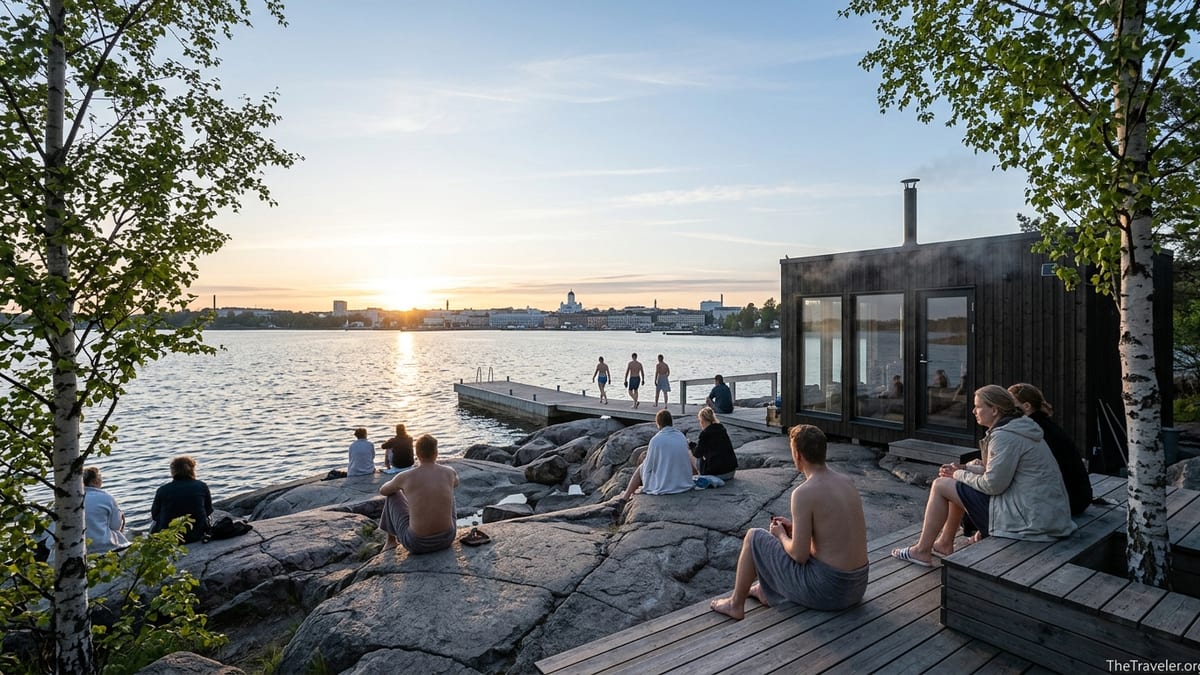
That closeness to nature runs through the whole country. More than 70 percent of Finland is covered in forest, one of the highest proportions in Europe, and it shapes how Finns live and how visitors experience the place. In summer, Helsinki locals finish work, grab a grocery-store picnic and board a commuter ferry to an island like Pihlajasaari or Suomenlinna, treating outer-island rock slabs as their “city beach.” In Tallinn or Copenhagen you might find a waterfront promenade; here the default evening plan is to sit on warm granite looking out over the Baltic, feet dangling above the water.
Even a short trip north amplifies that sense of space. A three-hour train ride from Helsinki takes you to Jyväskylä or Kuopio, towns where lakes push right into the center and rental cottages with their own jetties sit within an easy drive. I rented a simple lakeside cabin near Savonlinna in August and realized how unusual this is by European standards. For less than the cost of a mid-range hotel room in Amsterdam, I had a rowboat, private sauna and clear swimming water straight off the dock. The nearest neighbor’s dock light was a distant pinprick across the lake.
In southern Europe, beaches and mountain villages carry the postcard images. In Finland, the iconic landscape is quieter: a line of birch trees reflected in still lake water, a boardwalk trail disappearing into bogland, a stand of spruce glowing in the low evening sun. It feels more like Canada than what most travelers think of as Europe.
Silence, Space and the Strange Comfort of Not Talking
The first thing I noticed in downtown Helsinki was what I did not hear. Trams glided past with a soft hum, people queued for coffee without chatter, and even crowded terraces in the Kallio neighborhood were low-key. After the bustle of Barcelona and Naples, the volume dial seemed turned down several notches. On the metro to Itäkeskus I counted almost an entire carriage of people silently scrolling their phones or reading paperbacks, no one on speakerphone, no one forcing conversation.
Finnish reserve has a reputation bordering on stereotype, but as a visitor it feels less like coldness and more like a collective respect for personal space. On a local train from Tampere to Seinäjoki, a woman moved seats to give an elderly man room, nodded once and then returned to her book. In another country someone might have turned this into small talk; in Finland, the quiet gesture was the whole interaction. Even service culture reflects this. Waiters are polite but rarely effusive, shop staff tend to leave you alone unless you ask for help, and no one seems offended if you keep answers brief.
This can be disorienting if you arrive with Central European habits. I caught myself filling silences in cafés and over-explaining simple requests at first. Gradually, it became a relief to know that you could sit in a bar like Kultapalmu in Kallio or a café in Turku for an hour and no one would push conversation or ask why you were alone. When a stranger on a train finally did strike up a conversation about the weather around Oulu, it felt intentional rather than automatic small talk.
For travelers, this different social temperature has real practical effects. Solo diners are unremarkable, people give each other physical and conversational room in queues, and nobody seems in a hurry to perform friendliness. It contrasts sharply with the street-front sociability of southern Europe or the ironic banter you often find in Britain. Finland invites you to be quiet, and that is more radical in today’s Europe than it sounds.
Sauna as Everyday Infrastructure, Not Spa-Day Luxury
If there is one Finnish experience that exposes how different the country is from its neighbors, it is the sauna. In other parts of Europe, a sauna is a hotel extra or a wellness treat. In Finland, it is closer to a basic utility. There are an estimated two to three million saunas for a population of around 5.5 million, and it shows. Apartment buildings in Helsinki schedule weekly shared sauna slots in the basement, rural petrol stations advertise a sauna in the back, and many lakeside cottages consider a private sauna more essential than a dishwasher.
As a traveler you encounter this quickly. Public saunas in Helsinki such as Löyly, Allas Sea Pool and the older Kotiharjun sauna in Kallio operate more like neighborhood living rooms than spas, with locals dropping in on a Tuesday evening after work. Families move calmly between the hot, wood-scented rooms and the Baltic Sea or cold plunge pools, pausing to chat in between. The price is often similar to a cinema ticket in Western Europe, and in rural areas your Airbnb or cottage will almost certainly include a private sauna at no extra cost.
Cultural expectations differ from much of Europe too. In Finland, showering before going into the sauna is non-negotiable, as is sitting on a small towel to protect the wooden benches. Alcohol inside the sauna is generally frowned upon, conversations are relaxed but never rowdy, and nudity norms vary by place. Some public saunas are strictly single-sex and nude, others mixed with swimsuits. Unlike Central European spa towns where ornate interiors and wellness packages dominate, Finnish saunas emphasize plain wood, good heat and proximity to cold water, whether that means a lake hole cut in the ice in January or the sea in October.
Most revealing of all is how integrated sauna is into everyday rhythms. My host family in the Tampere region, for example, took sauna several times a week without ceremony. One evening we heated the wood-fired sauna, alternated between the steam and quick plunges into the dark lake, then returned inside to eat rye bread and salmon soup at the kitchen table. No scented oils, no silence signs, just routine. It felt less like a wellness activity and more like a domestic ritual, closer to brewing tea in England than visiting a spa in Germany.
Lakes, Light and a Landscape That Plays by Arctic Rules
Traveling north from Helsinki, you start to realize that Finland operates on different natural settings from most of Europe. The Lake District, stretching roughly from Tampere through Jyväskylä to Kuopio and Savonlinna, is a maze of water and islands. Official figures list more than 180,000 lakes of significant size in the country, which means your road trip or train journey will cross bridges, skirt shorelines and pass summer cottages on almost every leg.
The way Finns use this watery landscape differs from the Mediterranean model. Rather than developed resort coastlines, you find small marinas with modest motorboats, public swimming piers in even tiny towns, and an extensive network of holiday cottages that locals often rent by the week. Many of these simple “mökki” cabins come with rowing boats, fire pits and basic amenities, sometimes without mains water but with a sauna heated by chopped local birch. It is an outdoor culture geared toward self-sufficiency rather than service-heavy resort stays.
Further north in Lapland, which covers more than a quarter of Finland’s area but only a small share of its population, the rules shift again. Above the Arctic Circle, the sun does not set for weeks in summer and barely rises in the heart of winter. In June, I hiked near Saariselkä at midnight in full daylight, the fells washed in soft golden light while mosquitoes danced in the air. Locals adjusted without fuss, black-out curtains drawn, daily routines carrying on in what felt like permanent late afternoon. In December, many visitors time their trips around a few dim hours of blue daylight before darkness returns and the chance of seeing the northern lights increases.
These light extremes set Finland apart from most of the continent and shape everything from sleeping patterns to festival calendars. The midsummer holiday, Juhannus, often spent at cottages with bonfires and lake swims, takes full advantage of the long days, while in winter, Lapland’s tourism pivots to husky sleds, reindeer sleigh rides and snowmobile safaris. In places like Rovaniemi and Levi, you can finish a day on the ski slopes, spend the evening in a smoke sauna and step outside around midnight to scan for faint green aurora bands. No Mediterranean capital can compete with that particular combination.
An Indigenous Homeland in the Heart of Modern Europe
Another difference that quietly sets Finland apart is the presence and visibility of the Sámi, the only Indigenous people recognized within the European Union. Their traditional homeland, known as Sápmi, stretches across northern Norway, Sweden, Finland and into Russia, but Finnish Lapland includes some of its most accessible communities for visitors. Towns like Inari, Utsjoki and smaller villages in the far north are not just remote Arctic outposts; they are part of a living cultural landscape shaped by reindeer herding, fishing and deep connections to specific rivers, fells and forests.
Inari in particular makes these layers visible. Street signs appear in Finnish, Northern Sámi and often English, and the Siida complex combines a Sámi Museum with a nature center that explains both Arctic ecosystems and Sámi history. Exhibits show traditional clothing and tools but also contemporary Sámi art and political movements, underlining that this is not a frozen-in-time minority but a modern Indigenous society navigating tourism, climate change and language preservation. Compared with heritage villages or folk museums in other parts of Europe, there is a sharper sense here that the culture on display is still in active use just beyond the museum doors.
For travelers, engaging with this reality requires more care than booking a generic “Lapland experience” package. Many Sámi-owned operators offer reindeer farm visits, storytelling evenings or handicraft workshops that prioritize cultural accuracy and environmental respect. Prices for these small-group experiences tend to be higher than mass-market snowmobile tours in resort towns, but the money supports local livelihoods rather than distant companies. This mirrors debates around Indigenous tourism in places like Canada or New Zealand, but in a European setting where most visitors do not expect to encounter Indigenous rights issues at all.
That gap between traveler expectations and on-the-ground complexity is part of what makes Finland feel different. In a single trip you might move from a sleek Helsinki design hotel to a family-run reindeer herding cooperative near Inari, passing protest posters about mining projects along the way. It is Europe, but it challenges the conventional idea of a culturally uniform continent of cathedrals and castles.
Design, Daily Life and a Welfare State That Works in the Background
Walk into a Finnish supermarket and the differences from much of Europe begin in the details. The dairy section devotes entire shelves to lactose-free products, from milk and yogurt to ice cream, reflecting national consumption habits and tolerance levels. Beer shelves feature local brands from Lapland to Turku alongside international names, and recycling points at the entrance quietly advertise deposit refunds on bottles and cans. Self-service salad bars, affordable soup lunches and neat rows of rye bread make quick, healthy eating far easier than in many southern European grocery stores.
The way cities are built also tells a different story. Helsinki’s housing blocks in neighborhoods like Töölö and Kamppi usually include shared laundry rooms, drying spaces and bike storage as standard. Tram and bus stops display real-time information that tends to be accurate, and digital ticketing through integrated apps covers trains, metro, ferries and local buses across regions. In Tampere and Oulu, separated cycle lanes with clear signage run year-round, plowed after snowfalls with a consistency that surprises cyclists visiting from elsewhere in Europe.
You catch glimpses of Finland’s social model in these mundane details. Free tap water on restaurant tables, well-maintained playgrounds even in small towns, functional public libraries with modern architecture in places like Oodi in Helsinki or the library in Seinäjoki. While many European countries offer variations of the welfare state, Finland’s version is particularly tangible in how safe public spaces feel and how accessible services are. As a traveler, you might not see the tax rates or administration behind this, but you feel the results when catching a spotless night train to Lapland, stepping into a warm waiting room at a remote station, or using public health advice numbers advertised in English in tourist areas.
Design, too, works differently here. Rather than dramatic showpieces only in capital-city museums, Finnish design crops up in everyday objects: Iittala glasses in casual cafés, Marimekko prints on tram seat fabrics, simple birch furniture in modest hotels. Many European cities have design boutiques; Finland diffuses its design heritage through mid-range retail chains and municipal buildings. Sitting on a gently curved wooden bench at a lakeside bus stop, you realize that this design culture is not about luxury; it is about making daily life slightly more pleasant for everyone.
Costs, Seasons and the Practical Realities of Traveling Finland
On paper, Finland looks like one of Europe’s pricier destinations, especially compared with southern and eastern countries. Restaurant mains in Helsinki often sit in the same price bracket as in Paris or Amsterdam, and winter activities in Lapland, from husky safaris to aurora tours, can quickly add up. Yet the way Finns travel within their own country offers visitors tools to manage costs. Long-distance buses and advance-purchase train fares can be competitively priced, particularly outside peak holiday weeks, and self-catering in a rental apartment or cottage is straightforward thanks to well-stocked supermarkets even in smaller towns.
Lapland, in particular, requires realistic budgeting. In ski resorts like Levi or Ruka, a one-day lift pass is typically in line with alpine resorts in Austria or France, and guided snowmobile or reindeer tours often cost more than one hundred euros per person for a few hours. However, many of the region’s most distinctive experiences remain free or low-cost. Renting cross-country skis for a day to explore groomed forest trails, walking out onto frozen lakes at midday to experience the deep winter quiet, or sitting in a public lakeside sauna before rolling in the snow cost far less than packaged excursions and can be just as memorable.
Seasonality also shapes how Finland feels compared with much of Europe. While cities like Rome or Lisbon maintain a degree of buzz year-round, Finnish travel patterns are strongly clustered. Summer cottage season peaks around July, when many Helsinki residents leave the capital almost en masse, and Christmas tourism concentrates in places like Rovaniemi where Santa-themed attractions draw families from across Europe. Visit Helsinki in late October or early April and you may find yourself in an in-between season of soft light, near-empty cafés on some streets and hotel prices that are noticeably lower than high summer.
The practical lesson for travelers is that Finland rewards matching your expectations to its rhythms. If you want midnight sun hiking without crowds, early June in Lapland may suit you better than peak July weeks. For crisp city breaks with good value, March in Tampere or Turku, when days are growing longer but winter activities still run, can feel more authentic than December when Christmas markets and package tours keep prices high. It is still Europe, with budget airlines and modern infrastructure, but the timing and texture of a trip differ significantly from a Mediterranean city break.
The Takeaway
When people say “Europe,” they often mean a narrow band of images: Parisian terraces, Tuscan hills, Bavarian beer halls, perhaps the canals of Amsterdam or the squares of Prague. Finland exists slightly apart from that mental map, on the same continent but operating according to different natural, cultural and social logics. Its capital bleeds into forest, its most famous national ritual takes place in small wooden rooms full of steam, and its northernmost region is both a tourist playground and an Indigenous homeland.
Traveling there forces you to recalibrate what you think a European trip should look like. You may find yourself standing alone on a lakeside rock at 11 p.m., the sky still pale, listening to nothing but distant bird calls and the hiss of a nearby sauna chimney. Or sharing a quiet tram with commuters who politely ignore you, not out of rudeness but out of respect for your space. Or learning, on a reindeer farm visit in Inari, that European history includes stories and struggles far from the well-trodden axes of London, Paris and Berlin.
Nothing prepared me for how different Finland felt from the rest of Europe, and that is exactly why it lingers in memory. It is a country that does not shout for attention yet quietly rewires your sense of what travel on this continent can be. If you are willing to embrace silence, steam, wide skies and a social pace that values understatement over display, Finland might just redefine Europe for you.
FAQ
Q1. Is Finland really that different from other Nordic countries for travelers?
Yes, although Finland shares some traits with Sweden and Norway, its language, sauna-centered culture, lake landscape and Sámi homeland in the north make the experience feel distinct.
Q2. When is the best time to visit Finland for a first trip?
For a balanced introduction, late May to early September works well, with long days, accessible hiking and lake swimming, while still allowing time in cities like Helsinki and Tampere.
Q3. How expensive is Finland compared with the rest of Europe?
Finland is generally similar to other Nordic countries for prices, but costs can be managed by using trains and buses, self-catering in apartments or cottages and limiting organized excursions.
Q4. Do I need to book saunas in advance as a visitor?
In major cities, popular design saunas often require advance booking on busy evenings, but many public saunas, hotel saunas and small-town facilities allow you to just show up and pay on entry.
Q5. Is Lapland only worth visiting in winter?
No, while winter brings snow activities and Christmas tourism, summer and early autumn in Lapland offer midnight sun hikes, berry picking, cycling and quieter encounters with Sámi culture.
Q6. Can I visit Sámi communities in a respectful way?
Yes, by choosing Sámi-owned tour companies, museums and cultural experiences, listening more than you talk, and avoiding operators that treat Sámi culture as a costume or stage show.
Q7. Do people in Finland speak good English?
English is widely spoken, especially in cities and among younger Finns, so most travelers can manage easily with English while learning a few Finnish phrases as a courtesy.
Q8. How cold does it really get in winter and what should I pack?
In southern Finland winter temperatures often hover around freezing, while in Lapland they can drop far lower, so layered clothing, windproof outerwear and insulated boots are essential.
Q9. Is it easy to get around Finland without a car?
Between major cities and many towns, trains and long-distance buses are efficient, but in rural areas and parts of Lapland you may need a rental car or organized transfers to reach remote cabins.
Q10. What surprised travelers most about Finland compared with the rest of Europe?
Many mention the deep quiet, the ubiquity of everyday saunas, the closeness of real wilderness to cities and the understated but highly functional public services.