


On most winter evenings in Saariselkä, the first thing visitors do is aim their cameras at the sky and hope the aurora cooperates. During a few slow days in this quiet corner of Finnish Lapland, I learned that the real magic is not just overhead. It lives in the fells and forests just beyond the village, in the smoke of an old sauna and the hush of ski tracks that disappear into Urho Kekkonen National Park. Spend some time off the tourist script here and a different Lapland appears, one that most travelers never quite reach.
Get the latest updates straight to your inbox!
Where Saariselkä Really Begins
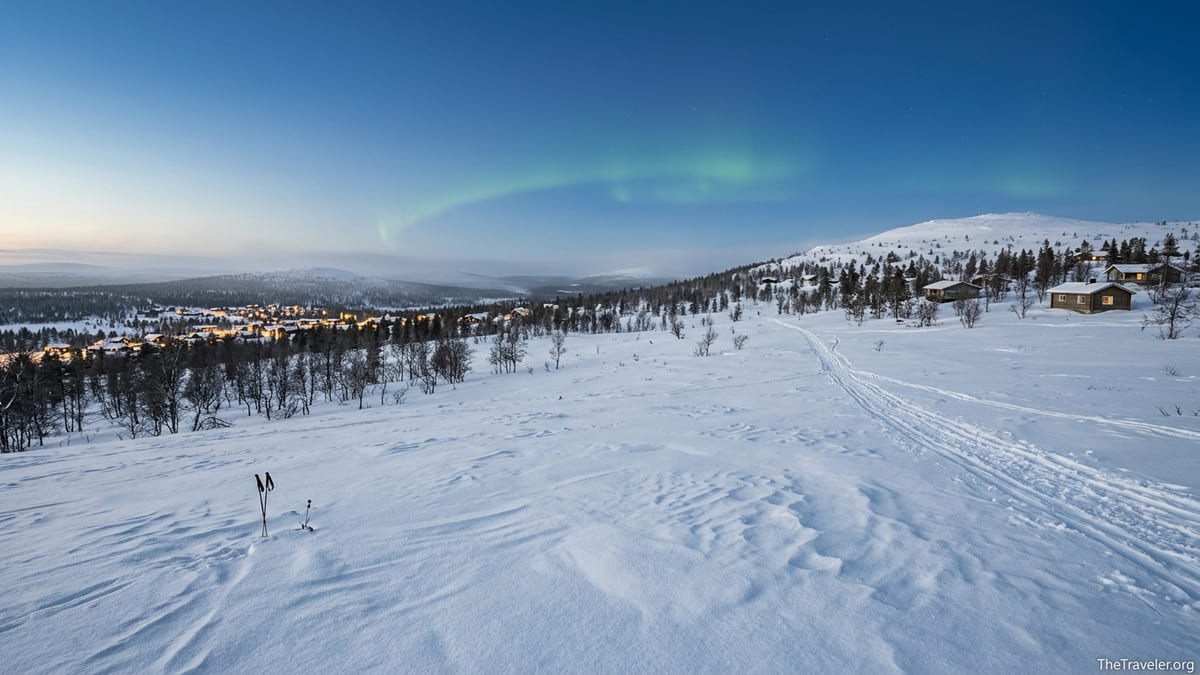
Saariselkä is often described as a resort village above the Arctic Circle, a place of aurora cabins, package holidays and reliable snow. That is true as far as the main road and hotel strip go. Walk ten minutes away from Saariselkäntie, though, and the lights fall behind. The village is perched at the edge of Urho Kekkonen National Park, Finland’s vast protected wilderness where marked trails run for roughly 200 kilometers and many routes start from the outskirts of town or from nearby Fell Centre Kiilopää. Here, the resort ends abruptly and a low, treeless fell plateau begins, bending away toward the Russian border.
On my first morning, I followed an innocuous blue sign behind a supermarket parking lot. Within minutes, the hum of snowplows faded and I was sliding along a cross-country ski track that cut into sparse birch forest. The temperature sat around minus 15 degrees Celsius, the type of dry cold that squeaks under your boots. People passed in ones and twos, mostly locals and long-stay Finns who had season passes clipped to their jackets. No one was in a hurry. The slow gradient of the fell and the rhythm of ski poles made it clear that Saariselkä is not only a backdrop for tours but a real outdoor playground that residents use every day.
For many visitors, the resort area feels self-contained. Supermarkets, gear rental shops and hotel restaurants are all within a few hundred meters of one another. Yet the real Saariselkä reveals itself as soon as you step past the last chalet. The fells open up, gently rolling rather than dramatic, with occasional wind-bent pines and, on clear days, views toward the higher summit of Kiilopää. It is this transition zone between village and wilderness that shapes daily life here and offers travelers a chance to experience Lapland in a quieter key.
Life on the Trails Instead of in the Lobby
Most winter brochures for Saariselkä lead with aurora hunting, husky safaris and snowmobile tours that can cost between about 130 and 250 euros per person for a half day. These are easy to book through resort desks and can be memorable early encounters with the Arctic. During my stay, I joined a short evening snowshoe outing that promised a faint aurora and a campfire sausage, one of the more modestly priced activities at just over 100 euros for several hours including transport and gear. It was enjoyable, but what stayed with me most were the unguided hours in daylight, moving at my own pace.
Saariselkä maintains an extensive cross-country skiing network, with about 200 kilometers of groomed tracks stretching into Urho Kekkonen National Park and the surrounding fells in a good snow year. Day passes are typically less than the cost of a restaurant main course in the village, and ski rental for 24 hours usually comes in under 40 euros for basic classic gear. I rented a simple setup from a family-run sports shop just off the main roundabout, where the owner casually pointed to a wall map, traced a loop past Laanila and wished me good weather.
Out on the tracks, I met more retirees than Instagram influencers. A Finnish couple from Oulu, staying for two weeks, had been skiing a different loop every day and “saving the steep Kiilopää climbs” for later in their trip. At a small wilderness café a few kilometers from town, skiers stood their skis in the snow and shuffled into a low wooden hut. Inside, the air smelled of cardamom buns and woodsmoke. A simple lunch of salmon soup and rye bread cost around 15 euros, the kind of practical, hearty meal that keeps this trail culture running.
In summer and early autumn, many of these ski routes shift into hiking paths and mountain bike trails. Short day walks from Saariselkä can be as gentle as a one- or two-hour stroll on duckboard paths across marshy ground, or as ambitious as a full-day hike toward the fell ridges that anchor the national park. The infrastructure is understated: signposted junctions, rustic fire pits with wood stocked by park authorities, and a scattering of open wilderness huts. For travelers who are used to interpretive centers and scenic overlooks designed for selfies, the simplicity feels refreshing.
Stepping Through the Gate of Urho Kekkonen National Park
Saariselkä’s greatest asset is its location at the threshold of Urho Kekkonen National Park, one of Finland’s largest protected areas. From the village and from nearby Kiilopää, well-marked trails lead directly into the park’s latticed network of day routes and multi-day treks. Official maps show roughly 200 kilometers of summer hiking trails in the Saariselkä and Kiilopää section alone, with additional unmarked wilderness routes further east. Day visitors make up the majority of park users, but the atmosphere is resolutely noncommercial once you pass the boundary boards.
On my second day, I took an early bus to Fell Centre Kiilopää, about a twenty-minute ride south of Saariselkä. The complex describes itself as an outdoor hiker’s base and it feels that way: wax smells from a ski maintenance room, racks of rental snowshoes, and a cafeteria where the lunch buffet is advertised more to skiers than to overnight guests. Outside, a staircase climbs the lower slope of Kiilopää, leading to a 546-meter summit that looks out over a mosaic of fells and forests. In winter, the top can be windswept, but on a clear day you see the scale of the park laid out in every direction.
Even a short circuit from Kiilopää’s trailhead reveals how quickly the landscape shifts from managed recreation area to backcountry. On a three-hour loop I followed, the groomed ski tracks gave way to narrower paths where trees grew shorter and more twisted. Wooden bridges crossed frozen streams; at one open shelter, a local family was frying pancakes over a fire that crackled in the still air. They told me they came up almost every weekend in March when the light stretches into evening but the snow is still deep enough to ski.
For more experienced hikers, Kiilopää is also a classic starting point for multi-day trips deeper into Urho Kekkonen National Park, towards remote lakes like Luirojärvi where wilderness saunas and simple huts offer shelter. Even if you do not venture that far, spending a day simply crossing the invisible line between resort and national park gives a hint of what draws Finnish hikers back year after year. It is an intimacy with landscape that rarely makes it onto brochure covers.
Smoke, Steam and a Stream at Kiilopää’s Sauna
Ask regulars what sets this part of Lapland apart and the conversation quickly turns to saunas. While many hotels in Saariselkä have modern wellness areas, it was the smoke sauna and stream at Kiilopää that showed me the most distinctive side of local sauna culture. The facility, run by outdoor association Suomen Latu, has earned national recognition as a must-try sauna in Finland, and for good reason. The building is squat and dark, logs blackened from years of wood smoke. There are no colored lights, no background music, just the hiss of water on hot stones and the murmur of Finnish and English spoken in low voices.
On the evening I visited, the air outside hovered around minus 10 degrees Celsius. Guests booked into separate men’s and women’s sauna timeslots, each lasting a couple of hours. The entrance fee was comparable to a casual restaurant meal in town, and many people combined it with dinner at the Kiilopää cafeteria or with a short ski before the session. Inside, the smoke had cleared hours earlier, leaving a soft, even heat that wrapped around you the moment you stepped onto the wooden benches. Locals advised sitting lower to acclimatize, then gradually moving up to hotter tiers.
Between rounds of heat, bathers padded down a short, snowy path to a natural pool in the Kiilopuro stream. A rough staircase led into the black water, a hole cut through the ice. Some people waded in up to their chests, others dipped quickly and scrambled back out, laughing through clouds of frozen breath. The contrast between the fierce cold and the enveloping warmth of the smoke sauna is central to Finnish wellness tradition, but experiencing it in a fell-side setting like this, with stars overhead and almost no artificial light, felt uniquely Saariselkä.
Reservations are essential in peak season, as capacity is capped to keep the atmosphere relaxed. Early evening sessions often attract more families and trail users who have been out all day, while later times can be quieter. For travelers who usually encounter sauna only as a hotel spa amenity, Kiilopää’s smoke sauna offers a deeper, more grounded experience of Lapland life, connected directly to the trails and terrain that define the area.
Finding the Aurora Beyond the Igloo Complexes
Glass igloo resorts have become the defining image of Finnish Lapland, and Saariselkä is no exception. Around the village, properties with names referencing northern lights and auroras offer heated cabins with transparent roofs, where guests can lie in bed and hope the sky performs. These stays can easily run to several hundred euros per night in high winter. For some travelers, that one unforgettable aurora display justifies the price. Yet spending a few days in the area reveals that there are simpler, less choreographed ways to watch the sky.
In Saariselkä itself, it is possible to see the aurora from open patches within walking distance of most accommodations, provided the clouds cooperate. Locals often suggest heading out onto the toboggan hill or to small, unlit clearings near the edge of the village where streetlamps fade. On one cold evening, around minus 18 degrees, I walked fifteen minutes beyond the last streetlight with a thermos of blueberry juice. The only sound was the crunch of boots. A pale arch began to form above the treeline, slowly resolving into curtains of green that rippled quietly overhead.
Guided aurora tours remain popular, with some companies based in Saariselkä offering small-group excursions by minibus or snowshoes, typically priced from around 120 to 170 euros per person depending on duration and inclusions. A premium six-hour hunt that combines photography instruction, hot drinks and flexible routing can cost more. These tours are valuable if you lack winter driving experience or want help reading the ever-changing forecasts. However, they represent only one way to engage with the night sky.
What many short-stay visitors miss is how aurora watching becomes a rhythm rather than an event for people who spend longer here. Hotel staff talk about checking the sky like other people check the news. In guesthouse kitchens, tripods stand permanently by back doors. Instead of one big expedition, locals build small nightly habits: a ten-minute step outside between sauna rounds, a quick walk down to a darkened ski track after dinner, a pause on the way back from the supermarket when the sky looks promising. That quiet, repeated attention to the sky is another side of Lapland life that a few unstructured days in Saariselkä reveal.
Village Rhythms Most Visitors Overlook
Because Saariselkä is compact, it is easy to treat it as a cluster of hotels rather than a functioning community. While the permanent population is small, there is a year-round rhythm here that becomes visible once you slow down. Early in the morning, before the first tour buses warm up, locals stop by the supermarket bakery counter for fresh pulla and karelian pies to take on the trails. Delivery trucks slide quietly between loading bays and snowbanks. Guide dogs trot alongside their owners as they walk to work at the rental shops.
On one weekday afternoon, while many visitors were out on snowmobiles, I ducked into a small café tucked behind the main drag. The menu offered simple lunches, filter coffee and homemade pastries, with prices noticeably lower than the resort restaurants up the hill. At a corner table, two ski instructors compared notes about the day’s conditions, while a local entrepreneur tapped on a laptop, the glow of spreadsheets reflecting off ski goggles pushed up on their head. Conversations slid easily between Finnish and English. For all its reliance on tourism, the village retains a practical, workaday side.
Accommodation also tells a different story when you look past the obvious. Alongside the well-known aurora resorts and branded hotels, Saariselkä and neighboring Kiilopää have modest cabins and apartment-style lodgings favored by repeat visitors, many of whom return every March. These self-catering units usually come with drying cupboards, simple kitchens and direct access to ski trails. Nightly rates in shoulder seasons can be significantly lower than for full-service hotels, and guests shop for groceries, cook simple dinners and organize their own excursions rather than relying entirely on packaged itineraries.
Spending time in these spaces changes how you experience Lapland. Instead of rushing between scheduled activities, you might take a midday nap while the polar twilight glows outside, or wander down to the local swimming hall for a public sauna session that costs only a few euros. The slower pace reveals how much of Saariselkä’s charm lies not in one-off attractions, but in the small conveniences that allow people to live comfortably at northern latitudes: efficient buses linked to flight arrivals in nearby Ivalo, well-maintained winter sidewalks, and reliable trail grooming even after heavy snow.
Planning Your Own Quiet Days in Saariselkä
Reaching Saariselkä is relatively straightforward despite its remote feel. Most visitors fly first to Helsinki and then connect to Ivalo Airport, which in winter has multiple daily flights and, in peak season, some direct services from other European cities. From Ivalo, airport buses timed to arrivals run the roughly 30 kilometers to Saariselkä village in about half an hour. Tickets cost noticeably less than a private transfer and can often be purchased on board or in advance. If you prefer more flexibility, rental cars are available at the airport, though winter driving conditions require caution and experience.
Once in Saariselkä, you do not need a car to explore the core experiences described here. Ski and snowshoe rentals, grocery stores, cafés and hotel lobbies all sit within walking distance, and local buses or prearranged shuttles connect the village with Kiilopää and nearby trailheads. Guided activities such as snowmobile safaris, husky tours and reindeer visits usually include transport from central meeting points in the village. If you want to focus on quieter, self-guided days, consider choosing accommodation close to one of the major trail access points so you can step straight from your door onto maintained routes.
Costs in Saariselkä are on par with the rest of Finland, which means higher than many other European destinations. A basic lunch of soup and bread at a trail café might run 12 to 18 euros, while main courses at hotel restaurants often start around 20 to 30 euros. Self-catering is a practical way to manage expenses; supermarkets stock everything from fresh vegetables and local cheese to ready-made meatballs and vegan options. Trail access itself is affordable: cross-country ski passes, when required, are modestly priced, and many short walking routes can be used without any fee beyond optional parking charges.
The best time to experience this understated side of Lapland depends on your priorities. For deep winter atmosphere and long nights suited to aurora watching, January and February are reliable, though temperatures can drop well below minus 20 degrees and daylight is limited. March often brings brighter, longer days with still excellent snow conditions, a favorite among Finnish families and seasoned skiers. In summer, usually from late June into August, the fells turn green, mosquitoes emerge but are manageable on breezy ridges, and the midnight sun flattens the distinction between day and night. Autumn, especially in September, brings vivid ruska foliage and cooler hiking days before the first proper snows.
The Takeaway
A few unhurried days in Saariselkä will not show you every corner of Lapland. This is only one small cluster of fells in a vast northern region. Yet its position at the edge of Urho Kekkonen National Park, combined with a compact, functional village and access to places like Kiilopää’s smoke sauna, makes it an ideal place to experience the quieter habits of Arctic life. Where many visitors glimpse Lapland only through the window of a tour minibus, Saariselkä invites you to clip into skis, shoulder a daypack or simply step outside and look up.
What lingers after you leave is not the memory of a single dramatic activity, but a constellation of smaller moments: the rasp of cold air in your lungs as you crest a low fell, the way a simple bowl of salmon soup tastes after hours on the trail, the soft crackle of birch logs in a sauna where phones are forgotten. In an era of curated experiences and carefully staged wilderness, Saariselkä rewards those willing to trade a tight schedule for empty hours. In that space, Lapland reveals a side of itself that most travelers still, quietly, pass by.
FAQ
Q1. How many days should I spend in Saariselkä to see this quieter side of Lapland?
Plan at least three full days on the ground, not counting travel. That gives you time for one or two guided activities if you want them, plus slow, self-guided days on the trails, an evening at the Kiilopää smoke sauna and at least a couple of unhurried nights watching the sky.
Q2. Do I need a car to explore Saariselkä and Urho Kekkonen National Park?
No. If you stay in or near the main village, you can walk to ski and hiking trailheads, supermarkets and rental shops. Buses and prearranged shuttles connect Saariselkä with Ivalo Airport and Kiilopää. A car can be useful for broader exploration but is not essential for the experiences described here.
Q3. When is the best time to visit Saariselkä for northern lights?
The aurora can appear anytime from roughly late August to April, but the highest chances combine dark skies, clear weather and enough nighttime hours. In practice, that means visiting between September and March, with January and February offering long nights but colder temperatures, and autumn or early spring providing milder conditions.
Q4. Is Saariselkä suitable for beginners who have never skied before?
Yes. The area offers gentle cross-country loops close to the village, downhill slopes with easy runs and ski schools that teach both classic Nordic and alpine techniques. Rental shops can help you choose appropriate equipment, and you can start with short outings on flat terrain before tackling longer fell routes.
Q5. How expensive are activities like husky safaris and snowmobile tours in Saariselkä?
Prices vary by operator and duration, but as a rough guide, short husky or snowmobile experiences often start around 130 to 180 euros per adult, with longer, multi-hour tours costing more. Many packages include warm clothing, guiding and hot drinks. Booking in advance is recommended in peak winter weeks.
Q6. What should I pack for a winter trip to Saariselkä?
Focus on layers. Bring a moisture-wicking base layer, insulating mid-layers like fleece or wool, and a windproof, waterproof outer shell. Add insulated boots with room for thick socks, a warm hat, mittens or gloves, a buff or balaclava and sunglasses for bright snow days. Hand warmers and thin liner gloves are helpful for handling camera equipment in the cold.
Q7. Can I visit the Kiilopää smoke sauna if I am not staying overnight there?
Yes, visiting the smoke sauna is typically possible for non-residents, but advance reservations are usually required and session times are fixed. It is common to combine a sauna visit with a day of skiing or hiking in the surrounding fells and a simple meal at the Kiilopää cafeteria.
Q8. Are there ethical, animal-friendly ways to experience Lapland nature around Saariselkä?
Absolutely. You can focus on activities that rely on human power, such as cross-country skiing, snowshoeing, winter walking, fat biking or summer hiking. Guided nature walks, photography outings and aurora workshops that do not involve animal rides are widely available and allow you to experience the environment with minimal impact.
Q9. How cold does it really get in Saariselkä, and is it safe?
Mid-winter temperatures often range from around minus 5 to minus 25 degrees Celsius, and brief cold snaps can drop lower. It is generally safe if you dress appropriately, limit time outdoors in severe wind chill and follow local advice. Guided tours provide suitable clothing when needed, and indoor spaces are well heated.
Q10. Is Saariselkä crowded, or can I still find solitude?
The village center can feel busy during peak holiday weeks, especially around Christmas and school vacations, but the trail network and nearby fells disperse people quickly. Even on popular days you can often find quiet sections of ski track or hiking path within an hour’s walk of the resort, especially if you start early or head toward less publicized routes.