


I went to the Vasa Museum in Stockholm expecting a cool shipwreck story: a massive 17th century warship that sank on its maiden voyage and was miraculously raised from the seabed. I left thinking very differently about history itself. What I thought would be a quick look at a famous wooden hull turned into a day-long lesson in power, propaganda, engineering failure, and how ordinary lives are often hidden in the footnotes of grand national stories.
Get the latest updates straight to your inbox!
Meeting Vasa for the First Time
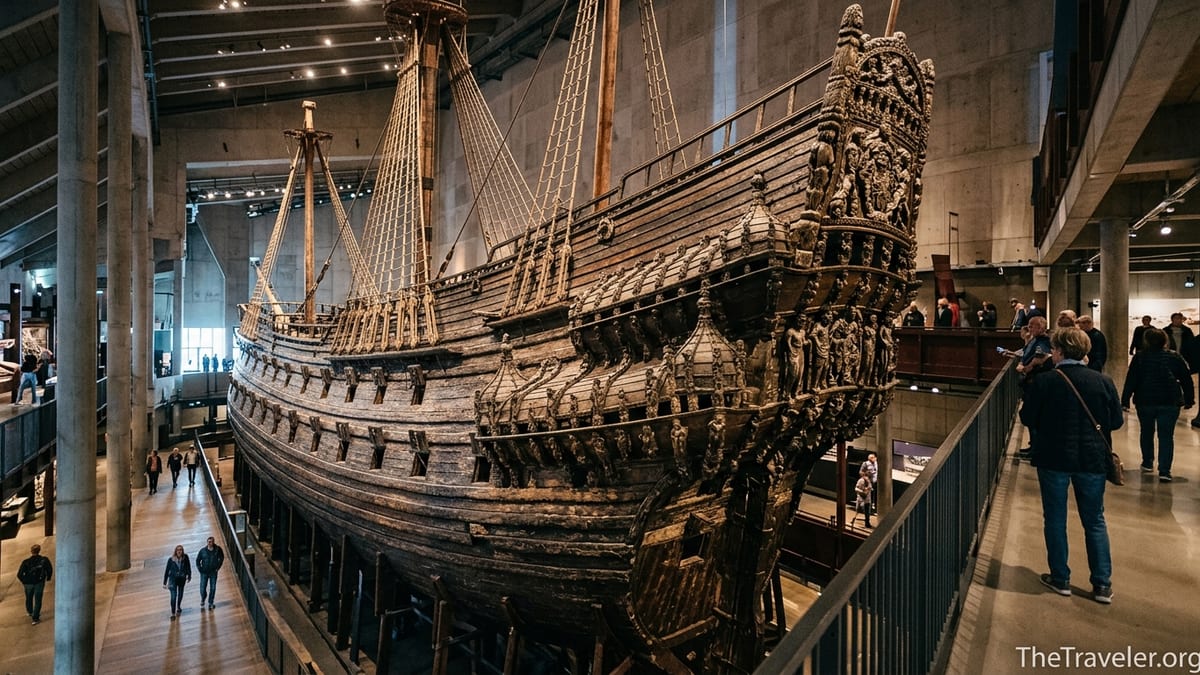
The Vasa Museum stands on the island of Djurgården, a short ferry or tram ride from central Stockholm. Inside, the lighting is low and the air is cool and dry, carefully managed to protect one object: Vasa, the only almost fully intact 17th century warship on display anywhere in the world. The entire museum is built around the ship, which looms above visitors like a dark wooden cliff.
When you step into the central hall, the first impression is physical. Vasa is nearly 70 meters long and around 50 meters high from keel to the top of the mainmast. More than a thousand wooden sculptures, once brightly painted and gilded, cover the stern and sides. Standing on the entry level, roughly at Vasa’s former waterline, you feel small. School groups fall silent. Conversations drop to whispers. What I had imagined as a wreck feels instead like a presence.
That presence is made more intense by how close you can get. The museum is arranged on multiple balconies, from the keel level up to near the height of the upper decks, so you can circle the ship from different angles. On one level, you are eye to eye with grinning lion heads. On another, you look straight into the dark gun ports that once held bronze cannons. It is impossible not to imagine the ship on the water, sails full, moving past you. Then you remember it never sailed more than a short distance before it rolled over and sank.
On a spring weekday in 2026, there were constant reminders that this is also a modern attraction. The ticket desk accepts only cards, in line with Sweden’s largely cash free system. Entry for an adult was a little over 200 Swedish kronor, with reduced prices for students and free admission for children on certain days. Over by the café, visitors in rain jackets and fleece queued for cinnamon buns and strong coffee before returning to the dim hall where a warship from 1628 waits in the dark.
From Royal Weapon to National Embarrassment
The introductory film, screened regularly in several languages in a small cinema off the main hall, sets out the bare facts. Vasa was commissioned by King Gustavus Adolphus during Sweden’s rise as a Baltic great power in the early 17th century. It was meant to be a floating symbol of royal ambition, armed with dozens of heavy bronze cannons on two gun decks and decorated with an explosion of carved figures celebrating the monarchy, the Vasa dynasty, and Sweden’s perceived place in the world.
On August 10, 1628, the king was away with the army, but crowds filled the quays of Stockholm to watch Vasa’s maiden voyage. The ship sailed a short distance, caught a gust of wind, heeled sharply, water poured into the open gun ports, and it capsized in the harbor. About 30 people died. The ship sank within sight of the city that had built it, in front of citizens expecting a show of strength and receiving instead a demonstration of failure.
What the museum does so effectively is to slow that story down. In an exhibition about the investigation that followed, documents are projected on the walls. You can read the questions posed to shipbuilders, officers, and crew. The transcripts show a careful attempt to find blame without pointing too directly at the king or his advisors. Modern historians and maritime engineers now describe Vasa as top heavy and unstable, with too much weight in the cannons and upper works for its narrow hull. That conclusion feels obvious when you walk around the ship today, but at the time, the political pressure to produce an impressive warship overrode these concerns.
In one gallery, a simple, almost childlike demonstration explains the physics. Two scale models, one stable and one built with Vasa’s flawed proportions, sit in a shallow tank of water. Staff sometimes rock the tank gently. The stable model rights itself. The Vasa model tips dangerously, mimicking what happened in 1628. Watching children cluster around the tank and immediately grasp what 17th century power brokers did not is quietly unsettling.
How Conservation Turned a Wreck into a Time Capsule
After the sinking, divers using primitive equipment salvaged many of Vasa’s cannons, and the wreck eventually disappeared into the mud of Stockholm harbor. It remained there for more than three centuries. The ship’s modern story begins in the 1950s, when an amateur researcher, Anders Franzén, convinced that the cold, low salinity waters of the Baltic Sea lacked the shipworms that normally destroy wooden hulls, went searching for Vasa. His hunch proved correct. The wreck was located, and after a complex operation involving steel cables and floating pontoons, the ship broke the surface in 1961.
The museum tells this recovery story with black and white photographs, film clips, and the kind of technical details that usually stay behind the scenes. For nearly two decades, Vasa was sprayed constantly with polyethylene glycol, a conservation chemical that slowly replaced the water in the saturated timbers. The wood was then dried under carefully controlled humidity. Even today, visitors will notice steel supports and scaffolding subtly integrated into the display as engineers continue to manage the long term stability of the hull.
In 2025, work began on a new external support structure around the ship, designed to ease stress on the aging wood and protect it for future generations. Inside the museum, this is visible as a discreet but robust framework around Vasa’s hull. Reading the explanatory panels, you realize that the ship is still in the middle of a scientific experiment in preservation. The museum is open daily, but behind the scenes, sensors constantly monitor movement, humidity, and temperature. Staff explain that no wooden object of this size and age has ever been preserved like this before, so they are learning in real time.
Seeing Vasa not just as a relic, but as an ongoing conservation project, changes the tone of the visit. The ship is both past and present, both artifact and patient. You begin to notice small details: the slightly velvety surface of conserved beams, the seams where new wood has been carefully added to support old structures, the slightly metallic scent of treated timber in the air.
Faces, Names, and the Ordinary People on Board
One of the most striking exhibitions lies slightly away from the main hall. Behind glass, human remains recovered from the wreck are displayed with care and restraint. Next to each set of bones is a reconstruction: a three dimensional model of a face created using forensic techniques, along with a name chosen by the museum to make the story more personal. Genetic and osteological analysis has allowed researchers to estimate age, possible origins within Sweden or beyond, physical injuries, and signs of previous illness or hard labor.
One reconstructed sailor, nicknamed "Johan," shows healed fractures that suggest a life of physical work long before he stepped on board Vasa. Another skeleton, identified as female, likely belonged to a woman traveling with the ship, a reminder that early modern warships sometimes carried civilians as well as soldiers. Though these names are fictional, the details are grounded in scientific analysis. Suddenly the story of a royal warship and a royal mistake becomes a story of ordinary people who lived, worked, and drowned as a direct result of political decisions.
Nearby, the "Life on Board" exhibition uses full scale mockups of sections of the deck and cabins to bring those lives into sharper focus. Low ceilings force visitors to stoop, and the sound design hints at the constant creak of timber and ropes. Displays explain that around 450 people might have been crammed onto Vasa in wartime: sailors, soldiers, officers, and specialists such as carpenters and gunners. Rations were dominated by hard bread, dried peas, salted meat, and beer, stored in barrels that were also recovered from the wreck.
For travelers used to reading history in terms of kings and battles, this focus on individual bodies and daily routines is quietly radical. It invites you to ask who benefits when a state decides to build an oversized warship, and who takes the physical risk. The answers are written into the bones under glass and the reconstructed hammocks strung tight across the replica decks.
Propaganda in Carved Wood
From a distance, Vasa’s stern looks like an intricate lacework of dark shapes. Up close, thanks to the museum’s elevated walkways, you see that almost every available surface is covered in carved figures: roaring lions, Roman emperors, biblical heroes, warriors, and allegorical females representing virtues and conquered territories. Many were originally painted in vivid reds, blues, and golds. A nearby replica section, fully colored according to traces of pigment found on the original wood, gives a sense of how loud the ship would have appeared when new.
These carvings are not decoration for decoration’s sake. They are a program, a visual argument about power. The Vasa dynasty coat of arms appears again and again. Figures from classical antiquity stand in for virtues the king wanted to claim. Enemies are represented as defeated, smaller characters underfoot. Standing on the balcony, with tour guides explaining this in Swedish, English, and German to different groups, you realize you are looking at propaganda preserved in oak.
The museum does not shy away from this interpretation. One panel describes Vasa as a "floating billboard" for Gustavus Adolphus and his policies, built at a time when Sweden was expanding through almost constant warfare around the Baltic. Another notes that the ship’s artistic program was as much a message to domestic elites as to foreign enemies. Anyone approaching Stockholm’s harbor in the 1620s would have seen this towering symbol of royal ambition under construction at the shipyard.
That ambition makes the subsequent failure more poignant. The same carvings that were meant to project invincibility ended up lying in cold mud a few hundred meters from the royal palace. Today, tourists photograph them on smartphone cameras set to portrait mode. The objects have not changed, but the story we attach to them has. Visiting Vasa makes it hard to see grand symbols of power elsewhere without remembering how quickly they can become cautionary tales.
Failure, Responsibility, and the Vasa Syndrome
Engineers and project managers sometimes use the term "Vasa syndrome" to describe complex projects that collapse under the weight of conflicting demands, unclear accountability, and political interference. Standing beneath the ship’s massive hull, this abstract concept becomes surprisingly concrete. An exhibition on "The Building of Vasa" lays out the chain of decisions that produced a ship too unstable to sail safely.
Shipwrights were asked to build a vessel with unprecedented height and firepower, while also reusing existing design ideas and working under time pressure created by war. The king requested more heavy guns after construction had already begun, which added weight above the waterline without allowing for a wider hull. Different measuring standards used by Swedish and Dutch craftsmen appear to have created subtle asymmetries in the frame. There was no modern way to calculate stability, so builders relied on experience and rule of thumb. Several people raised concerns, but no one had both the authority and the courage to insist on major changes.
Readers familiar with modern infrastructure delays, software projects that ship half finished, or public buildings that go wildly over budget will find echoes here. The museum highlights these parallels without straining for effect. A simple display shows Vasa alongside a few contemporary examples of complex projects that struggled: not to mock, but to suggest that the underlying pattern is old. Technical problems are rarely just technical. They sit inside political, financial, and psychological systems that reward optimism and punish caution.
Leaving this section, you may find yourself thinking differently about any large object or system: a bridge, a high speed rail project, a new airport terminal. Behind each, there is some version of the Vasa story: decisions made with imperfect knowledge, under pressure, with consequences that will affect people who have no say in the matter.
Planning Your Own Visit to the Vasa Museum
For all its philosophical weight, a visit to the Vasa Museum is also a very practical day out in Stockholm. The museum is open year round, with slightly longer hours in summer and shorter ones in winter. In 2026, it remains one of Sweden’s most visited museums, attracting well over a million visitors in a typical year. Arriving early in the morning or later in the afternoon helps avoid the busiest hours, especially when cruise ships are in port.
Reaching Djurgården is straightforward from central Stockholm. Many visitors walk from the historic district of Gamla Stan across the bridge toward the National Museum and then follow the waterfront, a route that takes around 30 minutes at a moderate pace. Others prefer the tram that runs from the city center or the small commuter ferries that cross the harbor, which add a scenic element to the journey and run reliably in most weather conditions. For travelers using the popular hop on hop off buses and boats, Vasa is a standard stop.
Ticket prices change periodically, but visitors can expect to pay the equivalent of a modest restaurant meal for adult admission. Families may find that a combined visit with nearby attractions on Djurgården makes logistical sense. Within walking distance are the open air museum and zoo at Skansen, the Nordic Museum of cultural history, and a museum dedicated to the pop group ABBA. A few hundred meters away, the newer Vrak Museum of Wrecks, which explores other Baltic shipwrecks, sometimes offers combination tickets that include both institutions.
Inside the Vasa Museum, signage is clear and available in multiple languages. Free short introductory talks or guided tours are offered several times a day in Swedish and English, with audio guides providing additional languages. The museum café serves simple hot meals, sandwiches, and pastries that are typical of Swedish museum cafés, at prices comparable to mid range Stockholm cafés elsewhere in the city. There is also a well stocked shop with books and replicas ranging from small scale models of Vasa to reproductions of carved figures.
The Takeaway
When I arrived at the Vasa Museum, I expected to admire a beautifully preserved wooden ship, take a few photographs, and move on. Instead, I found a place that quietly rewrites how visitors think about history. Vasa is undeniably spectacular, but the museum’s real achievement is to turn that spectacle into a lens on power, failure, and the lives of ordinary people who rarely appear in traditional narratives.
Seeing the ship’s ornate carvings as propaganda, reading the testimony of carpenters who worried about stability, looking into the modeled faces of sailors reconstructed from their bones, and learning about the decades long struggle to preserve the hull all pull the story away from a single day in 1628 and into a much longer arc. History becomes less about a list of dates and more about systems, choices, and consequences that feel surprisingly familiar in the 21st century.
For travelers, that shift in perspective may be Vasa’s most valuable gift. After a day circling the ship from keel to masthead, you walk back out into modern Stockholm noticing different things: the engineering under a new bridge, the ambition in a glass office tower, the quietness of memorials. Vasa’s paradox is that a failed ship, which barely left its home harbor, now travels widely through the imaginations of the people who come to see it. You go in expecting a shipwreck and step out thinking about how stories of power are built, sunk, recovered, and told again.
FAQ
Q1. Where is the Vasa Museum located?
The Vasa Museum is on the island of Djurgården in central Stockholm, Sweden, a short tram, ferry, or walk from the city center.
Q2. How long should I plan to spend at the Vasa Museum?
Most visitors spend between two and three hours, but travelers with a strong interest in history or engineering can easily stay half a day.
Q3. Is the Vasa Museum suitable for children?
Yes. There are family friendly exhibits, simple stability demonstrations with ship models, and clear storytelling that engages school age children.
Q4. Do I need to book tickets in advance?
Advance booking is not always required, but during peak summer months or busy weekends it can reduce waiting time at the entrance.
Q5. Are guided tours available in English?
Short guided introductions in English are offered several times daily, and audio guides provide more in depth commentary in multiple languages.
Q6. Is the museum accessible for visitors with reduced mobility?
The building has elevators between levels, step free routes around the ship, and accessible restrooms, though some older style reconstructions are more confined.
Q7. Can I take photos inside the Vasa Museum?
Photography for personal use is generally allowed without flash, but tripods and professional equipment may require special permission.
Q8. What is the best time of year to visit?
The museum is open year round. Summer brings longer opening hours and more visitors, while winter offers quieter galleries and a calmer atmosphere.
Q9. Is there food available at the museum?
Yes. A café on site serves hot dishes, sandwiches, pastries, and drinks at prices similar to other mid range cafés in Stockholm.
Q10. What other attractions are near the Vasa Museum?
Nearby on Djurgården are Skansen open air museum, the Nordic Museum, the ABBA museum, and the Vrak Museum of Wrecks, all within walking distance.