


For many international travelers, Bogotá’s El Dorado International Airport is the first stop in Colombia before continuing on to Medellín, Cartagena, Cali or smaller cities. Understanding how connections work at El Dorado, how much time you really need and what to expect on arrival can turn a stressful dash into a smooth start to your trip. This guide explains the airport layout, typical connection times and real-world scenarios so you can plan smarter and avoid missed flights.
Get the latest updates straight to your inbox!
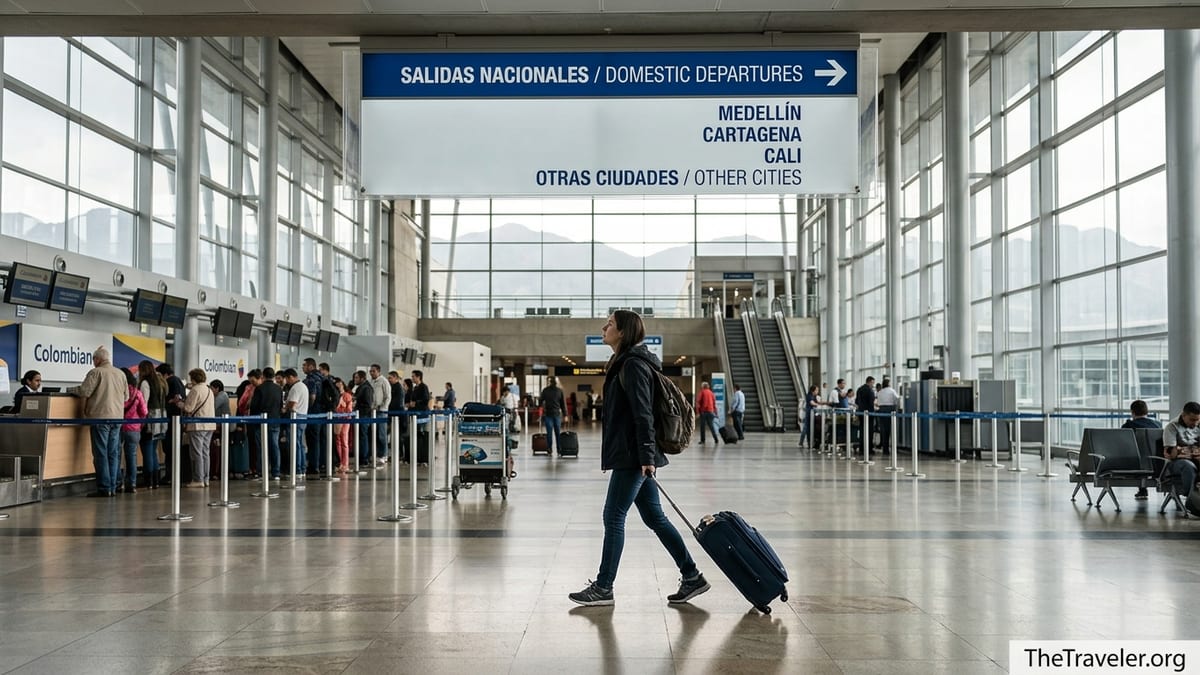
Understanding El Dorado’s Layout and Terminals
El Dorado International Airport sits on the western edge of Bogotá and is Colombia’s main aviation hub for both international and domestic flights. The airport has two passenger terminals: Terminal 1, the large main building handling all international flights and most domestic traffic, and Terminal 2, also known locally as Puente Aéreo, which serves a handful of regional and low-cost domestic airlines. In practice, most travelers connecting to major Colombian cities will stay within Terminal 1 the entire time.
Terminal 1 has separate levels for departures and arrivals but functions as a single complex for domestic and international flights. If you arrive internationally with an airline such as Avianca, LATAM or Copa and then connect to Medellín, Cartagena, Cali, Barranquilla or other large cities, you will almost always depart again from Terminal 1. Terminal 2, located a short distance away on the same airport campus, mainly serves airlines like Satena, Clic and some low-cost or regional services, making it relevant primarily when you are heading to smaller destinations such as Nuquí or San Vicente del Caguán.
Travelers occasionally confuse Terminal 2 with a separate “domestic airport” and expect a long city transfer between buildings. In reality, T1 and T2 are part of the same airport complex, and a free shuttle bus connects them. You are unlikely to use Terminal 2 unless your onward ticket clearly shows an airline based there. For most visitors heading straight to tourist favorites such as Medellín, Cartagena, Cali, Pereira or Santa Marta, every leg of the journey will take place in Terminal 1.
This single-terminal setup for most domestic connections is a big advantage. Instead of repeating check in from scratch or crossing the city, your connection typically involves walking from the international arrivals area to domestic departures within the same building. That said, bottlenecks at immigration, security and baggage handling can still make tight connections risky if you have separate tickets or checked luggage.
Airlines and Typical Domestic Routes from Bogotá
El Dorado is the main hub for Avianca and an important base for LATAM and other Colombian carriers, which means a dense network of domestic routes radiates out from Bogotá. From Terminal 1 you will find frequent flights to Medellín’s José María Córdova Airport near Rionegro, Medellín’s city airport Olaya Herrera on some carriers, Cartagena’s Rafael Núñez Airport, Cali’s Alfonso Bonilla Aragón Airport, Barranquilla, Bucaramanga, Pereira, Armenia, Santa Marta, San Andrés and many more. On busy routes such as Bogotá to Medellín and Bogotá to Cartagena, there are often flights from early morning until late evening.
International travelers landing in Bogotá from North America or Europe commonly connect onwards with Avianca or LATAM on a single ticket. A typical itinerary might be New York to Bogotá on Avianca, arriving around 8:00 pm, then a 10:30 pm Avianca flight from Bogotá to Medellín on the same reservation. Another common combination is Madrid to Bogotá with Iberia or Avianca followed by a domestic Avianca flight to Cartagena, leaving two to three hours for the connection. In these single-ticket scenarios, airlines generally check your baggage through to the final Colombian destination and issue boarding passes for all segments at the origin airport, which simplifies the process in Bogotá.
If you arrive on one airline and continue on a different airline using a separate booking, the experience can be very different. For example, flying Miami to Bogotá with American Airlines and then Bogotá to Cali on a separately booked low-cost carrier may require you to collect your checked luggage in Bogotá, clear immigration and customs, exit the secure area and then recheck your bags at the domestic airline’s counter. This effectively turns your layover into a fresh departure from Bogotá and calls for far more buffer time than a simple same-airline connection.
For smaller cities or remote destinations, flights may operate from Terminal 2 with carriers like Satena or Clic. A traveler arriving from Toronto on Air Canada and continuing to a city such as Arauca might first land in Terminal 1, then use the airport shuttle to reach Terminal 2 for the domestic leg. These routes are less frequent and sometimes operate only once or twice per day, making it even more important to leave generous connection time or consider an overnight in Bogotá to avoid disruptions.
Minimum Connection Times and How Much You Really Need
The official minimum connection times at El Dorado are relatively tight compared with some other hubs, especially within Terminal 1. Industry data indicates that standard minimums are around 30 minutes for domestic to domestic, 60 minutes for domestic to international, and about 90 minutes for international to domestic or international to international connections. Some airlines even schedule international to domestic connections of around 60 to 70 minutes within their own networks when both flights operate in Terminal 1.
In reality, what is “enough” time depends heavily on your passport, whether your baggage is checked through, the time of day and whether your flights are on a single ticket. A traveler arriving from Madrid at 3:40 pm with a same-ticket Avianca connection to Cartagena at 5:35 pm and checked luggage tagged to Cartagena might find 1 hour 55 minutes comfortable, because the baggage is automatically transferred and immigration may offer automated kiosks for eligible passports. On the other hand, a traveler arriving from São Paulo at the same hour on one airline, then needing to collect bags, clear customs and recheck with another carrier for a domestic flight, might find even a 2 hour 55 minute layover tight during peak evening queues.
For most travelers arriving from abroad and continuing to a major Colombian city on the same ticket with luggage checked through, a practical rule of thumb is to aim for at least 2 hours for an international to domestic connection. This gives a reasonable buffer for a modest delay at immigration or at the gate. If your connection involves separate tickets or a terminal change to Terminal 2, planning for 3 to 4 hours is safer. Many experienced travelers build in this extra time, especially when heading to destinations with fewer daily flights, such as Pereira or San Andrés, where a missed flight can mean a long delay or overnight stay.
Domestic to domestic connections, such as arriving from Cartagena and continuing to Medellín, can be faster because you skip immigration and customs. Within Terminal 1, 45 to 60 minutes can work for a protected, single-ticket connection with checked baggage staying in the system. However, travelers report that short domestic connections of around 40 minutes can feel rushed if the arriving flight is delayed, taxi time is long or the onward gate is far away. As always, booking a slightly longer connection can buy you peace of mind, especially if you are unfamiliar with the airport or traveling with children.
Step-by-Step: International Arrival and Domestic Connection
When your international flight lands in Bogotá and you have a domestic connection, the process begins as soon as you step off the aircraft. From the jet bridge, follow signs for arrivals and immigration. If Bogotá is your first point of entry into Colombia, you must go through passport control even if you are flying onward to another Colombian city. Some nationalities can use automated immigration kiosks, which generally move faster than staffed booths, but queues fluctuate a lot depending on the time of day and how many flights arrive at once.
After immigration, you proceed to the baggage claim hall. If your checked baggage is tagged only to “BOG” on the luggage tag, you must collect it, clear customs and recheck it with your domestic airline. If your bags are tagged to your final Colombian destination, such as “MDE” for Medellín or “CTG” for Cartagena, they are usually transferred automatically and you continue with your hand luggage only. In that case, you still pass through customs, typically walking through the green channel if you have nothing to declare, and then follow signs for domestic connections or departures.
Once in the public arrivals hall, domestic connections within Terminal 1 require going up one level to the departures area. If you already have a boarding pass for your onward flight, you may be able to head straight to security. Otherwise, you will first stop at your airline’s check in counters. Avianca’s domestic check in is usually on the second floor near Door 8, while LATAM typically uses counters near Door 7, though layouts can change. After check in, pass through security screening again and walk to your domestic gate, which might involve a 5 to 15 minute walk depending on how far along the pier your gate is located.
Travelers connecting from Terminal 1 to a flight in Terminal 2, for example to reach remote cities served by Satena or Clic, need to exit Terminal 1 and locate the free inter-terminal shuttle. The shuttle bus stop for the airport’s internal buses is outside the terminal at ground level and typically operates frequently, with travel times of about 10 to 15 minutes between stops near each terminal in normal traffic. You should add at least 30 to 45 minutes of buffer time to your planned connection if a terminal transfer is involved, on top of the time you expect for immigration, baggage and security.
Real-World Itineraries: Is Your Connection Time Enough?
Consider a traveler flying from Chicago to Cartagena with a connection in Bogotá. They choose an itinerary on a single ticket with Avianca, landing in Bogotá at 7:30 pm and continuing to Cartagena at 9:50 pm. With baggage tagged through to Cartagena and boarding passes for both flights in hand, a 2 hour 20 minute connection is usually comfortable. They clear immigration, skip baggage claim because their luggage is through-checked, pass customs and go back up to the departure level. After security, they still have time to stop at a café before boarding.
Now imagine someone flying from London to Bogotá on a European carrier, with a separate ticket from Bogotá to Medellín on a domestic low-cost airline in Terminal 1. Their flight from Europe lands at 5:00 pm, and the domestic ticket to Medellín leaves at 7:00 pm. In this case, the 2 hour connection is much riskier. They must clear immigration, collect checked bags, pass customs, exit into the arrivals hall, find their domestic airline’s check in area, queue, drop their bags, clear security and then walk to the gate. A small delay at any step could cause a missed flight. For this type of separate-ticket connection, allowing at least 3 hours is advisable, and 4 hours offers a more comfortable margin.
A third scenario involves Terminal 2. Picture a traveler arriving from New York on Avianca at 9:00 am, then flying at 11:30 am from Terminal 2 with Satena to a smaller city like Florencia. Even if their two flights are on the same airline group, they often need to retrieve baggage in Bogotá and recheck it at Terminal 2, then ride the free shuttle between terminals. That means going through immigration, baggage claim and customs, finding the shuttle stop outside Terminal 1, riding 10 to 15 minutes over to Terminal 2, checking in again, passing security and reaching the gate. In practice, 2 hours 30 minutes can be just enough if everything runs smoothly, but 3 hours or more reduces the stress significantly.
When in doubt, look at how many daily flights run on your onward route and how important it is to arrive the same day. For connections to Medellín, Cartagena or Cali, there are usually many daily frequencies, so missing one flight might mean a delay of just a few hours. For destinations with only one or two flights a day, missing your connection could mean rebooking for the next morning and paying for an unplanned night in Bogotá, which makes padding your schedule much more attractive.
Overnighting in Bogotá vs. Same-Day Connections
For long-haul arrivals late at night or very early in the morning, some travelers debate whether to push through with a same-day connection or plan an overnight in Bogotá. If your inbound flight from North America or Europe lands after 9:00 or 10:00 pm and the only remaining domestic option is a tight connection to cities like Santa Marta or Pereira, it can be more relaxing and sometimes safer to sleep near the airport and take a morning flight instead. Bogotá’s altitude and cooler nighttime temperatures can also make a short layover more tiring than expected, particularly after long flights.
The airport area along Avenida El Dorado has several chain hotels that cater specifically to transit passengers, including properties with complimentary shuttles operating all day and night. Staying at one of these hotels means you can clear immigration and customs without worrying about a closing check in desk, collect your baggage and get a few hours of real rest before returning early the next morning for a domestic departure. This approach is especially appealing if you are traveling with children, carrying sports equipment or heading somewhere with limited daily flights where a missed connection could seriously disrupt your itinerary.
On the other hand, same-day connections work well when you arrive earlier in the day and your airline offers multiple onwards flights. Travelers landing from Miami or Panama City before noon, for example, often connect to Cartagena or Medellín in the early afternoon, arriving at their final destination in time for an early dinner. In these cases, even a modest delay in the first flight leaves room for rerouting to later departures. For well-served routes, a 2 to 3 hour layover is usually a good middle ground between excessive downtime and unnecessary risk.
When considering an overnight, factor in the cost of a hotel, meals and transfers versus the potential expense and hassle of rebooking a missed connection. If you are traveling during holidays or peak travel seasons in Colombia, domestic flights can sell out or jump in price at the last minute, making a cautious overnight plan attractive. During quieter periods, the risk and cost of same-day rebooking may be lower, allowing you to be more flexible.
Getting Into Bogotá During a Long Layover
Some travelers with a long connection in Bogotá consider leaving the airport for a few hours to explore the city. This can be a rewarding option if your layover is at least 7 to 8 hours during the daytime. After clearing immigration and customs, you can store luggage at the airport and then head into town by taxi, app-based ride service or Bogotá’s bus rapid transit system, known as TransMilenio. The Portal El Dorado station on the main TransMilenio line along Avenida El Dorado is close to the airport and connected by a dedicated airport bus route, making it possible to reach central areas like the city’s historic La Candelaria district in roughly 45 to 60 minutes, depending on traffic and transfers.
For example, a traveler arriving from Toronto at 9:00 am with a domestic connection to Cali at 7:00 pm might decide to spend midday in the city. After immigration and customs, they could take a licensed airport taxi into the historic center, have lunch near Plaza de Bolívar and visit the Gold Museum or Botero Museum before returning to the airport in the late afternoon. With this plan, they would aim to be back at El Dorado around 4:30 or 5:00 pm in order to reenter security and comfortably make their evening flight.
If your layover is shorter, leaving the airport is usually not worth the risk. Bogotá’s traffic is often heavy, particularly during weekday rush hours and when there are protests or accidents. A journey that takes 30 minutes one way in light traffic may easily stretch to an hour or more at busier times. When combined with the need to return for security screening and potential lines at domestic departures, a brief venture into the city on a 4 or 5 hour layover can quickly become stressful. In such cases, it is often better to stay in the terminal, find a café or lounge, and rest until your connection.
Travelers who do decide to head into Bogotá should make use of official airport taxis or reputable app-based services, confirm approximate fares in advance and keep an eye on the time. Bogotá’s altitude, weather and crowded sidewalks can be taxing after a long international flight, so it is wise to prioritize one or two key sights instead of trying to “do everything” in just a few hours.
The Takeaway
Connecting in Bogotá’s El Dorado International Airport is straightforward when you understand the layout, typical connection times and the differences between single-ticket and separate-ticket itineraries. Most travelers continuing to popular destinations like Medellín, Cartagena and Cali will remain entirely within Terminal 1, moving from international arrivals to domestic departures via immigration, customs and a second security check. Only a small portion of passengers heading to regional destinations will need to transfer to Terminal 2 using the airport’s free shuttle bus.
As you build your itinerary, consider more than the official minimum connection times. Factors such as whether your luggage is checked through, whether you must change terminals, the time of day and the number of daily flights to your final destination all matter. For same-airline international to domestic connections with through-checked bags, layovers of about 2 hours are often workable; for separate tickets, terminal changes or routes with few daily flights, planning for 3 to 4 hours or even an overnight in Bogotá can save you from missed flights, rebooking costs and unwanted stress.
Finally, be realistic about how you will feel on arrival. A long-haul overnight flight followed by a tight domestic connection at 8,600 feet of altitude can be more draining than it looks on paper. Giving yourself a bit of extra time at El Dorado, whether for a proper meal, a shower or a quick rest in a nearby hotel, can make the onward journey to Medellín’s hills, Cartagena’s Caribbean walls or Cali’s salsa clubs much more enjoyable. With thoughtful planning and a clear understanding of the airport, your Bogotá connection can be a smooth gateway rather than a hurdle.
FAQ
Q1. Is 1 hour enough to connect from an international flight to a domestic flight in Bogotá?
For most travelers, 1 hour is considered tight for an international to domestic connection at El Dorado, especially if you need to clear immigration, collect luggage and recheck it. Airlines sometimes sell 60 to 70 minute connections on a single ticket with through-checked bags, but aiming for around 2 hours is more comfortable.
Q2. Do I need to change terminals for flights to Medellín or Cartagena?
In most cases, no. The majority of flights from Bogotá to major cities such as Medellín and Cartagena depart from Terminal 1, which is also where international flights arrive. You usually remain within the same terminal for the entire connection.
Q3. How long does it take to transfer between Terminal 1 and Terminal 2 at El Dorado?
The free shuttle bus ride between Terminal 1 and Terminal 2 typically takes about 10 to 15 minutes in normal traffic. You should allow an additional 15 to 30 minutes for walking to the shuttle stop and waiting for the next bus, so plan for at least 30 to 45 minutes of extra buffer time if a terminal change is involved.
Q4. Will my luggage be checked through to my final destination in Colombia?
If your international and domestic flights are on one ticket and cooperating airlines, your checked bags are often tagged to your final Colombian city, such as Medellín or Cartagena. If you booked separate tickets or are switching airlines, you may need to collect your luggage in Bogotá, clear customs and recheck it for your domestic flight.
Q5. How much connection time should I leave on separate tickets?
For separate tickets where you must collect and recheck baggage, it is safest to allow at least 3 hours between scheduled arrival and departure, and 4 hours if possible. This extra time helps absorb delays at immigration, baggage claim, check in and security.
Q6. Can I leave the airport and visit Bogotá during a long layover?
Yes, if your layover is at least 7 to 8 hours during the daytime, it can be feasible to visit areas such as the historic center. You will need time to clear immigration and customs, travel into the city and return for security screening, so shorter layovers usually do not allow a realistic or relaxing city visit.
Q7. Is it better to overnight in Bogotá instead of taking a very late domestic connection?
Overnighting near the airport can be a smart choice if your long-haul flight arrives late at night or if your onward destination has few daily flights. Staying in an airport-area hotel lets you rest properly and take a morning flight, reducing the risk and stress of tight late-night connections.
Q8. How early should I be back at the airport for a domestic flight from Bogotá?
For domestic departures from El Dorado, it is sensible to be at the airport about 2 hours before your flight, especially if you need to check bags. During peak travel times or holidays, arriving slightly earlier gives you more margin for security lines and check in queues.
Q9. Are there many daily flights from Bogotá to Medellín, Cartagena and Cali?
Yes. Routes from Bogotá to Medellín, Cartagena and Cali generally have numerous daily flights operated by major Colombian airlines. This frequency provides some flexibility if you miss a connection on a same-airline itinerary, though it is still better to plan a reasonable buffer.
Q10. Is it safe to take a taxi or bus from El Dorado into Bogotá on a layover?
Licensed airport taxis and reputable app-based services are commonly used by travelers heading into the city from El Dorado. Bogotá’s TransMilenio system also connects the airport area to central districts. As with any large city, it is important to use official services, keep an eye on belongings and allow ample time to return for your onward flight.