


Landing at Bogota’s El Dorado International Airport and heading straight to Chapinero is a common route for both business travelers and tourists. Chapinero is home to major office towers, co-working spaces, embassy residences, and some of the city’s most interesting hotel and nightlife areas. This guide explains, in practical terms, how to get from the airport to Chapinero, what each transport option really looks like on the ground, and how to adapt if you arrive late at night or during heavy traffic.
Get the latest updates straight to your inbox!
Understanding the Route: Airport to Chapinero in Real Terms
El Dorado International Airport sits on the western edge of Bogota, while Chapinero stretches along the city’s central-northern corridor, roughly between Calles 39 and 72 and from Avenida Caracas up the hillsides toward the Andes. The distance between the airport and central Chapinero (around Calle 60 with Carrera 7) is approximately 13 to 16 kilometers depending on your exact destination, such as Zona G, Parque de los Hippies, or the financial district near Calle 72.
In light traffic, a direct road trip can take about 20 to 30 minutes by taxi or app-based ride. However, during peak hours, particularly weekday mornings from around 6:30 to 9:00 and late afternoons from around 4:30 to 7:30, the same journey can stretch to 45 minutes or more as Avenida El Dorado (Calle 26) and the approaches into Chapinero fill with commuters. Travelers heading to business meetings in office hubs like the financial district near Calle 72 or coworking spaces around Calle 53 should factor generous buffer time into their itineraries.
Chapinero is not a single neighborhood feel but several micro-areas. Traditional hotels and business towers cluster around Calle 57 to 72 and Carreras 7, 11, and 13. Boutique hotels and hostels are common near Zona G (around Calle 69) and Parque de los Hippies (Calle 60 / Carrera 7), while nightlife focuses on Chapinero Alto and the so-called “Zona T / Parque 93” corridor just to the north. Knowing your exact hotel address will influence which routes and drop-off points make the most sense.
Official Airport Taxis: The Most Straightforward Option
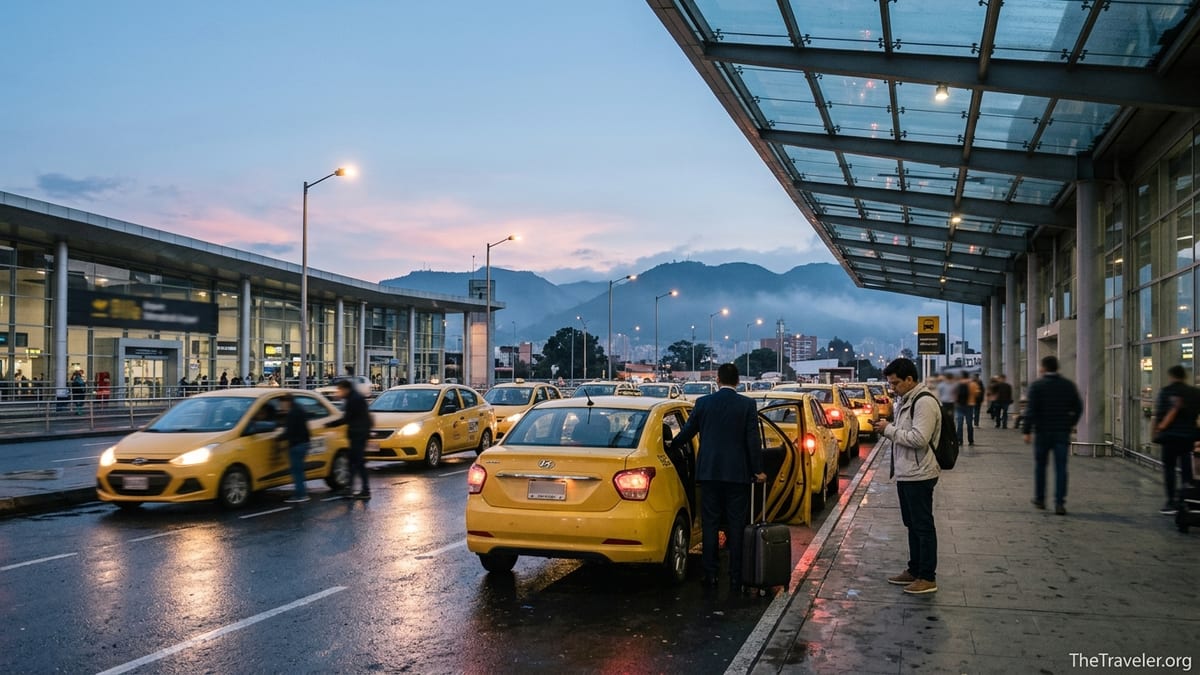
For most first-time visitors and many frequent travelers arriving with luggage or after dark, the official airport taxi is the simplest and safest choice. Inside each terminal you will find authorized taxi counters and clearly signed queues outside. Vehicles are usually yellow sedans with company branding and a visible taxi meter. Staff at the official stands can help you with basic English or Spanish to confirm the destination written on a slip with an estimated fare band.
The fare between El Dorado International Airport and central Chapinero typically falls in a range comparable to other downtown trips, often around 35,000 to 45,000 Colombian pesos depending on traffic, route, and the exact hotel location. For example, a ride from the airport to a mid-range hotel near Calle 57 and Carrera 13 may sit around the middle of that range in normal traffic, while a trip deeper into Chapinero Alto up the hill can be slightly more. The meter is regulated, and there is usually a small airport surcharge already included.
In practice, the process is straightforward. After collecting luggage, follow signs for “Taxis autorizados.” At the counter, tell the agent your destination, for instance “Hotel BH Parque 93 in Chapinero” or “Zona G, Calle 70.” They will issue a printed slip with a reference value; this is not a fixed quote but a guideline. You then proceed to the taxi queue, present the slip to the driver, and once in the car check that the meter (taxímetro) is running. Payment is in cash Colombian pesos, though some drivers accept local card payments or mobile wallets; keeping small bills is helpful.
Official taxis remain recommended for late-night arrivals, especially after around 10:30 pm, when public transport frequencies drop and some bus stops become much quieter. Many Bogota universities and international organizations advise new arrivals to use official airport taxis for their first trips in the city because of their controlled pick-up area and traceable companies. If you are heading to a business hotel like those around Calle 72, drivers are usually very familiar with the route and can navigate quickly even in heavy rain or evening traffic.
Ride-Hailing Apps: Uber, DiDi, Cabify and Local Practices
Bogota has an active market for ride-hailing apps, including Uber, DiDi, Cabify and local services. Regulations evolve, but in practice many travelers routinely use these apps between El Dorado and Chapinero. Pick-ups at the airport are sometimes sensitive from a regulatory perspective, so drivers may ask to meet at a particular door, on a specific level, or in the general departures area rather than right at the most visible curbside taxi ranks.
Costs vary with dynamic pricing, but during average demand an app-based ride from the airport to Chapinero often comes out similar to, or slightly cheaper than, an official taxi. It is reasonable to expect a range that overlaps with the 35,000 to 45,000 pesos area for central Chapinero in regular traffic, sometimes higher if rain or rush hour pushes up demand. The app will show a live estimate in local currency before you confirm, which is useful if you have just exchanged money or are monitoring a company travel budget.
One real-world scenario: a traveler landing at around 7:30 pm, heading to a boutique hotel near Parque de los Hippies, requests an Uber or DiDi from the arrivals level. The app may show a 20 to 25 minute estimate without traffic, but because this is still a semi-peak time with many people leaving the airport, waiting time for a driver might be 10 minutes and the ride itself closer to 35 to 40 minutes. In heavy rain, surge pricing can add several thousand pesos, occasionally making the cost similar to or higher than a metered taxi.
For business travelers, ride-hailing apps have some advantages: digital receipts, easy tracking in expense systems, and the ability to share your trip in real time with colleagues. You can also request higher-category vehicles for more comfortable seating, which matters if you are heading straight from the airport to a meeting in a suit or with technical equipment. However, if a driver cancels repeatedly or you feel uncertain about where to meet, it is often more efficient to fall back to the clearly signposted official taxi lines inside the airport grounds.
Public Transport: TransMilenio and SITP Buses for Budget Travelers
For those traveling on a tighter budget or wanting to experience Bogota’s public transport, a combination of airport buses, TransMilenio trunk lines, and SITP urban buses can take you from El Dorado to Chapinero at a fraction of the taxi price. The key requirement is a rechargeable travel card, currently the TuLlave card, which you can buy and top up at machines or ticket windows in the airport and main stations. The card itself carries a small one-time cost, and single rides are relatively inexpensive compared to private transport.
From the airport, you can connect to the TransMilenio system through routes that reach Portal El Dorado, a large terminal station on Avenida El Dorado (Calle 26). Services operating along this axis include trunk lines connecting the airport area to the rest of the BRT network. Once at Portal El Dorado, passengers can board other services that cross the city, including routes that approach the central and northern areas leading toward Chapinero. The city has introduced several express services and bilingual assistance at this portal to make navigation easier for visitors.
Another practical option is the integrated SITP (Integrated Public Transport System) bus that runs from the airport toward the Andino shopping area in the north, passing along corridors that serve Chapinero. One example, commonly cited among locals, is a route that links the airport with commercial and residential areas around Andino and Carrera 11, with stops near the Chapinero sector. Actual route codes and stop names can be checked in real time using journey-planning apps such as Moovit or the official TransMilenio tools, since minor changes to services, operating hours, or naming do occur over time.
For a concrete example, a traveler with a small backpack heading to a hostel near Zona G arrives at midday. They purchase a TuLlave card at the airport, load enough for several trips, and board an airport feeder bus toward Portal El Dorado. From there, they transfer to a trunk route running along Calle 26 until it connects with lines heading north through the city, and finally to a bus corridor that drops them within walking distance of their hostel. The entire journey may cost only a fraction of a private car ride, but take 60 to 75 minutes depending on transfers and waiting times.
Traffic Patterns and Time Management for Business Trips
Bogota’s traffic is highly variable and strongly influenced by time of day, rain, and incidents on a few key arteries. The main corridor between El Dorado and Chapinero uses Avenida El Dorado (Calle 26) and then either Avenida Caracas, Carrera 30, or the eastern avenues like Carrera 7 and Carrera 11 to climb toward the hills. If you land during rush hour, these roads can slow to a crawl, especially near large intersections with traffic lights and bus lanes.
Business travelers with morning meetings in Chapinero’s office districts should try to avoid arrivals that coincide with the peak inbound flow between about 7:00 and 9:00 am. If this is not possible, it is wise to schedule your first meeting for a time at least two hours after scheduled landing, giving you room for immigration, baggage claim, potential airport queues, and a 45 to 60 minute ride. When leaving Chapinero for evening flights, consider that the outbound rush to the west often intensifies from around 4:30 to 7:30 pm, particularly if there has been afternoon rain.
Some travelers find that mixing modes helps dodge the worst congestion. For example, a visitor staying near a TransMilenio station on Avenida Caracas might use a taxi from the airport during late-night arrivals when the roads are fluid, but take TransMilenio back toward Portal El Dorado during off-peak midday times if they are comfortable with the system and not carrying heavy luggage. The east-west TransMilenio corridor on Calle 26 is considered by many locals to be less crowded and chaotic than heavily loaded lines on Avenida Caracas at rush hour, though space and comfort still vary by time of day.
Weather also matters. Bogota’s frequent showers can appear suddenly and slow traffic as drivers reduce speed, pedestrians cluster around crossings, and minor fender-benders become more likely. It is common for a ride that usually takes 25 minutes to expand to 40 or 50 minutes during a heavy downpour, even outside the classic peak periods. Monitoring a map app from the back seat gives you a sense of how your arrival time is evolving and can be helpful if you need to message a hotel or office to advise of a delay.
Where to Stay: Key Hotel Zones in and around Chapinero
Choosing the right hotel zone in Chapinero influences your airport route and daily movements. For traditional business stays, the financial and office corridor around Calle 72 is a strong choice, with international-branded hotels, serviced apartments, and easy access to corporate towers. From the airport, taxis and ride-hailing cars usually follow Calle 26 and then climb north, with drivers familiar with the grid of Calles and Carreras in this area. Travel times are similar to central Chapinero, with small variations depending on exact street access.
Zona G, roughly bounded by Calles 65 to 72 and Carreras 4 to 7, is known for upscale restaurants, boutique hotels, and well-rated guesthouses. It is popular with both business and leisure travelers who want walkable dining options after work. Nights here are active but generally calmer than the city’s main party areas, and the area has good taxi and app coverage. From the airport, drivers often approach via Calle 26, then swing north along avenues such as Carrera 7 or Carrera 11, depending on traffic conditions and their knowledge of shortcuts.
Backpackers and younger travelers frequently choose areas around Parque de los Hippies near Calle 60 and Carrera 7, where budget hostels, small hotels, bars and cafes cluster. The atmosphere is livelier and more bohemian, and it is easy to reach tourist sites in La Candelaria or the Monserrate cable car by short rides or a few TransMilenio stops. If your hotel is near this park, it helps to show the driver the exact address and mention “cerca al Parque de los Hippies” so they immediately recognize the area.
Finally, some visitors opt to stay close to the airport for early morning flights or short layovers, in hotels clustered around the business parks near Portal El Dorado. While these are technically outside Chapinero, they can be practical bases for travelers who only need to come into Chapinero for a specific meeting or dinner. In that case, you might take a short shuttle or taxi to your airport hotel, freshen up, and then travel light into Chapinero using either rideshare or TransMilenio on Avenida El Dorado.
Practical Tips for Late-Night and Early-Morning Arrivals
Many international flights into Bogota arrive late at night or in the early morning hours. After about 10:30 or 11:00 pm, bus frequencies drop, the atmosphere around some stops becomes very quiet, and the balance of safety and convenience shifts further toward private transport. For solo travelers or those unfamiliar with the city, an official taxi or a pre-arranged app ride is usually worth the extra cost compared with navigating multiple buses in the dark.
If you land after midnight, it is sensible to walk directly to the official taxi ranks inside the terminal rather than stepping outside the airport grounds and negotiating with unofficial drivers. Have your hotel name and address written clearly, ideally with the nearest major intersection. Many business hotels in Chapinero offer 24-hour reception and are used to late-night check-ins, but if you are staying in a smaller guesthouse or apartment rental, confirm in advance that someone will be available to open the door or provide a code.
Travelers arriving at dawn, for example around 5:00 or 6:00 am, face a different trade-off. The streets are relatively quiet, and an official taxi to Chapinero can be very fast, often under 25 minutes. However, as the morning commute builds, buses and TransMilenio quickly become more crowded, and by around 7:00 am the main corridors can already feel packed. If you want to experiment with public transport, it may be wiser to do so later in your stay, during a midday excursion, rather than on your first jet-lagged morning with luggage.
For both late-night and early-morning trips, keeping valuables discreet and luggage zipped is as important as in any large city. Inside taxis and ride-hailing cars, keep windows mostly up at intersections, avoid displaying phones outside the vehicle, and store bags on the floor rather than on laps visible from outside. These small habits are part of everyday life for many locals and help your arrival and departure feel routine rather than stressful.
Tourist-Friendly Routes and How to Combine Transport with Sightseeing
Travel between El Dorado and Chapinero can double as a first orientation tour of Bogota if you choose your route and timing intelligently. The drive along Avenida El Dorado offers early views of the city’s skyline and the rise of the Andes to the east. On a clear afternoon, you may catch sight of the Monserrate and Guadalupe hilltop sanctuaries as you approach Chapinero. Asking a talkative taxi driver about neighborhoods you pass, from Engativá and Teusaquillo to the central corridors, can give useful context for later exploration.
Some visitors intentionally schedule a midday arrival, drop bags at a Chapinero hotel, and then use the relatively calmer midday public transport window to ride TransMilenio into the historic center. Bus routes along Avenida Caracas and Calle 26 connect Chapinero to downtown stations near La Candelaria and the Plaza de Bolívar. This approach allows you to understand the system while feeling the pulse of local commuters, but still return by taxi or rideshare after dark when the museums and government buildings close.
Others stay in Zona G or near Parque de los Hippies and rely largely on walking and short taxi rides within Chapinero, using longer rideshares only for airport transfers and day trips. In this pattern, the journey from the airport is simply a comfortable transfer at the start and end of the trip, while daily movement remains compact and low-stress. If you are in Bogota for a conference, you might spend mornings in meeting rooms, walk to nearby restaurants for lunch in Zona G, and reserve one late afternoon or Saturday morning to explore downtown with the help of public transport.
Regardless of your plan, it helps to download a reputable map app and a local journey planner before landing, with offline maps if possible. When you are in the taxi from the airport, following the route on your phone gives you a sense of orientation and confirms that you are indeed heading along Calle 26 toward Chapinero rather than in a different direction. This also reduces anxiety if traffic slows or drivers take alternate paths along parallel avenues to avoid jams.
The Takeaway
Reaching Chapinero from El Dorado International Airport is flexible and manageable, whether you prioritize safety, speed, budget or a bit of city immersion. Official airport taxis offer a controlled, straightforward experience that many first-time visitors and late-night arrivals appreciate, at fares that are reasonable for a major Latin American capital. Ride-hailing apps add the convenience of digital payment and receipts, although pick-up logistics may require brief coordination with your driver.
Public transport, through TransMilenio and SITP buses, opens up a low-cost, everyday perspective on Bogota, ideal for budget-conscious travelers and repeat visitors who already feel comfortable with the city. However, the need for a TuLlave card, line changes, and crowded conditions at peak times mean that most business travelers will prefer private vehicles at least for their airport transfers. In any case, understanding the geography of Chapinero’s hotel zones and the city’s traffic rhythms will help you choose the combination of routes that best fits your schedule.
With realistic expectations about travel times, clear communication of your destination, and a few simple safety habits, your journey between El Dorado and Chapinero can be just another smooth step in a productive business trip or an enjoyable Colombian holiday. Plan your arrival window, pick the mode that suits your needs, and let the ride be your first introduction to Bogota’s altitude, skyline, and everyday energy.
FAQ
Q1. How long does it usually take to get from El Dorado Airport to Chapinero by taxi?
In light traffic, an official taxi or app-based ride can take around 20 to 30 minutes. During peak rush hours or heavy rain, the trip can stretch to 45 minutes or more, so it is wise to allow extra buffer time.
Q2. How much should I expect to pay for a taxi from the airport to Chapinero?
Fares vary with distance and traffic, but many travelers report paying somewhere in the range of about 35,000 to 45,000 Colombian pesos to reach central Chapinero. The official airport surcharge and metered distance are included in the final price.
Q3. Is it safe to use Uber, DiDi or Cabify from El Dorado to Chapinero?
Many visitors do use ride-hailing apps between the airport and Chapinero. While rules and enforcement can shift, in practice drivers often arrange specific meeting points near the terminals. As usual, check the driver’s rating, vehicle plate, and route in the app before getting in.
Q4. Can I take public transport from the airport to Chapinero if I am on a budget?
Yes. With a TuLlave transit card, you can use airport-connected buses to reach Portal El Dorado and then connect to TransMilenio or SITP services toward Chapinero. This is much cheaper than a taxi but generally slower and involves at least one transfer.
Q5. Should I use public transport at night when arriving in Bogota?
After around 10:30 or 11:00 pm, frequencies decrease and bus stops become quieter. For safety and convenience, most first-time or solo travelers prefer official airport taxis or ride-hailing apps for late-night arrivals instead of navigating multiple buses.
Q6. Which Chapinero area is best for business travelers coming from the airport?
Business travelers often choose the financial corridor around Calle 72 or hotels in Zona G, which offer good access to offices, restaurants, and reliable taxi and app coverage. These areas are well known to airport taxi drivers.
Q7. How do I pay for taxis and buses from El Dorado?
Official taxis are usually paid in cash Colombian pesos, though some drivers accept local cards. For buses and TransMilenio, you need a TuLlave card loaded with credit before boarding. The card can be purchased and recharged in the airport and main stations.
Q8. What is the best option if I arrive very early in the morning?
In the very early hours, such as around 5:00 or 6:00 am, an official taxi is usually the easiest and fastest choice. Streets are relatively quiet, and your ride to Chapinero is likely to be quick compared with later in the morning when rush hour builds.
Q9. How can I reduce the chances of getting stuck in bad traffic on this route?
Try to avoid traveling between the airport and Chapinero during the heaviest rush hours when possible. If you must move at those times, add generous buffer time and let colleagues or your hotel know your expected arrival. Watching live map traffic in the car helps you understand delays.
Q10. Are Chapinero’s hotel areas walkable once I arrive from the airport?
Many parts of Chapinero, especially around Zona G and Parque de los Hippies, are reasonably walkable during daylight and early evening, with plenty of cafes, shops and restaurants. For longer distances, steep hills, or late-night movements, taxis and ride-hailing cars remain the most practical choice.