


Landing at Bogotá’s El Dorado International Airport and jumping straight onto TransMilenio is one of the cheapest ways to get into the city. It is also one of the most confusing for first‑time visitors. This guide explains, step by step and with real examples, how to ride TransMilenio from the airport, where to buy and recharge the TuLlave card, what to expect at Portal El Dorado, and the tourist mistakes that cost time and money.
Get the latest updates straight to your inbox!
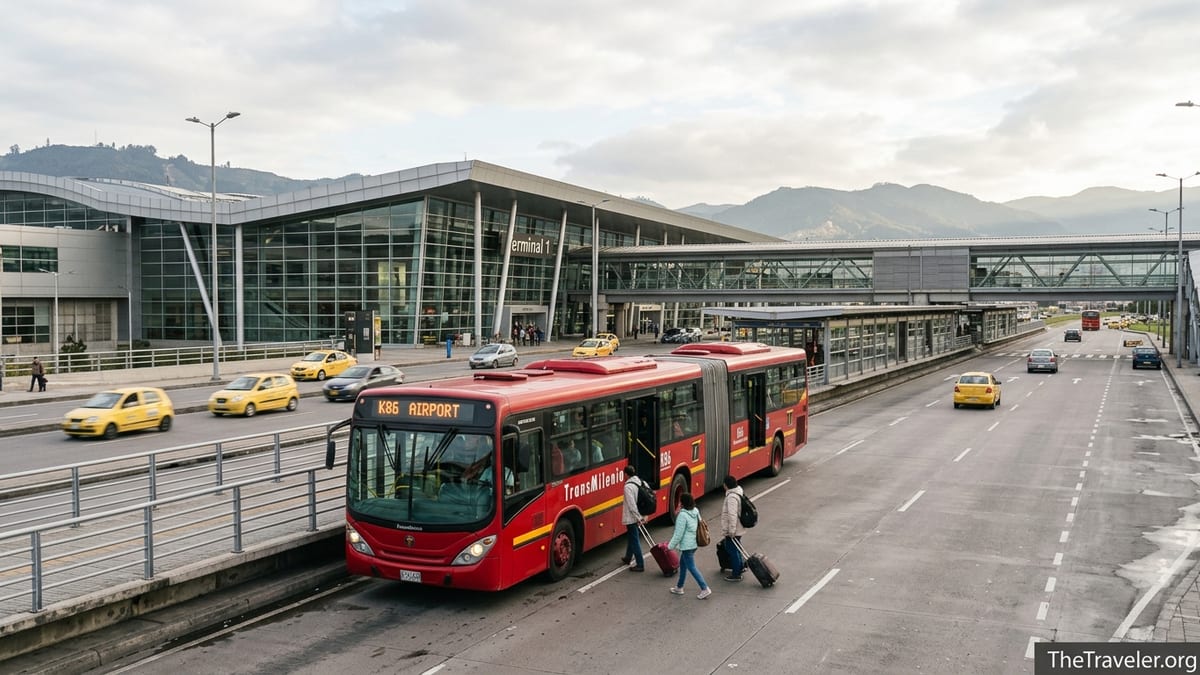
Why Use TransMilenio From El Dorado Airport
For budget travelers, TransMilenio is the backbone of public transport in Bogotá. From El Dorado International Airport, it connects you to major areas such as Salitre, Chapinero, Zona Rosa and the historic center for a fraction of what a taxi or app car costs. As of early 2026, the unified TransMilenio fare is about 3,550 Colombian pesos per ride, compared with 40,000 to 70,000 pesos for a typical taxi ride into central areas depending on traffic and time of day. That difference adds up quickly on a multi‑day stay or for long layovers.
Using TransMilenio is not only about saving money. Airport traffic in Bogotá can be heavy, and buses often move along dedicated lanes on Avenida El Dorado (Calle 26). At rush hour, when cars are barely moving between the airport and downtown, a K86 bus from the airport plus a quick transfer at a station like Gobernación or Concejo de Bogotá can sometimes be faster than a taxi door to door, especially if your hotel is near a TransMilenio station.
For travelers with an early or late flight, TransMilenio also offers broad service hours. The dual route K86 / M86 that directly serves the airport operates from early morning until night on all days of the week, so a traveler landing around 21:00 on a weekday can still realistically reach most central neighborhoods by bus. That flexibility makes it a reliable option if your flight is delayed or if you are arriving during the evening rush.
The tradeoff is comfort and complexity. TransMilenio can be crowded, signage is mostly in Spanish, and the system uses a dedicated smart card. This guide helps you understand each step, from buying the card inside the terminal to managing your bags inside sometimes busy buses and stations.
Understanding TuLlave: The Card You Need
To board TransMilenio you must use a TuLlave smart card. Cash is not accepted at station turnstiles or on most airport‑related buses. At El Dorado Airport, there is usually a TuLlave service point around Door 4 on the second floor of Terminal 1, where arriving passengers can buy a basic card and load it with credit. Look for a small kiosk or counter with the TuLlave logo near the public transport and information area.
There are two main versions of the card that interest visitors: an anonymous basic card and a personalized card. The basic card is easier and faster to obtain. You pay a small one‑time cost for the plastic itself, then add travel credit on top. A personalized TuLlave requires you to show identification and register your name, but it allows benefits such as recovering your balance if you lose the card and receiving integrated transfer discounts that reduce the cost when you switch between TransMilenio and the city bus network. For a short stay of a few days, most tourists choose the basic card for simplicity.
When planning your first recharge, think about your itinerary rather than loading a very high amount. For example, if you arrive on a Friday for a long weekend and expect to make two to four rides per day, starting with around 40,000 to 50,000 pesos on the card is usually enough. You can always add more later at Portal El Dorado or any major station. Overloading the card on day one is a common mistake, especially if several people plan to share one card, which is allowed at the entry gates but not ideal during busy times because you must tap for each person one by one.
If you are arriving late at night and the airport TuLlave point is closed, you still have options. Some 24‑hour convenience stores inside Bogotá sell TuLlave cards, and at Portal El Dorado there are vending machines and staffed booths during operating hours. However, reaching Portal El Dorado without a card means relying on a specific free feeder service when it is available, so whenever possible, buying the card inside the airport remains the smoothest experience.
Where and How to Buy or Recharge TuLlave
The most convenient place for air travelers to get started is the TuLlave counter at El Dorado Airport. Once you exit customs in Terminal 1, follow the signs to public transport or look for Door 4 on the upper floor. At the counter you can purchase a new TuLlave card and load credit in cash. Staff are accustomed to foreign visitors, and while English is not guaranteed, they generally understand basic requests such as “card” and “recarga” if you show cash and indicate the amount you want.
Once you leave the terminal and board the K86 airport bus or a free feeder to Portal El Dorado, you will find more recharge options. Portal El Dorado, the large terminal station on Avenida El Dorado, has TuLlave booths and automatic top‑up machines. The machines typically accept Colombian banknotes and some accept debit or credit cards issued in Colombia. Travelers have reported that foreign cards may not always work, so carrying pesos in cash is wise when you plan to recharge.
Digital recharge is an increasingly popular solution for residents and can also help visitors who open a local digital wallet. The official TuLlave system supports online top‑ups through its website and mobile applications, and TransMilenio has published instructions for recharging via smartphone using partner apps. However, even when you add money digitally, you often need to “activate” the new balance by tapping your card on a special reader at a station kiosk or turnstile. If you are only in Bogotá for a few days, relying on in‑person recharges at booths or machines in stations is usually simpler than experimenting with apps that may require local bank accounts.
Personalization points, where you can register the card to your name, are located at several major stations and transport terminals across the city. These desks generally follow office‑style hours rather than staying open late at night. If you expect to stay in Bogotá for weeks or months, taking the time to personalize your card at one of these locations can be worthwhile, but short‑term visitors can safely ignore this step and use the basic anonymous version sold at the airport.
Portal El Dorado and Airport Routes Explained
Portal El Dorado is the main TransMilenio terminal closest to the airport, located along Avenida El Dorado (Calle 26). It functions as a hub where airport buses, feeder buses from surrounding neighborhoods and trunk line services converge. Most travelers starting at the airport first reach Portal El Dorado, then transfer to a trunk route heading toward downtown, the north or the west of the city. Physically, the portal is a large elevated structure above the avenue with multiple platforms and a central concourse, so give yourself a few minutes to orient on your first visit.
The dual route K86 / M86 is the most important service for airport passengers. In practice, these are the same line in opposite directions. When you are leaving the airport toward the city, you will normally board the K86. When you return to the airport, you will most often look for the M86 leaving from Portal El Dorado or intermediate stations. The line operates along Avenida El Dorado and then continues northeast toward areas like Salitre, the National Museum and shopping centers in the north. Operating hours start very early in the morning on weekdays, around 4:30 or 5:00, and finish at night, typically around 22:00, with slightly later first departures on Saturdays and Sundays.
At the airport, the K86 bus stop is on the main access road outside Terminal 1. After buying or recharging your TuLlave card, exit the building following the TransMilenio or public bus icons. You will pass a lane of taxis and ride‑hailing pick‑up points and eventually reach a dedicated bus platform clearly signed for TransMilenio services. Here you tap your card at a small validator before stepping through the gate into the boarding area. When the K86 arrives, doors open level with the platform, which makes it easier to handle luggage than on typical city buses.
Once on board, announcements and signage are primarily in Spanish, but each stop is displayed on an electronic panel. If you are heading somewhere central such as La Candelaria, Chapinero or Zona Rosa, your first move is usually to ride the K86 to Portal El Dorado, then transfer to another trunk bus in the direction you need. For example, a traveler staying near Avenida Chile in Chapinero might ride K86 from the airport to Portal El Dorado, then switch to an E or F trunk line heading east toward the Caracas corridor, and finally to a local bus or short taxi ride for the final few blocks.
Luggage, Crowds and Safety on TransMilenio
Traveling with luggage on TransMilenio is completely normal, but it requires some awareness. The articulated buses that serve airport routes have space in the middle section where many locals stand with backpacks and shopping bags. Medium suitcases that you can roll by your side are common, while very large, heavy bags can be difficult to handle in crowds. If you are traveling with multiple large checked bags, consider whether saving the taxi fare is worth the physical effort of lifting them on and off the bus and maneuvering through station escalators and gates.
Rush hours in Bogotá typically run from around 06:30 to 09:00 in the morning and 16:30 to 19:30 in the afternoon on weekdays. During those periods, TransMilenio stations and buses can become quite full, especially on main corridors. The good news for airport passengers is that the K86 and M86 segments near the airport and Portal El Dorado are often less crowded than central stations. Travelers who commute from neighborhoods near the airport report that early‑morning K86 services leaving the airport toward the city can be relatively calm compared with the intensity closer to downtown. Still, if you arrive exactly at rush hour and head into the core of the system, be prepared for standing room only on subsequent buses.
Security on TransMilenio is generally adequate, but petty theft is a realistic risk, particularly in crowded conditions. Keep phones and wallets in front pockets or interior compartments, close all zippers on backpacks and avoid using your phone near the doors when the bus is full. A typical scenario is a distracted traveler following a map on their phone while the bus is packed at a station like Calle 26 or Avenida Jiménez, making it easy for a pickpocket to slip the phone from a side pocket shortly before doors close. To avoid this, memorize your station in advance or step away from the doors to check directions between stops.
Women and solo travelers often ask whether TransMilenio is safe at night. After dark, the system remains fairly busy until around 21:00 or 22:00, especially at larger stations like Portal El Dorado. As with any big city, avoid empty platforms late at night, keep valuables hidden and if you feel uncomfortable at any point, it can be worth spending extra on a registered taxi or app car for the last leg of the journey. Many locals mix TransMilenio and taxis in this way, using the bus for the long approach into town and a car for the final short ride to a hotel or apartment.
Planning Your Route From El Dorado: Real Itineraries
A clear route plan makes TransMilenio from the airport feel much less intimidating. Imagine you are staying in La Candelaria, the historic center near Plaza de Bolívar. After landing, you buy a TuLlave card at Door 4, exit to the K86 stop and ride the bus toward Portal El Dorado. At the portal you transfer to a trunk line that runs east along Avenida El Dorado and then south toward the center. From stations such as Las Aguas or Museo del Oro, you can walk into the historic streets or take a short taxi up the hill if you are carrying heavy bags.
If your base is in Chapinero, a common plan is similar but with a different final segment. You start with K86 from the airport, transfer at Portal El Dorado, and ride a trunk service toward a station close to Carrera 7 or Carrera 13, such as Calle 63 or Calle 72. From there, many hotels, hostels and apartments in Chapinero Alto or near Zona G are a short taxi ride uphill. Travelers often find that mixing TransMilenio for the main corridor and a quick app‑based car for the last two or three kilometers keeps costs low while avoiding a long uphill walk with bags.
For business travelers heading to the northern commercial districts around Parque de la 93 or shopping centers like Unicentro, TransMilenio again offers a low‑cost backbone. After reaching Portal El Dorado on K86, you transfer to a northbound trunk line and ride to stations that intersect with east‑west avenues like Calle 100 or Calle 106. From those stations, taxis and ride‑hailing apps are plentiful and fares to the final destination are usually modest compared with the airport‑to‑north taxi fare. Many people who work near the airport but live in central or northern neighborhoods rely daily on combinations of K86 / M86 and these northbound lines.
Travelers on tight schedules should also consider potential delays. While buses in dedicated lanes avoid some traffic, incidents, protests or heavy rain can still slow the system. If you need to catch a flight and plan to return to the airport by M86 and TransMilenio, leaving at least one extra hour on top of your door‑to‑door travel estimate is prudent. On days with strong afternoon storms, which are common in Bogotá, short disruptions or slower boarding at exposed stations can easily add 20 or 30 minutes to a trip.
Tourist Mistakes to Avoid When Using TransMilenio
The first and most costly mistake is assuming you can pay with cash on board. Many visitors exit customs, find the K86 stop and then realize they have pesos but no TuLlave card. Without a card, you cannot pass the gate, and if the airport TuLlave point is closed for the day, you may need to wait for a different free feeder bus or give up and take a taxi. Always prioritize buying the TuLlave card immediately after exiting the secure area, before heading down to the ground transport lanes.
A second common mistake is overloading a single card for a group and then keeping that card in only one person’s wallet. Since everyone must pass through the turnstiles separately, the group can be split if the person holding the card gets ahead or behind, especially in busy stations like Portal El Dorado. It is usually smoother if each adult has their own card with enough credit for the stay. If you want to save on the initial plastic fee, one shared card can work, but agree in advance who carries it and stay physically close at all entry and transfer points.
Another frequent issue is underestimating how confusing station names and directions become once you are inside the system. Many visitors glance at a network map in the hotel lobby and think they have memorized their route, only to discover, in the middle of a crowded platform, that two lines use similar codes or that multiple stations have similar names. Before leaving the airport, write down the exact codes of the lines you need and the name of your transfer station and final station. Use a mapping app to download an offline snapshot of the route and keep it handy. This is especially useful if your mobile data is not yet active when you land.
Finally, some tourists treat TransMilenio as a sightseeing tour with all their luggage, riding at peak rush hour to “experience” Bogotá’s daily life. While the system is indeed an expression of the city, turning up with two large suitcases at 8:00 in the morning on a weekday is not appreciated by commuters, and it will be stressful for you. If your schedule forces you to travel at peak times, try to board near the start or end of a line and position yourself away from the doors. Otherwise, adjust your airport departure or arrival slightly earlier or later so you can travel during calmer periods.
The Takeaway
Using TransMilenio from El Dorado International Airport is one of the most economical ways to reach Bogotá, and with a bit of preparation, it can be straightforward. The key steps are buying or recharging a TuLlave card at the airport, understanding how to reach Portal El Dorado, and planning your route from there to your neighborhood using the K86 / M86 and connecting trunk lines. With a current fare that is only a small fraction of a taxi ride, the savings over several days or weeks can be significant.
At the same time, TransMilenio is not for everyone in every situation. Very heavy luggage, very late‑night arrivals or travelers uncomfortable with crowds may prefer to pay more for a taxi or private transfer. Many visitors combine options, using TransMilenio in daytime for budget‑friendly trips into or out of the city and switching to taxis or ride‑hailing services after dark or when carrying bulky bags.
If you choose to ride TransMilenio from El Dorado, plan ahead: know your stations, keep your card loaded, guard your belongings and avoid peak hours when possible. Treat it as what it is for locals, a practical workhorse of daily mobility, and you will likely find that it offers a revealing first glimpse of Bogotá’s energy long before you reach your hotel.
FAQ
Q1. Can I board TransMilenio from El Dorado Airport without a TuLlave card?
Not in most cases. Regular TransMilenio buses like the K86 and M86 require a TuLlave card to pass the gate or validator, so you should buy or recharge the card at the airport before going to the bus stop.
Q2. How much does a TransMilenio ride from the airport cost in 2026?
The unified TransMilenio fare in 2026 is around 3,550 Colombian pesos per trip. This is the same whether you board at the airport or any other station, and it is significantly cheaper than a taxi into the city.
Q3. Where exactly can I buy a TuLlave card at El Dorado Airport?
In Terminal 1 you will usually find a TuLlave point of sale near Door 4 on the upper floor, close to the public transport and information area. Look for the TuLlave logo on a small counter or kiosk where staff sell and recharge cards.
Q4. What is the difference between the K86 and M86 airport routes?
K86 and M86 are two directions of the same dual route connecting the airport, Portal El Dorado and northeastern Bogotá. K86 generally runs from the airport toward the city, while M86 is used when you are returning from the city or Portal El Dorado to the airport.
Q5. Is it safe to use TransMilenio with luggage?
Yes, many people use TransMilenio with carry‑ons and medium suitcases, especially on the airport routes. Keep your luggage close, avoid blocking the doors and be alert to pickpockets in crowded sections, just as you would in any large city.
Q6. What if my flight arrives late at night?
If you land very late, first check whether the K86 or M86 is still operating by asking at the information desk or TuLlave counter. If services have finished for the night or if stations look very quiet, using an official taxi or ride‑hailing service from the airport may be safer and more convenient.
Q7. Can several people share one TuLlave card?
Yes, at the entry gates one person can tap the card multiple times to pay for companions. However, it can slow you down at busy stations, and if the cardholder is separated from the group it becomes complicated. For longer stays, it is usually better for each adult to have their own card.
Q8. How do I know which station to get off at for my hotel?
Before leaving the airport, check your hotel’s address on a map and identify the TransMilenio station closest to it. Write down the station name and any necessary transfers. Once on board, follow the station names on the bus’s electronic display and count how many stops you need before changing or getting off.
Q9. Are there discounts or special fares for tourists?
There are no specific tourist discounts. Reduced fares and special passes are aimed mainly at local residents, students and vulnerable groups. Tourists pay the standard TransMilenio fare using the TuLlave card like any other passenger.
Q10. Is TransMilenio a good option for a short layover?
It can be if your layover is long enough and falls within TransMilenio operating hours. For a daytime layover of six hours or more, you can ride from the airport to central Bogotá for a low cost, walk around areas like La Candelaria or the museum district, and return by M86 and connecting buses with a comfortable time buffer before your next flight.