


For many travelers, Capri begins and ends with a boat queue at the Blue Grotto and a quick spin past the Faraglioni rocks. Yet the island is far richer, stranger and quieter than those two postcard scenes suggest. If you are willing to walk a little farther from the Piazzetta, stay after the last day-trippers sail back to Sorrento, and trade big-name beach clubs for family-run kiosks, a very different Capri appears.
Get the latest updates straight to your inbox!
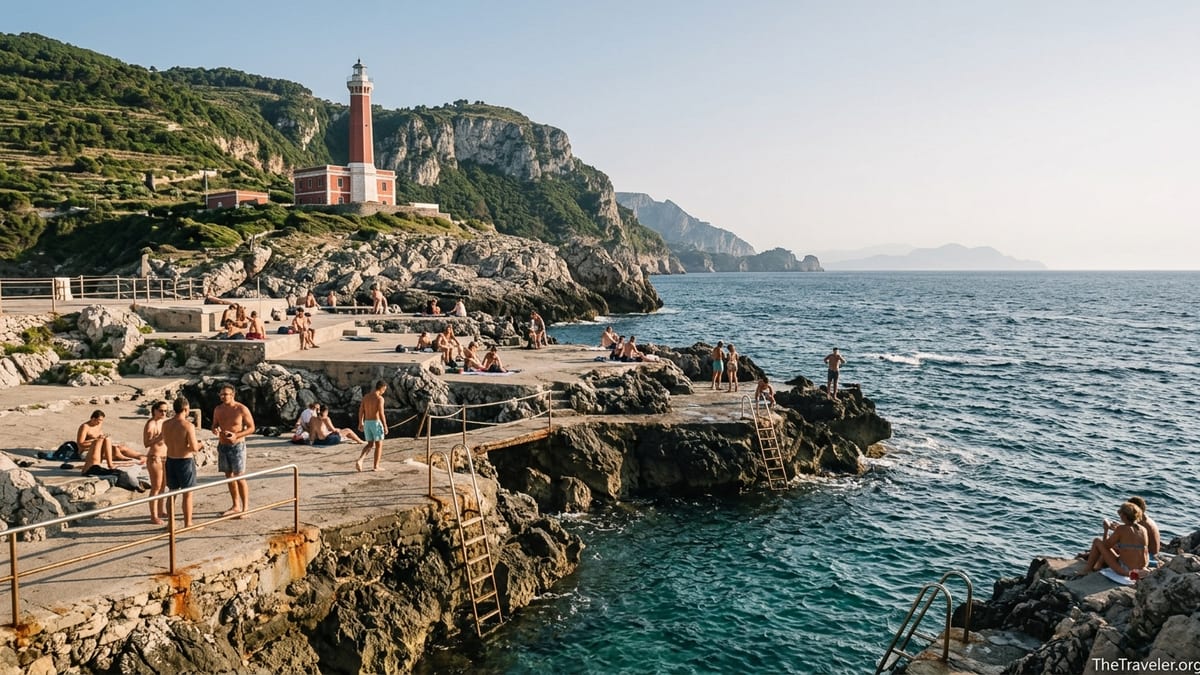
Punta Carena: Sunset at the Lighthouse Instead of the Grotto Queue
If the Blue Grotto is Capri’s most overexposed attraction, Punta Carena is its antidote. At the southwestern tip of the island, the working lighthouse rises above a rocky cove where locals come to swim and watch the sun disappear into the Tyrrhenian Sea. It is the only bathing area on Capri that keeps the sun until sunset, which means you can still be in the water at 7:30 pm in July while excursion boats are already heading back to the mainland.
From Anacapri’s Viale Tommaso de Tommaso, buses run regularly down to the Faro stop, dropping you beside the lighthouse terraces in about 10 to 15 minutes. The ride costs only a few euros and can be paid directly on board or at the ticket booth near the Piazza Vittoria bus hub. Walk a few steps and you find a sloping concrete platform and flat rocks used as an informal public beach, with a mix of teenagers, off-duty waiters and families settling in with towels and plastic bags of snacks.
Alongside the free area sit a handful of simple businesses that feel worlds away from the polished scene at Marina Grande. Da Antonio, a tiny bar that has been here since the 1950s, serves panini stuffed with grilled squid or mozzarella and tomato, along with cold beer and granita; a sun lounger and umbrella here generally cost noticeably less than at the more glamorous clubs near the Faraglioni. Next door, Lido del Faro offers a more refined take, with a small saltwater pool carved into the rocks, showers and a restaurant that will bring linguine alle vongole straight to your sunbed. Both remain open into the evening, when Aperol spritzes appear and the lighthouse switches on one by one.
What most visitors miss is how easy it is to replace a rushed morning at the Blue Grotto with a half day here. Boats sometimes suspend visits to the grotto when the sea is rough or when the entrance is crowded, leaving travelers frustrated. At Punta Carena, the worst-case scenario is a little wind and bigger waves against the rocks, conditions the regulars treat as an excuse for a late-afternoon spritz and a front-row seat for the sunset.
The Fortini Trail: Capri’s Wild Western Edge
Between the Blue Grotto and Punta Carena runs one of Capri’s great walks, a route surprisingly empty given how dramatic it is. The Sentiero dei Fortini, or Path of the Forts, threads along the western coastline, linking a series of 19th-century stone blockhouses once used by British and French troops. Today the forts of Orrico, Mesola and Pino are quiet viewpoints, their two-meter-thick walls framing some of the island’s widest sea panoramas.
The full hike can take three to four hours at a relaxed pace, including photo stops and water breaks. Many travelers start near the Blue Grotto bus stop, walk south along the path, then end at Punta Carena in time for a swim. You will want sturdy walking shoes, water, sunscreen and a hat: although stone steps and paved sections appear intermittently, much of the route is rugged path, with ups and downs that can feel like a natural stair workout in the afternoon heat.
Along the way, interpretive signs in Italian and English describe the Napoleonic history of the forts and the native plants that cling to the cliffs. Spring and early summer are particularly rewarding, when low shrubs flower and the sea below swings from deep cobalt to jade green. Unlike the crowded viewing terraces at the Gardens of Augustus, there are stretches on the Fortini Trail where you might not see another person for fifteen or twenty minutes, save for a lizard darting across the path or a kestrel gliding along the thermals above the sea.
Practical details matter on this walk. Bus tickets from Anacapri to either the Grotta Azzurra or Faro stops are inexpensive, and it makes sense to buy a couple at once if you plan to use public transport regularly. In the height of summer, set off early in the morning or later in the afternoon to avoid the harshest sun. When you reach Punta Carena, a plunge into the water in front of the lighthouse and a plate of fried anchovies at one of the bars is a reward that feels far from the island’s heavily photographed boat tours.
Villa Lysis and Villa Jovis: Capri’s Quieter Roman and Belle Époque Corners
Capri is famous for its villas, yet many visitors never see beyond the crowd-pleasing Gardens of Augustus or the well-known Villa San Michele in Anacapri. On the northern side of Capri town, two less visited sites create a layered story of the island’s fascination with beauty and exile: Villa Lysis, a decadent Belle Époque hideaway, and Villa Jovis, the cliff-top palace of Emperor Tiberius.
Villa Lysis stands on a high promontory above the sea, about a 40 to 45 minute walk uphill from the Piazzetta through the Monte Tiberio district. The path winds past everyday homes, small grocery shops and shrines, gradually shedding the luxury storefronts of Via Vittorio Emanuele. When you arrive, the villa’s neoclassical columns, Art Nouveau details and shaded terrace over the water feel quietly removed from the crowds below. Built by the French count Jacques d’Adelswärd-Fersen, it has become known for its melancholic atmosphere and occasional art exhibitions. In summer 2026 it operates on extended hours but is temporarily closed for part of June for a contemporary sculpture installation, so it is worth checking the current schedule locally before climbing.
Continue farther along Monte Tiberio and the road narrows into a path that eventually leads to Villa Jovis, once the main residence of Tiberius. Unlike the manicured grounds of some villas, Villa Jovis feels almost austere: broken walls, large cisterns and open terraces give only hints of the palace’s former scale. The payoff is the view, with the Sorrento Peninsula and the Bay of Naples stretching north and the cliffs plunging sheer into the sea below. Entry tickets are modestly priced by European heritage-site standards, and a typical visit, including the walk up from town, comfortably fits into a long morning.
Together, Villa Lysis and Villa Jovis show how Capri has long drawn outsiders looking for refuge, from Roman emperors to scandal-shadowed aristocrats. Visiting them on foot also forces a slower rhythm. You hear roosters, passing motor scooters and the chatter of residents outside their doors, details largely absent from the heavily trafficked routes between the Piazzetta and the designer boutiques.
Anacapri Lanes, Monte Solaro and the Philosophical Park
Most organized tours give Anacapri only an hour or two, often limited to a quick look at Villa San Michele or a group ride up to Monte Solaro’s summit. Yet the higher town deserves half a day or more on its own. The whitewashed houses around Piazza Vittoria and along Via Giuseppe Orlandi create a network of narrow lanes where laundry hangs over your head and cats sleep on window ledges. Here, ceramic workshops still sell hand-painted tiles and house numbers, and small bars pour espresso for local drivers and shopkeepers rather than cruise passengers.
From Piazza Vittoria, the single-seat chairlift sails silently up to Monte Solaro, the island’s highest point, in about 12 minutes. Tickets are reasonably priced, and you can choose a return trip or hike down one way. Many travelers ride up in the middle of the day, when the views are hazy and the terrace cafe fills with people taking phone selfies. A more rewarding strategy is to go early, around opening time, or near closing on a clear day. With fewer people on the platform, you can pick out the Amalfi Coast, the green bulk of Ischia and the outline of the mainland without a forest of selfie sticks in the way.
On the western slope of Anacapri lies one of Capri’s most overlooked corners: the Philosophical Park. Reached by a quiet lane that continues past the residential district of Migliera, this small park is set among terraces of Mediterranean scrub and low walls. Ceramic tiles lining the paths are inscribed with quotes from Eastern and Western philosophers, placed here by a Swedish physician and writer who made Capri his adopted home. Entry is free, and you are more likely to see dog walkers and local couples than organized groups. On clear afternoons, the promontory near the park offers head-on views of the Faraglioni from a distance, without the noise of boat engines.
None of these places require much money, only time and a willingness to walk. Anacapri’s buses connect easily with Marina Grande and Capri town, and a day ticket can make hopping between the upper town, Monte Solaro and Punta Carena straightforward. Stopping for a slice of torta caprese in a family pastry shop along Via Orlandi between outings is one of those simple moments that remind you Capri is not only a series of viewpoints but also a working community.
Hidden Swim Spots: Gradola and Marina Piccola’s Quieter Corners
Capri’s beaches are mostly small platforms and coves carved into the rock instead of long stretches of sand. The crowded strips nearest the main harbors can feel more stressful than relaxing, but if you know where to look, the island still has a few low-key spots where the sea is just as blue and the atmosphere more forgiving.
Near the Blue Grotto, Gradola is a rocky cove with an informal restaurant and a simple platform for swimming. Bus services from Anacapri stop close by, and the water here shares the same striking color as the grotto entrance, especially on calm mornings. Facilities are basic compared with the high-end clubs near the Faraglioni, but that is part of the appeal: a plate of spaghetti alle vongole or a grilled fish here typically costs less than at the most famous spots, and reservations are often less essential outside of peak holidays.
On the southern side of the island, Marina Piccola shelters under steep cliffs with a view of the Faraglioni. The main pebble beaches and the road above them draw plenty of visitors, especially in August, but by walking a little farther along the seafront or taking small paths toward the rocks, you can still find relatively quieter corners for a swim. Early morning is the secret: be in the water by 8 am and you will often share the cove only with a handful of locals starting their day before work.
Because much of Capri’s coastline is rocky, plastic sea shoes and a lightweight towel can make a big difference in comfort. Sunbed and umbrella prices vary widely, with the most exclusive clubs charging premium rates, but using public sections and buying only a coffee or snack at nearby bars keeps costs manageable. For travelers used to wide sandy beaches, these tiny terraces can be a revelation: the water is deep within a few strokes, and from sea level the cliffs and houses of Capri take on a dramatic verticality that you cannot appreciate from the roads above.
Strolling Capri Town Beyond the Piazzetta and Shopping Streets
The heart of Capri town is compact, and most visitors trace the same loop from Marina Grande up to the Piazzetta, then along Via Camerelle past luxury boutiques before turning toward the Gardens of Augustus. To understand the town as a place where people live, it helps to turn away from the shop windows and follow the side streets.
From the Piazzetta, lanes such as Via Le Botteghe, Via Fuorlovado and Via Sopramonte peel away from the main flow. Within a few minutes the crowds thin, and you find a mix of small grocery stores, bakeries selling warm cornetti in the morning and tiny wine shops with crates stacked on the pavement. Old men stand in doorways arguing over football, and children race scooters along the narrow lanes. Prices here are lower than on the more photogenic squares: a coffee at a bar tucked into a residential street might cost half of what you would pay for a table overlooking the clock tower.
In the early evening, especially in shoulder seasons like late April or October, locals emerge for a passeggiata, strolling slowly and greeting neighbors. While day-trippers rush for the last hydrofoil back to Naples or Sorrento, the upper parts of town soften. Small restaurants away from the main drag, some with only a handful of tables, start serving plates of ravioli capresi and grilled vegetables. Without needing to chase views or famous names, you can choose a place because you like the smell from the kitchen or the handwritten menu listing the day’s catch.
Farther out, toward quieter districts like Tiberio and Matermania, you pass terraced gardens and small vineyards. Here the stone steps and narrow lanes offer glimpses of domestic life: cages of canaries on balconies, tomatoes drying in the sun, scooters parked at odd angles. When you finally re-emerge at a well-known viewpoint such as the Arco Naturale or the Belvedere di Tragara, the island’s famous scenery feels anchored by an understanding of who actually lives beneath it.
The Takeaway
Capri’s reputation as a polished, crowded playground is not entirely undeserved, especially in high summer. Yet beyond the queues for the Blue Grotto and the traffic around the main squares, the island keeps many of its best experiences slightly offstage. A sunset swim under the lighthouse at Punta Carena, a solitary stretch of the Fortini Trail, the faded elegance of Villa Lysis or an unhurried espresso in a backstreet bar in Anacapri all reveal a slower, more intimate Capri.
To find this side of the island, it helps to adjust your expectations as much as your itinerary. Allow time to walk, choose early mornings or late afternoons for popular spots, and do not be afraid to skip a headline attraction if the conditions are wrong or the queues are overwhelming. Ask bus drivers, shopkeepers and cafe staff where they go to swim or watch the sunset on their day off, and be prepared to follow their suggestions even if they do not appear in glossy brochures.
Most of all, remember that Capri is not only a day-trip destination but a place with neighborhoods, routines and hidden corners. If you treat it as such, the island responds in kind. The reward is a Capri that feels personal and surprising, long after the last tour boat of the day has turned back toward the mainland.
FAQ
Q1. Is it realistic to skip the Blue Grotto on a first trip to Capri?
Yes. Many visitors find the wait times, cost and brief visit inside the grotto underwhelming, especially in high season. Spending that time walking the Fortini Trail, visiting Villa Lysis or swimming at Punta Carena can provide a richer sense of the island without relying on sea conditions or queues.
Q2. How much time should I plan in Capri to explore beyond the main sights?
Staying at least one night, ideally two, makes a big difference. With an overnight stay you can explore Anacapri and Monte Solaro one day, then walk to Villa Lysis and Villa Jovis and finish with a sunset at Punta Carena on another, all at a comfortable pace.
Q3. Are the lesser-known hikes like the Fortini Trail suitable for children?
Active children and teenagers who are used to walking and uneven terrain often enjoy the Fortini Trail, but there are steep sections and exposed areas. Closed shoes, sun protection and enough water are essential. Families with younger children might prefer shorter walks near Anacapri or the easier paths around the Philosophical Park.
Q4. Do I need a guide to visit Villa Lysis, Villa Jovis or the Philosophical Park?
No. All of these places can be visited independently. Basic information panels are available on site, and guidebooks or audio apps can provide additional context. A guided tour, when available, can add historical detail, but it is not necessary to appreciate the views and atmosphere.
Q5. What is the best season to experience Capri with fewer crowds?
Late April, May, late September and October usually offer a good balance of mild weather and fewer visitors. Many hotels and services are open, but the island is noticeably quieter than in July and August. Sea temperatures in late spring and early autumn are often warm enough for comfortable swimming.
Q6. How expensive are the more local beach spots compared with famous clubs?
Smaller, more traditional spots such as Gradola or basic terraces at Punta Carena generally charge less for sunbeds and umbrellas than the best-known beach clubs near the Faraglioni. Prices vary by season and location, but budget-conscious travelers can save by using free public areas and purchasing only occasional drinks or snacks from nearby kiosks.
Q7. Is it safe to walk the quieter paths alone?
During daylight hours, main walking routes such as the paths to Villa Lysis, Villa Jovis, Monte Solaro and the Fortini Trail are generally considered safe for solo travelers who take normal precautions. Good footwear, staying on signed paths, checking the weather and letting someone know your plans are sensible steps, especially if you are walking outside peak hours.
Q8. How can I avoid long lines for buses and funiculars on Capri?
Traveling early in the morning, late in the afternoon or outside peak months helps considerably. Buying bus tickets in advance at official ticket points rather than from the driver can also speed things up. When possible, walking between Capri town and Anacapri or along lesser-used paths reduces your reliance on the busiest public transport stretches.
Q9. Do I need to book restaurants and beach clubs in advance for the quieter areas?
In July and August, advance reservations are sensible even at smaller places, especially for weekend evenings or sunset tables. In shoulder seasons and for lunch in local bars or simple trattorias, you can often walk in without a booking, particularly away from the main squares and famous viewpoints.
Q10. Can I visit these lesser-known spots on a day trip from Naples or Sorrento?
It is possible but requires careful planning. On a single day you might choose either the Anacapri area with Monte Solaro and Punta Carena, or Capri town with Villa Lysis and a quieter swim at Marina Piccola. Trying to combine too many areas plus the Blue Grotto in one day usually leads to rushed visits and time lost in queues.