


Departing from Prague’s Vaclav Havel Airport (PRG) is usually a smooth experience, but it helps to know how the terminals work, how early to arrive, where security and passport control sit in the journey, and which lounges or food options are worth your time. This guide walks you through each stage of departure with current, real-world details so you can move from city to gate with less stress.
Get the latest updates straight to your inbox!
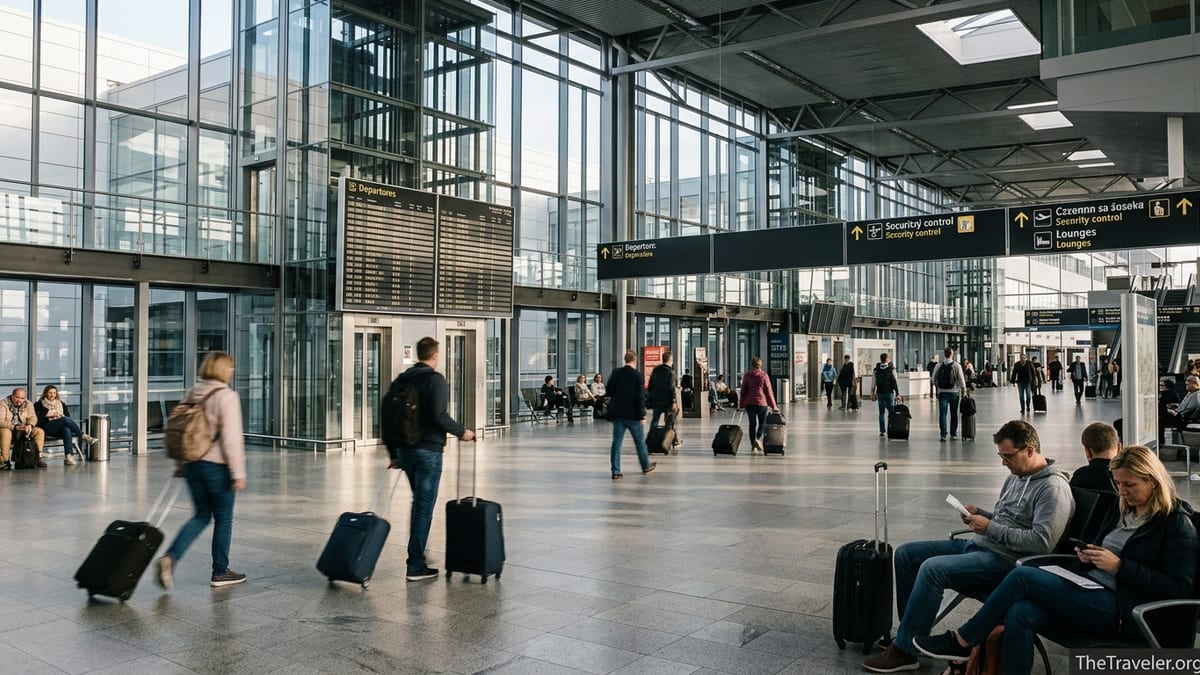
Understanding Prague Airport’s Terminals and Layout
Prague’s Vaclav Havel Airport has two main passenger terminals for regular commercial flights: Terminal 1 and Terminal 2. Terminal 1 handles departures to non-Schengen destinations such as the United Kingdom, United States, Canada, Turkey, United Arab Emirates and most long-haul flights. Terminal 2 serves flights within the Schengen Area including popular routes to cities like Paris, Amsterdam, Rome, Vienna and many domestic-style hops within Europe. Both terminals are in the same overall building complex and are connected landside by an indoor corridor, so if you arrive at the wrong terminal you can usually walk to the other in around 5 to 10 minutes.
On departure, both terminals follow a similar macro layout. You enter on the public landside level with check-in islands and information desks, then move toward security and, where applicable, passport control, and finally out to the gates and waiting areas. In Terminal 1, you will find central passport control and then individual security checkpoints located at or near each gate or cluster of gates. In Terminal 2, you typically pass through a central security checkpoint and then into a combined airside area with shops, restaurants and lounges leading out to the Schengen gate piers.
Signage is generally clear and multilingual, with Czech and English on all directional signs and flight displays. Immediately inside either terminal, large departure boards display airline names, flight numbers and check-in desk ranges. For example, a morning Prague to London Heathrow flight might show “BA859, desks 203–208,” while a Prague to Paris flight could be listed with Air France or a codeshare partner and a different island. The check-in island ranges and gate letters are consistent, so once you understand where your airline usually checks in, it becomes easy to orient yourself on future trips.
Because the two main terminals are physically close, families or groups on different flights can still meet before or after check-in. For example, one person departing on an early morning Ryanair flight to a UK airport from Terminal 1 can wait with a friend flying later on a Lufthansa or Austrian Airlines Schengen flight from Terminal 2, meeting in the public corridor between terminals where you also find fast-food outlets and seating.
When to Arrive and How Check-in Works
Prague Airport recommends arriving well in advance, especially if you need to check bags. As of mid-2026, the airport’s official guidance is to arrive at least two hours before scheduled departure if you are checking luggage, with many airlines opening check-in counters around two hours prior and closing them approximately 40 minutes before departure for standard flights. In practice, for busy holiday seasons or early morning bank departures to hubs like Frankfurt, Amsterdam or London, many frequent travelers aim for about 2.5 hours as a comfortable buffer.
At the terminal, the first step is to find your airline’s check-in desks on the large departure screens. Airlines usually occupy the same or neighboring islands during their daily waves. For example, Czech Airlines and some SkyTeam partners may share one group of counters, while low-cost carriers like Ryanair or easyJet use another. If you have already checked in online and only carry hand luggage, you can go straight toward security, although some airlines still require a quick document check at their desk for destinations that need visas or additional paperwork.
Self-service options are common. Many full-service carriers such as Lufthansa, Air France, KLM and some codeshare partners support self-service kiosks where you can print boarding passes and sometimes bag tags before using dedicated bag-drop counters. For instance, if you are flying Prague to Amsterdam on KLM with checked baggage, you may print your tag at a kiosk, attach it to your suitcase and drop it at a shorter “bag drop” line rather than queueing in the full-service line. This can save 10 to 20 minutes during peak morning hours.
If you are connecting on the same ticket via Prague, such as flying from a regional European city into Prague and then onward to a long-haul destination, your bags are often tagged through to the final destination. However, you should always confirm this at your origin check-in. When connecting from a Schengen to a non-Schengen flight in Prague, anticipate an additional passport control step after you arrive airside in Terminal 2 before reaching your non-Schengen gate area in Terminal 1, and factor that into your minimum connection time.
Security Screening, Passport Control and Fast Track
The exact order of procedures differs slightly between Terminal 1 and Terminal 2, so it helps to know what to expect. In Terminal 2, which serves Schengen flights, you normally proceed from the public departures level to centralized security screening, and once through you are in the main airside area with shops and gates. There is no routine outbound passport control for Schengen departures for EU or Schengen residents; most passengers simply walk from security directly to their gates. Non-EU nationals who are leaving the Schengen Area from another airport later in their trip may have their passport checked at that onward point instead.
In Terminal 1, serving non-Schengen destinations, the flow is typically check-in first, then central passport control, then security screening closer to the gate. The security check at many Terminal 1 gates is positioned just in front of the boarding area rather than at a single central checkpoint. In practice, this means you might not clear security until roughly 45 to 60 minutes before departure, when your gate opens. For example, on a lunchtime flight from Prague to London Stansted, passengers often form a queue in the gate area corridor while security staff begin screening for that specific flight. It is important to pay attention to gate opening times on your boarding pass and the screens, as arriving extremely early at the gate does not always mean you can clear security earlier.
Prague Airport offers a Security FastTrack service in Terminal 2, giving passengers a priority lane through the central security checkpoint. This fast track is aimed at flights to Schengen destinations and can be booked online or purchased at self-service kiosks in the departure hall. When buying online, your time slot usually covers a window around the selected time, and you scan both your boarding pass and a QR code from your FastTrack confirmation at the dedicated entrance. While exact pricing can vary, it is typically a modest surcharge per person compared with the overall cost of a European ticket, and is especially useful for early morning business flights to hubs like Frankfurt or Zurich where queues can lengthen.
For passport control, Terminal 1 includes both staffed booths and automated e-gates for eligible biometric passports. Citizens of EU and certain other countries can often use the automated gates, which can significantly speed up the process when there are long lines at staffed counters. Travelers report that during peak holiday periods, the manual passport control queue can sometimes take 20 to 40 minutes, especially when new systems such as enhanced entry-exit checks are active. Allow extra time if you are a non-EU traveler on a busy weekend or heading to long-haul destinations with larger aircraft loads.
Shops, Food and Services Before You Board
Once you are airside, both terminals offer a reasonable range of dining, shopping and services, though Prague Airport is smaller than major European hubs. In Terminal 2, after security you enter a walk-through duty free area with typical travel retail items including cosmetics, perfumes, spirits and local specialties such as Czech herbal liqueurs and Bohemian glass gifts. Prices on international brands are similar to other mid-size European airports, while local products sometimes offer better value compared with city-center tourist shops.
Food options are clustered around the central airside zone and along the piers. Expect familiar international chains alongside local-style cafés. Passengers can grab a quick espresso and sandwich from café bars near the security exit, sit down for a pizza or pasta dish at mid-range restaurants, or opt for fast food in the corridor connecting the terminals, which is accessible before security if you want to eat with someone departing from the other terminal. Prices are generally on the higher side compared with central Prague: a basic cappuccino might sit in the range of the equivalent of 3 to 4 euros, while a simple hot meal such as a pasta dish or burger is commonly around 10 to 15 euros, depending on the outlet.
Terminal 1’s airside area includes duty free shops and smaller boutiques selling electronics, travel accessories, books, magazines and last-minute souvenirs. You will also find pharmacy outlets and currency exchange counters both landside and airside. The airport’s own information materials promote online pre-order of currency at preferential rates for pick-up upon arrival at the airport, which can be more favorable than walking up to a counter unprepared shortly before boarding.
Additional services include children’s play areas, small smoking areas where permitted by local regulations, and business-focused amenities such as printing and quiet work corners in or near lounges. If you need to move between terminals airside due to a connection, you will follow a marked route and may need to pass through passport control if moving from Schengen to non-Schengen zones or the reverse. Always follow signs and staff instructions, as the exact routes can change with renovations and security updates.
Lounges and Quiet Spaces: Where to Relax
Prague Airport offers several lounges that can significantly improve your waiting time before departure. In Terminal 2, a prominent facility recently rebranded as the Visa Lounge serves Schengen departures and reflects a partnership with a major global payment network that began in mid-2026. This lounge is accessible to eligible premium cardholders and often also to passengers holding business-class tickets or certain lounge memberships. Facilities include comfortable seating, hot and cold buffet options, alcoholic and soft drinks, Wi-Fi and usually quiet corners suitable for work.
Another notable lounge in Terminal 2 is the ERSTE Premier Lounge, situated airside after security. Entry typically requires a valid boarding pass for a flight leaving from Terminal 2 along with either an eligible premium banking relationship, a business class ticket, or a paid entry fee or lounge membership such as those offered by global lounge networks. Travelers appreciate this lounge for its combination of work-friendly seating and panoramic terminal views, making it a good choice if you want to catch up on emails or simply watch aircraft movements while you wait.
Terminal 1 has its own selection of contract and airline lounges serving non-Schengen flights. These lounges often host passengers traveling in business class on long-haul services to destinations such as Dubai, Doha or Seoul, as well as eligible frequent flyers on alliance carriers. Amenities usually include light buffet dining, showers in some cases, dedicated workstations and quieter seating away from the bustle of general waiting areas. If your bank card includes lounge access as a benefit, it is worth checking specifically which Prague Airport lounges participate and whether access is landside or airside, since a few bank-sponsored lounges in some airports sit before security rather than after.
For travelers who do not have lounge access or prefer not to pay extra, there are still quieter corners to be found. In Terminal 2, seating areas near the ends of the piers tend to be calmer than the central shopping zone. Families often choose gates with nearby play areas or large windows so children can watch aircraft taxiing. Terminal 1, despite having security at individual gates, also has common seating zones in the main airside corridor where you can wait comfortably until your gate’s security checkpoint opens.
Fast Track, Special Assistance and Time-Saving Strategies
Beyond the standard Security FastTrack lane in Terminal 2, Prague Airport offers a range of paid extras and services that can simplify your departure if you value time or comfort. For example, passengers can prebook certain premium services that may include dedicated staff assistance from curb to gate, access to VIP lounges and sometimes private check-in or security arrangements. These services are typically targeted at corporate travelers, high-profile guests or those who simply prefer an escorted experience and are priced accordingly above standard fast-track options.
If you are traveling with reduced mobility, young children or heavy luggage, it is important to arrange assistance through your airline at least 48 hours before departure. Upon arrival at the airport, you will find designated meeting points where assistance staff can escort you through check-in, security and, if necessary, passport control. Using these services can significantly reduce stress, particularly in Terminal 1 where queues at passport control can sometimes spike when several long-haul flights depart around the same time.
For most travelers, the best time-saving strategy remains arriving early, checking in online where possible and understanding where bottlenecks typically form. For instance, on a Friday afternoon in summer, departure queues for popular leisure routes to southern Europe from Terminal 2 may be longer at check-in than at security, while on Monday mornings business-heavy flights to hubs like Frankfurt or Zurich may produce lines at the central security checkpoint. Booking a Security FastTrack slot for those peak times or using self-service bag drop can turn a stressful wait into a more relaxed pre-flight coffee.
Another practical tip is to factor in the journey to the airport itself. As of 2026, road works and traffic around the Aviatická intersection near the airport can occasionally slow car or taxi access during rush hour, so it is wise to add extra time if you are coming from the city by road. Public transport options, such as the frequent airport express bus from the main railway station, are generally less affected by road construction bottlenecks and can provide more predictable arrival times, especially in the morning and late afternoon peaks.
Boarding Tips: Gates, Queues and Last-minute Checks
Once everything is complete and you are near your gate, boarding at Prague Airport is usually orderly, but there are a few quirks worth knowing. In Terminal 1, you will not pass through your final security checkpoint until the gate opens for your flight. Airline staff typically announce when security for the specific flight is ready, and passengers begin moving through in groups. It is wise to have liquids and electronics ready and your boarding pass accessible so you do not hold up the line at this last stage. After security, you wait in a smaller holding area immediately next to the aircraft door or jet bridge until boarding begins.
In Terminal 2, security is already behind you, so the boarding process resembles that of many Schengen airports. Gates display boarding groups or zones depending on the airline. Low-cost carriers such as Ryanair and easyJet often create long lines early as passengers try to secure overhead bin space, while full-service carriers tend to board by groups, starting with families needing extra time, premium cabins and higher-tier frequent flyers. If you are traveling with only a small backpack and do not care about overhead bin space, it is often more comfortable to wait seated until later in the boarding process instead of standing in line.
Common reasons for boarding stress at Prague are last-minute gate changes and misunderstandings about when to be at the gate. Electronic screens in the shopping and lounge areas regularly update, so check them occasionally rather than relying solely on your printed boarding pass. For example, a flight to Madrid originally showing at Gate C may be reassigned to another gate area if operations require, and your airline’s announcements will direct you accordingly. Being within a 5-minute walk of your gate from about 40 minutes before departure is a sensible rule of thumb.
Before boarding, do one final check of travel documents, especially if you are departing the Schengen Area from Terminal 1. Make sure your passport, any required visas, and if applicable, proof of onward travel or accommodation are easy to reach. Some carriers still conduct additional document checks at the gate for destinations with stricter entry requirements. Having everything ready minimizes delays for yourself and those behind you.
The Takeaway
Departing from Prague’s Vaclav Havel Airport becomes far easier when you understand its structure and procedures. Terminal 2 focuses on Schengen flights with centralized security and a broad airside shopping area, while Terminal 1 handles non-Schengen journeys with passport control before gate-specific security. Both terminals share a connected landside space, making it simple for groups to coordinate even when flying from different zones.
Arriving roughly two hours before departure, or 2.5 hours at busier times or when checking luggage, provides a comfortable buffer for check-in, any queues at security or passport control, and a relaxed stop at a café or lounge. Using online check-in, self-service kiosks, the Security FastTrack lane in Terminal 2 and, where needed, prebooked assistance can further streamline your journey. With realistic expectations and a few strategic choices, your path from Prague city streets to your aircraft seat can be smooth, predictable and even pleasantly unhurried.
FAQ
Q1. How early should I arrive at Prague Airport before my flight?
Most travelers should plan to arrive about two hours before departure, and around 2.5 hours in busy seasons, especially if checking luggage or flying long-haul.
Q2. How do I know whether my flight leaves from Terminal 1 or Terminal 2?
Flights to non-Schengen countries such as the UK, US or Turkey typically depart from Terminal 1, while flights within the Schengen Area usually depart from Terminal 2.
Q3. Is there fast track security at Prague Airport?
Yes. Terminal 2 offers a Security FastTrack lane for Schengen departures, which you can usually book online or buy at kiosks in the departure hall for an extra fee.
Q4. Where does passport control happen when departing Prague?
For non-Schengen flights from Terminal 1, you pass passport control after check-in and before gate security. Schengen departures from Terminal 2 typically involve only security, without outbound passport stamping.
Q5. Are there good food options after security?
Both terminals offer a mix of cafés, fast food and sit-down restaurants airside. Expect airport-level pricing, with coffee around the equivalent of 3 to 4 euros and hot meals in the 10 to 15 euro range.
Q6. Which lounges can I use at Prague Airport?
Terminal 2 hosts lounges such as the Visa Lounge and ERSTE Premier Lounge, while Terminal 1 has contract and airline lounges for non-Schengen flights. Access depends on your ticket, status, bank card or paid membership.
Q7. Can I walk between Terminal 1 and Terminal 2?
Yes. The terminals are connected landside by an indoor corridor, so you can walk between them in about 5 to 10 minutes before passing through security or passport control.
Q8. How long do security and passport control usually take?
Waiting times vary with season and time of day. On normal days it may take 10 to 20 minutes, but during peak holiday periods queues at security or passport control can stretch to 30 minutes or more.
Q9. Is Prague Airport suitable for passengers with reduced mobility?
Yes. Special assistance is available and should be requested through your airline in advance. Staff can help with check-in, security, passport control and boarding as needed.
Q10. What should I do if my gate changes at the last minute?
Monitor the airport departure screens and listen for announcements. If your gate changes, follow the new signs promptly and aim to stay within a short walk of your gate from about 40 minutes before departure.