


Bangkok’s Suvarnabhumi Airport is one of Southeast Asia’s busiest hubs, and the way you travel between the terminal and the city can shape your first and last impressions of Thailand. From the fast Airport Rail Link to metered taxis, ride-hailing apps and local buses, there is a reliable option for every budget, schedule and comfort level. This guide walks through the main choices with realistic journey times, typical prices and practical examples so you can step off the plane knowing exactly what to do next.
Get the latest updates straight to your inbox!
Orientation: Understanding Suvarnabhumi’s Layout and Location
Suvarnabhumi Airport sits roughly 25 to 30 kilometers east of central Bangkok, in Samut Prakan province. In light traffic, a taxi or car can cover that distance in about 30 minutes, but in the evening rush or during heavy rain it can easily stretch to an hour or more. That is why so many travelers weigh up the Airport Rail Link against road options before they land. Having a rough mental map of the airport and where each transport option starts will save you time and confusion after a long flight.
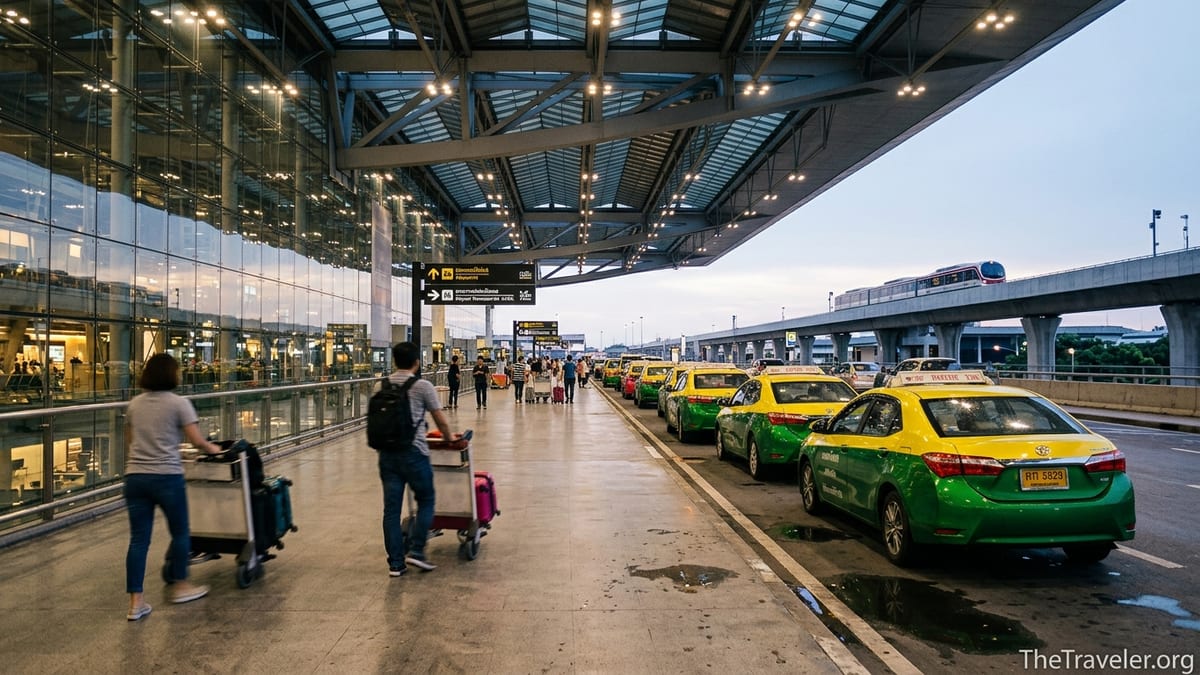
Inside the terminal, most international passengers arrive on Level 2, the Arrivals level. Metered taxis, the airport’s own limousine counters and the shuttle to the Bus & Public Transport Center are all accessed from here. The Airport Rail Link station is one level below ground, on the Basement or B floor, reached by escalators and elevators from the central atrium. Knowing that the train is downstairs and most road transport is just outside Arrivals makes it easier to decide on the move: if you are traveling light and staying near a rail station, you head down; with big suitcases or kids in tow, many people prefer to roll their bags straight out toward the taxi stands.
Another useful orientation point is where you are going in Bangkok. If your hotel is around Phaya Thai, Victory Monument, or the Siam and Asok interchange areas, the Airport Rail Link integrates smoothly with the BTS Skytrain and the MRT. If you are staying in riverside districts like Bangrak or Thonburi, or in more residential areas without rail access, a taxi or pre-booked car to the hotel door can be more sensible despite the traffic.
Remember that Suvarnabhumi is a 24-hour airport serving long-haul flights that arrive at awkward times. In the small hours of the morning, rail services stop but taxis and ride-hailing cars still operate. In the middle of the day, heat and humidity in Bangkok can be intense, so even budget-conscious travelers sometimes choose air-conditioned rail or door-to-door car options purely for comfort.
Airport Rail Link: The Fastest Route into Central Bangkok
The Airport Rail Link, often shortened to ARL, is usually the fastest and most predictable way to travel between Suvarnabhumi and the city center. Trains run between the airport station on the B floor and Phaya Thai station in central Bangkok, stopping at several intermediate stations including Lat Krabang, Hua Mak, Ramkhamhaeng, Makkasan and Ratchaprarop. Most sources report a travel time of about 25 to 30 minutes from the airport to Phaya Thai, regardless of road traffic, with trains typically departing every 10 to 15 minutes during the day.
Fares are distance-based and remain affordable even after recent adjustments. For most visitors heading to the last stops like Makkasan or Phaya Thai, the one-way fare is around 35 to 45 baht. That means a solo traveler can reach a central rail interchange for under 2 US dollars, which compares very favorably with taxis that will usually cost several hundred baht for the same journey. Tickets can be bought from vending machines or ticket counters inside the station, and since late 2025 the system also accepts contactless payment with many international bank cards, letting you tap in and out without buying a separate token.
To picture a real journey, imagine landing at 10:00 in the morning with only a cabin bag and a hotel booked near Siam. After clearing immigration you follow the signs to the Airport Rail Link, buy a token to Phaya Thai for about 45 baht and board the next train. Twenty-five minutes later you arrive at Phaya Thai, walk upstairs and transfer directly to the BTS Skytrain. From there it is only a few stops to Siam or Chit Lom, and you reach your hotel without ever touching Bangkok’s congested roads.
The main drawbacks of the Airport Rail Link are crowding and luggage. At peak commuter hours, such as 7:30 to 9:00 in the morning and 17:00 to 19:00 in the evening, trains can be very busy with local commuters. If you have multiple suitcases or are traveling with young children, navigating packed carriages and stairs between lines can be stressful. In those cases, even budget travelers often decide that paying more for a direct taxi to the hotel is worth it.
Connecting the Rail Link with BTS, MRT and Other Trains
One of the strengths of the Airport Rail Link is how it slots into Bangkok’s growing urban rail network. At the city end, Phaya Thai station connects directly to the BTS Sukhumvit Line, making it the best transfer point if you are staying in areas like Siam, Chit Lom, Nana, Asok, Phrom Phong or Thong Lo. You simply exit the ARL platform, follow signs to the BTS and purchase or top up a Rabbit Card or single-journey ticket to your final station.
Makkasan station, a few stops before Phaya Thai, sits next to Phetchaburi station on the MRT Blue Line, linked by a short indoor walkway. This is a convenient interchange if your hotel is around Asok junction, Sukhumvit Soi 11, Ratchada or the new Rama 9 business district. For example, a traveler heading to an Asok-area serviced apartment might ride the ARL to Makkasan, cross to the MRT, and then ride one stop to Sukhumvit station which connects directly with BTS Asok.
Other intermediate stations can be useful for specific neighborhoods. Hua Mak and Ramkhamhaeng stations lie close to several suburban condos and are near feeder bus and canal boat routes, which longer-stay visitors and budget travelers sometimes use. Ratchaprarop station brings you within walking distance of the Pratunam market district and some of the city’s most popular mid-range hotels. While these connections require a bit more planning and navigation, they allow many visitors to avoid sitting on congested expressways altogether.
If you plan to use rail frequently during your stay, consider how you will pay for tickets. The Airport Rail Link sells its own stored-value cards, but for short visits it is usually simpler to pay per ride using tokens or a contactless bank card where accepted. On the BTS, the Rabbit Card remains widely used in 2026, although contactless payment is being rolled out gradually. On the MRT, you can buy single-journey tokens or use compatible bank cards. Having some small banknotes and coins on arrival makes all of these transactions smoother.
Metered Taxis: Door-to-Door Convenience at a Reasonable Price
For many travelers, especially couples, families or people carrying large suitcases, the classic metered taxi from Suvarnabhumi remains the easiest choice. Official airport taxis queue on the Arrivals level, typically around Level 1 or 2 depending on the current layout and signage. The process is straightforward: you follow signs for “Public Taxi,” join the organized queue, and receive a printed slip that shows your taxi bay number and the car’s registration. This slip is important if you need to report any issue later.
Fares consist of three parts: the metered distance fare, a fixed airport surcharge of around 50 baht added at the end of the trip, and any expressway tolls if you choose to use the tollways into town. In practice, sources that monitor prices in 2025 and 2026 suggest that a typical metered taxi from Suvarnabhumi to central areas like Sukhumvit, Silom or Khao San Road usually comes to somewhere between 300 and 500 baht in normal traffic, including the surcharge and basic tolls. Some estimates that bundle in heavier toll use and peak-time delays mention totals closer to 600 or 700 baht, especially for longer cross-city journeys.
A realistic example helps put this in context. A couple arriving from Europe with two large suitcases and a smaller cabin bag hail an official taxi to a hotel in Asok. The driver uses the expressway, paying two tolls that they reimburse at around 80 to 100 baht in total. After about 40 minutes in moderate traffic, the meter shows roughly 260 baht. At the hotel, the driver adds the 50 baht airport surcharge for a final bill around 310 baht, to which many visitors add a small tip of 20 to 50 baht if service was polite and direct. The couple reach their hotel lobby without hauling luggage on and off trains and up escalators.
Although airport taxis are regulated, forum discussions in 2025 and 2026 still mention occasional scams, such as drivers refusing to use the meter or taking indirect routes. To reduce the risk, always insist politely on the meter, avoid negotiating flat fares from drivers who approach you inside the terminal, and use the official queue rather than cars parked at random outside. Checking that the meter starts at the normal base fare shortly after departure and keeping the printed slip until you arrive adds an extra layer of protection.
Ride-hailing Apps, Hotel Cars and Private Transfers
Alongside taxis and trains, ride-hailing services and private transfers have become an important part of getting to and from Suvarnabhumi. Apps like Grab and Bolt continue to operate in Bangkok in 2026, though regulations and pick-up rules at the airport can shift. Some travelers report smooth experiences arranging a Grab or Bolt as soon as they collect their luggage, while others mention issues with drivers waiting off-site or difficulty finding the agreed pickup point when the official taxi system is already well organized just outside Arrivals.
Prices for ride-hailing cars vary with demand, time of day and service type, but for a standard car to central Bangkok they are often in the same broad range as a metered taxi, roughly 300 to 500 baht when traffic and surge pricing are moderate. A traveler leaving the city around midday might call a Bolt to the airport from the Asok area and pay about 250 to 350 baht, arriving at Suvarnabhumi in 35 to 45 minutes if the expressway flows freely. The advantage is paying through the app, seeing the fare estimate upfront and tracking the car on your phone.
Many mid-range and upscale hotels offer their own airport transfer services, either using in-house cars or partnering with limousine companies. These services are usually more expensive, with one-way prices into the city often around 1,000 to 1,500 baht for a sedan and more for a van. In return, you get a driver waiting in the arrivals hall with a sign, help with luggage and a guaranteed, prearranged ride without having to navigate queues or language barriers. This can be particularly attractive for families arriving late at night or business travelers on tight schedules.
Independent private transfer companies operate in a similar price bracket. Travelers commonly pre-book these online, choosing vehicle size and specifying flight details. The driver then tracks your arrival and adjusts pickup if your flight is delayed. The key advantage is peace of mind: after a long-haul overnight flight, many people appreciate the certainty of walking straight out to a named driver and immediately heading toward the city, even if it costs more than public transport or a standard taxi.
Buses, Public Transport Center and Night-time Travel
Beyond trains and taxis, Suvarnabhumi connects to Bangkok’s extensive bus network, though this option tends to suit experienced travelers or those on very tight budgets. The main bus hub is the Suvarnabhumi Public Transport Center, located a short distance from the main terminal. A free airport shuttle bus circulates between the terminal and this center, usually departing every 10 to 15 minutes from designated stops on the arrivals level. Once there, you can board city buses to various districts or longer-distance services to provinces like Pattaya or Hua Hin.
The cheapest Bangkok city buses from the transport center can cost significantly less than the Airport Rail Link or a taxi, but they are slower and less predictable. Routes may take indirect paths through suburban neighborhoods, and drivers seldom have space to store large suitcases securely. For instance, a backpacker heading to Lat Phrao with only a small pack might take a public bus for under 50 baht, but the trip could stretch to 90 minutes or more in rush hour, compared with 40 to 50 minutes by taxi.
There are also dedicated airport bus routes that run between Suvarnabhumi and popular tourist areas. An example is the long-standing connection to the Khao San Road and Old Town area, used by budget travelers who prefer a cheap point-to-point option rather than combining rail and taxi. These buses are generally air-conditioned coach-style vehicles with luggage space. Fares are higher than regular city buses but still well below taxi costs, and journey times can range from 60 to 90 minutes depending on traffic and exact route.
At night, your options narrow but do not disappear. The Airport Rail Link operates roughly between early morning and just before midnight, with first and last train times occasionally adjusted, so very late-night arrivals after the last train must rely on taxis, ride-hailing or pre-booked cars. Conversely, very early departures before the first train commonly mean leaving the city by taxi around 3:00 or 4:00 in the morning. Night traffic is usually light, so trips that might take an hour in the evening rush often shrink to 25 or 30 minutes in the small hours.
From Bangkok Back to Suvarnabhumi: Choosing the Right Return Option
Planning your return to the airport is just as important as choosing how to arrive. A safe rule of thumb is to allow more time than you think you need, especially if you are traveling during rush hours or in the rainy season when sudden storms can slow traffic dramatically. Many airlines recommend arriving at Suvarnabhumi at least two to three hours before international departures, and adding 30 to 60 minutes for the journey into that estimate is sensible.
If you are staying near a BTS or MRT station, using the Airport Rail Link to get back to the airport is often the simplest and most reliable. For example, a traveler staying near Victory Monument might board the BTS one or two stops to Phaya Thai, transfer to the ARL and ride directly to the airport, knowing the total rail journey time is around 30 to 40 minutes door to door. Even if trains are slightly crowded at commuter times, the predictability of rail schedules gives many people peace of mind on departure day.
From areas less connected to rail, such as riverside hotels along the Chao Phraya or smaller guesthouses in old-town neighborhoods, taxis and ride-hailing cars remain the main options. It is common to ask your hotel reception to call a reputable taxi or arrange a fixed-price transfer. A family leaving a riverside resort for a mid-morning flight, for instance, might agree a 500 to 800 baht car service that picks them up directly from the hotel lobby and drives them via the expressway to the departure level, aiming to leave the hotel about three hours before their scheduled departure time.
In all cases, it helps to check local conditions on the day: if there has been heavy rain, a major event or an accident on the expressway, consider leaving even earlier or choosing rail for at least part of the journey if that is practical from your location. Bangkok residents are quick to adapt; following their lead and giving yourself a generous buffer will make your final hours in the city much less stressful.
Money, Tickets, Luggage and Safety Tips
Whichever mode of transport you choose, a few simple habits can make getting to and from Suvarnabhumi smoother. First, have some Thai baht in small denominations before you leave the arrivals hall. While ATMs and currency exchange counters are readily available at the airport, transport ticket machines and toll booths often require cash or small change. For example, even if you plan to pay a taxi fare in 1,000 baht notes, having a 100 baht note ready for expressway tolls and 20 or 50 baht for small tips speeds things up.
On the Airport Rail Link and connecting BTS or MRT lines, keep your ticket or token handy and be prepared to pass through fare gates at both ends of the journey. The system is generally straightforward, with clear English signage, but stations can become crowded at peak times. If you have heavy luggage, look for elevators instead of escalators and avoid blocking gates while you organize bags. Many travelers find it worth paying slightly more for a taxi if they have multiple large suitcases simply to avoid wrestling them through busy stations.
Safety standards on official transport services are generally good, but sensible precautions are still wise. In taxis, fasten your seatbelt and keep valuables like passports and wallets on your person rather than in the trunk. If a driver suggests a detour to a particular gem shop or tailor, decline politely and insist on going directly to your destination. On trains and buses, keep a hand on your bag in crowded areas and be cautious of anyone creating distractions in tight spaces.
Finally, consider your energy levels and comfort after a long flight. A seasoned backpacker arriving mid-afternoon with only a small rucksack may be happy to take the Airport Rail Link and two BTS transfers to reach a guesthouse in Ari. A family with two young children arriving around midnight after a 12-hour flight might quite reasonably decide that a pre-booked hotel car straight to their riverside suite is worth the extra cost. There is no single “best” way to travel between Suvarnabhumi and central Bangkok, only the option that suits your budget, schedule and state of mind on a given trip.
The Takeaway
Suvarnabhumi Airport offers a broad mix of transport options, from the fast and inexpensive Airport Rail Link to convenient metered taxis, ride-hailing apps, hotel cars and low-cost buses. The right choice depends on where you are staying, how much luggage you have, what time you arrive or depart, and how comfortable you feel navigating an unfamiliar city after a long journey. By understanding how each option works in practice, including realistic prices and travel times, you can step into Bangkok with confidence instead of uncertainty.
For short-stay visitors near the BTS and MRT, the rail link often provides the best balance of speed and cost. For families, late-night arrivals or travelers with bulky luggage, taxis, private cars or hotel transfers may make far more sense, even at a higher price. Budget travelers can still reach the city on a handful of coins by using public buses from the transport center, trading time and comfort for savings. Preparing a loose plan before you land, then adjusting based on how you feel and what you see at the airport, is the most reliable way to ensure your first and last journeys in Bangkok are as smooth as the rest of your trip.
FAQ
Q1. How long does it take to get from Suvarnabhumi Airport to central Bangkok?
In light traffic, a taxi or car usually takes about 30 minutes, but during rush hours it can stretch to an hour or more. The Airport Rail Link typically takes around 25 to 30 minutes from the airport to Phaya Thai station, largely unaffected by road congestion.
Q2. How much should I expect to pay for a taxi from Suvarnabhumi to the city?
Most travelers pay somewhere between 300 and 500 baht to reach central areas like Sukhumvit, Silom or Khao San Road, including the airport surcharge and basic expressway tolls. Very heavy traffic, longer cross-town routes or extra toll roads can push the total closer to 600 or 700 baht.
Q3. Is the Airport Rail Link safe and convenient with luggage?
The Airport Rail Link is generally safe, air-conditioned and reliable. With a single medium suitcase and a backpack it is manageable, but at peak commuter times trains can become crowded. If you are traveling with several large suitcases or small children, a taxi or private car may be more comfortable.
Q4. Which station should I use if I need to connect to BTS or MRT?
Phaya Thai station connects directly to the BTS Sukhumvit Line, ideal if you are staying near Siam, Chit Lom, Nana, Asok or further east. Makkasan station connects by walkway to Phetchaburi station on the MRT Blue Line, useful for destinations around Asok, Ratchada and Rama 9.
Q5. Are ride-hailing apps like Grab or Bolt allowed at Suvarnabhumi?
Ride-hailing apps operate in Bangkok and many travelers use them to reach or leave the airport. However, pickup rules and waiting areas can change, and official airport taxis are usually easier to find directly outside Arrivals. It is sensible to check your app on arrival and compare price and wait time with the taxi queue.
Q6. What is the cheapest way to get from Suvarnabhumi into Bangkok?
The lowest-cost options are regular public buses from the Suvarnabhumi Public Transport Center, where fares can be well under 50 baht for some city routes. These buses are slow, can be crowded and are not ideal for large luggage, so they are best suited to experienced or very budget-conscious travelers.
Q7. How early should I leave Bangkok for a flight from Suvarnabhumi?
For international flights, it is wise to be at the airport two to three hours before departure and to allow at least 30 to 60 minutes for the journey from most central neighborhoods. In heavy rain, during peak commute times or if you are traveling from more distant suburbs, leaving even earlier provides a useful safety margin.
Q8. Can I buy Airport Rail Link tickets with a contactless bank card?
The Airport Rail Link has been rolling out contactless payment and many stations now allow you to tap in and out with compatible Visa, Mastercard, JCB or UnionPay cards. Ticket machines and counters also sell single-journey tokens, which remain a simple option if you prefer to pay in cash.
Q9. Is tipping expected for taxi and car drivers?
Tipping is not mandatory in Thailand, but it is common to round up the fare or add a small amount, such as 20 to 50 baht, if the driver is polite, uses the meter and takes a direct route. For hotel cars and private transfers, service charges may already be included, though many travelers still offer a modest tip for good service.
Q10. What should I do if I think a taxi driver is overcharging or scamming me?
If a driver refuses to use the meter or suggests a suspiciously high flat fare, it is usually best to step out and choose another taxi from the official queue. Keep the printed taxi slip from the airport and note the car’s registration number. If you feel you have been seriously overcharged or mistreated, you can report the incident to airport authorities or your hotel, who can help you contact the relevant transport officials.