


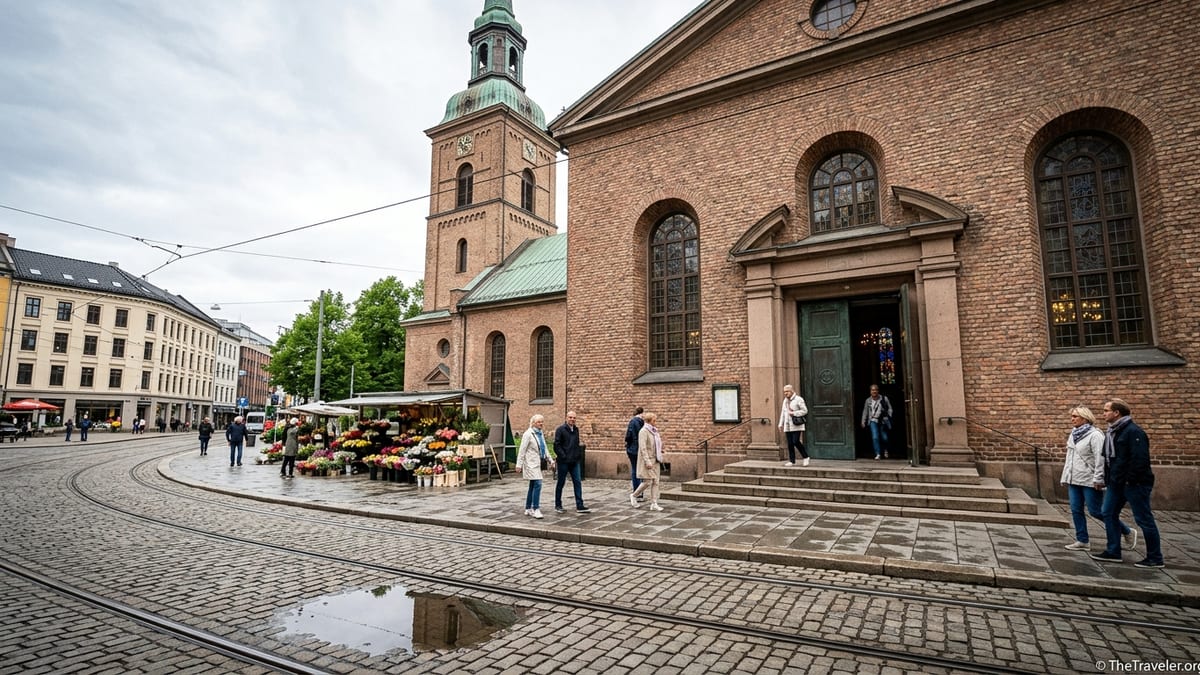
Oslo Cathedral is easy to pass by on a busy day in Norway’s capital. Its modest Baroque tower and brick façade can blend into the streets around Karl Johans gate, and many visitors step inside only for a few minutes. Yet this is one of Oslo’s richest interiors, packed with stories, hidden symbols, and artworks that reward anyone who slows down and looks more closely. This guide explains how to visit Oslo Cathedral and, just as importantly, how to really see it.
Get the latest updates straight to your inbox!
Planning Your Visit to Oslo Cathedral
Oslo Cathedral, known in Norwegian as Oslo domkirke, stands at the top of Karl Johans gate, a few minutes’ walk from Oslo Central Station. You will usually see its square tower rising above the trees and trams in Stortorvet square. The cathedral is an active parish church as well as the main church for the Diocese of Oslo, so access is shaped around services and events rather than a pure tourist schedule. Expect it to be open most days in the late morning and afternoon, but with occasional closures for weddings, funerals, and concerts. If you are in Oslo in summer, you are likely to find doors open more frequently and for longer hours than in the winter season.
Entry to the main space of Oslo Cathedral is free, which makes it an easy stop even if you are traveling on a tight Scandinavian budget. You may occasionally find a small suggested donation box or card terminal near the entrance to support maintenance and music programs, and it is customary to give a little if you linger. Guided tours in English are sometimes offered in peak months through local tour companies or as part of broader city walking tours, typically costing the equivalent of 25 to 40 US dollars per person, but most visitors simply explore independently. Plan at least 30 to 45 minutes if you want to notice the hidden details rather than just walking up the central aisle and leaving.
Because this is a working church, it is wise to check for service times posted outside the main door before entering. The main Sunday service is usually at 11:00, and there are often weekday services or organ recitals. You are welcome to attend, but photographing and walking around for sightseeing should wait until after the service has finished. If you prefer a quieter visit to focus on the artwork, aim for late morning on a weekday, when the building is often calm, or late afternoon outside of major religious holidays.
Oslo’s weather is changeable, even in summer, and the cathedral offers both shelter and a chance to adjust to the slower rhythm of the city. In winter, you will likely step in from snow or icy rain into a warm, candlelit nave. In July and August, it can be a cool, dim refuge from bright Nordic sunlight. Either way, give your eyes a moment to adjust at the door before you start looking for details; the subtler carvings and inscriptions will reveal themselves once you are not rushing.
Respectful Etiquette and Practical Tips Inside
Oslo Cathedral is informal by European cathedral standards, but it is still a sacred space. Dress codes are relaxed, and everyday travel clothes are fine, but it is considerate to avoid beachwear, loud slogans, and uncovered shoulders during services. Locals often sit quietly for a few minutes, even if they are only dropping in on their lunch break. If you are wearing a backpack, carry it in your hand or at least keep it close to avoid bumping benches or other visitors as you move around the narrow aisles.
Photography is generally permitted for personal use, and many visitors take pictures of the ceiling paintings, altar, and stained glass. Flash, however, is discouraged because it can disturb worship and gradually damage delicate surfaces. A modern smartphone is more than enough to capture details, especially if you increase exposure manually and stand still for a second or two. If a concert, rehearsal, or service is in progress when you enter, put cameras away and take a seat toward the back or sides until it is clearly appropriate to walk around again.
Sound carries very clearly under the painted wooden ceiling, so keep voices low. If you are traveling with children, it helps to turn the visit into a game of spotting symbols in the art so that they whisper instead of shout. Many families challenge children to find the sun with the words “Gloria in excelsis Deo” in the central ceiling panel or to count angels in the stained glass. This keeps them engaged while respecting the contemplative atmosphere.
The cathedral does not operate like a museum with a ticket desk and cloakroom, so plan to keep your belongings with you. There are public toilets in nearby shopping arcades and cafes rather than inside the church itself. If you are arriving directly from Oslo Airport with luggage, use lockers at Oslo Central Station and walk the short distance to the cathedral with only a small day bag. This makes it easier to move up into the choir, around the pulpit, and along the side aisles without blocking others.
Understanding the History Behind What You See
Oslo Cathedral was consecrated in 1697, replacing an older medieval church that once stood closer to the Akershus fortress. It reflects a period when the city, then known as Christiania, was rebuilding after devastating fires and asserting itself as a Baroque capital under Danish-Norwegian rule. The brick exterior and tower, while not as towering as Gothic cathedrals in other European countries, were designed to convey stability and royal presence for a growing trading city by the Oslofjord.
The building has changed appearance several times. In the 19th century, it was refitted in a neo-Gothic style that added pointed arches and Victorian flourishes inside. Later restorations stripped much of that away to recover its original Baroque character, returning the massive carved altar, pulpit, and box pews to prominence. During a major renovation in the 2000s, the cathedral closed for several years and reopened with carefully restored artwork, updated lighting, and modern technical systems hidden behind the old surfaces, so what you see today is a mix of centuries-old wood and carefully integrated contemporary solutions.
Knowing this layered history changes how you notice details. The Baroque woodwork around the altar and pulpit dates from the very early 1700s and shows a mix of Dutch and Norwegian craftsmanship, with swirling acanthus leaves and expressive biblical figures carved in oak. Higher up, the ceiling paintings and some of the stained-glass windows are 20th-century additions. The result is that when you look up, you are seeing the theology and aesthetics of the 1930s and 1940s, while when you look toward the altar, you are looking directly at art shaped by the politics and piety of the late 17th century.
This blend makes Oslo Cathedral less overwhelming than many larger European churches, but in some ways more approachable. You are not walking into a museum frozen in a single medieval moment; you are stepping into a space that has continuously adapted to new generations. As you explore, try to think about who would have been sitting in each pew, looking at each artwork, in different centuries and what might have mattered to them in that time.
Ceiling Frescoes: How to Read the Painted Sky
The ceiling of Oslo Cathedral is one of its greatest treasures. Covering around 1,500 square meters, this painted wooden vault is the largest of its kind in Norway. The artist Hugo Lous Mohr worked on the fresco-style paintings from the mid-1930s until around 1950, turning the entire ceiling into a visual meditation on key lines from the Christian Creed. If you walk in and only see an overall swirl of color, pause in the center aisle and let the forms resolve; the more you look, the more scenes you recognize.
Start at the crossing, directly under the central dome where the nave and transept meet. Here, a radiant sun bursts across the ceiling with the Latin words “Gloria in excelsis Deo,” meaning “Glory to God in the highest.” The rays stretch into surrounding panels filled with figures, symbols, and abstracted clouds. This central sun becomes a kind of compass for your visit. Many travelers stand here, tilt their heads back, and trace the rays with their eyes to understand how the rest of the ceiling is organized.
As you move along the nave toward the altar, you can pick out different sections that correspond loosely to lines of Christian belief, from creation to resurrection. Some figures are easily recognisable, like Christ, angels, and prophets. Others are more symbolic, with rich blues and golds suggesting heaven and earthly greens and browns representing human history. Because the paintings sit on a wooden barrel vault rather than a stone Gothic ceiling, the images curve gently overhead, creating a feeling of shelter rather than dizzying height. In the late afternoon, when sunlight filters through the side windows, the colors soften and you can often see brushwork that is invisible at midday.
If you are interested in art technique, look for how Mohr adapted traditional fresco ideas to a wooden surface. The painted fields are not pure Renaissance illusion, but a modern, slightly simplified style influenced by early 20th-century church art in Scandinavia. Many visitors compare the mood more to mural cycles in Nordic town halls than to Italian chapels. Standing still in the nave for five minutes, you can watch how other visitors react: some sit in a pew and lean back, while others walk slowly with phones pointed straight up, trying not to bump into each other as they capture the painted sky.
Altarpiece, Pulpit, and Carved Details Up Close
Where many visitors simply glance toward the altar from the back, the real discoveries begin when you walk right up into the chancel. The towering Baroque altarpiece, carved around 1699 to 1700 by a combination of Dutch-trained and Norwegian craftsmen, is a dense forest of biblical scenes, angels, scrolls, and acanthus leaves. From a distance, it reads as a single golden wall. Up close, it becomes a series of framed stories stacked vertically, with the crucifixion and resurrection scenes anchoring the composition.
Stand slightly off-center to the left or right, rather than squarely in front, to see the depth of the carving. The figures project strongly from the background, creating deep shadows that change with the light. Many travelers miss the small gestures and facial expressions of minor figures like soldiers and onlookers at the foot of the cross. If you have a zoom lens or a phone with a good telephoto mode, try focusing on a single face or hand instead of the whole structure. You will notice how the woodcarvers added swirling hair, flowing drapery, and tiny decorative motifs that speak of both Baroque drama and local folk carving traditions.
The pulpit, on the left as you face the altar, is carved in the same Baroque style and almost as intricate. Its supporting post and staircase are covered in ornament, and the sounding board above, shaped like a small canopy, is richly detailed. Imagine the 18th-century pastors preaching to a packed congregation of merchants and craftspeople, their voices amplified by this carefully designed acoustic structure. During your visit, you may see a modern pastor or a reader using the pulpit in much the same way, a striking continuity between past and present.
Do not forget to look along the ends of the pews and the gallery fronts. These areas carry simpler carved motifs that many guidebooks barely mention. In some places you can see the initials of donors or small shields, a reminder that church furnishings once carried social status along with devotional meaning. On a quiet afternoon, you can walk slowly along the side aisles and run your fingers lightly over the smooth, time-worn wood, feeling centuries of use in the softened edges and polished surfaces.
Stained Glass and Subtle Light Effects
The stained glass in Oslo Cathedral is less immediately overwhelming than in some Gothic churches, but it is rich in symbolism and history. The seven main stained-glass windows in the choir are works by Emanuel Vigeland, installed in the early 20th century. They bring strong vertical bands of color into a space otherwise dominated by dark wood and painted ceiling, and their themes weave together scenes from the life of Christ with broader ideas of light overcoming darkness. One well-known window depicts Jesus driving the moneychangers from the temple, rendered in intense reds and blues that shimmer on the floor on bright mornings.
Because the choir is slightly raised and often partially roped off during services, visitors sometimes think they cannot get close to the stained glass. In practice, you can usually walk up to the front steps of the chancel when no worship is in progress and stand to the side to look closely. The glass is framed by neo-Gothic stonework from earlier renovations, so you are literally seeing layers of history in a single view: Baroque altar in front, 19th-century tracery around, and early 20th-century glass within. Look for the way Vigeland’s figures are both idealized and distinctly modern, with strong lines and a certain austerity compared to medieval saints in other European cathedrals.
In the transept, you will notice a different style of glazing. Sixteen windows in shades of grey, known as grisaille, are the work of artist Borgar Hauglid in the 1950s. At first they seem almost plain compared with the colorful choir windows, but they perform a subtle function. By admitting a softer, more controlled light, they keep the painted wooden ceiling and Baroque woodwork from being washed out by direct sun. Stand halfway down the nave and look toward one transept, then the other; you will see how this grey glass shapes atmosphere, creating a gentle, even daylight ideal for contemplation and for preserving delicate art.
If you visit on a clear winter day with low sun, try returning to the cathedral in the late afternoon after an earlier morning look. In the morning, light slants across the nave and spotlights individual details like the pulpit or specific ceiling scenes. By late day, the light filters more directly through the stained glass and pools in soft patches of color on the stone and wood. Observant travelers sometimes sit quietly and watch how long it takes a patch of colored light from a choir window to move across the floor or climb a pillar, a slow-motion reminder of time passing in a building that has already seen more than three centuries.
Side Chapels, Doors, and Often-Missed Corners
Beyond the obvious focal points, Oslo Cathedral contains a series of quieter spaces and details that many visitors overlook. Along the side aisles, small chapels and memorial corners house modern artworks, candles, and plaques to notable Norwegians. Some of these commemorate national events, including the role the cathedral has played in royal weddings and funerals or gatherings of national mourning. Pause in these chapels not just to take photographs but to read names and dates; they reveal how closely the cathedral is tied to Norway’s political and social history.
At the western end, do not rush out the moment you reach the door. Turn around and look up at the organ gallery and the back wall. The cathedral’s main pipe organ, rebuilt and expanded in the late 20th century, towers above the entrance. When you stand under it, you can often feel the vibration of low notes during rehearsals long before you register the sound clearly. If you are in Oslo on a weekday afternoon, you may stumble into a free or low-cost organ recital and find the nave filling with locals on their way home from work.
Outside, walk around to examine the main portal doors executed in bronze by Dagfin Werenskiold in the 1930s. These doors, with their reliefs and figures, are artworks in their own right and are sometimes missed by visitors who enter by a side door from the bustling square. Run your eyes, not your hands, over the sculpted scenes; oils from skin can gradually damage bronze surfaces. As you stand there, you may hear trams rattling by and conversations from outdoor cafes, a vivid juxtaposition of sacred art and everyday city life.
Another often-missed element is the series of small details connected to the cathedral’s role as a stop on Norway’s historic pilgrimage routes. The building is a starting point or waymark for paths that lead north toward Nidaros Cathedral in Trondheim. Look for subtle wayfinding symbols and information panels that mention pilgrims. For travelers interested in slow tourism, it is entirely possible to combine a short urban visit to Oslo Cathedral with a half-day walk on one of the marked regional pilgrimage stretches, returning by local train or bus in the evening.
Combining the Cathedral with the Surrounding Neighborhood
Oslo Cathedral sits in one of the most walkable parts of the city, so it is easy to weave a visit into a broader day of sightseeing. Many travelers start at Oslo Central Station, walk up Karl Johans gate past shops and street musicians, pause at the cathedral, then continue toward the Parliament building and the Royal Palace. On Saturdays, Stortorvet square in front of the cathedral often hosts a flower market, and the contrast between bright bouquets, tram lines, and the church tower behind creates some of the most characteristic photos of central Oslo.
If you are interested in art and want to deepen your understanding of Emanuel Vigeland after seeing his stained glass in the choir, consider a trip to the Emanuel Vigeland Museum in a residential area of Oslo. There you can experience his monumental fresco “Vita” in an intimate, echoing mausoleum space and then compare its themes and colors with his more restrained church glass. The museum has limited opening hours, often centered on weekend afternoons, and a modest admission fee comparable to other small Oslo museums, so it is wise to check times in advance and build your day around them.
Food and coffee breaks are straightforward to combine with a cathedral stop. Around the square and along the nearby streets, you will find local bakeries, coffee bars, and casual restaurants where you can reflect on what you have seen. Prices for a cappuccino often hover around the equivalent of 4 to 5 US dollars, so budget accordingly, and consider trying a cinnamon bun or cardamom bun, local favorites that pair well with a mid-morning cathedral visit. In winter, many travelers enjoy slipping from the cold streets into the candlelit interior, then out again to a nearby café with steamed-up windows.
For those exploring Oslo on a 24-hour layover, the cathedral is an ideal anchor point. You could land in the morning, drop bags at the central station, walk to the cathedral and spend an hour exploring, then continue on to the harborfront and the newer cultural landmarks like the Opera House or the MUNCH museum. In this way, your short stay combines Oslo’s historic spiritual heart with its contemporary waterfront architecture.
The Takeaway
Visiting Oslo Cathedral is less about ticking off a major European monument and more about discovering a layered, lived-in space at the center of Norwegian life. You will not find the towering vaults of a Gothic giant or long ticket lines; instead, you will encounter a Baroque interior shaped by local craftsmanship, a vast modern painted ceiling that turns theology into color, and stained glass that subtly transforms Nordic light. With entry free of charge and opening hours that fit easily into a city stroll, it offers exceptional value for travelers who are willing to pause and look closely.
The key to unlocking the cathedral’s hidden details and artwork is time and attention. Stand under the sunburst ceiling and read the Latin inscription. Walk right up to the altarpiece and pick out individual faces. Notice how Emanuel Vigeland’s choir windows and Borgar Hauglid’s grey transept glass choreograph the daylight. Step into side chapels and look at plaques and candles that connect the building to personal and national stories. By moving slowly, you begin to see Oslo Cathedral not just as a backdrop for royal ceremonies but as a place where art, history, and everyday faith continue to meet.
When you leave, do not forget to turn back in Stortorvet square and look once more at the tower and portal. Knowing what lies inside, the exterior will no longer feel anonymous. You may hear the organ through a cracked window, catch the glow of stained glass at dusk, or see a wedding party emerging onto the cobblestones. In that moment, the cathedral stops being just another church on your itinerary and becomes a landmark you genuinely know.
FAQ
Q1. Do I need a ticket to visit Oslo Cathedral?
Entry to Oslo Cathedral is generally free, with no ticket required, though small donations are appreciated and special concerts may charge an admission fee.
Q2. What are the usual opening hours for Oslo Cathedral?
The cathedral is typically open daily from late morning into the afternoon, with extended hours in summer and occasional closures for services, weddings, and funerals.
Q3. How long should I plan to spend inside the cathedral?
Most visitors spend 30 to 45 minutes, but if you want to study the ceiling paintings, stained glass, and carvings in detail, allow up to an hour.
Q4. Is photography allowed inside Oslo Cathedral?
Private photography is usually allowed, provided you turn off flash, move quietly, and refrain from taking photos during services or close to people who are praying.
Q5. Can I attend a service at Oslo Cathedral as a visitor?
Yes, visitors are welcome at services, including the main Sunday worship, as long as they join respectfully, follow the liturgy as they can, and avoid sightseeing during the service.
Q6. Are guided tours available inside Oslo Cathedral?
Formal guided tours are occasionally offered through local tour companies or group bookings, but many travelers explore independently using basic information provided on-site.
Q7. Is Oslo Cathedral suitable for children?
Yes, children are welcome, and many families keep them engaged by having them quietly search for details such as angels, the sunburst ceiling, or colorful stained-glass figures.
Q8. What is the best time of day to see the artwork and stained glass?
Late morning offers good natural light for the ceiling and altar, while late afternoon can create especially beautiful effects as sunlight passes through the choir windows.
Q9. Is there a dress code for visiting Oslo Cathedral?
There is no strict dress code, but modest, respectful clothing is recommended, especially if you plan to attend a service or visit during a religious holiday.
Q10. How can I combine a visit to Oslo Cathedral with other nearby sights?
You can easily pair the cathedral with a walk along Karl Johans gate to the Parliament and Royal Palace, or continue onward to the harborfront and Oslo’s modern museums.