


Oslo Cathedral sits right on the city’s main axis, close to Karl Johans gate and the central station, so most visitors will walk past it at some point. The question is whether it is worth stepping inside when you only have a day or two in the Norwegian capital. The answer depends on what you look for in a historic church, but many travelers are surprised by how much is packed into this relatively modest baroque building: painted ceilings, modern stained glass, royal history and a lived-in city church atmosphere that feels very different from museum-like cathedrals elsewhere in Europe.
Get the latest updates straight to your inbox!
First Impressions: Size, Location and Atmosphere
Most travelers first encounter Oslo Cathedral almost by accident. The church rises over Stortorvet square, a few minutes’ walk from Oslo Central Station and just off the busy Karl Johans gate. From the outside it is smaller and more restrained than the Gothic giants many people associate with the word “cathedral.” Reviews often mention that visitors expecting something on the scale of Notre Dame or Cologne at first think they might skip it, until they step through the doors and realize how much detail is hidden inside.
The square in front of the cathedral can feel lively. Flower stalls, trams and commuters give the entrance a day-to-day, local feel rather than a staged tourist zone. In summer, people sit on the low walls around the church, children run through the square, and you may hear street musicians nearby. That everyday context shapes how many travelers experience the cathedral: not as a remote monument, but as a working city church in the middle of normal Oslo life.
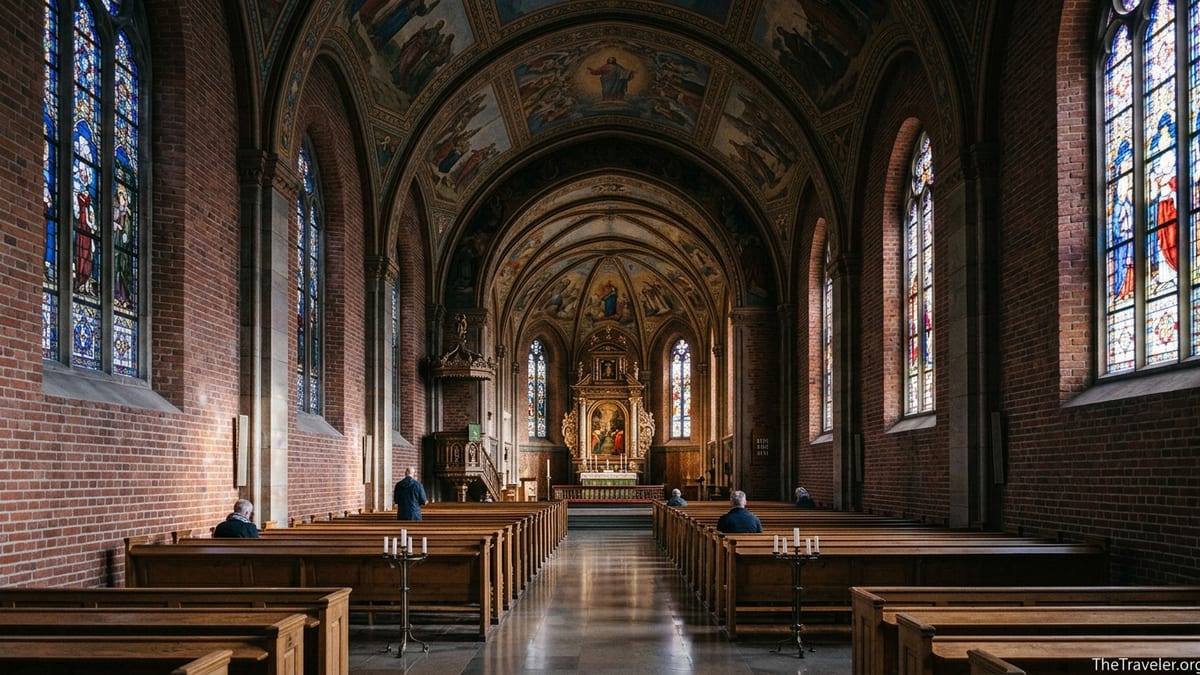
As soon as you enter, the noise from the square drops away. The interior feels warm and intimate, with heavy wooden pews, soft light on brick walls and a painted ceiling that immediately draws the eye upward. Even in the middle of the afternoon, it is usually easy to find a quiet corner to sit, which many visitors appreciate in an otherwise busy downtown.
Because entry is typically free and there are no ticket lines or security queues, the transition from bustling street to quiet nave is quick. That simplicity is one of the things travelers regularly highlight: you can duck in for ten minutes between sights or stay longer without worrying about timed slots or tour group schedules.
The Ceiling That Surprises Almost Everyone
The feature visitors mention most often is the painted ceiling vaulting above the nave. Completed in the mid-20th century but styled to harmonize with the baroque interior, it covers the central space with swirling scenes from biblical stories, angels and symbolic motifs. Many people walking in with modest expectations find themselves standing in the central aisle for several minutes, just craning their necks.
The paintings cover the entire length of the nave rather than being confined to a single panel. Scenes unfold from one bay to the next, which encourages a slow walk down the central aisle as you look up. Travelers who have seen the baroque churches of southern Europe often comment that they did not expect something similar in minimalist Norway. Here, though, the palette is more restrained, with earthy and muted colors that keep the mood contemplative rather than overwhelming.
In practical terms, the ceiling is easiest to appreciate from the middle third of the nave. If you stand just behind the center of the church and look back toward the organ loft, you get a strong sense of depth as the painted arches recede toward the entrance. Amateur photographers often try to capture this view handheld at a wide focal length, though it can be challenging without a tripod in the low interior light.
If you are short on time and wondering whether to step inside at all, the ceiling alone makes a quick five or ten minute visit worthwhile. Even travelers who usually focus on modern Oslo sights like the Opera House or the MUNCH museum often name this painted vault as an unexpected highlight.
Stained Glass, Altarpiece and Other Artistic Details
After the ceiling, the second thing most visitors notice is the stained glass. Several of the windows are by Norwegian artist Emanuel Vigeland, whose work combines traditional Christian symbolism with early 20th century color and composition. The result is vivid but not garish, with cool blues and deep reds that wash the brick and wood in colored light on sunny days. Many travelers time their visit for late morning or early afternoon so the sun can filter through at a low angle.
The main altarpiece, depicting the Last Supper, draws art and history enthusiasts. Its history involves periods when it was removed from the cathedral and later brought back, something that interpretive signs inside sometimes note in Norwegian and English. Similar to altarpieces in other Nordic churches, it manages to be both ornate and somewhat restrained, with carved figures and gilded details that catch the light from candles and side windows.
Do not rush past the pulpit and baptismal font, both examples of carved baroque woodwork that stand out precisely because the rest of the interior is relatively spare. Visitors who like to notice craftsmanship often linger over the small details here: the scrollwork around the edges, the expressive faces on carved figures and the way the dark wood contrasts with the light plaster and brick.
If you are used to cathedrals where every surface is covered with sculpture, Oslo Cathedral might seem simple at first. But many travelers report that the few artistic focal points here feel more readable and approachable, particularly when you have only a short time and want to leave with a clear impression of what you saw rather than a blur of ornate decoration.
Royal Ceremonies and Moments of National History
One reason many travelers feel drawn inside is the cathedral’s role in modern Norwegian history. As the main church of the Diocese of Oslo and a kind of national church, it has hosted royal weddings, funerals and services of remembrance. The Norwegian royal family often uses it for significant national occasions, which means you are walking into a space that Norwegians associate with televised state events as well as weekly worship.
After the 2011 attacks in Oslo and at Utøya, Oslo Cathedral became a focal point for mourning and solidarity. The square outside filled with flowers and candles, and many images broadcast around the world showed Norwegians gathering here in silence. Some visitors who remember those news images mention that they feel a particular weight when they step inside, knowing the building has held such recent national grief and reflection.
Inside, you may see plaques and memorial elements referencing different turning points in Norwegian history. These are not always prominently labeled in English, but visitors who take the time to walk the side aisles and chapels usually notice inscriptions, coats of arms and dedications that make clear this is a place where church, monarchy and civic life intersect.
For travelers interested in how Norway balances modern secular society with longstanding institutions, the cathedral offers a compact case study. You might attend a weekday service where a small congregation gathers under the same ceiling that appears on national television whenever there is a royal ceremony, and then step back into a city that otherwise feels relaxed and informal.
Practical Visitor Experience: Opening Hours, Costs and Crowds
One of the major practical reasons Oslo Cathedral is worth considering is how easy it is to visit. As of mid-2026, entry is typically free, and the building functions primarily as an active church rather than a ticketed museum. On many weekdays it is open through the middle of the day, commonly around late morning to late afternoon, with extended hours on some days for evening services or events. Hours can shift for holidays, concerts or private ceremonies, so it is sensible to check the cathedral’s official page or local tourist information shortly before you go.
The lack of an admission fee makes the cathedral an attractive stop if you are traveling on a budget in an otherwise expensive city. Travelers often combine a brief visit with a walk along Karl Johans gate, a coffee at a nearby cafe such as the long-running Cafe Cathedral across the square, and perhaps a later visit to bigger-ticket attractions like the National Museum or MUNCH.
In terms of crowds, midweek afternoons are usually comfortable, with a steady trickle of visitors but plenty of room to move and sit. Summer weekends, especially when cruise ships are in port, can be busier, and you may find organized groups near the front of the nave. Even then, the side aisles and back pews tend to remain quiet. During services, visitors are either asked to sit respectfully at the back or wait until the service has finished, depending on the occasion.
An average visit lasts 30 to 60 minutes if you take time to study the art, sit for a few minutes and possibly listen to a rehearsal or organ piece. Some travelers drop in for just ten minutes between shopping and sightseeing, while others linger longer to read informational leaflets or light a candle. Because the cathedral is steps from tram stops and only a short walk from Oslo Central Station, it also works well as a last stop before heading to the airport train.
Organ, Music and the Sound of the Space
Another aspect travelers notice is the sound environment. Oslo Cathedral has a sizable organ above the main entrance, and rehearsals or short recitals sometimes take place during visiting hours. Visitors frequently describe entering to find the nave filled with organ music, which immediately transforms a quick architectural visit into a more emotional experience.
Unlike some large cathedrals that rely heavily on ticketed concerts, Oslo Cathedral’s musical life is woven into regular worship and community events. If you glance at the noticeboards near the entrance, you may see posters for evening concerts, choral performances or organ recitals scheduled during your stay. Tickets for these events are usually reasonably priced compared with large concert venues in the city and give you the chance to experience the interior in low, atmospheric lighting.
The acoustics are clear rather than overly echoing, which suits both spoken liturgy and music. Travelers who attend a Sunday service often comment on how easy it is to understand readings and sermons even without speaking Norwegian, simply by following the rhythm of the liturgy and the responses of the congregation. Choirs sound present and immediate, with the painted ceiling and brick walls helping to diffuse sound evenly rather than producing a long, confusing reverberation.
Even if you are not able to attend a formal concert, it is not uncommon to hear someone practicing quietly on the organ or rehearsing a vocal solo while you wander the aisles. Many visitors note that these unscripted musical moments are among their strongest memories of the cathedral, especially on cold or rainy days when the interior feels like a warm refuge.
What Travelers Notice Most Compared With Other Oslo Churches
Oslo has several notable churches, from the brick bulk of Uranienborg Church behind the Royal Palace to the more modern churches scattered through residential districts. For travelers who visit more than one, Oslo Cathedral often stands out for its combination of historical age, central location and active, lived-in feel. It is one of the few places where you can sense both baroque heritage and contemporary national life in a single glance.
Compared with the stave church at the Norwegian Museum of Cultural History or the medieval ruins in Oslo’s older districts, the cathedral feels less like a preserved artifact and more like a functioning institution. Visitors who have toured many European cathedrals sometimes remark that Oslo’s version is more modest in scale but high in atmosphere, making it easier to connect emotionally even if you are only in the city for a short time.
Many travelers who rate Oslo as a “modern architecture” city discover that a stop at the cathedral rounds out their impression. After visiting the sharply angular Opera House, the glassy Barcode development and the waterfront library, stepping into this brick baroque interior gives a sense of continuity. Locals sometimes emphasize that Oslo’s story is precisely the mix of old and new buildings, and the cathedral plays a central role in that narrative.
For repeat visitors, Oslo Cathedral often becomes a kind of anchor point. People describe stopping in briefly at the start or end of each trip: to sit for a few minutes, listen to the creak of pews and low hum of voices, and notice small changes like new flower arrangements or temporary art installations. That kind of repeat attachment suggests that, for many, the cathedral offers more than a one-time sightseeing box to tick.
Is It Worth Your Time? Who Will Appreciate Oslo Cathedral Most
Whether Oslo Cathedral is “worth it” depends on your interests and how long you will be in the city. If you only have a half-day layover and are mainly interested in views and outdoor scenery, you might prioritize the Opera House roof, the harbor promenade and a quick tram ride to a viewpoint. The cathedral then becomes a pleasant but optional add-on if you happen to pass by and have ten spare minutes.
If, however, you appreciate religious architecture, European history or quiet interior spaces, Oslo Cathedral quickly moves into the “must see” category. Art lovers drawn by Emanuel Vigeland’s stained glass and the painted ceiling, music fans curious about Nordic sacred music, and travelers who like to understand how modern nations commemorate key events will all find clear points of interest inside.
The fact that it is free, centrally located and usually uncrowded during off-peak hours removes many of the barriers that can make famous cathedrals feel like a chore. You do not have to commit a whole morning, and you will not need to budget for an expensive ticket package. Even on a tightly planned two-day itinerary, it is very manageable to step inside between shopping along Karl Johans gate and heading to the waterfront or museums.
For families, the modest size is actually an advantage. Children are less likely to become overwhelmed or restless, and it is easy to set a simple challenge, such as counting the angels on the ceiling paintings or finding specific colors in the stained glass. Couples often appreciate the chance to sit together in a quiet pew after a busy day, while solo travelers value the contemplative atmosphere and the sense of sharing a space with locals rather than only fellow tourists.
The Takeaway
Oslo Cathedral will not impress with sheer size or a forest of Gothic spires, and that is precisely what many visitors come to value. Its strengths are subtler: an unexpectedly rich painted ceiling, stained glass that fills the brick interior with soft color, a history deeply woven into modern Norwegian national life and a calm atmosphere just steps from the busiest streets in the city center.
Because entry is generally free and visiting does not require advance planning, it is easy to fold the cathedral into almost any Oslo itinerary. Whether you spend ten minutes taking in the ceiling or an hour moving slowly from chapel to chapel, listening to the organ and tracing the outlines of royal ceremonies and public mourning, you will leave with a clearer sense of the city than you might gain from modern architecture alone.
If your idea of worthwhile travel includes not just seeing major landmarks but also understanding how a city breathes, worships and remembers, then yes, Oslo Cathedral is very much worth visiting. It is the rare attraction that can enrich both a tightly scheduled weekend and an unhurried weeklong stay.
FAQ
Q1. Is Oslo Cathedral free to visit?
Yes, entry to Oslo Cathedral is typically free, although donations are welcomed and special concerts or events may require a paid ticket.
Q2. How much time should I plan for a visit?
Most visitors spend 30 to 60 minutes inside, enough to appreciate the ceiling, stained glass, altarpiece and a few quiet moments in a pew.
Q3. When is the best time of day to go?
Late morning or early afternoon on weekdays usually offers the best combination of natural light through the stained glass and relatively light crowds.
Q4. Can I take photos inside Oslo Cathedral?
Casual photography without flash is generally tolerated when no services are in progress, but it is wise to check any posted signs and remain discreet and respectful.
Q5. Are there guided tours available?
Organized guided tours are not constant but are sometimes offered through local tour companies or by arrangement; most visitors explore independently using onsite information.
Q6. Is the cathedral accessible for wheelchair users?
The main entrance area includes steps, but there is usually an accessible entrance and level flooring inside; accessibility can vary slightly during events, so checking ahead is recommended.
Q7. Can I attend a service or just visit as a tourist?
Yes, you can do either. Visitors are welcome to attend services, sit quietly at the back or come outside service times simply to look around and enjoy the art and atmosphere.
Q8. Is there a dress code for visiting Oslo Cathedral?
There is no strict dress code, but modest, respectful clothing is appropriate, especially if you visit during a service, funeral or wedding.
Q9. Are there concerts or organ recitals?
Yes, the cathedral often hosts organ recitals and choral concerts. Schedules are posted inside the church and on local event listings, and tickets are usually moderately priced.
Q10. What other attractions are near Oslo Cathedral?
Within a short walk you will find Karl Johans gate, Oslo Central Station, Oslo City Hall, the Royal Palace area and plenty of cafes and shops.