


More news on this day
Fresh analysis of European transport pricing suggests that higher levies on air travel could do more to push passengers toward rail than incremental cuts in the fees train operators pay to use tracks, sharpening a long running debate over how to accelerate the shift to lower carbon transport.
Get the latest news straight to your inbox!
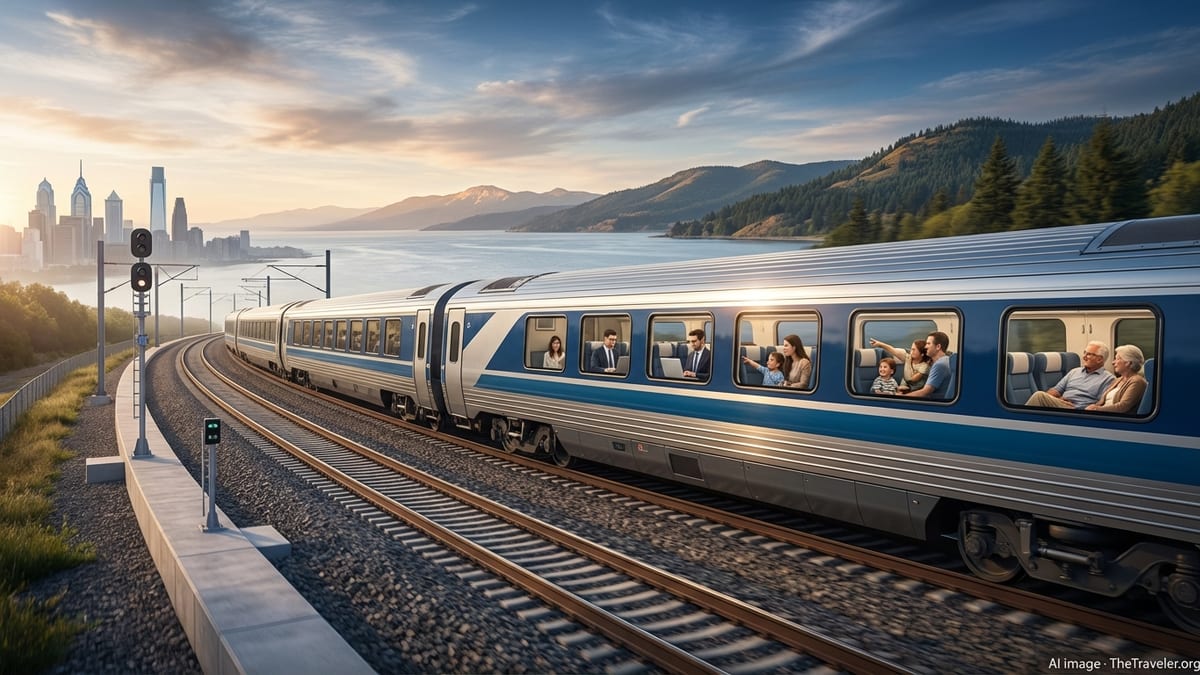
Air vs rail: a widening policy gap
Rail is widely promoted as a cornerstone of Europe’s climate strategy, yet aviation remains structurally cheaper on many cross border routes, in part because of how each mode is taxed. International flights in particular continue to benefit from long standing exemptions on kerosene taxation and value added tax that do not apply to most other forms of transport. Industry data compiled in 2024 indicate that specific taxes levied on air passengers worldwide reached more than 60 billion dollars, but these charges vary widely by country and often remain lower than would be expected if pollution and climate impacts were fully priced.
By contrast, rail operators face a complex mix of infrastructure fees, known as track access charges, which are set by national regulators within a common European legal framework. These charges recover part of the cost of building, maintaining and operating the rail network and can represent a substantial share of train operating costs. Guidance updated by the European Commission in 2025 underlines that the level and structure of these fees have a direct impact on the profitability of rail services and on ticket prices, especially on liberalised passenger and freight markets.
Despite that, experts in transport economics have repeatedly argued that attempting to make rail cheaper largely through lower access charges will struggle to close the price gap as long as aviation’s external costs remain under taxed. Analysis from the International Energy Agency notes that emission based taxes and congestion charges applied consistently to aviation would significantly improve rail’s competitiveness on medium distance corridors, especially where high speed infrastructure already exists.
Why flight taxes create a stronger price signal
Recent scenario work by academic and industry researchers suggests that targeted increases in flight related taxes can have a stronger and more immediate effect on travellers’ choices than gradual changes in infrastructure fees for rail. Raising departure taxes or introducing kerosene levies directly alters the final ticket price paid by passengers, which is the key factor most consumers compare when choosing between flying and taking the train.
In many European countries, particularly for short haul routes of 300 to 800 kilometres, low cost airlines still undercut rail fares on a total trip basis once airport charges, luggage fees and dynamic pricing are accounted for. Publicly available studies of modal split show that even modest increases in air ticket prices on these routes can push a measurable share of demand towards rail, provided that journey times remain competitive and that there is sufficient capacity on the rail network.
Infrastructure charges for rail, by contrast, are largely invisible to end users. They are levied per train kilometre on operators rather than directly on passengers, and are often partially offset through public subsidies or service contracts. When regulators reduce these charges by a few percentage points, the savings may improve operators’ margins or support additional frequencies, but they do not always translate into eye catching fare cuts. As a result, the behavioural signal to switch from air to rail can be diffuse and slow to materialise.
Researchers focusing on distributional impacts also point out that carefully designed aviation taxes can be more progressive than adjustments to rail charges. Higher income households fly significantly more often than lower income groups, especially on international routes, meaning that a larger share of any new tax burden would fall on frequent flyers rather than on occasional rail users.
The evolving debate over track access charges
Track access policy nevertheless remains central to the long term economics of rail. Across Europe, regulators and industry bodies are grappling with how to balance cost recovery for infrastructure managers with the goal of making rail more attractive for passengers and freight. A series of market monitoring reports from European rail regulators highlight sharp differences in access fee levels between countries, with some networks charging several times more per train kilometre than others for comparable services.
Concerns over rising charges have been particularly acute in freight and night train markets. Shippers’ associations warn that increases in access fees, introduced as pandemic era support schemes are withdrawn, risk undermining Europe’s targets for shifting freight from road to rail. Night train advocates argue that uniform per kilometre charges impose a disproportionate burden on long cross border services, making it difficult to sustain routes that directly compete with short haul flights.
In response, the European Commission’s interpretative guidelines on infrastructure charging emphasise that mark ups added to basic cost related charges must not constitute a barrier to market entry and should support broader policy goals such as optimising network use and preserving rail’s competitiveness. Some member states have experimented with reduced or zero marginal cost charges for specific segments, using public compensation mechanisms allowed under EU law to cover the resulting revenue gap for infrastructure managers.
Even so, specialists note that lowering track access fees alone cannot fully offset the fiscal advantage enjoyed by aviation. Cost modelling work for national regulators shows that infrastructure charges typically represent only part of a train’s operating cost base, alongside staff, rolling stock, energy and station access fees. Unless reductions are deep and sustained, the effect on final ticket prices is likely to be modest compared with the impact of a robust flight tax.
Climate targets push aviation pricing to the fore
Europe’s climate framework is adding urgency to the question of how to rebalance pricing between air and rail. The European Union has pledged to cut greenhouse gas emissions by at least 55 percent by 2030 compared with 1990 levels and to achieve climate neutrality by mid century. Transport is one of the hardest sectors to decarbonise, and aviation remains heavily reliant on fossil fuels despite emerging interest in sustainable aviation fuels.
To address this, European legislation is progressively tightening the inclusion of aviation in carbon markets and phasing in mandates for cleaner fuels. However, climate policy organisations and some research institutes argue that these steps, while significant, are unlikely to close the price gap with rail on their own. They contend that explicit flight taxes, applied especially to short haul routes where rail is a viable alternative, would send a clearer signal while also generating revenue that could be earmarked for rail infrastructure or cross border services.
Energy system analysis from international organisations supports the view that internalising aviation’s environmental and social costs would quickly improve the relative economics of rail, particularly on densely travelled corridors. Studies modelled for Europe suggest that when the full cost of carbon, local air pollution and noise is added to the price of a plane ticket, high speed trains become cost competitive or cheaper on many routes of up to 1,000 kilometres.
Some national governments have already moved in this direction by banning or discouraging short domestic flights where a direct rail alternative under a set journey time is available. These measures are often politically sensitive, but early experiences are being closely watched by other countries seeking tools to meet transport sector climate targets without undermining connectivity.
Towards a combined pricing strategy
Analysts increasingly argue that the choice between stronger flight taxes and lower rail access charges is a false dichotomy. For a durable modal shift, both levers may need to be pulled in a coordinated way, alongside investment in rail capacity and improvements to booking systems and service quality. Infrastructure charging rules can be used to encourage more efficient use of the rail network and to support socially valuable but commercially marginal services, while aviation taxes address the broader imbalance in how environmental costs are treated.
Policy papers from European think tanks suggest that one promising option is to link new or higher flight related levies directly to rail funding. Under such a model, revenue raised from passengers choosing to fly on routes with a good rail alternative could be channelled into upgrading tracks, removing bottlenecks and reducing access fees on strategic corridors. This earmarking approach is seen as a way to make the trade off more visible to the public while preserving long term investment signals for infrastructure managers.
There is also growing discussion about harmonising elements of both air and rail pricing at the European level. While aviation route charges are already coordinated through a common system, rail infrastructure fees remain largely national, which can complicate the operation of cross border services and raise costs for new entrants. Proposals for a clearer framework on track access charges, combined with minimum standards for aviation taxation, are likely to feature prominently in forthcoming debates on the future of European transport policy.
For now, the emerging consensus in recent research is that correcting the under taxation of aviation is likely to move more passengers to rail in the short to medium term than incremental reductions in what rail operators pay to access the network. How quickly policymakers act on that insight will help determine whether Europe’s stated ambition for a major modal shift away from air travel can be realised.