


More news on this day
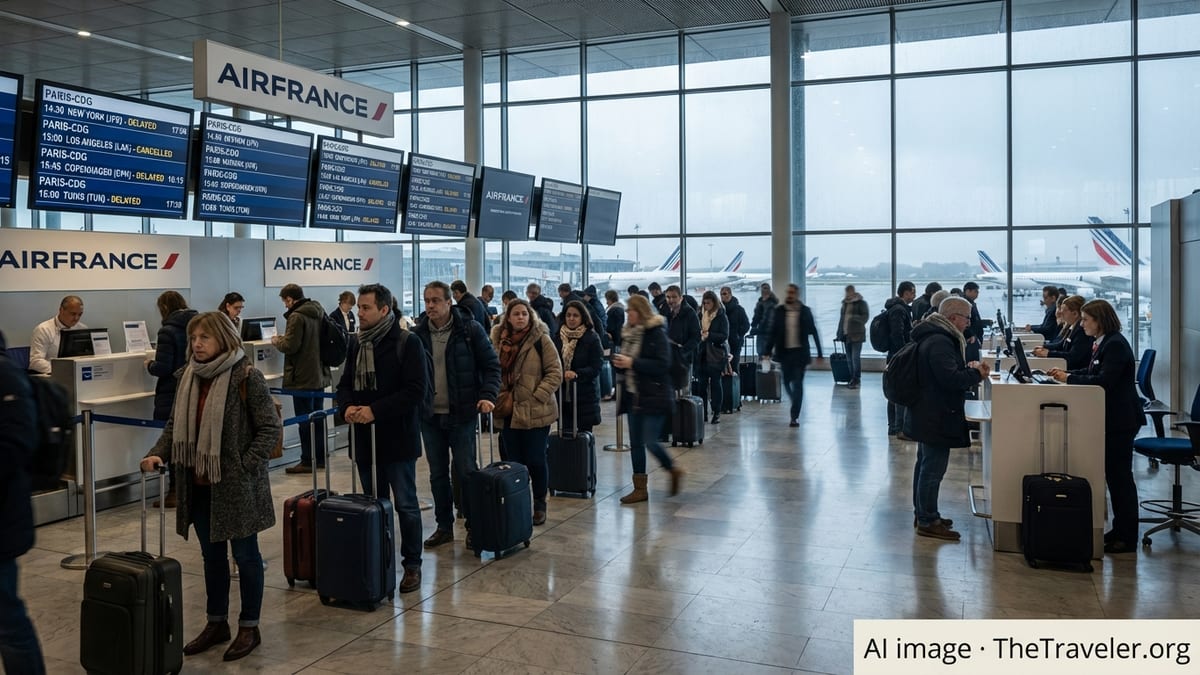
Travelers across France and neighboring European hubs have faced a difficult day of disruptions, with publicly available operational data indicating 472 flight delays and 12 cancellations affecting services operated by Air France, British Airways, KLM, Lufthansa, Emirates and easyJet through Paris, Amsterdam, Frankfurt and several regional French cities.
Get the latest news straight to your inbox!
Major Carriers Hit Across Key European Hubs
The disruption has been most visible at Paris Charles de Gaulle and Amsterdam Schiphol, two of Europe’s busiest hubs and primary bases for Air France and KLM. Operational monitoring platforms tracking day-of-travel performance show a spike in delayed and cancelled departures and arrivals on routes touching France, with knock-on effects reaching Frankfurt, London and other major gateways.
Air France, KLM, Lufthansa, British Airways, Emirates and easyJet feature prominently in today’s disruption statistics, reflecting their dense schedules in and out of France and nearby countries. Earlier industry updates from European air traffic management bodies had already highlighted mounting pressure in French and German airspace, where weather and capacity constraints have combined to create longer-than-usual airborne holding and ground delays.
Published network overviews for the spring and early summer period show that Paris, Amsterdam and Frankfurt have consistently ranked among Europe’s busiest airports by daily movements, increasing the likelihood that any operational issue rapidly cascades into large numbers of affected flights. Those same overviews also identified France and Germany as particular hotspots for air traffic flow management delays, a trend that appears to be reflected in today’s figures.
Low-cost operators such as easyJet, along with full-service groups anchored by Air France-KLM and Lufthansa, have all expanded schedules into the peak summer season. While that growth supports strong leisure and business demand, analysts note that it also reduces operational slack, making it harder to recover when weather or air traffic restrictions occur.
Paris, Amsterdam and Frankfurt See Ripple Effects
In Paris, the bulk of the disruption has been concentrated at Charles de Gaulle, a key long-haul and European transfer hub. Flight-tracking dashboards for CDG show a succession of delayed departures to European cities including Amsterdam, Frankfurt and Milan, alongside longer-haul routes to the Middle East and North America. Some of these delays are measured in hours rather than minutes, forcing missed connections and rebookings throughout the day.
Amsterdam Schiphol has also emerged as a focal point, with recent history demonstrating how quickly heavy traffic and weather can combine to trigger large-scale cancellations and delays. Earlier this year, separate incidents at Schiphol produced well over 100 delays and multiple cancellations in a single day for carriers including KLM and easyJet, setting a precedent for the kind of disruption now being seen on routes intertwined with French airports.
Frankfurt, a primary base for Lufthansa and an important connection point for British Airways and Emirates passengers transferring from regional flights, is experiencing secondary effects as delayed inbound aircraft from France and the Netherlands arrive off-schedule. Industry reporting on previous disruption days shows that when one hub such as Paris or Amsterdam falls badly behind schedule, Frankfurt’s tightly timed wave system can also be impacted, leading to aircraft rotations and crews being displaced from their intended schedules.
Regional French airports are not immune. Operational trackers focused on French airfields indicate pockets of delay pressure outside Paris, particularly on routes linking provincial cities to major European hubs. Even when some regional airports report high on-time rates overall, late arrivals from disrupted hubs can still affect passengers waiting to continue their journeys.
Passengers Face Missed Connections and Overnight Stays
For passengers, the headline numbers of 472 delays and 12 cancellations translate into long hours in terminal buildings, unexpected overnight stays and complex rebooking challenges. Reports from prior disruption events in France and the Netherlands this year describe travelers sleeping in airport seating areas, scrambling to secure hotel rooms, and competing for limited seats on remaining flights as airlines attempt to recover operations.
Travel-focused publications that monitor day-of-travel performance have highlighted how disruptions at Paris and Amsterdam frequently affect a broad network of destinations, from nearby European cities to long-haul routes to the Middle East, Asia and North America. Missed evening connections from hubs such as CDG, AMS and FRA can strand passengers far from home, particularly when the next available departures are fully booked at the start of the busy holiday season.
Consumer advocacy platforms that specialize in European passenger rights note that widespread delays and cancellations often lead to a surge in claims under EU261 and UK261 regulations. These rules can entitle eligible passengers to compensation for long delays and cancellations within the control of the airline, although weather and air traffic control restrictions are typically excluded. With multiple major carriers involved and a high number of affected flights, the volume of compensation and reimbursement requests is likely to be significant.
Social media posts and previous case studies from similar events suggest that passengers on multi-leg itineraries are particularly vulnerable. Travelers booked from smaller European cities through Paris, Amsterdam or Frankfurt to intercontinental destinations often face the most complex rebooking scenarios, as airlines juggle limited seats and aircraft positioning across their networks.
Weather, Airspace Constraints and Structural Strain
While a full picture of today’s disruption will take time to emerge, recent European aviation analyses point to several overlapping causes that have repeatedly driven delays in 2026. Air traffic management reports identify weather as a leading driver of en route delays in France and Germany, with thunderstorms and low visibility conditions triggering flow restrictions and holding patterns that ripple across the network.
At the same time, structural capacity limits in key control centers and at major airports continue to challenge the system. Earlier European overviews for 2026 show that average delays per flight have inched up compared with previous years as traffic has recovered strongly, even while staffing and infrastructure improvements have lagged. This imbalance leaves hubs such as Paris, Amsterdam and Frankfurt vulnerable when peak traffic coincides with adverse weather or localized industrial actions.
Separate coverage focused on Emirates and other Gulf carriers has documented schedule cuts and network adjustments during June, which can add complexity when these airlines also face operational constraints in European airspace. With Emirates operating multiple daily services into major hubs like Paris and Frankfurt, any delay or aircraft rotation issues can quickly affect onward connections for passengers traveling between Europe, Asia and Africa.
For European carriers, recent winters and early spring periods brought disruption linked to snow and storms at Amsterdam Schiphol and other northern airports. Those episodes, which generated large numbers of cancellations and delays, underlined how tightly interconnected the continent’s major hubs have become. Today’s figures suggest that similar systemic pressures remain in place as the summer season begins in earnest.
What Travelers Can Do as Disruption Continues
Given the scale of the delays and cancellations reported across France and neighboring hubs, travel experts generally recommend that passengers first verify their flight status directly with their airline or through the airline’s official app before heading to the airport. Industry guidance based on prior disruption days shows that schedules can change several times in a matter of hours as airlines retime departures, swap aircraft and open additional rebooking options.
Air passenger rights organizations advise travelers to keep detailed records of boarding passes, booking confirmations, receipts for meals and accommodation, and any written communication from airlines. These documents can be important when pursuing refunds or compensation later, particularly under EU261 or UK261 frameworks that require proof of delay length and cause.
For those still planning upcoming trips through Paris, Amsterdam, Frankfurt or French regional airports, publicly available aviation data suggests allowing extra connection time, especially for itineraries that involve separate tickets on different airlines. Travel publications also encourage flexible arrangements such as refundable hotel bookings and travel insurance products that explicitly cover delays and missed connections, which can provide an added layer of protection when networks come under stress.
With Europe’s summer travel season now gathering pace, the experience of passengers caught in today’s wave of 472 delays and 12 cancellations offers a stark reminder of how quickly disruption can spread across interconnected hubs. As airlines and air traffic managers work to stabilize operations, travelers passing through France and its neighboring gateways are likely to remain alert to the possibility of further schedule changes in the days ahead.