


By the time the agent at Los Angeles International Airport closed the boarding door, I was still in my socks at the security conveyor belt, silently bargaining with the universe. I had arrived what I thought was a safe two hours before departure. Yet between construction detours, a wrong terminal drop-off, and a security line that suddenly ballooned, my “perfectly timed” plan unraveled so fast that I came within minutes of missing my flight out of LAX. Here is exactly what went wrong, what has changed at the airport recently, and how you can avoid repeating my mistakes.
Get the latest updates straight to your inbox!
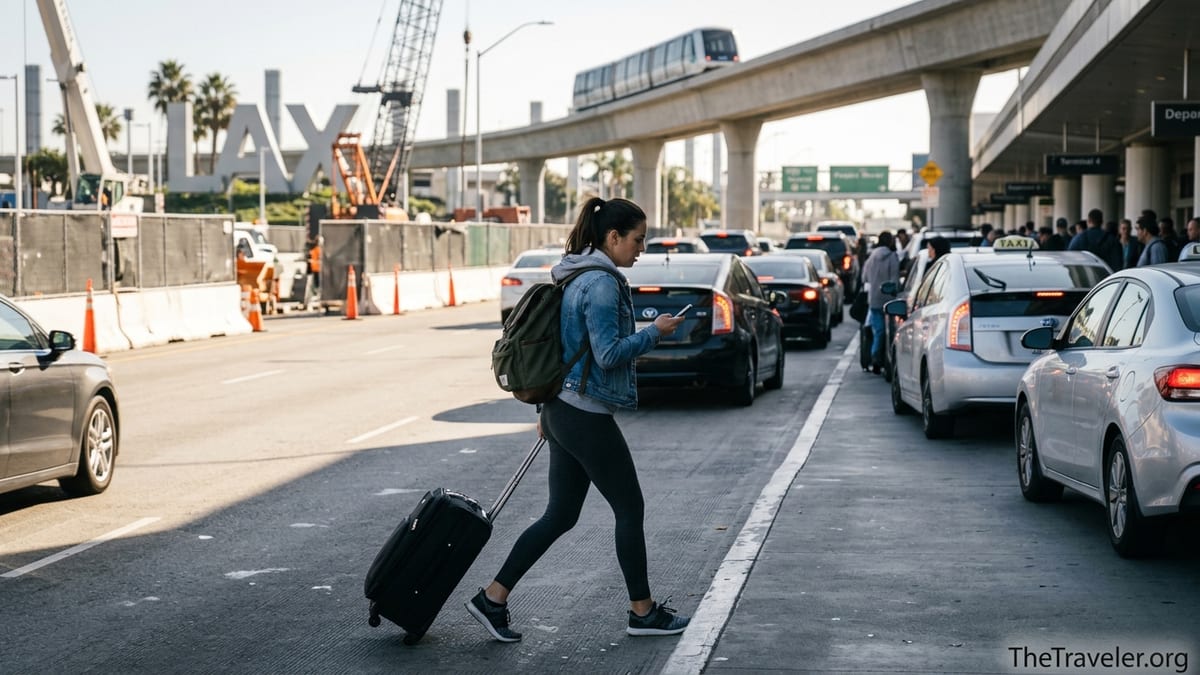
The Moment Everything Started To Go Wrong
The trip started like any other: a late-morning departure from LAX, checked bag, economy ticket, no elite status. I left my Westside hotel with what I believed was a generous buffer of just over two hours. The rideshare driver casually asked, “Which terminal?” and I confidently answered, “Tom Bradley, international.” Twenty-five minutes later, traffic slowed to a crawl as we entered the Central Terminal Area, boxed in by orange cones and construction barriers. That is when I opened my airline app and realized the first crack in my plan: my flight, while international, now departed out of Terminal 4, not Tom Bradley (Terminal B), thanks to a recent gate reassignment my brain had not fully registered.
This kind of shuffle is increasingly common at LAX. Airlines such as Japan Airlines, British Airways, and LATAM have shifted some operations between Tom Bradley and other terminals in early 2026, and American Airlines routinely uses both Terminal 4 and the Bradley building. If you show up at the wrong terminal, you are not doomed, because all the terminals are now connected airside. But you will still lose precious time walking back through crowded concourses, especially if you only discover the mistake curbside like I did.
By the time my driver looped from the Bradley curb to Terminal 4, my two hours had already become one hour and twenty minutes, and I had not even set foot in the check in hall. That idle ten minutes circling the U shaped roadway was the first reminder that at LAX, the airport experience begins well before you see a security line.
Construction, Detours, and the People Mover That Is Not Quite Moving
What makes LAX particularly tricky in 2026 is that it is both a functioning global hub and a massive construction project at the same time. The new automated people mover system, often called SkyLink or the LAX Automated People Mover, is visually front and center: sleek concrete guideways loop past the terminals, and trains are already testing without passengers. But despite test runs, the system is not yet open for riders and its official opening has slipped into late 2026. That means travelers still rely on the old web of shuttles, curbside pickups, and personal vehicles to get to and between terminals and the new consolidated rental car center and transit hub.
On my near-miss day, this reality translated into subtle but consequential delays. The rideshare drop-off zone at Terminal 4 had been pushed a bit farther from the doors because of lane closures. Instead of hopping out right at the entrance, I was unloading on a temporary curb with dozens of other cars, dragging my roller bag past construction signage and queueing traffic. What looked like “just one more minute in the car” on the map became five or six minutes of creeping forward and then walking along a crowded, partially fenced sidewalk.
Similarly, travelers arriving by rental car now funnel through the new consolidated rental car center, which opened in 2026 several minutes away from the terminals. Shuttle buses run frequently, but they are still at the mercy of the same congested airport road. If you are returning a car on a busy morning in July or around a big event like a concert or playoff game, that shuttle ride can easily absorb 20 to 30 minutes, longer than most people budget for “just getting from the garage to the gate.”
The big lesson is counterintuitive. The unfinished people mover can lull you into thinking LAX mobility is finally solved. In practice, in mid 2026, the opposite is true: construction and testing sometimes reduce curb space, shift loading zones, and tighten traffic chokepoints. If you budget for a smooth glide from the freeway to your terminal, you are planning for the airport LAX wants to be, not the airport you will actually encounter.
Security Lines at LAX Are Predictable Until They Are Not
Once inside Terminal 4, I checked my bag in under ten minutes at a bank of self-service kiosks. That brief win lulled me into thinking I was back on track. Then I turned the corner to security. Overnight, it seemed, the line had doubled back on itself and spilled near the food court. An airport display board that tracks queue times estimated a 25-minute wait for standard screening. Under normal circumstances, that would have been fine. The problem was that my boarding time was now just under 40 minutes away, and a gate change notification buzzed my phone, shifting my flight from a nearby gate to one across the connector bridge toward Tom Bradley.
Recent data from airport wait-time trackers shows that LAX can swing from a 5-minute lull to a 30-plus-minute surge in many terminals during the morning and late-evening peaks. Terminal 4, a major hub for American Airlines, is consistently among the most congested checkpoints. On a typical weekday, standard security there can stretch past the half-hour mark between 6 and 9 a.m., and again in the early evening when transcontinental and international flights stack up. For Tom Bradley International (Terminal B), even PreCheck passengers report that they sometimes need an extra 15 minutes compared with domestic terminals, especially in the early afternoon when multiple wide-body departures are scheduled.
I was in that uncomfortable gray zone where the posted wait time was technically manageable but left no cushion for hiccups. A mis-scanned boarding pass, a secondary bag check, or another sudden gate change would have put me past final boarding. That tension is the new normal at LAX. With the terminals now connected inside security, more passengers than ever are willing to clear at a less-crowded checkpoint and walk to their gate, which helps distribute demand but can make previously “quiet” checkpoints spike without warning.
The important takeaway: relying on static advice like “arrive two hours early for domestic” can be risky here. For LAX specifically, frequent flyers often swear by three hours for international flights and at least two and a half for busy morning domestic departures. It sounds conservative until you are the person watching your boarding group disappear while you are still half-dressed at the conveyor belt.
Terminal Changes, Airline Shuffles, and Hidden Walking Time
What almost cost me the flight was not just the security line itself but how far I ultimately had to walk after clearing it. When my boarding pass was first issued, my gate was squarely inside Terminal 4. By the time I reached the front of the security queue, a new alert showed my departure had moved closer to the Tom Bradley side of the complex. Thanks to the airside connectors built over the last decade, I could in theory walk there without reclearing security. In practice, it meant a ten to fifteen-minute power walk through crowded concourses past multiple duty-free shops and food courts.
Airline relocations at LAX in 2025 and 2026 have quietly changed how much time you should budget for walking. Japan Airlines and British Airways, for instance, have shifted some operations away from the main Bradley gates into Terminal 4, especially for code-share flights with American. Several Latin American carriers share space between Terminal 3, Terminal B, and other satellites. A passenger who arrives early enough to linger over coffee in the wrong end of the terminal might find themselves stuck in a slow-moving crowd trying to cross bridges to a remote gate when boarding is already halfway through.
On my day, the ripple effects looked like this: I cleared security with just under 20 minutes to go before scheduled boarding and about 35 minutes before departure. I then spent nearly half of that precious time simply traversing the airport, weaving around rolling suitcases and stopping twice to re-check the overhead monitors when gate numbers on my app did not immediately match what was posted. By the time I reached the correct gate, the first boarding group was already lining up, and the agent was calling for passengers with tight connections, not people who had simply cut it too close getting to the airport.
If your itinerary touches multiple terminals for a connection, or if you are flying on an airline known for last-minute gate shifts at LAX, this walking time is not an optional extra. It is a core part of your schedule. A ten-minute miscalculation here is often the difference between a relaxed boarding and a white-knuckle jog down the moving walkways.
Ground Transport: The Silent Time Thief Before You Even Reach the Terminal
Looking back, the single biggest factor in my near miss was not security or walking time. It was the complacency I had about ground transport to the airport. On a good day, it takes about 20 to 30 minutes to reach LAX from much of the Westside by car or rideshare. I had unconsciously built my entire plan around hitting that “good day” window. I did not plan for a fender bender on the 405, a long queue of cars waiting to loop into the terminal U, or being forced to detour because a construction crew had temporarily closed a lane near my terminal.
This is especially dangerous now that the new LAX/Metro Transit Center is operational but still relies on shuttle buses to bridge the gap to the terminals. If you are coming from downtown Los Angeles or Hollywood by rail and then transferring to the airport, it is easy to underestimate how long that last leg will take. The shuttle can be fast when traffic is light, but at peak times travelers have reported 15 to 25 minutes just to snake through the central terminal roadways, even though the distance is short on a map.
Rental cars add another wrinkle. The new consolidated rental car facility has simplified drop-off in one sense, but it has also concentrated demand onto a single shuttle corridor. If your return falls at the same time as dozens of other travelers from big name agencies are trying to reach their terminals, you may wait for a second or third bus or endure a crowded ride where every stop takes several extra minutes as passengers jockey to unload luggage at different terminals.
For my part, the rideshare driver and I lost a combined 15 minutes to traffic slowdowns and construction-related detours on what looked like a routine Monday late morning. When you subtract that from a supposedly “safe” two-hour arrival window, you are suddenly playing airport roulette. When you are planning a departure from LAX, the practical rule of thumb is to time your arrival to the airport access roads as if you are expecting delays, not hoping to avoid them. It is better to spend an extra half hour at your gate with a coffee than to spend it watching brake lights creep forward outside the terminal.
What I Would Do Differently Next Time at LAX
After my sprint though Terminal 4 and across the connector to the Bradley side, I made it to the gate just as my boarding group was called. Technically, I did not miss my flight. Emotionally, it felt like I had aged several years in those final fifteen minutes. Walking down the jet bridge, heart racing, I mentally rewrote my LAX playbook.
First, I would treat three hours as the real baseline for any international flight out of LAX and at least two and a half hours for domestic departures during the morning or evening peaks. That clock should start from the moment I expect to reach the terminal curb, not from when I leave my house or hotel. For example, if I am flying to New York at 8 a.m. on a Monday from Terminal 4, I would plan to be at the curb by 5:30 a.m., which probably means leaving Santa Monica no later than 4:45 a.m.
Second, I would verify my airline’s exact terminal and gate information repeatedly in the 24 hours before departure. That means checking the airline app and boarding pass after online check-in, again before leaving for the airport, and once more as I approach the terminal. If there is any ambiguity, I would aim for the terminal my airline primarily uses rather than the international building, knowing that I can always walk over airside if my gate ends up elsewhere.
Third, I would think in segments of time instead of one big block. How long might it realistically take to get from my door to the airport entrance, from the entrance to the check-in counter, from check-in to the security queue, and from security to my gate? At LAX in 2026, a realistic budget for each of those legs can be surprisingly high: 30 to 45 minutes on the road, 10 to 20 for curbside drop-off and check-in, 15 to 35 for security, and 10 to 20 for walking to a more distant gate. When you add those up, the conventional “two hours” quickly looks naïve.
The Takeaway
My near-missed flight at Los Angeles International Airport was not the result of a single catastrophic error. It was death by a dozen small assumptions that no longer hold true for this airport at this stage of its transformation. I assumed the old wisdom about arrival times would protect me. I assumed my airline would not quietly move my departure point across the complex. I assumed construction would be a visual nuisance, not a real drag on curbside access and shuttle schedules. All of those assumptions were just close enough to plausible that I did not question them until it was almost too late.
If you are flying through LAX in 2026, treat the airport as a major international hub in transition. Build in more time than feels necessary. Double-check where your flight is actually leaving from, not just what your mental picture of LAX tells you. Assume you will have to walk farther than you expect after security, and that your ground transport may be slowed by construction and traffic even on seemingly routine weekdays.
You may never know if that extra 30 or 45 minutes you give yourself truly “saved” your trip, because nothing bad will happen. That is the point. A smooth, boring airport experience at LAX right now is less a matter of luck and more the result of deliberate over-planning. After coming so close to missing a flight I had carefully booked weeks in advance, I am perfectly content to be the person at the gate who is simply early.
FAQ
Q1: How early should I arrive at LAX for a domestic flight?
For most travelers, arriving at the terminal curb at least two and a half hours before a domestic departure is wise, especially during morning and evening peaks.
Q2: How early should I arrive at LAX for an international flight?
Plan to be at the terminal curb a full three hours before departure, and consider three and a half hours if you are checking bags or flying during busy holiday periods.
Q3: Is two hours still enough time at LAX if I have TSA PreCheck?
Sometimes, but not reliably. PreCheck helps at security, but it does not protect you from traffic delays, construction detours, or long walks between terminals.
Q4: Are all LAX terminals connected after security?
Yes, the main passenger terminals and Tom Bradley International are connected airside, so you can walk between them without reclearing security, though it may take 10 to 20 minutes.
Q5: How much time should I allow to walk from Terminal 4 to Tom Bradley International?
Most travelers should budget around 10 to 15 minutes, longer if you are moving slowly, traveling with children, or navigating heavy crowds.
Q6: Does the new LAX people mover train help me get to my terminal yet?
Not yet. As of mid 2026 the automated people mover is still in testing, so travelers must rely on shuttles, rideshares, and private vehicles.
Q7: How long does it take to reach the terminals from the consolidated rental car center?
Shuttle rides can take around 10 to 20 minutes in light traffic, but in peak periods it is safer to assume 20 to 30 minutes from return to terminal curb.
Q8: What is the busiest time for security lines at LAX?
Security tends to be busiest between roughly 6 a.m. and 9 a.m. and again in the late afternoon and evening when many long-haul and transcontinental flights depart.
Q9: Can I clear security at one terminal and walk to my gate in another to save time?
Yes, some travelers choose a less-crowded checkpoint and then walk airside to their actual gate, but you must still allow time for that walk and verify your route.
Q10: What is the single biggest mistake people make when flying out of LAX?
The most common mistake is underestimating how long ground transport, construction, and terminal changes will add to the trip and arriving with too little buffer before departure.