


I was ready to roll my eyes at Banff. The turquoise lakes, the mountain selfies, the tour buses that make the town feel more theme park than wilderness – it all sounded like the kind of overhyped destination I usually avoid. I had seen a thousand filtered photos of Moraine Lake and Lake Louise in my social feeds. Surely the real thing could not live up to the postcards. Then I went. I navigated the shuttle queues, the visitor center crowds, and the parking rules, and finally stood on those shores with my own eyes. That was the moment Banff stopped being a cliché and started feeling like one of the most extraordinary landscapes I have ever seen.
Get the latest updates straight to your inbox!
Arriving Skeptical in a Place Everybody Talks About
I landed in Calgary with a chip on my shoulder and a carry-on backpack. On the airport shuttle into the Rockies, the bus TV cycled through glossy clips of canoes gliding across glassy lakes and couples sipping lattes under jagged peaks. It looked more like an advertisement than a national park. Other riders were swapping bucket-list comments about finally seeing “that Instagram lake” and debating whether Lake Louise or Moraine Lake was more photogenic. I pulled my hat down and quietly wondered if I had made a mistake.
Banff town did not help my skepticism at first. Banff Avenue is lined with gear shops, branded fleece hoodies, and busy patios offering bison burgers and craft beer. On a July evening the sidewalks feel closer to a ski village on a holiday weekend than a remote mountain outpost. Visitor parking meters blink with three-hour limits, and Roam Transit buses roll past with digital signs flashing Sulphur Mountain and Lake Minnewanka. Prices reflect the park’s popularity: a casual dinner in town easily lands around 30 to 40 Canadian dollars per person without drinks, and hotel rates in peak summer often soar above 400 dollars a night for a standard room.
Still, signs of the real park peek through the commercial gloss. On my first evening I followed the Bow River Trail just a few minutes from downtown. Within ten minutes the sound of traffic faded under the rush of the river and the distant call of ravens. It was a small preview of how quickly Banff can shift from crowded to quiet if you are willing to step a little to the side of the main flow.
That first night, jet lag nudged me awake before sunrise. I walked out onto a nearly empty Banff Avenue, the mountains above town painted soft pink. Delivery trucks rumbled past shuttered souvenir shops. For a few minutes, the place looked less like a postcard and more like what it actually is: a community living inside one of the world’s busiest national parks, balancing everyday life with an extraordinary landscape.
Lake Louise: Where the Hype Starts to Make Sense
Lake Louise was my first real test. This is the lake you see on brochures in airports from Toronto to Tokyo: the milky turquoise water, the Fairmont Chateau fringing one shore, and the Victoria Glacier hanging like a frozen curtain at the far end of the valley. It is also where overtourism headlines tend to focus. On busy summer mornings the main lakeshore parking lot regularly fills before sunrise, and traffic restrictions and time limits have become the norm in recent years.
I opted to avoid the parking scramble and took public transit instead. From Banff town, a reservable Roam Transit bus now runs to the Lake Louise lakeshore, and a day pass for the network typically sits around 30 Canadian dollars for unlimited rides, with children under 12 riding free on most services. This meant I could step onto the bus outside the Banff High School field and step off directly at the lakeshore without worrying about highway traffic or parking tickets. The ride itself became an unexpected part of the experience, as the bus climbed past Castle Mountain and along the Bow Valley with peaks rising on both sides.
Nothing prepares you for that first direct view of Lake Louise. You pass through a gap between trees, and suddenly there it is: a broad sweep of opaque turquoise water that looks almost artificial if you have never seen glacial lakes before. On my visit, clouds were sliding quickly over the valley, sending bands of shadow and light moving across the surface. Canoes carved deep V-shaped ripples through the still water. Even with hundreds of people along the paved path, there was a hush whenever the clouds parted and sunlit the glacier at the far end.
Despite the crowds, it took only a few minutes of walking to find some breathing room. Most visitors cluster within a couple of hundred meters of the main viewpoint in front of the hotel. When I followed the lakeshore trail past the canoe dock, the noise dropped away. Within fifteen minutes I had stretches of the path almost to myself, with squirrels darting in the undergrowth and the gentle lap of glacial water against the rocks. The further I walked, the more the lake felt like a living landscape instead of a backdrop for selfies.
Moraine Lake and the Moment It All Clicked
Moraine Lake was the place I was most skeptical about. It is probably one of the most reposted images of the Canadian Rockies, and that level of internet attention can warp expectations. It also has some of the strictest access rules in the park. In recent seasons, private vehicles have been banned from Moraine Lake Road due to chronic overcrowding and environmental concerns. To get there between early June and mid-October, you now need to use a Parks Canada shuttle, a Roam Transit connection paired with a lake connector bus, or a licensed commercial shuttle or guided tour.
I booked a morning departure on the Parks Canada shuttle from the Lake Louise Park and Ride, a large lot just off the highway a few minutes from the village. Shuttle reservations for the season typically open in mid-April, and on launch day tens of thousands of people join an online queue within minutes. Seats are relatively affordable compared with many guided tours, usually under 10 Canadian dollars each way for adults, with youth riding free but still requiring reservations. Arriving at the Park and Ride early in the day meant I could check in without stress, grab a coffee from a mobile cart, and board the bus with a mixture of anticipation and skepticism.
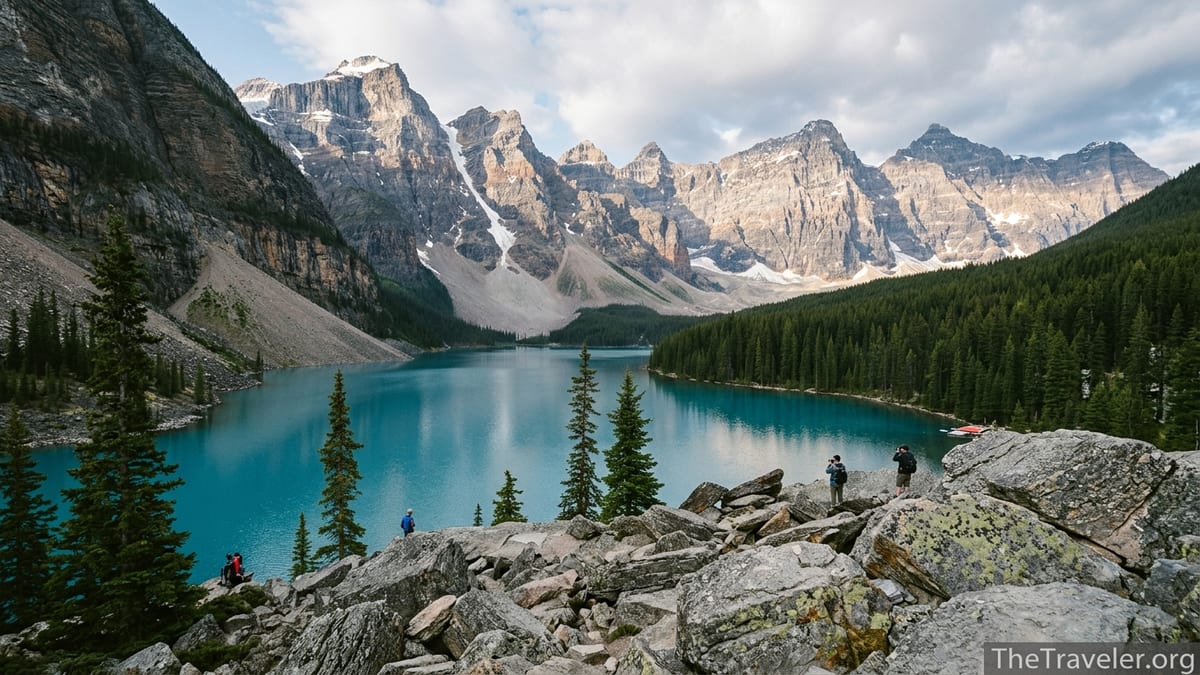
The ride up Moraine Lake Road is a slow climb through dense forest, with occasional glimpses of distant peaks through breaks in the trees. When the bus finally rounds the last bend and the valley opens, there is a split second where everyone stops talking. The lake appears almost suddenly, pressed against a crown of ten jagged summits, the water a deeper, more electric blue than Lake Louise. I had seen this view a hundred times on screens, but the real version is shockingly three-dimensional: thrusting peaks, shifting clouds, and the sound of meltwater pouring into the far end of the lake.
I climbed the short rocky path to the famous viewpoint on the moraine pile. This is where most of the iconic photographs are taken, but it is still a scramble over logs and boulders rather than a manicured overlook. Perched on a sun-warmed rock, I watched as shafts of light moved across the lake, turning some sections almost cobalt while others looked turquoise. The crowds were there, of course. Tripods clicked, couples took turns photographing each other on a prominent rock outcrop, and hikers adjusted their boots before tackling the lakeshore trail. Yet the scale of the mountains and the intensity of the color made all of that human busyness feel small.
That was the moment my skepticism cracked. The combination of limited vehicle access, lake-level quiet, and those vast rock faces encircling the valley felt more like a sanctuary than an attraction. It was not that the hype was wrong. It was that no photo, no matter how viral, can capture what it feels like to stand there, lungs full of cold alpine air, listening to ravens circling above the trees.
Behind the Scenes: Shuttles, Reservations, and Crowds
Banff’s reputation for crowding is not exaggerated. In peak summer the park can welcome several million visitors in a season, and weekends in July and August see long lines at the gondolas, tight parking around trailheads, and heavy traffic along the Trans-Canada Highway. Lake Louise and Moraine Lake have become focal points in the conversation about overtourism, prompting a shift toward shuttles and reservations to keep the area functioning and protect the fragile shoreline.
For many visitors, the logistics are now part of the story. The Parks Canada park-and-ride shuttle to Lake Louise and Moraine Lake requires advance online booking for most of the summer period, currently running roughly from early June through Thanksgiving weekend in October. Departure windows can sell out for popular days, especially around Canadian and US holiday weekends and peak larch season in late September when the subalpine larches turn gold. If you plan a trip without checking shuttle availability, you may find that your ideal sunrise at Moraine Lake is not possible on short notice.
Public transit has become a practical alternative to driving, particularly if you are staying in Banff or Canmore. Roam Transit’s network connects Canmore to Banff and Banff to Lake Louise, and seasonal routes or partnerships often extend this to Moraine Lake via lake connector shuttles. Local in-town fares are typically between 2 and 3 Canadian dollars per ride, with regional and express routes costing more, while unlimited-day passes and a so-called Super Pass cover entire days of exploration. Compared with paying for hotel parking, gas, and potential parking tickets near popular sites, the math often works in transit’s favor.
Understanding these systems ahead of time turned what could have been a frustrating experience into a relatively smooth one for me. I booked my Moraine Lake shuttle weeks in advance, reserved a Roam Transit seat a few days before traveling between Banff and Lake Louise, and built in buffer time around transfers. That planning paid off when I watched drivers circling the Lake Louise village area in search of elusive spaces or turning away from a road closed to personal vehicles. The layers of management may feel complicated, but they exist because the alternative would be gridlock.
Finding Quieter Corners and Everyday Magic
Once I accepted that Banff’s busiest icons would always be popular, I started looking for the spaces in between where the park still feels intimate. Some of them were within minutes of the main attractions. At Lake Louise, I followed the Lakeshore Trail away from the hotel until the pavement faded to dirt and the crowd thinned. Small cascade streams tumbled down from the cliffs above, and the color of the lake shifted subtly as I moved along its length. A family stopped to skim stones, counting how many times they could make them skip. It was a simple, uncurated moment among scenery that usually appears only in carefully framed images.
Closer to Banff town, I took Roam Transit out to Lake Minnewanka one windy afternoon. The shoreline there offers big-mountain views without the same intensity of crowds you see at Lake Louise. On the path toward Stewart Canyon, chipmunks darted across the trail and a group of local teenagers practiced skipping rocks near the boat launch. Park staff reminded visitors to keep food stored and packs closed after a black bear had been spotted in the area earlier in the week. It was one of those interactions that quietly underlines that Banff is a working ecosystem, not just a backdrop.
One of my favorite surprises came at dusk on a side street in Canmore, just outside the park gates. I had taken the regional Roam bus back from Banff and was walking to a guesthouse when I noticed a small crowd gathered near a soccer field. A herd of elk was grazing at the edge of the trees while kids kicked a ball nearby under their parents’ watchful eyes. A local told me this was such a regular sight that many residents have a mental checklist for elk safety alongside their grocery list. For a visitor like me, it felt like an unfiltered reminder that life in the Bow Valley flows alongside wildlife every single day.
The contrast between these quiet encounters and the spectacle of Moraine Lake made me appreciate Banff’s range. This is a park where you can share a trail with hundreds of people at midday and then, with a small change of direction and timing, find yourself alone on a riverbank watching the last light catch the peaks.
When to Go So Banff Feels Less Like a Theme Park
If my trip taught me anything, it is that timing can make or break your Banff experience. Peak summer, roughly from late June through early September, brings the warmest weather, the fullest range of tour options, and long daylight hours. It also brings the heaviest crowds and the highest prices. In July, hotels in Banff and Lake Louise regularly command their top rates, restaurant reservations are a good idea, and popular trails can feel like steady processions by mid-morning.
Shoulder seasons can deliver a gentler introduction to the park. Late April and May often see melting snow at town level while higher trails remain partially covered, but accommodation prices and rental car rates tend to be lower, and parking around less famous viewpoints is easier. In late October and early November, the first consistent snowfalls begin to dust the peaks, many summer services wind down, but the core park infrastructure remains open. For some travelers, these transition periods strike the best balance of quieter days and still-accessible scenery, especially if you are more interested in short hikes and scenic drives than big alpine objectives.
Then there is larch season, usually centered on the second half of September depending on the year. This is when the subalpine larches around Moraine Lake and the Lake Louise area flare into rich gold against the slate-grey peaks. It is visually spectacular and has become a magnet for photographers and hikers. In recent years, weekends during peak larch color have felt nearly as busy as mid-summer, so planning for weekday visits, early morning shuttles, and flexible expectations is important if that is your goal.
Winter confounds the overhyped narrative in an entirely different way. Banff and Lake Louise transform into snowbound resorts with ice-sculpture festivals, frozen waterfalls at Johnston Canyon, and skating loops on outdoor rinks. Lift tickets at the major ski areas represent a separate budget consideration, but the overall pace in town can feel slower once the December and February holiday surges pass. Some regional routes operate reduced schedules, and Moraine Lake is inaccessible by road once the seasonal closure returns, yet the snow-covered ranges and hoar-frosted trees deliver their own brand of drama that is difficult to oversell.
The Takeaway
Before I visited, I thought of Banff as the definition of an overhyped destination: too many people chasing the same view, too many rules and shuttles, too many social posts insisting it was “life-changing.” I expected to appreciate the scenery intellectually while feeling detached from it emotionally. Instead, I ended up deeply moved by how powerful the landscape remains even under the weight of its own fame.
Standing above Moraine Lake, watching a storm cloud slide across the Valley of the Ten Peaks, I realized that the shuttles, reservation systems, and parking rules are simply evidence of how many people want to stand in that same spot. The turquoise water is not a filter, but the natural result of rock flour suspended in glacial melt. The crowds do not erase the wildness; they challenge us to experience it thoughtfully and share it with some humility.
Banff may be busy, and its logistics can feel complicated compared with less famous parks. Yet with a little planning, a willingness to ride a bus instead of fight for a parking spot, and a habit of walking just a bit farther than the average visitor, it still offers something rare: an accessible entry point into truly grand mountain country. If you have written it off as overhyped, consider giving it the chance to surprise you. It certainly surprised me.
FAQ
Q1. Is Banff still worth visiting if I hate crowds?
Yes, as long as you manage expectations and timing. Avoid peak holiday weekends, book shuttles early, start hikes before 8 a.m., and look beyond just Lake Louise and Moraine Lake to quieter areas like the Bow Valley Parkway, Lake Minnewanka, and lesser-known day hikes.
Q2. Do I really need to book a shuttle for Moraine Lake?
In the main summer and early fall season, yes. Private vehicles are not allowed on Moraine Lake Road during this period, so you must use a Parks Canada shuttle, a Roam Transit connection paired with a connector shuttle, a commercial operator, or go by bike or on foot outside shuttle hours.
Q3. How far in advance should I plan a Banff trip?
For peak summer or larch season, start watching accommodation and shuttle reservations at least three to six months ahead, especially if you want specific dates or lake access times. Shoulder seasons are more flexible, but it is still wise to book key pieces like lodging and car rental several weeks in advance.
Q4. Is it possible to visit Banff without renting a car?
Yes. Roam Transit connects Canmore, Banff, Lake Louise, and key attractions, and shuttles plus guided tours cover many popular lakes and canyon trails. You will trade some flexibility for simplicity, but many visitors now design completely car-free itineraries using buses, walking, and in-town taxis.
Q5. How expensive is Banff compared with other mountain destinations?
Banff is on the higher end for Canada. Expect mid-range hotel rates in peak summer to be several hundred Canadian dollars per night, restaurant mains often in the 20 to 40 dollar range, and activities like gondola rides or guided tours priced accordingly. Using public transit, cooking some meals, and visiting in shoulder seasons can soften the overall cost.
Q6. When is the best time to see the turquoise color of the lakes?
The vivid turquoise at Lake Louise and the intense blue at Moraine Lake are most reliable from roughly late June through September, when glacial melt is feeding fine rock particles into the water. In spring, ice can linger, and in late fall the lakes may start to freeze, muting the colors.
Q7. What should I pack for a Banff trip in summer?
Plan for rapidly changing mountain weather. A waterproof shell, insulating mid-layer, and moisture-wicking base layers are essential, along with sturdy walking shoes or light hiking boots. Add sun protection, a refillable water bottle, and a small daypack for layers and snacks on shuttle-based excursions.
Q8. Are wildlife encounters common in Banff?
Yes, but spotting animals is never guaranteed. Elk, bighorn sheep, and deer are frequently seen near roads and towns, while bears and other predators are present but more elusive. Always follow Parks Canada guidance on distance, food storage, and bear spray use, especially on forested trails.
Q9. Can I find quieter hikes near the main attractions?
Often, yes. Around Lake Louise, trails like the lakeshore extension beyond the hotel or moderate routes leading away from the core viewpoints quickly shed the heaviest crowds. Similarly, starting less publicized trails off the Bow Valley Parkway or in the Minnewanka area can deliver mountain views with far fewer people.
Q10. Is Banff a good destination for first-time mountain travelers?
Very much so. The park pairs dramatic scenery with relatively accessible infrastructure, plentiful trail information, and regular public transit. While advanced mountaineering routes require experience, many short hikes and viewpoints are suitable for beginners who are prepared for variable weather and basic altitude considerations.