


Banff is one of those rare mountain destinations that feels both timeless and surprisingly modern. On any given summer day, families queue for gondolas, photographers line up along the shores of turquoise lakes and backpackers shoulder heavy packs bound for backcountry passes. Yet this global fame did not happen by accident. It is the result of more than a century of smart rail marketing, conservation decisions, infrastructure investment and, more recently, the amplifying power of social media. Together they turned a remote corner of the Canadian Rockies into one of the most recognized mountain landscapes on earth.
Get the latest updates straight to your inbox!
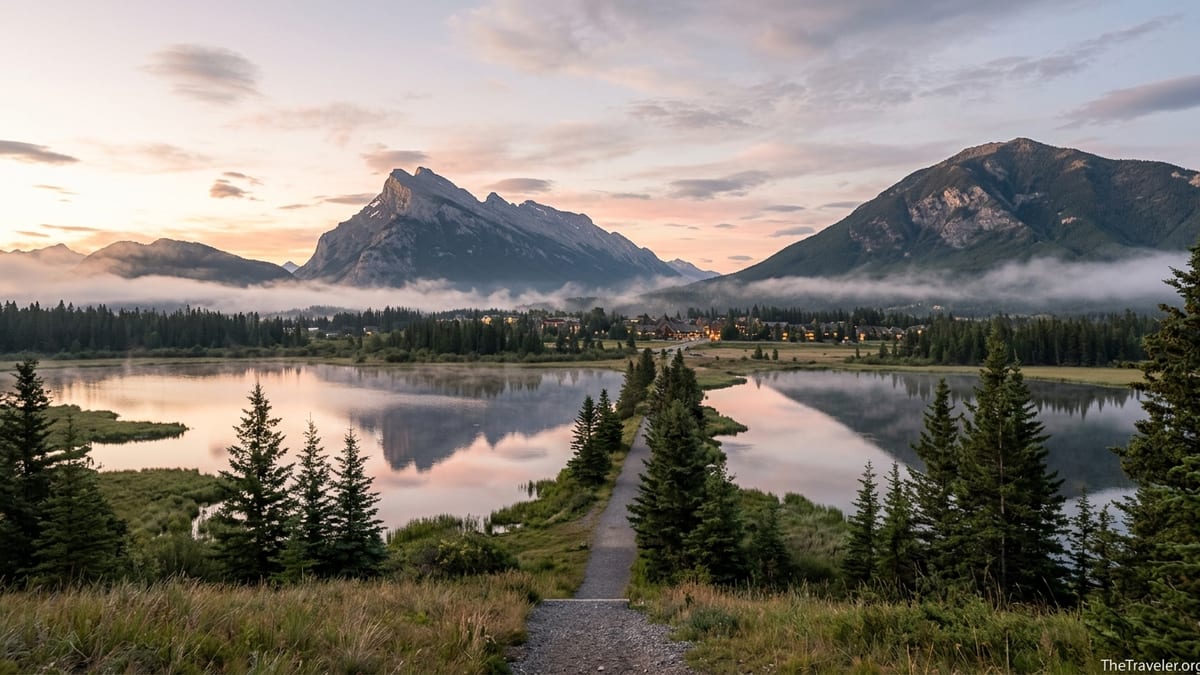
From Mining Claim to Canada’s First National Park
Banff’s rise began not with tourism brochures but with a few railway workers who stumbled onto steaming hot springs in the 1880s. The Canadian Pacific Railway was pushing tracks through what is now Banff National Park when employees discovered thermal pools on Sulphur Mountain. The federal government quickly asserted control over the area, setting aside a small reserve around the springs. That modest move in 1885 grew into Rocky Mountains Park, later renamed Banff National Park, the first national park in Canada and now one of the most visited protected areas in North America.
From the start, Banff was marketed as a destination rather than merely a scenic backdrop. The Canadian Pacific Railway promoted the park as a health and leisure resort for well-heeled travelers crossing the continent by train. Grand hotels were built to anchor that vision, most famously the Banff Springs Hotel, whose castle-like silhouette still looms above the Bow River valley. By the early 1900s, visitors were arriving not only to bathe in the hot springs but also to hike, ride horses and climb peaks, laying an early foundation for the mountain tourism culture that remains central to Banff’s identity today.
Crucially, the decision to create a national park placed conservation at the center of Banff’s story. As roads replaced rail as the primary means of access and private cars began pouring into the region by 1911, regulations limited development to specific townsites and protected the surrounding wilderness from unfettered expansion. This balance between access and preservation is one reason that modern visitors can still stand on Tunnel Mountain and look out over forested valleys that appear largely unchanged from century-old photographs, even as the town below has grown into a year-round resort hub.
International recognition helped cement Banff’s reputation. In 1985, Banff and neighboring parks in the Canadian Rockies were collectively declared a UNESCO World Heritage Site, highlighting both their striking landscapes and the importance of their protection. That designation still shows up in tour brochures and hotel marketing, reassuring travelers that Banff is not just beautiful but also globally significant in environmental and cultural terms.
Iconic Landscapes That Photograph Themselves
Plenty of mountain towns offer pretty peaks, but Banff is blessed with a concentration of postcard views that seem designed for the camera. Lakes like Louise and Moraine have become global shorthand for alpine beauty, their unreal turquoise color caused by “rock flour” suspended in the glacial meltwater. It is no exaggeration to say that millions of travelers have chosen Banff after seeing a single photograph of a red canoe floating on Lake Louise or the jagged Valley of the Ten Peaks reflected in Moraine Lake at sunrise.
That visual appeal is amplified by easy access. From the town of Banff, visitors can reach Lake Louise in about 40 minutes by car or bus along the Trans-Canada Highway. Once there, the Fairmont Chateau Lake Louise rises directly from the lakeshore, and a paved path rings the water, meaning even visitors with limited mobility can experience the classic view within minutes of stepping off a shuttle. Canoe rentals, while not cheap, are a quintessential experience; travelers regularly report paying well over 100 Canadian dollars per hour for a lakeside paddle in peak season, yet demand remains so high that queues often form on sunny afternoons.
Moraine Lake offers a different kind of drama. Since Parks Canada closed the road to private vehicles during the main season, access is now by shuttle or commercial tour, which has paradoxically increased the lake’s appeal. Visitors who secure a pre-booked shuttle seat, often for a little over 10 Canadian dollars per adult on the official bus or more with private operators, are rewarded with a short walk from the drop-off point to the rock pile viewpoint. From there, one of the most famous vantages in the Rockies opens before them. Photographers routinely arrive for pre-dawn departures from Banff or Lake Louise so they can be in place when the first light hits the Ten Peaks.
Beyond the headline lakes, Banff’s landscapes remain remarkably varied within a compact area. In a single day, a traveler can ride the Banff Gondola up Sulphur Mountain for a boardwalk walk along a high ridge, soak in the Banff Upper Hot Springs, drive the Bow Valley Parkway in search of wildlife and still be back in town in time for dinner. Tour companies in Banff routinely bundle these experiences into day tours that include transportation, gondola tickets and guiding, catering to first-time visitors who want to see as much as possible in a short trip.
Year-Round Adventure Capital of the Canadian Rockies
Another reason Banff enjoys a global profile is that it is not just a summer destination. The town and park have carefully cultivated a four-season identity, with winter now as crucial to Banff’s brand as hiking season. Skiers know the area as “Canada’s Big 3” thanks to the trio of major ski resorts within or adjacent to the park: Banff Sunshine, Lake Louise Ski Resort and Mount Norquay, all accessible on shuttle buses that run from town during the snow season.
Sunshine and Lake Louise in particular attract international visitors who plan entire holidays around ski weeks. Day lift tickets bought directly at the hill can approach or exceed 150 Canadian dollars for adults in high season, though multi-day passes and advance-purchase deals on resort or third-party websites often bring the per-day cost down significantly. Hotels in Banff build packages around these passes, bundling lodging, breakfast and ski shuttles into per-person nightly rates that make it easier for long-haul travelers from Europe, the United States or Asia to budget a full resort-style stay.
In summer and fall, hiking and backpacking step into the spotlight. Well-known day hikes like the Plain of Six Glaciers near Lake Louise or the Cory Pass loop above Banff can be reached via short drives or public transit, and trail conditions are regularly posted at visitor centers along Banff Avenue. Backcountry permits are required for overnight trips, and popular routes such as the Skyline-like experiences in neighboring parks or multi-day treks into Banff’s Sawback Range often book out months in advance through Parks Canada’s online reservation system, where a service fee is added to each booking. Travelers quickly learn to treat these backcountry trips like concert tickets: log on early on release day or risk missing out.
The Icefields Parkway, which links Banff and Jasper, extends the adventure beyond the immediate townsite. This road is repeatedly cited in travel media as one of the most beautiful highway drives in the world, and for good reason. Along the way, road pullouts lead to short walks to waterfalls, glaciers and turquoise rivers. Commercial sightseeing outfits based in Banff routinely sell full-day Icefields Parkway excursions that include transportation to the Columbia Icefield, a guided walk on a glass-floored skywalk above the valley and stops at lakes like Peyto or Bow. For travelers without rental cars, these tours convert what could feel like an inaccessible wilderness into a curated day out.
Infrastructure That Makes Wilderness Feel Manageable
Banff’s wild scenery might draw the eye, but the town’s infrastructure is what makes it practical for millions of visitors to enjoy that wilderness each year. The townsite itself is walkable, and local authorities have steadily shifted policies to reduce car congestion and encourage transit. Many central streets have paid parking, and new parking fees introduced at busy spots such as the Sulphur Mountain area and Lake Louise lakeshore mean that driving your own vehicle is no longer always the cheapest or easiest choice. At Lake Louise, for example, parking during the main summer season has reached over 40 Canadian dollars per day in recent years, pushing many cost-conscious travelers toward shuttle options.
Parks Canada and private operators have responded with a dense web of buses. In peak season, visitors can park at the Lake Louise Ski Resort lot and ride an official shuttle to both Lake Louise and Moraine Lake, paying a modest per-person fare plus a small reservation fee when booking online. Private companies based in Banff and Canmore run additional services, some starting as early as 4 am to cater to sunrise photographers. A traveler staying in downtown Banff might, for instance, walk from their hotel on Banff Avenue to a designated pickup outside a major hotel, ride a pre-booked shuttle to Moraine Lake for a few hours, then connect to Lake Louise and be back in town in time for dinner without ever having to search for parking.
Inside Banff itself, local buses run from the town center to popular spots such as the Banff Gondola, Upper Hot Springs and Tunnel Mountain campgrounds. Many visitors now leave their cars at lodging or in satellite lots and rely on transit day-to-day, both to avoid parking headaches and to reduce their environmental impact. Accommodation providers frequently include transit passes or discount codes for shuttle services in their nightly rates, a small perk that can save couples or families dozens of dollars over a multi-day stay.
Campgrounds and lodging have also evolved to meet modern expectations. Sites such as Tunnel Mountain and Two Jack Lake offer everything from traditional tent spots to “equipped camping” setups where Parks Canada supplies a ready-to-use tent, sleeping pads and basic gear at nightly rates that can sit in the 80 to 90 Canadian dollar range. These options appeal especially to first-time campers or international visitors who are not traveling with full camping kits but still want to sleep under the pines and listen for elk bugling at night.
Accessible Luxury Meets Small-Town Mountain Culture
Another factor behind Banff’s international fame is the way it blends high-end comfort with a down-to-earth mountain town feel. Travelers who want five-star service can check into properties like the Fairmont Banff Springs or the Rimrock Resort Hotel, book spa treatments after days on the slopes and dine at white-tablecloth restaurants offering multi-course tasting menus. It is not uncommon to see guests in plush robes in hotel hallways in the morning and then spot the same visitors later that day in ski gear waiting for the Sunshine shuttle out front.
At the same time, Banff still feels approachable for backpackers and budget-conscious travelers. On Banff Avenue, gear shops sell last-minute hiking boots and rental skis, and casual eateries serve burgers, pizza and ramen to a constant flow of people in puffy jackets. Hostels and simple motels provide cheaper beds a short bus ride from the center, and grocery stores allow visitors to self-cater, an important option for families or long-stay guests trying to manage costs in what is undeniably an expensive destination.
The town’s events calendar adds to this mix. Film festivals, mountain sport competitions and seasonal celebrations like winter light festivals and Pride events give Banff a cultural life that extends beyond simple sightseeing. For travelers, this means you might plan a trip around a signature event, such as a well-known mountain film festival in late autumn, then spend additional days skiing or hiking. Hotels capitalize on these moments by offering event-themed packages, bundling tickets and lodging into one price that simplifies planning.
Critically, the town operates at a scale that keeps everyday logistics manageable. Walking from one end of Banff Avenue to the other takes minutes, not hours, and many popular restaurants accept reservations or run efficient waitlists, meaning a family arriving at 6 pm on a summer evening can usually find a table after a short stroll and brief queue. This combination of small-town walkability and big-resort services is a large part of what keeps visitors returning and recommending Banff to friends.
The Digital Age Multiplier: Banff on Screens Around the World
While trains, highways and grand hotels laid the groundwork for Banff’s fame, smartphones and social media accelerated it. Over the past decade, images of Banff’s lakes and peaks have spread across Instagram, TikTok and travel blogs, turning specific viewpoints into global reference points. A traveler in Brazil or India who has never visited Canada may still recognize the color of Lake Louise or the silhouette of Mount Rundle from a friend’s feed.
This digital exposure creates very concrete effects on the ground. Guides in Banff report that clients frequently request stops at exact rocks or boardwalk curves they have seen online. At Moraine Lake, sunrise viewing areas can fill with tripods long before the sun clears the horizon, with travelers trading advice about camera settings and sharing real-time weather updates with friends at home. Outfits in Banff now offer “Instagram tours” that focus on the most photogenic sites, timing departures to lighting conditions and, in some cases, providing basic photo coaching as part of the experience.
Local businesses have adapted as well. Rental shops stock colorful canoes, stand-up paddleboards and even picnic setups that feature prominently in visitor photos. Cafes along Banff Avenue design dishes and latte art that photograph well, knowing that a single viral post can bring in a wave of new customers. Hotels invest in lobby design and rooftop terraces that showcase mountain views, turning common areas into backdrops for travel selfies that quietly double as free advertising.
At the same time, Parks Canada and the Town of Banff have used digital platforms to nudge behavior in more sustainable directions. Official websites and social channels emphasize shuttle use over private cars, promote lesser-known trails when headline routes get crowded and share real-time updates on wildlife sightings and closures. Travelers planning trips in 2026, for example, can read about pilot parking fees at Sulphur Mountain or the schedule for peak-season park-and-ride shuttles long before they arrive, allowing them to build public transit and walking into their itineraries from the start.
The Takeaway
Banff’s status as one of the world’s most famous mountain destinations did not happen overnight, nor is it based only on dramatic scenery. It is the product of early conservation, savvy promotion by rail and hotel companies, sustained investment in infrastructure and a modern embrace of digital storytelling. The result is a place where travelers can sleep in a 19th-century railway hotel or a simple tent, where they can ski powder in the morning and soak in a historic hot spring in the afternoon and where jaw-dropping photographs are often just a few steps from the parking lot or shuttle stop.
For would-be visitors, understanding this history and context makes the modern Banff experience easier to navigate. Knowing that parking at Lake Louise is expensive, that Moraine Lake shuttles often sell out, that lift tickets reward advance purchase and that campgrounds and town buses are part of a carefully managed system helps travelers make smarter choices. A couple might opt for a multi-day Discovery Pass and bus-based sightseeing rather than multiple day-park passes and downtown parking, or a family might plan their Moraine Lake visit around an early-morning shuttle instead of a last-minute drive.
Most important, Banff’s story offers a model for how a mountain destination can be both globally famous and still feel wild. By putting limits on where development can occur, charging entry and parking fees that reflect the true cost of managing crowds and continuously investing in trails, transit and interpretation, Banff has preserved much of what first drew visitors in the 19th century. Peaks still rise abruptly from forested valleys, elk still wander the golf course at dusk and, on clear nights, the Milky Way still arcs above the dark silhouettes of the Rockies, reminding travelers that beyond the hotels, buses and cameras, this is still first and foremost a protected mountain landscape.
FAQ
Q1. Do I need a park pass to visit Banff?
Yes. Every visitor traveling through Banff National Park, whether by car, bus or tour, must have a valid Parks Canada pass covering the dates of their stay. Daily and annual Discovery Pass options are available, and in 2026 there is a special period in late June to early September when general park admission is free for all visitors, though separate fees for services and parking still apply.
Q2. Why is Banff considered so famous compared with other mountain towns?
Banff combines several advantages: it was Canada’s first national park, it has iconic and easily accessible scenery like Lake Louise and Moraine Lake, it offers year-round activities and it has been heavily promoted for more than a century, from early railway posters to modern social media. This long history and constant visibility have made it a household name among mountain destinations.
Q3. When is the best time of year to visit Banff?
The best time depends on what you want to do. June through September offers the most reliable hiking and lake conditions, with all facilities open but also the biggest crowds. November through April is prime ski season at Sunshine, Lake Louise and Norquay. Shoulder seasons in May and October can be quieter and cheaper, though some high alpine roads and trails may still be snow-covered or closed.
Q4. How crowded does Banff get in summer?
In peak summer, especially July and August, Banff can feel very busy. Parking lots at Lake Louise and popular trailheads often fill early in the day, sidewalks on Banff Avenue are lively well into the evening and shuttle reservations to Moraine Lake can sell out. Travelers who prioritize early starts, use public buses and consider visiting in June or September typically find the experience more relaxed.
Q5. Is Banff suitable for budget travelers?
Yes, but it requires planning. Accommodation and dining can be expensive, especially in high season, yet there are hostels, basic motels and campgrounds that bring costs down. Using the town buses instead of taxis, cooking some meals with groceries from local supermarkets and choosing a few paid highlights, such as a gondola ride or canoe rental, rather than trying to do everything, can keep a Banff trip within a moderate budget.
Q6. Can I visit Moraine Lake and Lake Louise without a car?
Absolutely. Parks Canada runs seasonal shuttles from a park-and-ride near the Lake Louise Ski Resort to both lakes, and several private companies operate buses from Banff and Canmore. Tickets must normally be reserved in advance, and prices are charged per person rather than per vehicle, but the system allows visitors to see both lakes in one day without worrying about parking.
Q7. What are typical costs I should expect in Banff?
Costs vary by season and choices, but travelers often report daily park admission for adults in the low teens in Canadian dollars, summer parking at Lake Louise in the 40-dollar-per-day range, gondola tickets from roughly 60 dollars and up per adult and restaurant mains in town commonly in the 25 to 45 dollar range before tax and tip. Booking early and choosing some self-catered meals can help manage overall expenses.
Q8. Is Banff family-friendly for children and older travelers?
Yes. Many of Banff’s classic experiences are accessible to a wide range of ages and abilities. Lakeside paths at Louise and Minnewanka are relatively flat, gondolas and chairlifts whisk visitors to high viewpoints without long hikes and wildlife viewing can be done from scenic drives or short walks. Families often choose to combine easy strolls with more adventurous activities tailored to older kids or teenagers, such as rafting, biking or beginner-friendly hikes.
Q9. How do I avoid harming the environment when visiting Banff?
Travelers can reduce their impact by staying on marked trails, using shuttle buses instead of driving to every viewpoint, packing out all garbage, giving wildlife plenty of space and choosing accommodations and tour operators that emphasize sustainability. Simple habits, such as refilling a reusable water bottle at your hotel rather than buying multiple plastic bottles each day, also help protect the park.
Q10. Do I need to book everything in advance for a trip to Banff?
For peak summer and major holiday periods, advance booking is strongly recommended for hotels, campgrounds, Moraine Lake shuttles and some guided tours. In shoulder seasons you may find more last-minute availability, but securing at least your accommodation and key transport ahead of time is wise. Lift tickets, gondola rides and some attractions often cost less when purchased online before arrival, and early bookings give you more flexibility in shaping your itinerary.