


Every major city claims to have a “fast and easy” way to get from the airport into town. In Stockholm, that promise belongs to the Arlanda Express, the bright yellow train that links Arlanda Airport with Stockholm Central Station. I finally tried it on a recent trip, half expecting just another overpriced airport link. Instead, I came away with a mix of pleasant surprises, a few shocks, and some very practical lessons for anyone flying into Sweden’s capital.
Get the latest updates straight to your inbox!
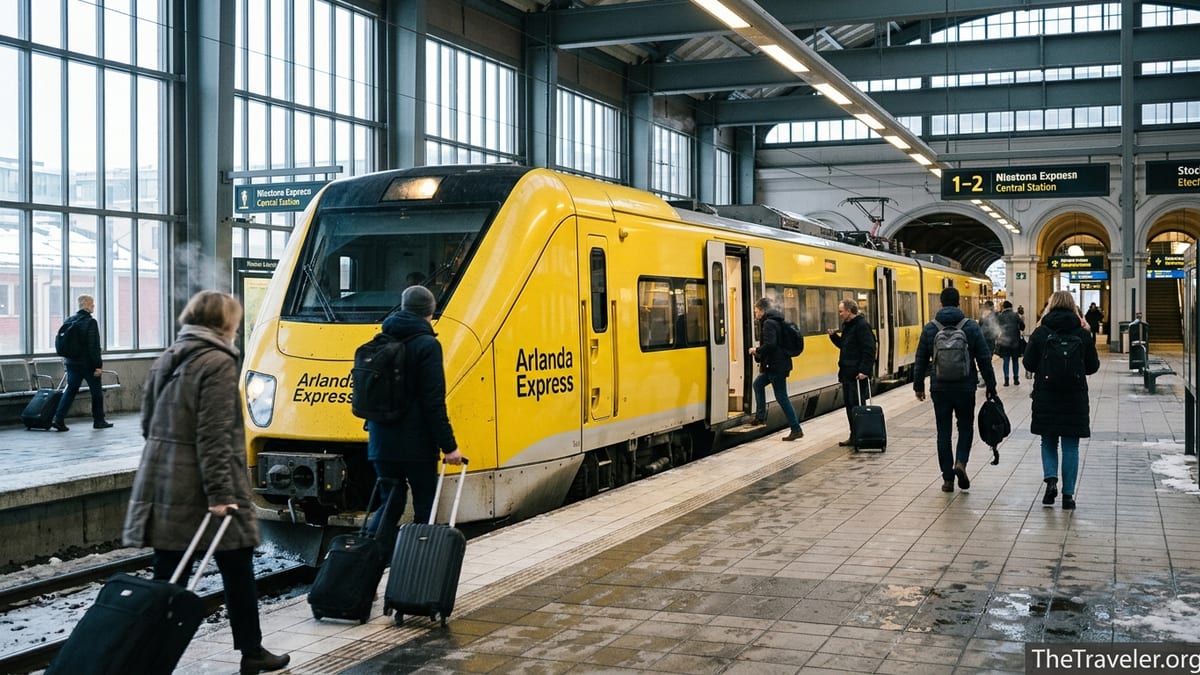
The First Surprise: It Really Is Only 18 Minutes
The biggest claim Arlanda Express makes is printed everywhere: 18 minutes between Stockholm Central Station and Arlanda Airport. I assumed that was marketing optimism. It was not. From the moment the doors slid shut at platform 1 of Stockholm Central to the moment they opened under the terminal, I timed exactly 18 minutes, with barely a gentle sway along the way. For an airport line that covers roughly 40 kilometers, that is impressive by any standard.
What makes that feel even faster is the lack of intermediate stops. The first time I rode in from the airport, we left Arlanda South station beneath Terminals 2–4, paused briefly at Arlanda North beneath Terminal 5, and then it was a nonstop sprint into the city. Looking at the screens above the doors, the list of stops is comically short: Airport, Airport, Central. Compared with the 35 to 40 minutes on the commuter train or 45 minutes on a typical airport coach, you do feel like you have somehow skipped a chapter of the journey.
There is also something psychologically calming about knowing exactly how long the ride will take. When your flight lands late in the evening and you are trying to work out if you can still make a dinner reservation or a last regional train, having a transfer that does not depend on Stockholm traffic or winter road conditions is a quiet luxury. In January, with the roads dusted in snow and taillights glowing red along the E4 motorway, watching the train glide past congestion is a genuine relief.
For travelers with tight connections, that reliability is the unsung benefit. On one trip I landed with only about an hour before my onward night train north. There was no way I would have risked a bus in heavy evening traffic. The Arlanda Express timetable, with departures roughly every 10 to 15 minutes during most of the day, is designed for precisely those situations where minutes matter.
Sticker Shock: The Price Tag You Need to Be Ready For
The second surprise hit even before I boarded: the price. As of mid‑2026, a standard one‑way adult ticket from Arlanda to Stockholm Central costs in the ballpark of a couple of hundred Swedish kronor. That pushes it into the same psychological bracket as short‑haul airfares within Europe and far above typical city‑to‑airport trains in places like Vienna or Berlin. If you walk up to the ticket machines without preparation, the total on the screen can feel abrupt.
Online, the debate around Arlanda Express pricing is intense. Locals frequently compare it with cheaper options: the regional “pendeltåg” commuter trains that run from Arlanda Central station via an airport supplement, or express buses operating between the terminals and Stockholm Cityterminalen. Commenters like to point out that a coach or FlixBus ride can cost a fraction of the Arlanda Express fare if booked in advance, while the airport supplement on commuter trains is a perennial sore point among residents who feel they are paying twice to travel on essentially the same rails.
That said, the value equation changes quickly when you factor in time, fatigue, and the rest of your travel budget. For a solo backpacker stretching every krona, that extra cost might be painful. For a couple arriving from a long‑haul flight with a limited number of vacation days, shaving half an hour off the transfer, plus the ease of rolling luggage directly onto a level train, may be worth far more than the difference in price. One Stockholm resident put it bluntly to me at the station: if you can afford a multi‑thousand‑krona flight, you can probably afford to budget a little extra for the smoothest possible airport transfer.
There are also deals if you know where to look. Arlanda Express regularly promotes advance purchase fares, youth discounts, and group tickets where several people traveling together pay a reduced total. Families with older children can, for example, sometimes bundle tickets so that parents pay full price while kids travel at a discount or, during special campaigns, even for free. The catch is that you need to buy in advance or at least be aware of the offers, which is why I now recommend checking the official site or app before you land instead of just paying the first price you see on a platform machine.
Navigating Stations: Easier Than Expected in a Foreign City
My third surprise came not on the train but in the stations. Major European hubs can be disorienting, especially after a long flight. Stockholm Central Station is Sweden’s busiest rail hub, handling hundreds of thousands of people daily, and it sprawls over multiple levels. I expected a bit of a maze. Instead, reaching the Arlanda Express platforms turned out to be remarkably straightforward.
The dedicated platforms for Arlanda Express are numbered 1 and 2 and are tucked on one side of Stockholm Central. From the main hall with its cafés, bakeries, and newsstands, you simply follow the bright yellow Arlanda Express signage and walk toward the far right of the station. There are escalators that bring you up to platform level, and suddenly you emerge into a quieter, almost self‑contained departure area with large windows, yellow branding, and staff in uniform. For travelers arriving on long‑distance trains or the Stockholm metro, that color coding is a welcome cue in a station otherwise full of blues and reds from other transport providers.
At the airport end, the setup is equally intuitive once you know there are actually three different rail stops under Arlanda. Arlanda Express serves two of them exclusively: Arlanda South below Terminals 2, 3, and 4, and Arlanda North under Terminal 5. For most international passengers arriving at Terminal 5, it is a matter of following the “Train to City” signs up an escalator or elevator and along a short corridor until the bright yellow machines and barriers come into view. The platforms are underground but well lit, and the presence of uniformed staff on the platforms makes it feel less intimidating than some cavernous airport train stations.
What surprised me most was how little walking was involved compared with some other big European airports. In London or Paris, you can easily find yourself trudging through tunnels for ten or fifteen minutes before reaching a rail link. At Arlanda, even from baggage reclaim, I was standing on the platform in roughly ten minutes at a comfortable walking pace, and on a subsequent trip, when I walked briskly with only a carry‑on, I made it in closer to five. For travelers with reduced mobility or heavy luggage, the combination of elevators and level access at the train doors is a quiet but important design win.
Onboard Comfort: A Mini Lounge Between City and Airport
I expected Arlanda Express to feel like a typical commuter train: functional, slightly worn, efficient but forgettable. Instead, it felt closer to a mobile airport lounge. The interiors are bright and modern, with a mix of forward‑facing seats and bar‑style counters where business travelers tap away on laptops. The lighting is soft rather than harsh, and the cars are noticeably clean, with broad aisles that make it easy to wheel suitcases to the luggage racks at the ends of each carriage.
One small but meaningful surprise was the amount of dedicated space for bags. Instead of awkward overhead racks or cramped shelves, there are clearly signed luggage zones near the doors and between seat blocks. On my midday journey, even with a full flight’s worth of passengers boarding at once, there was still room for several large checked suitcases per rack, plus cabin‑size bags. That alone removes a lot of the stress many travelers feel when they board a crowded commuter train after landing, wondering if there will be anywhere to park their belongings.
Connectivity is another area where the train quietly over‑delivers. Free onboard Wi‑Fi is now almost expected, but on some European rail services it can be patchy or slow. On my laptop, the connection was stable enough to download email attachments, check onward connections, and send a few photos home before the train even reached the halfway point. Power outlets at many seats mean you can give your phone a crucial top‑up after a long flight. For anyone arriving on a red‑eye, being able to plug in instead of hunting for a socket in a crowded arrivals hall is a small but very real luxury.
Most of all, the atmosphere is calm. Unlike buses that weave through traffic or older suburban trains with hard benches, Arlanda Express gives you 18 minutes of near‑silent gliding through the Swedish landscape. On an early morning ride in winter, I sat by the window, watching snowy pines and frozen fields slide past in a soft blue light. Around me, some passengers were already in work mode, others simply closed their eyes. It felt like a buffer zone, a chance to mentally arrive before hitting the rush of Stockholm Central.
Punctuality, Frequency and the Quiet Power of Predictability
Stockholmers are famously particular about punctual public transport, and Arlanda Express has built much of its reputation on precisely that. The line runs on its own dedicated tracks between the airport and the city, which reduces conflicts with slower regional trains and allows for tightly timed services. Internally, the operator has often highlighted high on‑time performance figures, and in normal conditions the trains feel almost metro‑like in their dependability.
For travelers, that reliability translates into less anxious clock‑watching. Services start early in the morning and continue late into the evening, with trains typically leaving every 10 or 15 minutes during the daytime peak. On one of my trips, a minor delay was announced as we waited at Stockholm Central. The board flicked from “on time” to a two‑minute delay, and there was an almost comical murmur among regulars on the platform. It was a reminder that for many commuters and frequent flyers, the train is such a fixed part of their routine that even tiny changes stand out.
Seasonal weather in Sweden can be brutal, especially in winter when snow, ice, and freezing rain can cause road chaos. That is where the predictability of a dedicated airport rail link becomes more than just a convenience. I spoke with a consultant who flies in and out of Stockholm several times a month. She described a January afternoon when a snowstorm had slowed traffic on the E4 to a crawl and several friends were stuck on airport buses for more than an hour. Her Arlanda Express train, by contrast, rolled into Stockholm just a few minutes behind schedule. She said she gladly pays the higher fare just to remove that kind of uncertainty from her travel days.
It is worth noting, of course, that no system is perfect. On some evenings, especially during maintenance periods or unexpected disruptions, trains can be crowded or temporarily less frequent. However, because tickets are typically valid across departures within a time window rather than being tied to a single train, most passengers simply board the next available service. That flexibility, combined with a generally high level of punctuality, is one of the least glamorous but most important reasons the line has become such a fixture of travel in and out of Stockholm.
Comparing Options: When Arlanda Express Makes Sense (and When It Doesn’t)
After a few trips, I stopped thinking of Arlanda Express as the automatic default and started seeing it as one choice among several. Whether it is the right option depends heavily on who you are traveling with, what time you arrive, and how tight your schedule is. For solo budget travelers arriving midday with no urgent connections, the cheaper airport coaches or the commuter train via Arlanda Central can make more sense. These alternatives usually take roughly twice as long but cost significantly less, especially if you already plan to buy a regional transport pass.
For couples or small groups with luggage, the calculation shifts. When two or three adults split the cost of Arlanda Express tickets, the per‑person difference from the bus narrows, while the benefits of speed, comfort, and station location grow. Arriving at Stockholm Central puts you within a short walk of many downtown hotels and one quick metro stop away from neighborhoods like Södermalm and Östermalm. Late at night, the idea of a quick, well‑lit walk from a central platform can be more appealing than waiting at an outdoor bus bay.
Families face a different trade‑off. Pushing strollers and wrangling tired kids through crowded buses can be stressful, and the step‑free access plus ample luggage space on Arlanda Express can make those 18 minutes far less chaotic. Many parents I spoke to said they were happy to pay more for a smoother start and end to their holiday. That said, if you are a family of five on a tight budget, the total cost of fares may tip you toward a slower but cheaper option, especially on daytime arrivals when you are not racing the clock.
There is also an environmental angle. Arlanda Express markets itself as a climate‑friendly way to travel between airport and city, highlighting electric traction and the ability to move large numbers of people quickly without cars. While it is hard to quantify exactly how many individual car journeys the train replaces, it certainly represents a relatively low‑emission link in what is otherwise a carbon‑intensive travel day. For some visitors, especially those already making conscious choices about trains within Europe instead of flights, that matters as much as the speed.
The Takeaway
By the time I had used Arlanda Express a handful of times, my view had evolved from mild skepticism to a nuanced appreciation. The train is not cheap, and anyone planning a trip to Stockholm should be prepared for that first moment of sticker shock at the ticket machine. But what I discovered is that, in practice, Arlanda Express delivers very precisely on what it promises: a fast, predictable, and remarkably stress‑free bridge between plane and city.
The biggest surprises were not just the 18‑minute journey or the polished interiors, but the way the entire experience has been engineered to remove friction. From clear yellow signage and level boarding to generous luggage space, stable Wi‑Fi, and frequent departures, the train quietly solves many of the small annoyances that usually plague airport transfers. In winter weather or when you are racing a tight connection, that design work becomes more than just a nice‑to‑have; it can be the difference between a relaxed arrival and a fraught scramble.
For travelers who value time, comfort, and predictability, Arlanda Express is often worth the premium. For those whose priority is saving every possible krona, the city offers slower but cheaper alternatives. The key is making an informed choice before you land, so that your first impression of Stockholm is not a panicked search for tickets, but a calm glide through pine forests on your way to one of Europe’s most elegant capitals.
FAQ
Q1. How long does the Arlanda Express journey between Arlanda Airport and Stockholm Central actually take?
The scheduled journey time is about 18 minutes from airport to city or vice versa, assuming normal operating conditions.
Q2. How often do Arlanda Express trains run during the day?
During most of the day, trains typically depart every 10 to 15 minutes in each direction, with slightly less frequent services early in the morning and late at night.
Q3. Where exactly do I catch the Arlanda Express at Stockholm Central Station?
You board Arlanda Express at platforms 1 and 2 on the upper level of Stockholm Central Station, in a clearly signed yellow‑branded area on the station’s side.
Q4. Which airport terminals does Arlanda Express serve?
The train serves two underground stations at the airport: Arlanda South for Terminals 2, 3, and 4, and Arlanda North for Terminal 5 and nearby services.
Q5. Can I buy tickets onboard or do I need to purchase them in advance?
You can usually buy tickets from machines or staff before boarding, and there are also app and online options; advance purchase can unlock better deals.
Q6. Is Wi‑Fi available on the Arlanda Express train?
Yes, Arlanda Express offers free onboard Wi‑Fi along with power outlets at many seats, so you can check email or plan your stay during the short ride.
Q7. Is the Arlanda Express accessible for travelers with reduced mobility?
The platforms and trains are designed for step‑free access, with level boarding and space for wheelchairs, making it one of the more accessible options.
Q8. How does Arlanda Express compare in price with buses or commuter trains?
It is usually significantly more expensive than airport buses or commuter trains, but faster and more comfortable, so travelers weigh cost against time and convenience.
Q9. Are there discounts for children, youth, or groups on Arlanda Express?
Yes, there are often reduced fares for young travelers and group or campaign offers, so families and groups should check for current discounts before buying.
Q10. What happens if my flight is delayed and I miss the specific train I planned to take?
Tickets are generally valid for a time window rather than a single departure, so if you miss one train you can usually board the next available service without issue.