


Few airport trains spark as much debate as Stockholm’s Arlanda Express. At around 340 SEK for a standard one way adult ticket, it is one of Europe’s pricier airport links. In return, it promises a fast, stress free, downtown to terminal run in under 20 minutes. For some travelers it is an easy yes. For others it feels like a splurge when cheaper buses and commuter trains run the same route. Whether Arlanda Express is worth the price depends on how you value time, money and comfort on the specific trip in front of you.
Get the latest updates straight to your inbox!
What the Arlanda Express Actually Offers
The Arlanda Express runs between Stockholm Central Station and Stockholm Arlanda Airport in roughly 18 minutes, making it the fastest public transport option on the route. Trains usually depart every 15 minutes in daytime and early evening, and somewhat less frequently late at night and early in the morning. For travelers landing at Terminal 4 or 5 and heading to central Stockholm, it delivers a simple, one seat ride directly into the heart of the city, with platforms just below the main concourse.
As of early 2026, a standard adult ticket for ages 26 to 64 costs about 340 SEK one way or 640 SEK return when bought through Arlanda Express channels. Youth tickets for ages 18 to 25 and promotional student tickets are typically around 160 SEK one way, essentially half price, and there are regular deals for groups and advance purchases. Children traveling with paying adults ride free under the operator’s current rules, which can change the value equation significantly for families.
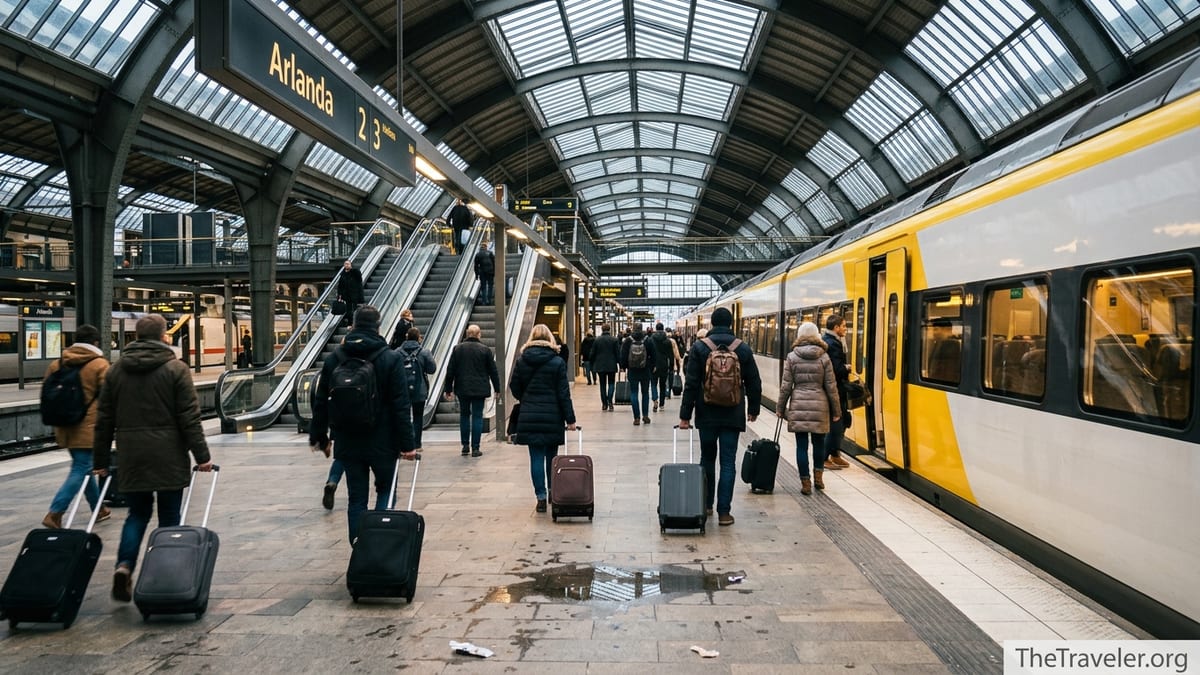
On board, the experience is closer to an intercity rail service than to a city commuter train. Trains are modern, with Wi Fi, luggage racks near the doors and overhead, and wide aisles that make it easy to roll a big suitcase to your seat. Seats are generally clean and comfortable with power outlets at many places. The train is also fully integrated into the terminals: you walk directly from arrivals into the station area without going outside, which feels especially welcome in winter or in bad weather.
For many business travelers, the core appeal is predictability. In normal conditions, the train time barely varies: about 18 to 20 minutes platform to platform. Even if the airport access roads are congested, the train timetable is usually reliable. If you have a morning flight and are staying within walking distance of Stockholm Central, that reliability is part of what you are paying for when you choose the Arlanda Express over buses or taxis.
How It Compares to Buses and Commuter Trains
To decide if Arlanda Express is worth the price, it helps to compare it with real alternatives on the same route. The most common competitors are Flygbussarna and similar airport coach services, as well as the SL commuter train that runs via Arlanda Central station. Each option balances time, cost and convenience slightly differently.
Airport buses such as Flygbussarna typically cost around 120 to 140 SEK one way for an adult when booked online in advance, and they often run every 10 to 20 minutes for much of the day. Journey times are advertised around 40 to 45 minutes between Arlanda and Stockholm Cityterminalen, which is adjacent to the central rail station. In light traffic late at night you might arrive faster, while in rush hour you can easily add 15 minutes or more. In practice, taking a bus instead of Arlanda Express can save a solo traveler around 200 SEK on a one way trip in exchange for roughly an extra 20 to 30 minutes of travel plus exposure to road traffic.
The SL commuter train, branded as the pendeltåg, splits the difference between speed and price. From Arlanda Central station to Stockholm City station the ride takes about 38 minutes, roughly twice as long as Arlanda Express. However, with an SL travelcard covering Stockholm public transport you only pay an airport supplement, which is markedly cheaper than a full Arlanda Express ticket. If you are staying several days in Stockholm and already plan to buy a 72 hour or 7 day SL pass for the metro and buses, the marginal cost of using the commuter train to and from the airport can be significantly below the Arlanda Express fare, especially for budget conscious travelers.
Taxis and ride hailing services form the last major category. A typical fixed fare taxi from Arlanda to central Stockholm can run to 600 or 700 SEK or more, depending on company and traffic, but it provides a door to door ride with no need to manage bags on and off trains. For a couple with heavy luggage staying in a hotel far from the central station, a taxi can cost only a little more than two full price Arlanda Express tickets while eliminating a transfer. For a solo traveler staying a short walk from Stockholm Central, the Arlanda Express is usually both faster and cheaper than a taxi, although less flexible if you are landing at odd hours or traveling with mobility challenges.
When the Price Makes Sense
There are clear scenarios where the higher price of the Arlanda Express is easy to justify. One common example is the short trip business traveler. Imagine you land on a winter Monday morning from Frankfurt with only a carry on bag and a meeting near Stockholm Central at 09:30. The scheduled landing at Arlanda Terminal 5 is 08:30. Taking Arlanda Express, you can be at Stockholm Central around 09:00 with very little stress, leaving margin for a quick coffee or a short walk to the office. An airport bus leaving around the same time might not get you into the city until close to your meeting start, leaving less room for delays and unexpected queues.
Another scenario is the late evening arrival. If you land around 23:00, bus services may be less frequent and the roads can still be busy after a congestion event or roadworks. The Arlanda Express, when operating normally, offers a fixed timetable and keeps you indoors from gate to train. Many travelers describe the psychological comfort of stepping into a warm, bright train station attached to the terminal, knowing they will be downtown in under half an hour including walking and waiting. For some, especially those arriving with children or after a very long flight, that convenience is worth the premium fare.
The train can also be compelling for families who make use of its child policies. A couple traveling with two children who ride free with adult ticket holders might pay 640 SEK total for two adult return tickets if booked at once. Split over four people for the round trip, that comes to 160 SEK per person to travel swiftly and comfortably between airport and city twice. In this sort of case the Arlanda Express begins to look more competitive compared to paying separate bus tickets for each family member.
Group discounts further tilt the equation. For example, Arlanda Express sells one way group fares where additional adults traveling on the same train pay a much lower add on price. Three adults traveling together might pay significantly less per person than a solo traveler. For a small team arriving together for a conference, the per person cost difference between Arlanda Express and the bus can shrink to tens of kronor, while the benefits of speed and a shared, predictable arrival become more valuable.
When Cheaper Options Win Out
Equally, there are many situations where the premium for Arlanda Express is hard to defend. The most obvious is the budget backpacker or student traveler staying a longer time in Sweden. If you land midday, have no tight schedule and plan to buy an SL travelcard to use the metro and buses, taking the commuter train or a bus often cuts your airport transfer cost by half or more. With a youth or student discount, Flygbussarna and similar buses become particularly attractive, and the extra 20 to 30 minutes in transit may feel trivial against the savings.
Consider a solo visitor on a long weekend who buys a 72 hour SL travelcard to explore neighborhoods such as Södermalm, Vasastan and Djurgården. If this traveler opts for the commuter train via Arlanda Central instead of Arlanda Express, they pay the airport supplement on top of the travelcard, but not a full 340 SEK fare each way. For someone who values stretching their budget across meals, museums and nightlife, that difference can cover a good dinner in Gamla Stan or a ticket to a gallery.
Travelers staying outside central Stockholm also gain less from using Arlanda Express. If your accommodation is in an outlying suburb or in Uppsala, you will likely need at least one transfer after arriving at Stockholm Central, sometimes retracing part of your route by commuter train or metro. In such cases a regional train or direct coach line that stops closer to your final destination, or the SL commuter train with one connection, can be more efficient overall even if the airport to city segment is slower.
The train’s value also drops when only a small slice of your trip budget is available for ground transportation. For price sensitive travelers booking low cost flights and hostels, the jump from about 130 SEK for a bus to 340 SEK for Arlanda Express can feel disproportionate. On a tight itinerary, saving over 400 SEK on the round trip by choosing slower options can free up funds for experiences in the city that matter more than reducing one transfer by 20 minutes.
Comfort, Stress Levels and Real Time Risks
Beyond duration and price, comfort and stress are important but subjective factors. Arlanda Express trains are usually quiet, with more space for luggage than on city buses. You step straight off the station platform into the main station hall, and from there you are a short walk to metro lines, regional trains and taxis. For travel at peak times or in winter storms, it can feel much calmer than queuing curbside for buses in the cold or sitting in a coach during heavy traffic on the E4 motorway.
Yet there are trade offs even here. With Arlanda Express you are dependent on a single operator using a dedicated line. When things work, they work very well. When disruptions occur, alternatives can quickly grow crowded. Buses and commuter trains use different infrastructure and can sometimes recover more quickly from specific faults on the airport line. Travelers who experienced service interruptions have described having to pivot at short notice to buses or taxis, sometimes queuing with hundreds of others with the same idea.
Buses, by contrast, can feel more cramped when they are full, especially if a flight has just unloaded a large group of passengers. Luggage racks fill up, aisles get blocked, and moving to an empty seat can be hard with a big suitcase. However, the coach seats themselves are often reasonably comfortable for the 40 to 50 minute ride, and the direct drop off at Cityterminalen works well for many central hotels. For some travelers, the small increase in crowding is a fair price to pay for halving the fare.
On the commuter train, comfort is mixed. These trains are designed for local commuters and may be busy during rush hours. Luggage space is not as generous as on Arlanda Express, and you might find yourself standing for parts of the ride if you travel during peak times. On the other hand, the carriages are modern and well lit, and if you board at Arlanda Central rather than an inner city station you often have a good chance of finding a seat, particularly outside the weekday peaks.
Practical Tips for Getting the Best Value
If you decide to use Arlanda Express, timing and ticket choice can significantly improve value. Buying return tickets rather than two separate singles typically saves money if you are sure you will be flying back from Arlanda within the validity period of the ticket. Online advance purchases occasionally include promotional discounts, and group fares for two or three adults traveling together can bring the price per person closer to that of the bus.
Youth and student discounts are important for many visitors. The standard youth fare applies to travelers aged roughly 18 to 25, and there are sometimes additional promotions for students who can show valid student identification through partners. If you fit this category, you are more likely to find Arlanda Express worth it because your price can drop to around 160 SEK, the same as some child fares. Always double check the current age limits and conditions directly with the operator shortly before travel, as these promotions and eligibility rules can change.
For those who do not choose Arlanda Express, a little planning can keep cheaper alternatives smooth. If you favor airport buses, buying tickets online in advance guarantees your place on a specific departure and may lock in a lower price than paying on the spot. Build in extra buffer if you are traveling during weekday afternoon peaks or winter weather when traffic is more likely to cause delays. With the commuter train, understand where Arlanda Central sits in relation to the terminals and how to transfer between the train station and terminal buildings using the airport’s internal walkways and shuttle systems.
Whichever mode you pick, consider your entire door to door journey. If you are staying near Slussen, for instance, an Arlanda Express ride to Stockholm Central plus a metro transfer might be only marginally faster than taking a direct airport bus line that stops close to your hotel. Conversely, if your hotel is directly above Stockholm Central Station, Arlanda Express that delivers you to the basement platforms can be nearly door to door and uniquely convenient.
The Takeaway
So is the Arlanda Express worth the price? For travelers who place a premium on speed, predictability and an easy station to terminal connection, the answer is often yes. The 18 minute journey and central arrival point suit tight business schedules, late night arrivals, winter trips and stays in the areas immediately around Stockholm Central. Younger travelers benefiting from youth fares and families whose children travel free can also find the cost per person surprisingly reasonable, especially on return or group tickets.
For those on tighter budgets, with flexible timetables, or whose accommodation lies outside central Stockholm, the calculus shifts. Airport coaches and the SL commuter train provide slower but much cheaper routes that keep more of your travel budget available for experiences in the city instead of the stretch of track between downtown and the runway. If you are willing to trade off 20 to 30 extra minutes in transit and a bit more uncertainty from traffic, these alternatives commonly offer better value.
Ultimately, the decision is less about whether Arlanda Express is objectively expensive, and more about what your time and stress level are worth on this particular journey. Before you land, run the actual numbers for your dates, party size and hotel location, comparing the total trip time and total cost door to door. In many cases you will find the answer is clear. Either the train’s speed and simplicity are exactly what you need, or the slower savings of the bus or commuter rail fit your priorities better.
Think of Arlanda Express as a premium service that sometimes earns its premium. Used thoughtfully, it can be a calm, efficient bridge between Stockholm’s runways and its city streets. Used by habit when cheaper options would do just as well, it can quietly eat into a travel budget that might otherwise be spent enjoying everything the Swedish capital has to offer.
FAQ
Q1. How much does a one way ticket on the Arlanda Express cost?
A standard adult one way ticket is around 340 SEK, with discounted youth fares at about half that price and occasional promotions for groups and return tickets.
Q2. How long does the Arlanda Express take compared with buses?
Arlanda Express takes about 18 to 20 minutes between the airport and Stockholm Central, while airport buses generally take around 40 to 50 minutes depending on traffic.
Q3. Is the Arlanda Express worth it for solo budget travelers?
Often it is not. Solo travelers on a budget usually save more by using airport buses or the SL commuter train, trading a bit of extra travel time for a significantly lower fare.
Q4. Does the Arlanda Express offer discounts for students or young people?
Yes. There is a youth category typically covering ages 18 to 25 at a reduced price, and at times extra student discounts are offered through partner programs for those with valid student ID.
Q5. What is the best option for families with children?
For families, Arlanda Express can be attractive because children traveling with paying adults often ride free, which lowers the effective cost per person and combines with the speed and comfort of the train.
Q6. How does the SL commuter train compare to Arlanda Express?
The commuter train takes about twice as long at roughly 38 minutes but can be much cheaper, especially if you already have an SL travelcard and only need to pay the airport supplement.
Q7. Is Arlanda Express reliable in bad weather or during rush hour?
Generally yes. Because it runs on its own tracks, journey times are usually stable even when the roads are congested, though like any rail service it can occasionally face disruptions.
Q8. When is it better to take a taxi instead of the Arlanda Express?
A taxi can make sense for late night arrivals, heavy luggage, mobility concerns or when several people are traveling to an address far from Stockholm Central and can share the fixed fare.
Q9. Can I buy Arlanda Express tickets at the airport on arrival?
Yes. You can buy tickets at machines and service points in the terminal and station area, as well as through the operator’s digital channels if you prefer to arrange them on your phone.
Q10. How far in advance should I decide whether to use Arlanda Express?
You can often decide even on the day, but comparing prices and schedules a few days before you travel helps you choose between the train, bus, commuter rail or taxi with a clear picture of costs and timings.