


More news on this day
India’s railway network is poised for a historic capacity boost as plans move ahead to expand seven high-density routes, which carry a disproportionate share of the country’s train traffic, into four-track corridors designed to ease congestion, speed up trains and support economic growth.
Get the latest news straight to your inbox!
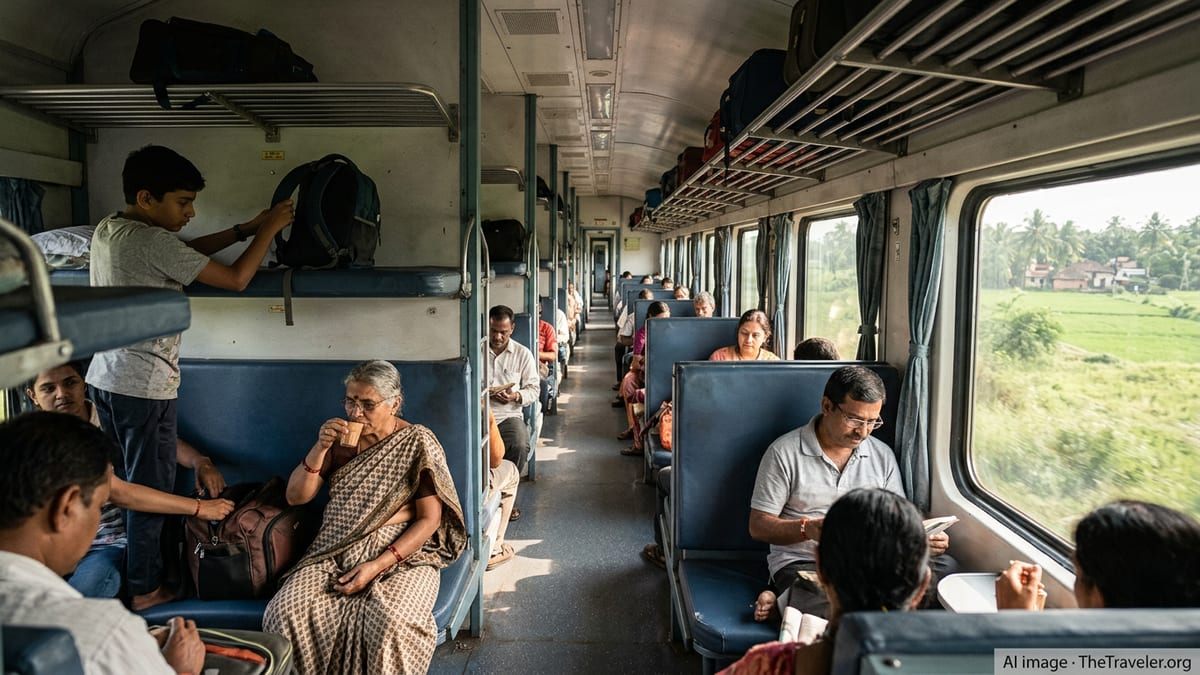
Seven High-Density Corridors at the Heart of the Network
Publicly available government data and recent media coverage describe the seven high-density routes as the backbone of Indian Railways, connecting Delhi, Mumbai, Howrah (Kolkata), Chennai and Guwahati. These corridors are identified as Delhi–Howrah, Howrah–Mumbai, Delhi–Mumbai, Delhi–Guwahati, Delhi–Chennai, Howrah–Chennai and Mumbai–Chennai, forming what is often referred to as the Golden Quadrilateral and its diagonals, along with the vital gateway to the northeast.
Reports indicate that this high-density network spans roughly 11,000 kilometres, or about 16% of the national route length, yet handles around 41% of total rail traffic. Much of this system has long operated at or above full capacity, with several sections routinely recording line utilisation above 100%, particularly where heavy passenger flows intersect with bulk freight such as coal, steel and cement.
Past analyses from policy think tanks and parliamentary documents have repeatedly highlighted these routes as critical bottlenecks for both freight mobility and intercity passenger services. The new initiative to systematically expand them to four tracks is framed as a structural response to those long-standing constraints rather than an incremental tweak.
Quadrupling Tracks to Unlock Capacity
New reporting from Indian business and national dailies states that Indian Railways intends to convert the entire 11,000-kilometre high-density network into four-lane corridors, with multiple sections already carrying more than two tracks. The plan involves a mix of third and fourth lines on double-track stretches and, where necessary, fifth and sixth lines on the most saturated approaches to major hubs.
According to recent explanatory coverage, this multitracking push builds on earlier phases that focused on doubling and selective tripling of key sections. Many stretches on the Howrah–Mumbai and Delhi–Howrah axes already have three or more tracks, but remaining bottlenecks, junction throats and single bridges still constrain overall throughput. Systematically stitching these upgraded segments into continuous four-track corridors is expected to provide a step-change in available capacity.
Financial outlays for specific packages, such as new third and fourth lines or doubling schemes in Andhra Pradesh, Karnataka and Jharkhand, have been detailed in government releases over the past year, underscoring that work is being advanced through a series of sanctioned projects rather than a single monolithic contract. Timelines reported for some of these schemes typically range from three to five years, suggesting that the full four-lane vision will be realised in phases through the late 2020s.
Signalling, Speed and Reliability Upgrades
The multitracking program is being paired with technology upgrades designed to extract more capacity and improve safety from each kilometre of the high-density network. Economic survey documents and railway yearbooks note the accelerated rollout of Automatic Block Signalling, which shortens the distance between trains and allows more services to run safely on the same infrastructure.
In parallel, Indian Railways is expanding deployment of its indigenous automatic train protection system and centralised traffic control on busy corridors. These systems aim to reduce human error, streamline operations and support higher speeds for both passenger and freight traffic. Policy analyses linked to the National Rail Plan point out that average freight speeds have historically hovered around 25 to 30 kilometres per hour, and raising this figure is seen as essential for improving logistics performance.
On passenger routes, the new tracks are expected to work in tandem with upgraded rolling stock, including semi-high-speed trains, to lift average journey speeds where curvature and terrain permit. Recent commentary around the high-density plan suggests that design speeds of up to 160 kilometres per hour are being targeted on several sections once track, signalling and fencing standards are raised, though actual operating speeds will vary by corridor.
Economic, Environmental and Travel Impacts
Government communications and sector analyses present the high-density expansion as a cornerstone of India’s wider infrastructure and logistics strategy. By easing chronic congestion on trunk routes, the additional tracks are expected to enable more freight paths at predictable timings, benefiting power plants, ports, industrial clusters and agricultural supply chains that rely on rail to move bulk commodities.
For passengers, the creation of parallel tracks offers scope to separate fast and slow services, reducing knock-on delays that ripple across the timetable whenever a disruption occurs. Observers note that this separation can make it easier to timetable premium express and semi-high-speed trains alongside regional and long-distance stopping services without the two constantly competing for scarce path slots.
The expansion is also being positioned as an environmental measure. Public posts by senior policymakers have compared the emissions profile of rail with that of road transport, arguing that shifting more freight from trucks to electrified rail corridors can lower logistics costs while cutting greenhouse gas emissions. As more of the high-density network is electrified and modernised, proponents say the relative climate advantage of rail could widen further.
Challenges in Delivering a Historic Upgrade
Despite its scale and ambition, the high-density capacity boost faces several practical hurdles. Land acquisition and environmental clearances along densely populated or ecologically sensitive sections can slow progress, especially where additional tracks require new alignments, bridges or realignment of station yards. Stakeholder consultations and legal processes add further complexity.
Engineering works on live, highly utilised corridors also pose operational challenges. To install new lines, remodel junctions or commission updated signalling, railway authorities must plan extensive traffic blocks while keeping essential passenger and freight services moving. Recent progress reports on individual projects show that this often leads to phased commissioning to minimise disruption.
Funding is another consideration. Budget documents and independent analyses describe sustained capital expenditure on rail infrastructure, but also highlight the need to prioritise among competing demands, from station redevelopment and rolling stock modernisation to dedicated freight corridors and new lines. Ensuring that the multitracking of high-density routes remains adequately financed over several budget cycles will be crucial to turning the four-lane vision into reality.
Even with these challenges, the combination of committed projects, technology upgrades and a clear strategic focus on the seven high-density corridors suggests that India’s core rail network is entering a period of significant transformation, with long-lasting implications for how people and goods move across the country.
Sources: The Indian Express; Mint; Press Information Bureau; PRS Legislative Research; Indian Railways Year Book