


More news on this day
Japan’s Tokaido Shinkansen, long defined by daytime speed, has entered the overnight era with the Tokaido Lumiere Express, a new limited-run service between Tokyo and Osaka that turns an eight-hour pause in operations into a full night of travel.
Get the latest news straight to your inbox!
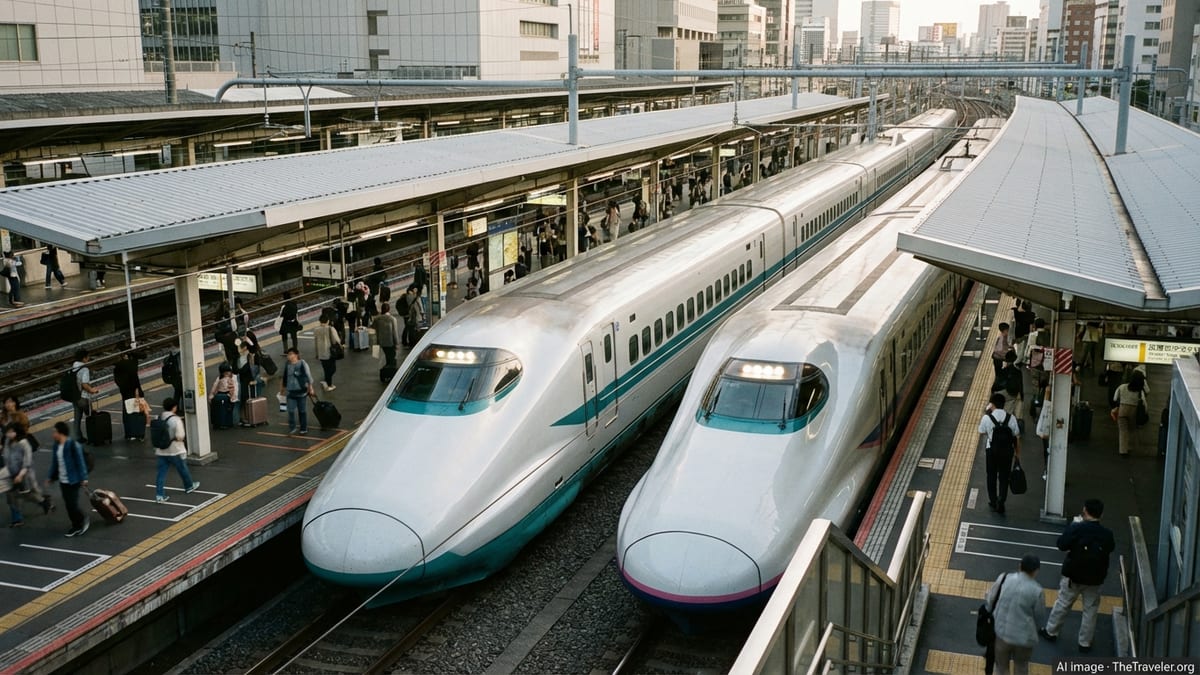
A Historic First for the Tokaido Shinkansen
The Tokaido Lumiere Express operated its inaugural run on August 8 2026, leaving Tokyo Station at 10 pm and arriving at Shin-Osaka at 6:59 am the following morning. Publicly available reporting describes it as the first commercially operated Tokaido Shinkansen service to “cross the night” rather than run entirely in daytime hours.
For decades, regular Tokaido Shinkansen trains have been restricted to a daytime window, with the last Nozomi from Tokyo to Shin-Osaka typically departing shortly after 9 pm and the first morning train leaving at 6 am. Overnight, the high-speed tracks are reserved for intensive maintenance and noise-control requirements, leaving an eight-hour gap in passenger operations between the country’s two largest metropolitan areas.
The Lumiere Express is designed to fill that gap. Instead of racing between Tokyo and Osaka in a little over two hours, as the fastest Nozomi services do, the overnight train stretches the journey to just under nine hours, functioning less as an express dash and more as a rolling alternative to a hotel room.
The name “Lumiere,” drawn from the French word for light, is presented in marketing materials as a nod to early-morning arrival and the idea of starting a new day already in the destination city.
How an Overnight Bullet Train Works
The key to making an overnight Shinkansen possible lies in how the Lumiere Express uses time rather than speed. According to detailed route descriptions from Japanese rail media, the train calls at Tokyo, then continues via Shinagawa and Shin-Yokohama before heading west and reaching Gifu-Hashima just before midnight.
Once at Gifu-Hashima, the train remains stationary for around six and a half hours while routine track inspections and maintenance proceed elsewhere on the line. Reports indicate that doors are opened twice during this extended stop, for roughly 30 minutes shortly after arrival and again in the pre-dawn hours, allowing passengers to stretch their legs, visit platform vending machines, or access station facilities.
In timetable terms, the train resumes its journey around 5:25 am, stopping at Kyoto at approximately 6:44 am before continuing to Shin-Osaka, where it arrives just before 7 am. The result is an overnight schedule that departs later than the standard final Nozomi but arrives earlier than the first morning one, effectively creating new usable hours at both ends of the trip.
Operationally, the train uses a standard 16-car N700-series Shinkansen set. The speed profile remains that of a conventional high-speed service outside the long stationary period, preserving the core Shinkansen attributes of smooth ride, punctuality, and high capacity once the train is in motion.
Pricing, Seating and Who It Is For
The Tokaido Lumiere Express is not sold as a normal point-to-point ticket. Seats are bundled into JR Central Tours travel products, with fares for the inaugural Tokyo or Shinagawa to Shin-Osaka journey set at 15,000 yen for ordinary-class cars and 20,000 yen for green cars, according to Japanese-language fare breakdowns from domestic outlets.
One of the defining features is the seating arrangement. Only window seats are sold in both ordinary and green cars. In ordinary class, A and E seats are offered, while B, C and D seats remain unsold, ensuring no immediate seatmate for window passengers. In green cars, A and D seats are used, applying the same principle. This layout creates more personal space without the need for full sleeping berths or compartments.
Reports further indicate that six of the 16 cars on the inaugural run were marketed as women-only cars, spanning several ordinary-class cars and a green car. The configuration suggests a deliberate attempt to address safety and comfort concerns that can be associated with overnight travel, and to differentiate the product from conventional night buses.
From a cost perspective, the 15,000 yen package undercuts the typical combined fare of a standard Tokaido Shinkansen ticket on this peak August date, while also allowing passengers to avoid paying for a separate hotel night. That positions the Lumiere Express somewhere between budget overnight buses and premium day-time rail or air travel, especially attractive for leisure travelers planning early-morning activities in Kansai.
Demand, Expansion Plans and Competition
Interest in the service appears strong. Coverage in domestic transport media notes that all 502 seats, including 100 in green class, sold out within about two days of going on sale on July 3. The timing coincided with Japan’s busy summer travel season, when accommodation in Tokyo and Osaka can be both expensive and scarce.
JR Central has publicly framed the overnight experiment in the context of rising hotel prices and growing demand for nighttime mobility between major urban regions. The Lumiere Express allows passengers to depart after work in Tokyo and still arrive in Osaka early enough to begin a full day, mirroring the logic that once supported classic overnight sleeper trains on conventional lines.
Following the inaugural trip, the company has scheduled additional Lumiere Express runs during Japan’s “Silver Week” holiday period in September. Announcements indicate that the same Tokyo to Shin-Osaka overnight pattern will be repeated on selected dates, suggesting that the operator is testing demand across multiple high-traffic periods before considering any wider rollout.
The experiment also plays into a broader competitive landscape. On the Tokyo–Osaka corridor, daytime Shinkansen services, domestic flights and highway buses already offer dense capacity and varied price points. An overnight bullet train introduces a new niche: passengers willing to trade speed for an extra day in their destination and for the comfort and reliability associated with Shinkansen rolling stock.
What It Means for Japan’s Sleeper-Train Future
The Lumiere Express arrives after years in which traditional overnight services in Japan have steadily disappeared. Iconic long-distance sleepers such as the Ginga between Tokyo and Osaka, which once ran on the conventional Tokaido Main Line, were phased out as air travel and high-speed rail eroded demand. Today, regular overnight operations are largely limited to a small number of conventional express services.
By using existing high-speed infrastructure in an unconventional way, the overnight Shinkansen trial effectively reimagines the sleeper concept. Rather than constructing dedicated sleeper cars or deploying bespoke rolling stock, JR Central is using standard N700 equipment, modified scheduling and tour-style ticketing to test whether overnight travel habits can coexist with modern high-speed operations.
The project is unfolding alongside other premium initiatives on the Tokaido corridor, such as the introduction of “Supreme Class” private cabins on selected daytime trains from October 2026. Together, these moves signal an effort to diversify Shinkansen offerings at both the high-comfort and time-efficient ends of the market, while maintaining the core daytime timetable that underpins business and commuter travel.
Whether the Lumiere Express remains an occasional special service or evolves into a more regular overnight option will depend on how consistently it can attract travelers beyond the initial novelty phase. For now, the experiment is giving passengers a rare chance to spend a full night aboard a Tokaido Shinkansen, waking up with the morning light in Osaka.
Traicy Japanese-language feature on the Tokaido Lumiere Express
Traicy Global report on JR Central’s first overnight Tokaido Shinkansen
Time Out coverage of Japan’s first overnight Tokyo–Osaka bullet train