


More news on this day
Volcanic ash from Indonesia’s Anak Krakatau has stranded an estimated 170,000 travellers after a major weekend eruption forced the closure of multiple airports, including Jakarta’s main international gateway, and triggered days of cascading flight cancellations across the archipelago.
Get the latest news straight to your inbox!
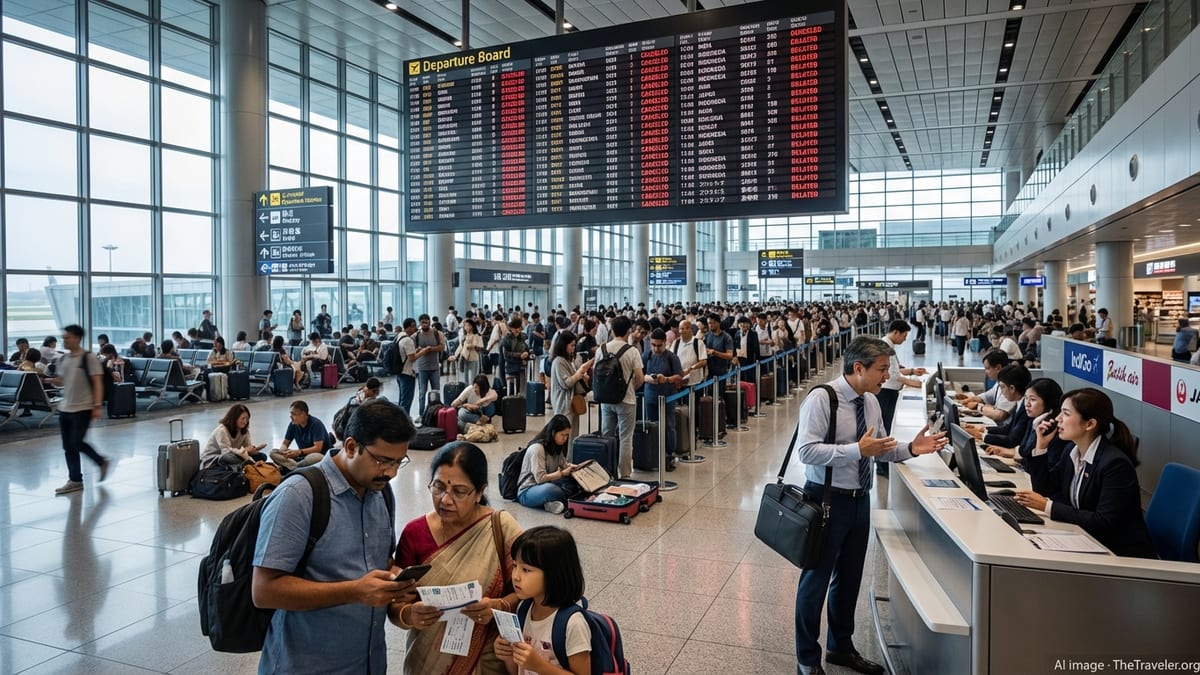
Seven airports closed as ash cloud disrupts key hubs
Flight operations across western Indonesia remain severely disrupted after eruptions from Anak Krakatau sent ash plumes tens of thousands of feet into the atmosphere, prompting aviation authorities to close at least seven airports serving some of the country’s busiest routes. Publicly available information indicates that closures initially affected eight airports on Sunday, including Jakarta’s Soekarno-Hatta and Halim Perdanakusuma facilities, before being scaled back as conditions gradually improved.
Reports from regional and international outlets describe Soekarno-Hatta, Indonesia’s main international hub, as the epicentre of the disruption, with hundreds of arrivals and departures suspended as ash drifted over flight paths. Airspace restrictions were extended repeatedly through Sunday evening and into Monday, as cloud density and wind patterns were reassessed.
By Monday, aviation notices and government statements cited in global coverage showed seven airports still closed, leaving a patchwork of suspended and heavily curtailed services around the Sunda Strait and western Java and Sumatra. Even where runways were technically open, operators faced backlogs, repositioning issues and mandatory safety inspections that limited the number of flights able to depart.
Indonesia’s transport authorities, according to published coverage, framed the extended closures as a precaution while runways, taxiways and parked aircraft were checked and cleared of abrasive ash, which can damage engines, sensors and cockpit windows.
170,000 travellers stranded and thousands of flights affected
Initial tallies from the transport ministry, relayed by multiple news organisations, put the number of passengers stranded at roughly 170,000 by Sunday evening, after more than 1,500 flights were cancelled or severely delayed across eight affected airports. Subsequent counts reported by regional media have suggested that the overall disruption has grown to nearly 3,000 flights and several hundred thousand impacted travellers as delays ripple through domestic and international networks.
Stranded passengers have been photographed crowding departure halls in Jakarta and other hubs, queuing at airline counters to seek refunds, rebookings or accommodation. Travel industry reports describe long waiting times for alternative flights, with peak-period departures fully booked and limited spare capacity on domestic links to secondary cities.
International connections have been especially affected for travellers using Jakarta as a transit point between Southeast Asia, Australia and the Middle East. According to aviation data cited in global coverage, hundreds of regional and long-haul services were either cancelled outright or forced to divert to alternative airports in neighbouring countries, complicating onward travel plans and visa arrangements.
For many domestic passengers, the ash cloud arrived at the end of a busy weekend travel period, amplifying the number of people in transit when the closures took effect. Travel-focused outlets note that some carriers have prioritised repatriation and repositioning flights as conditions allow, but schedules remain fluid and subject to last-minute changes.
Impact concentrated around Anak Krakatau and Sunda Strait corridor
Anak Krakatau, located in the Sunda Strait between Java and Sumatra, began a sustained eruptive phase late on Friday, with monitoring agencies recording continuous activity for roughly 25 hours into early Sunday. According to volcanology and aviation reports summarised by international media, ash clouds were detected at altitudes of up to 50,000 feet on the Sumatra side, well into cruising levels used by commercial jets.
The eruption’s location and prevailing winds created a corridor of disrupted airspace intersecting some of Indonesia’s most heavily used domestic and international routes. Coverage from regional broadcasters notes that ash was observed drifting over parts of Banten province in western Java and across sections of southern Sumatra, leading to rapidly evolving advisories for pilots and dispatchers.
Indonesia sits on the Pacific “Ring of Fire” and has a long record of volcanic events affecting aviation, from past disruptions in Java to extended airport closures in Bali and eastern Indonesia. Analysts quoted in travel and science reporting point out that Anak Krakatau, whose name means “child of Krakatau,” occupies the same volcanic complex as the infamous 1883 Krakatau eruption, though current activity is on a far smaller scale.
Even so, aviation experts cited in public reports emphasise that fine volcanic ash poses a serious safety risk if ingested by jet engines, where it can melt, fuse and cause power loss. As a result, modern air traffic management practices favour conservative stand-offs around active ash clouds, even when visibility at ground level may appear acceptable.
What travellers need to know if flying to or through Indonesia
Travel advisories from airlines and tourism boards, summarised in recent coverage, urge passengers with imminent departures to or within Indonesia to check flight status frequently and avoid heading to the airport until services are confirmed. With seven airports still subject to closure or partial restrictions, schedules are being revised in short increments as ash forecasts and inspection results come in.
Carriers operating in and out of Jakarta and other affected airports are generally offering free rebooking within a defined time window, subject to seat availability, and in some cases providing refunds for trips rendered impossible by ongoing closures. Industry outlets note that policies can vary significantly between airlines and ticket types, particularly for itineraries booked through online travel agencies or using frequent-flyer points.
Travellers planning holidays in Bali, Lombok or other Indonesian resort destinations are advised to pay attention not only to their final destination airport but also to transit points such as Jakarta, Surabaya or regional hubs that may still be coping with aircraft and crew imbalances. Some routes are being temporarily rerouted or consolidated, which can result in longer travel times and additional stops.
Experts discussing the disruption in aviation and travel media also highlight the importance of comprehensive travel insurance that covers natural hazards. Policies differ on what is classified as a covered event, so passengers are encouraged to review terms carefully before making claims for accommodation, missed connections or alternative transport.
Outlook for services as volcanic activity begins to ease
Monitoring agencies cited in local and international reports indicate that Anak Krakatau’s eruptive intensity has eased since the peak activity over the weekend, although the volcano remains at an elevated alert level and further bursts of ash are still possible. Authorities have maintained exclusion zones around the crater and continue to advise residents, tourists and fishermen to keep a safe distance from the island.
On the aviation side, publicly available notices suggest that some airports are preparing phased reopenings once ash concentrations fall below safety thresholds and ground facilities are cleared. However, industry analysts warn that restoring normal schedules could take several days, as airlines work through aircraft maintenance checks, crew duty limits and the backlog of displaced passengers.
Travel observers commenting on the situation point out that Indonesia’s experience with previous volcanic events may help accelerate coordination between meteorological agencies, air navigation providers and airlines. Even so, the scale of this disruption, with at least seven airports simultaneously affected and around 170,000 travellers initially stranded, underscores the vulnerability of the region’s air network to sudden geological events.
For now, travellers with flexible dates may find it prudent to postpone nonessential trips into the most affected areas until flight patterns stabilise and updated guidance clarifies which airports are reliably operational.
The Guardian: Volcano eruption in Indonesia leaves 170,000 travellers stranded
Channel NewsAsia: Several Indonesian airports remain shut due to volcanic ash
AP News: Volcanic island in Indonesia erupts, canceling hundreds of flights
Euronews: Indonesia keeps several airports closed but eruption is easing