


More news on this day
Iran’s newest wave of missile and drone attacks on US-linked bases across the Gulf, stretching from Jordan to Kuwait and Bahrain, is pulling more regional states into a widening confrontation that is unsettling aviation networks, threatening vital energy corridors and reviving fears of a broader Middle East war.
Get the latest news straight to your inbox!
Regional Map Redrawn As New States Enter The Line Of Fire
Published coverage indicates that the latest overnight strikes marked a significant expansion of Iran’s chosen battlefield, with Jordan again joining Qatar, Saudi Arabia, Bahrain, Kuwait, Israel, Oman and Turkey on a growing list of states exposed to direct or attempted attacks. Reporting from regional and international outlets describes barrages aimed at US facilities in Bahrain, Kuwait and Jordan, with interceptions also reported in airspace surrounding Saudi Arabia and other Gulf partners. Analysts note that this pattern reflects a deliberate effort by Tehran to signal that any country hosting US forces or logistical hubs is now within reach.
The attacks follow months of tit-for-tat exchanges between Iran, the United States and Israel that have already produced earlier strikes on the Al Udeid air base in Qatar, repeated missile launches toward Saudi and Emirati territory, and drone and missile incidents tied to US and allied assets in Iraq and Syria. Publicly available timelines show that what began as retaliation for joint US Israeli strikes in late February has evolved into an extended campaign spanning most of the Gulf littoral and the eastern Mediterranean.
For Jordan, which has served as a key logistics and intelligence hub for Western forces, renewed targeting highlights its increasingly fragile position between the Levant and the Gulf. Previous incidents involving Iranian projectiles entering or approaching Jordanian airspace have already strained domestic debates over the depth of the kingdom’s security partnerships. The latest round of attacks appears to confirm that Amman is now firmly counted by Tehran as part of what it considers a hostile security architecture.
Observers point out that the widening strike map also underscores how densely layered US and allied infrastructure has become around Iran’s periphery, from naval headquarters in Bahrain to air bases in Kuwait, Qatar and Turkey, missile-defense sites in Israel, and pre-positioned depots across Jordan and Oman. Each additional retaliatory volley increases the risk that a miscalculation in one country could draw neighboring states more deeply into the conflict than they intend.
Aviation Networks Face Renewed Disruptions And Rerouting
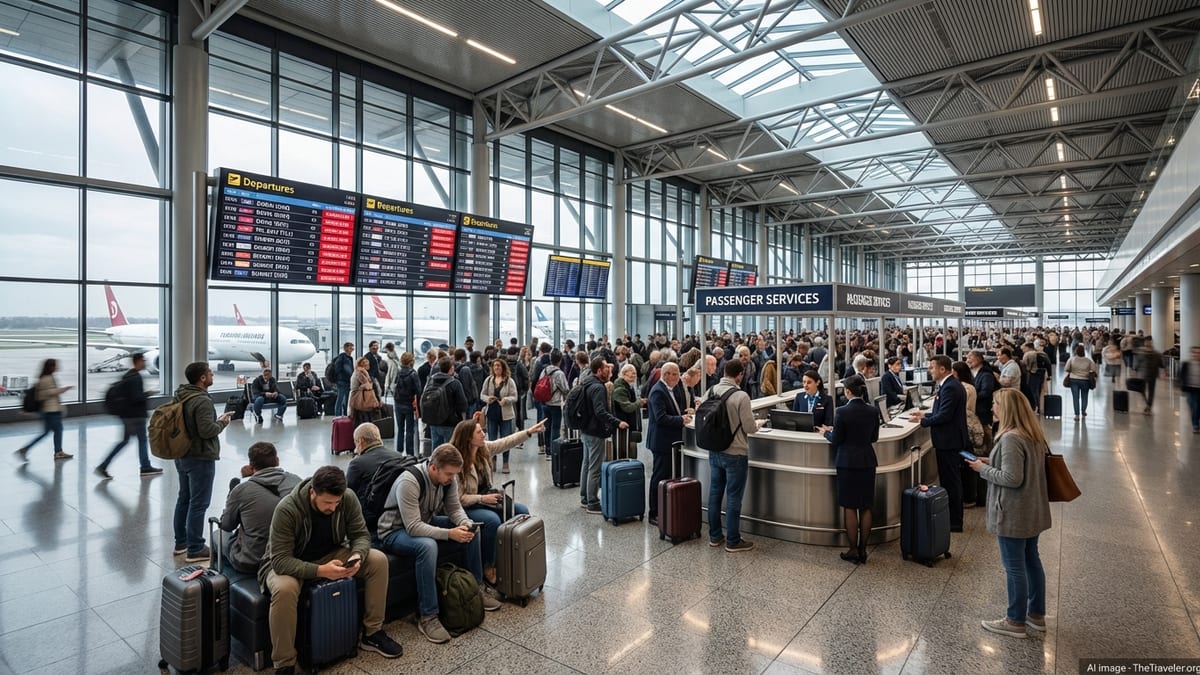
The immediate implications for aviation have been visible in successive waves of airspace closures and route adjustments over the past several days. According to flight data cited in regional coverage, Bahrain, Kuwait and Jordan issued alerts and temporary restrictions as missile and drone tracks were detected, prompting carriers to hold or divert flights and to adopt wider detours around contested air corridors. Episodes of suspended departures and arrivals at Kuwait International Airport and disrupted schedules at other regional hubs have become more frequent as the crisis has intensified.
This builds on earlier disruptions linked to Iranian strikes on or near US facilities in Qatar and Saudi Arabia, when several Gulf and international airlines briefly halted services or avoided key airways above the northern Gulf. Risk advisories circulated to corporate travel managers and aviation insurers in recent months have highlighted a corridor stretching from Israel and Jordan across Iraq, the northern Gulf and western Iran as particularly volatile, citing both state-to-state exchanges and the potential for misidentification of civilian aircraft during high-tempo operations.
Major European and Asian carriers have already shifted some of their long-haul routes to avoid crossing the central Gulf at sensitive altitudes, extending flight times between Europe and Asia and adding costs for airlines and passengers. Travel risk consultancies report growing concern among multinational firms with staff based in Doha, Dubai, Riyadh, Manama and Kuwait City, where even brief closures can strand travelers and complicate evacuations or emergency rotations.
For travelers, the practical effects are longer journeys, tighter aircraft rotations, and an increased likelihood of last-minute cancellations or diversions on routes connecting North America and Europe with South and Southeast Asia via the Gulf. Industry observers stress that, while regional civil aviation authorities and carriers are experienced in crisis management, the cumulative impact of repeated alerts and interceptions raises the prospect of more systemic disruption if the conflict continues to escalate.
Energy Corridors Under Pressure As Markets Watch The Strait Of Hormuz
The broader energy picture is equally fraught. Public analyses from energy-focused outlets emphasize that a substantial portion of the world’s crude oil and liquefied natural gas exports still moves through the Strait of Hormuz and nearby shipping lanes, areas that have been repeatedly referenced in Iranian signaling about retaliation. Over recent weeks Iran has combined missile and drone strikes on Gulf states with stepped-up naval activity and warnings about the possibility of further constraining traffic linked to US or Israeli interests.
Markets have reacted to each new salvo with spikes in price volatility, particularly on days when attacks were reported near export terminals, refineries or major pipeline junctions in Kuwait, Saudi Arabia, Qatar and the United Arab Emirates. While many facilities are hardened and designed with redundancy, earlier incidents involving damage to refineries and storage infrastructure in Kuwait and strikes on industrial zones in Qatar have reinforced the perception that energy assets are being treated as part of the wider contest.
Energy analysts quoted in open reports argue that even partial or temporary disruption to shipping lanes could have outsized effects because of already tight balances in global supply and the importance of Gulf crudes to Asian markets. Insurance premia for tankers transiting the northern Gulf have been edging higher, and some shippers are reported to be reviewing contingency routes that skirt the most exposed waters, although such workarounds carry higher costs and longer transit times.
For producers like Saudi Arabia, Kuwait and Qatar, the renewed strike cycle also revives a longer-running dilemma over how far to align defensively with the United States while managing their own channels with Iran. Joint statements issued with Jordan, Bahrain and others condemning Iranian attacks on regional infrastructure have signaled shared concern about the vulnerability of energy systems, yet governments remain cautious about taking steps that could be interpreted in Tehran as direct participation in offensive operations.
Diplomatic Tightrope For Gulf And Neighboring States
Diplomatic responses in recent days illustrate the narrow path Gulf monarchies and neighboring states are attempting to walk. Public communiqués from Kuwait, Bahrain, Saudi Arabia, Qatar and Jordan have combined language deploring Iranian actions and affirming the right to defend their territory with appeals for de-escalation and respect for regional sovereignty. The United Arab Emirates and Oman, both of which maintain comparatively open communication channels with Tehran, have issued statements framing the latest exchanges as a dangerous deviation from what had been a fragile pause in hostilities.
Analysts note that for countries such as Qatar and Oman, which frequently play mediating roles, outright alignment in a US Iran confrontation would jeopardize carefully balanced diplomatic portfolios that include ties to Iran, Turkey and various non-state actors. Turkey itself, which has reported intercepting ballistic munitions approaching or entering its airspace in earlier rounds of strikes, is also navigating a complex combination of NATO obligations, economic links with Gulf states and a history of tactical coordination and competition with Iran.
Israel’s position, as both a direct protagonist and a host of US facilities, remains central to the trajectory of the conflict. Cross-border fire between Israel and Iranian-aligned groups in Lebanon and Syria has continued alongside Iran’s long-range strikes, embedding the Gulf theaters within a broader network of flashpoints from the eastern Mediterranean to the Red Sea. Public commentary from regional think tanks stresses that as long as both Iran and Israel continue to see strategic value in demonstrating reach, the risk to nearby states that host Western forces will persist.
Against this backdrop, travel and corporate security advisors are increasingly treating the Gulf and its near neighbors as a single integrated risk zone rather than a collection of discrete markets. Guidance circulated to multinational companies in recent weeks recommends scenario planning for further escalation affecting multiple jurisdictions simultaneously, including coordinated cyberattacks on aviation and energy infrastructure, additional barrages targeting US-linked facilities, and more assertive moves around chokepoints like Hormuz and the Bab el Mandeb.
Travelers And Businesses Confront A New Baseline Of Uncertainty
For leisure and business travelers, the cumulative effect of Iran’s expanded targeting and the involvement of countries from Jordan to Turkey and Oman is a new baseline of uncertainty surrounding trips to, from and through the wider region. International travel advisories have been updated in several jurisdictions to reflect the potential for sudden airspace closures, disruptions to airport operations, and sporadic missile or drone activity near major cities that double as transport and commercial hubs.
Global travel management firms report rising demand for real-time tracking, alternative routing and evacuation planning, particularly from corporations with regional headquarters in Gulf Cooperation Council capitals and energy or construction projects in more sensitive areas of Iraq and Jordan. Some companies have begun quietly shifting non-essential meetings to virtual formats or relocating conferences from higher-risk locations to cities perceived as marginally more insulated, such as Muscat or Casablanca, though risk assessors caution that no venue in the broader Middle East can be considered fully immune to spillover.
Tourism boards in popular destinations like Dubai, Doha and Istanbul have so far emphasized business continuity, highlighting operational airports and ongoing events even during periods of heightened tension. However, industry data referenced in travel-sector coverage suggests that bookings on certain long-haul itineraries transiting the Gulf dipped during previous peak episodes of missile and drone activity, before partially recovering when hostilities appeared to ease.
With Iran now openly striking or threatening targets in a widening circle of countries that host US assets, many observers believe that volatility will remain a defining feature of the region’s travel landscape. Airlines, hotel groups and cruise operators that have spent years building the Gulf into a global crossroads are bracing for a protracted period in which route flexibility, crisis communications and diversified market exposure may matter as much as traditional metrics of demand.