


Naples has no shortage of green spaces, from the seafront Villa Comunale to the clifftop terraces of Parco Virgiliano. Yet ask locals where they go when they want to truly escape the city, and many will point you uphill to the Real Bosco di Capodimonte. More than just a park, it is a former royal hunting estate wrapped around one of Italy’s most important art museums, with woodland, meadows and historic buildings that feel worlds away from the dense streets below.
Get the latest updates straight to your inbox!
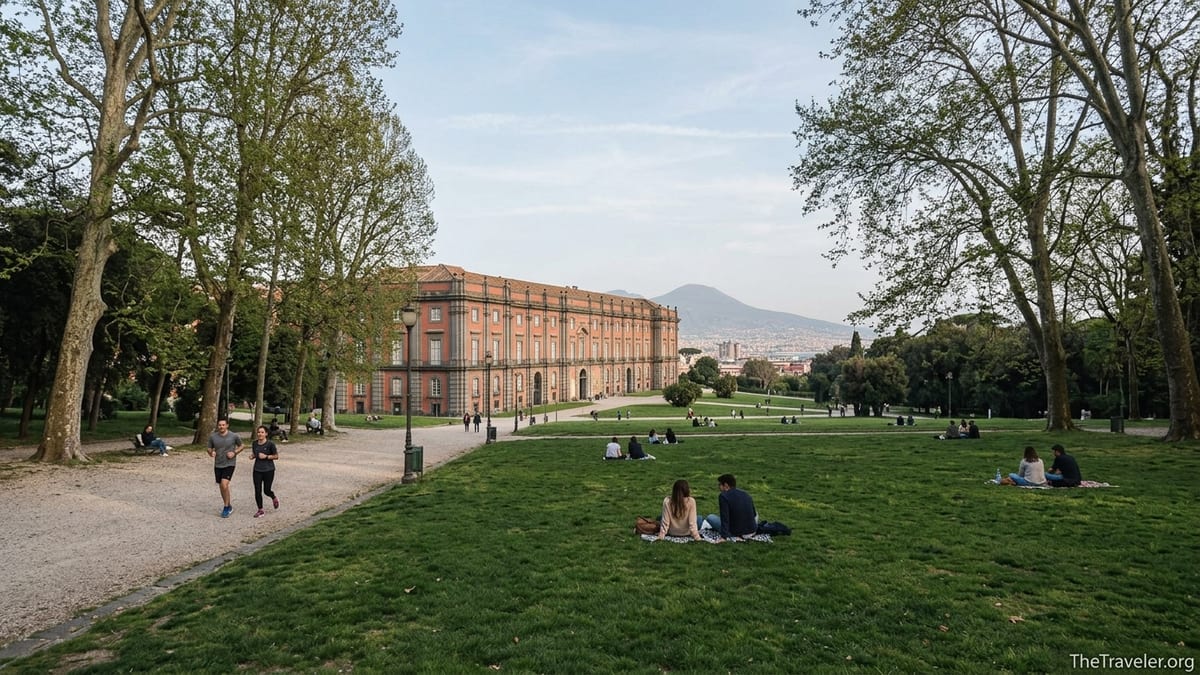
A Royal Hunting Estate Turned Everyday Escape
The first thing that sets Bosco di Capodimonte apart is its origin. Where many other Neapolitan parks began as public promenades or landscaped villas, Capodimonte was created in the 18th century as a royal hunting reserve for the Bourbon kings. The palace at its heart was built to house the Farnese art collections, and the surrounding 134 hectares were laid out as managed woodland for game rather than ornamental flowerbeds. You feel this immediately in the scale of the place: long, straight avenues cut through dense trees, and clearings open suddenly into broad lawns that once served as riding and hunting grounds.
By contrast, Villa Comunale on the seafront was conceived as an elegant urban promenade, a narrow strip between the Riviera di Chiaia and the water, lined with statues and a bandstand. It is perfect for a stroll before gelato, but you are never far from traffic or the sound of scooters. At Capodimonte, once you pass through one of the monumental gates and walk a few minutes inside, the city drops away almost completely. Birdsong and wind in the trees replace car horns, and the atmosphere is more countryside estate than municipal garden.
This royal pedigree still shapes how people use the park today. Neapolitans come here to jog along the former carriage roads before work, to walk dogs on wide grassy meadows, and to spread out picnic blankets beneath centuries-old oaks. On a busy Sunday you might see a football game improvised on one side of a clearing and a yoga group on the other, with plenty of space between them. In smaller parks such as Villa Floridiana in Vomero, groups often compete for the same patches of grass, but at Bosco di Capodimonte the historic hunting landscape translates into room to breathe.
The Largest Green Lung Within the City
Size matters in a dense city like Naples, and the numbers are striking. Bosco di Capodimonte stretches over roughly 134 hectares, making it the largest continuous park within the city limits. Even Parco Virgiliano, famous for its sunset terraces over the Gulf of Naples, is mostly a sequence of panoramic platforms and smaller lawns perched on a cliff. At Virgiliano, it is easy to cross from one end to the other in under half an hour. At Capodimonte, walking from the main palace down to the more remote meadows and back can become a half-day hike, especially if you follow the winding forest paths.
This scale translates into a very different experience for visitors. For runners, the main avenues form loops of several kilometres without repeating the same short circuit. Locals often start at Porta Grande on Via Capodimonte and follow a route that loops around the outer ring of the park, covering five kilometres or more without leaving the greenery. Families with energetic children find that the long, shaded paths keep them moving, even without playground equipment, while older visitors appreciate that they can find a solitary bench under a tree even on weekends in peak season.
The vastness also affects the park’s ecology. Unlike smaller gardens where ornamental shrubs dominate, Bosco di Capodimonte contains woodland, prairies and old agricultural areas. Over 400 plant species have been recorded here, ranging from native oaks and holm oaks to exotic camphor trees and palms introduced in the 19th century. In recent years, local botanists have noted the return of wild orchids and irises in the meadows, a sign that the semi-natural habitats are regaining diversity. Other parks in Naples often feel like designed urban gardens; Capodimonte feels, at times, like the edge of a rural landscape.
An Open-Air Museum of Architecture and Landscape Design
Most urban parks in Naples contain some monuments or follies, but Bosco di Capodimonte is dense with historic structures. Within its walls you can find around 17 historic buildings, from the imposing Royal Palace of Capodimonte to smaller pavilions, farm buildings and religious structures. As you walk, you might encounter the former porcelain factory site, where Capodimonte’s famous ceramics were once produced in the mid-18th century, or stumble upon the church of San Gennaro, a small jewel of religious architecture tucked among the trees.
This layering of architecture makes a visit feel like a walking tour as much as a nature break. For example, after entering through Porta di Mezzo, many visitors follow the broad avenue up to the palace terraces, where the formal gardens, known locally as the Spianato, open in front of the museum. These lawns, set out in the late 18th century, are framed by palms and ornamental trees introduced in the following century. From here, trails lead to more naturalistic English-style landscapes, with curving paths, irregular groves and carefully framed vistas back toward the palace.
Compare this with parks such as Parco Vergiliano at Piedigrotta, which is historically important for the tombs of Virgil and Giacomo Leopardi but occupies a very small, steep site, or Villa Comunale, where the main focus is the linear promenade and the small Anton Dohrn aquarium. At Capodimonte, the architecture is inseparable from the landscape itself. The layout reflects 18th-century ideas about how royalty should move through nature, and as a modern visitor you literally walk through those ideas: from controlled geometric gardens, to pastoral meadows, to seemingly wild woodland that was, in fact, carefully planned.
Art Masterpieces a Few Steps From Woodland Trails
Another key difference is the presence of the Capodimonte Museum inside the park, one of Italy’s most significant art collections. Other Neapolitan parks may sit near cultural institutions, such as the MADRE contemporary art museum in the historic center or the Duca di Martina ceramics museum at Villa Floridiana, but they are distinct entities. At Bosco di Capodimonte, the transition from gallery to greenery is immediate: you step out of a room containing works by Caravaggio, Titian or Artemisia Gentileschi and in minutes you can be on a shaded bench under a cedar tree.
This makes Capodimonte particularly appealing for travelers who want to combine culture and relaxation in one outing. A typical visit might begin with a timed-entry ticket to the museum in the late morning. After a couple of hours exploring the Farnese collection and Neapolitan paintings, visitors often head outside for a simple lunch. Some bring panini from a bar near the park gates, others pick up pastries from a local bakery and eat on the lawns looking back at the palace façade. It feels less like leaving the museum and more like extending the visit outdoors.
In practical terms, this combination sets Capodimonte apart from destinations like Parco Virgiliano, where most travelers come specifically for the views and leave after an hour, or Villa Comunale, which serves mainly as a scenic route between the historic center and the Mergellina waterfront. At Bosco di Capodimonte, it is easy to spend half a day or more without leaving the hill, alternating between art, walking and people-watching. This makes it especially attractive for slower travelers or families trying to balance adults’ interest in museums with children’s need for free play.
A Different Kind of View Over Naples
Naples is famous for its panoramas, and several parks compete for the best view of Vesuvius and the bay. Parco Virgiliano on the Posillipo hill has perhaps the most dramatic cliff-edge lookouts, and the seafront promenade by Villa Comunale offers postcard-perfect vistas of the Castel dell’Ovo and Capri on clear days. Bosco di Capodimonte, sitting on a different hill to the north of the historic center, offers another perspective that many visitors never see.
From certain clearings and from the terrace in front of the palace, you can look back toward the dense tangle of the old city, with church domes and apartment blocks stacked up toward Vomero. On hazy days, the view feels atmospheric rather than spectacular, but on clear afternoons the sun picks out the colors of the buildings and the profile of Vesuvius beyond. It is less about the open sea and more about understanding the geography of the city, seeing how the historic center, the port and the surrounding hills relate to each other.
These views are also experienced differently. At Virgiliano, visitors tend to cluster at a few specific terraces, especially before sunset, and the mood can be almost like a viewpoint in a coastal resort town. At Capodimonte, you might share a bench with a couple of local teenagers listening to music quietly or an elderly neighbor reading a newspaper. There are no dramatic drop-offs or railings to lean over; instead, the city appears in glimpses between trees. The effect is calmer and more introspective, and it reinforces the feeling that you are in a park where people live their daily lives, not only a scenic stop for photographs.
Local Life, Runners and Families Instead of Playgrounds and Rides
For visitors used to northern European or North American parks, one of the surprises at Bosco di Capodimonte is the relative lack of equipment. Unlike Parco Virgiliano, which includes dedicated playgrounds for children, or Edenlandia, the small theme park in the western part of the city with rides and attractions, Capodimonte is almost entirely about open space. There are benches, wide lawns and tree-lined avenues, but very few formal play structures. Local parents sometimes comment that they bring their children here “to run” rather than “to ride.”
This shapes the atmosphere throughout the day. Early mornings belong mostly to runners, dog walkers and older residents doing gentle exercise along the straight avenues. Late morning and early afternoon bring families with strollers, students sitting on the grass to study and small groups having picnics on weekends. Because the park is so large, these groups spread out naturally. Even during school holidays, you can walk for several minutes on side paths and only occasionally pass another person.
In smaller city parks, you often see more formal facilities: fenced playgrounds along the lungomare, or the compact lawns of Villa Floridiana crowded with dog walkers and families competing for shade. At Bosco di Capodimonte, the experience is closer to a countryside walk, even though public buses connect it to the city center in around 20 to 30 minutes. For travelers, this means you should not expect a structured destination for young children in the sense of a playground, but rather a safe, broad space for them to run, kick a ball and explore under supervision.
Opening Hours, Access and Practical Differences
On a practical level, Bosco di Capodimonte’s management also distinguishes it from many other Neapolitan parks. The park is generally open every day from early morning, around 7 am, with closing times that vary seasonally. In the summer months, gates typically close in the early evening, around 7.30 pm, while in the shorter days of winter they shut closer to late afternoon. This pattern is similar to other parks in the city, but because Capodimonte is managed as a state-owned royal park attached to the museum, its hours are published clearly and the main gates are regularly staffed.
In contrast, municipal parks such as Villa Comunale and Parco Virgiliano fall under the city administration, and their opening hours can be more variable in practice, sometimes affected by local events or maintenance. Travelers have occasionally found sections of the seafront gardens fenced off for works, or certain access points at Virgiliano closed. At Capodimonte, while some paths or minor gates may be temporarily restricted, the main arteries of the park tend to remain accessible, and information is usually posted at entrances and on official notices.
Reaching the park also feels different from visiting seaside gardens. To get to Villa Comunale, many travelers simply walk along the waterfront from the historic center. Reaching Bosco di Capodimonte involves a short uphill journey, usually by bus or taxi, passing through residential neighborhoods that most visitors would not otherwise see. This small effort often pays off in a quieter, less touristy atmosphere once you arrive. Near the entrances you will find a handful of local bars offering simple breakfasts, espresso and pastries at everyday Naples prices, rather than the more touristic seafront rates.
The Takeaway
For anyone spending more than a day or two in Naples, Bosco di Capodimonte offers a kind of escape that other parks in the city simply cannot match. Its origins as a royal hunting estate, its sheer size and its integration with one of Italy’s major art museums combine to create a place where culture, nature and everyday local life overlap. While Villa Comunale and Parco Virgiliano are beautiful in their own right, they are best suited to a scenic stroll or a sunset view. Capodimonte, by contrast, invites you to linger.
If your time in Naples is short and you want one green space that feels truly different from the streets below, plan half a day on the Capodimonte hill. Visit the museum in the cool of the morning, then let the straight royal avenues and quiet woodland paths guide you away from the traffic. You will see another face of Naples, one shaped as much by royal architects and landscape designers as by today’s joggers, families and elderly neighbors chatting on benches. That blend of history and everyday use is ultimately what makes Bosco di Capodimonte stand apart from every other park in the city.
FAQ
Q1. Is Bosco di Capodimonte free to enter?
The park itself is free to enter, with no ticket required at the gates. However, the museum inside the palace has a separate admission fee.
Q2. How does Bosco di Capodimonte differ from Parco Virgiliano?
Bosco di Capodimonte is a vast woodland and former royal hunting estate with a major art museum, while Parco Virgiliano is a smaller clifftop park known mainly for sea views and sunset terraces.
Q3. Are there playgrounds for children in Bosco di Capodimonte?
There are very few formal playground structures. Families mainly use the large lawns and wide avenues for free play, walking and ball games.
Q4. How long should I plan to spend at Bosco di Capodimonte?
If you are visiting both the museum and the park, allow at least half a day. For a simple walk or picnic in the park, two to three hours is usually enough.
Q5. Is Bosco di Capodimonte safe for solo travelers?
During daylight hours, especially mornings and afternoons, the park is usually well used by locals and generally feels safe, provided you follow normal urban common sense.
Q6. Can I have a picnic inside Bosco di Capodimonte?
Yes, picnics on the lawns are common, especially on weekends. Glass bottles, open fires and barbecues are not permitted, so bring simple, cold food.
Q7. How do I get to Bosco di Capodimonte from central Naples?
Most visitors take a city bus or taxi uphill from the historic center. The ride typically takes around 20 to 30 minutes depending on traffic.
Q8. Are dogs allowed in Bosco di Capodimonte?
Dogs are generally allowed on leads, and many locals walk their pets there. It is advisable to check posted rules at the entrance and keep dogs under control.
Q9. When is the best time of day to visit the park?
Early morning and late afternoon are the most pleasant, with cooler temperatures and softer light. Midday can be hot in summer, even under the trees.
Q10. Do I need to book museum tickets in advance?
Booking ahead is recommended during busy periods, such as weekends and holidays, especially if there is a major temporary exhibition on show.