


Standing at 6,643 feet, Clingmans Dome (also known by its Cherokee name Kuwohi) is the high point of Great Smoky Mountains National Park and a must-see on most itineraries. But what if you arrive in Gatlinburg, Cherokee, or Bryson City, look up at the ridgeline, and see nothing but thick cloud? On a foggy day, is the drive, the parking struggle, and the steep half-mile walk to the iconic observation tower still worth it, or should you skip Clingmans Dome and spend your limited vacation hours elsewhere in the Smokies?
Get the latest updates straight to your inbox!
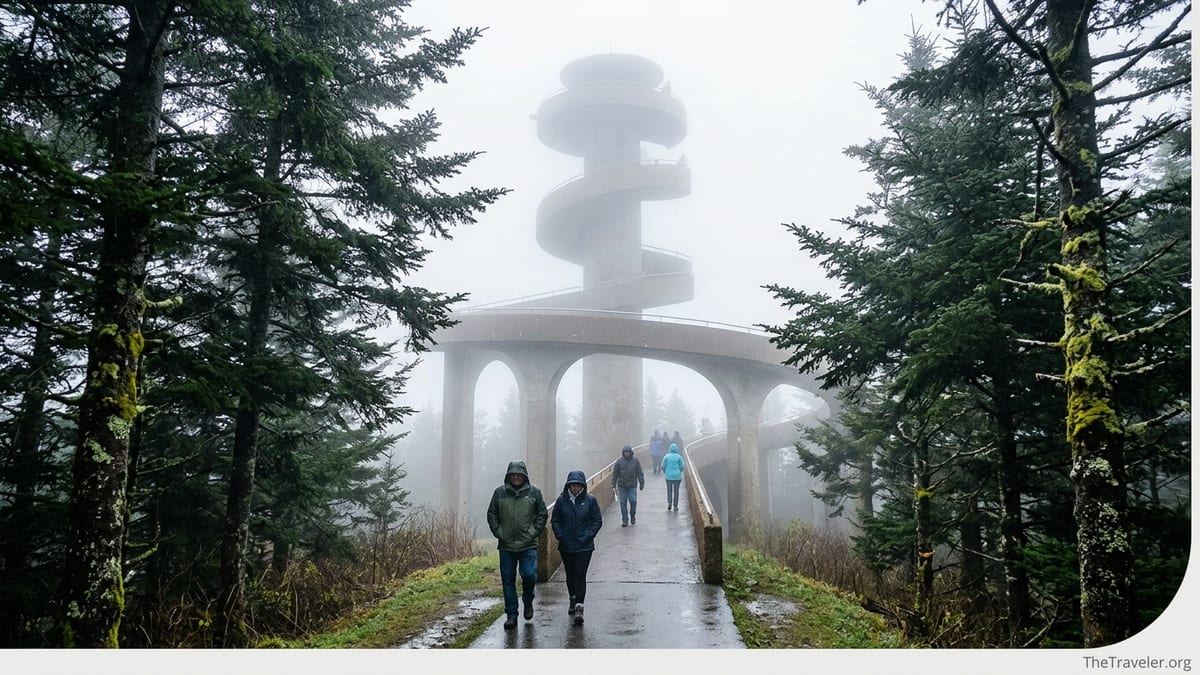
What Clingmans Dome Is Really Like in Fog
On a clear afternoon, visitors at the Clingmans Dome observation tower can see ridges of blue mountains rolling 100 miles into Tennessee and North Carolina. On a foggy day, that sweeping panorama can shrink to a circle of visibility just a few yards wide. The concrete ramp and tower may be completely swallowed in cloud, with trees, railings, and other visitors fading into white just a few steps away. Travelers routinely report arriving to “zero view,” even when lower-elevation spots like Gatlinburg or Newfound Gap looked only partly cloudy.
This dramatic shift happens because weather at 6,643 feet behaves very differently from weather in nearby valley towns. The Smokies sit in a humid, fog-prone region, and higher elevations like Clingmans Dome are significantly cooler and wetter than trailheads such as Sugarlands Visitor Center or Oconaluftee. A day that feels pleasantly warm and mostly sunny in Gatlinburg can still produce dense fog, drizzle, and gusty winds at the summit, with temperatures 15 to 20 degrees Fahrenheit colder. Travelers who show up in shorts and a T-shirt are often shocked by the chill and moisture.
The result is that your entire experience can revolve around atmosphere rather than views. Instead of distant peaks, you may find yourself walking through a quiet, almost otherworldly spruce-fir forest. Needles bead with water droplets, the paved trail glistens, and the occasional call of a raven echoes strangely in the cloud. Some people find this magical, especially photographers who love moody, diffused light. Others feel disappointed that they drove 45 minutes from Gatlinburg only to stare into a white wall from the top of the tower.
One practical implication is that fog often lingers longer at Clingmans Dome than forecast apps suggest. It is common for visitors to make multiple attempts over two or three days, only to time it wrong each time. Even if nearby overlooks like Morton Overlook or Newfound Gap briefly clear, the higher summit can stay socked in. If you arrive to find fog so thick you cannot see the parking lot from the trailhead sign, you should assume the tower view will be similar or worse, at least in the short term.
When a Foggy Visit Is Still Worth It
Although a clouded-in Clingmans Dome can be a letdown, there are several situations where it is still worth going. One is when you value the experience of being in high-elevation cloud forest as much as, or more than, the distant view. The summit area’s spruce-fir ecosystem is unique in the southern Appalachians, with mossy logs, Fraser fir skeletons from past insect damage, and dense, dark green stands of conifers. In fog, that landscape can feel like stepping into another world. Travelers who enjoy hiking for atmosphere often describe a foggy climb as “walking into the clouds” and remember it as a highlight, even without vistas.
Another case is when your schedule is tight and this might be your only opportunity to reach the park’s highest point. Many weekend visitors from Atlanta, Nashville, or Charlotte plan a single day to drive Newfound Gap Road, stop at Newfound Gap, and continue up Clingmans Dome Road. If your only free morning is foggy but road conditions are safe and the Dome road is open for the season, going anyway ensures that you at least experience the summit trail, the observation tower’s unusual spiral ramp, and the change in vegetation with elevation. Even if you do not get the postcard view, you will still have visited one of the park’s signature locations.
Fog can also be a useful ally if you dislike crowds. In peak months, especially July and October, Clingmans Dome’s large parking lot can fill by late morning, and visitors sometimes circle for 20 to 30 minutes waiting for a spot. On gloomy, low-visibility days, demand is often lighter, and the atmosphere at the tower can be noticeably calmer. If you have seen clear views earlier in your trip from other overlooks such as Clingmans Dome parking area itself or the Foothills Parkway and you primarily want a quieter, moodier walk, a foggy visit late in the day can be a smart trade.
Fog is also more appealing if you are a photographer comfortable working without blue skies. The diffused light eliminates harsh midday contrast, leading to richer greens in the spruce-fir forest and less glare on wet pavement. Close-up compositions of lichen, water droplets on spider webs, or silhouettes of trees fading into the white can be striking. Serious landscape photographers sometimes time their visit after checking valley fog forecasts, hoping for a partial inversion where you stand above a sea of cloud. While that scenario is hard to guarantee, it illustrates that “bad weather” can be creatively rewarding.
When You Should Probably Skip It
There are also many situations where a foggy trip to Clingmans Dome is not a good use of limited time. The clearest case is when road or weather conditions introduce safety concerns. The access road to Clingmans Dome typically opens each spring and closes around December 1, but even in the open season it can shut temporarily for snow, ice, or high winds. On days when fog combines with steady rain, strong gusts, or temperatures near freezing, the seven-mile access road and the steep, exposed paved trail can become slick. In such conditions, park rangers may close the road entirely, and even if it is open, a cautious traveler with children or older relatives might reasonably decide the risk is not worth the reward.
Another time to reconsider is if your trip is very short, you have not yet seen the park’s classic valley scenery, and the forecast suggests better visibility later. For example, if you arrive on a Friday evening in Pigeon Forge and wake up Saturday to dense cloud around Newfound Gap, but Sunday’s forecast improves, it often makes sense to spend Saturday exploring lower-elevation spots like Cades Cove, the Little River Road pullouts, or the Oconaluftee River Trail, then head for Clingmans Dome when the odds of a view are higher. With only a one- or two-day visit, burning an entire morning on a “whiteout” experience at the tower can feel wasteful.
Foggy conditions also pose particular challenges for visitors with mobility or health limitations. Although the paved trail from the parking lot to the tower is only about half a mile one-way, it climbs steeply and gains roughly 300 feet in elevation. For someone with asthma, heart issues, or knee problems, pushing up that grade in cold, damp air at high altitude can be uncomfortable or unwise, especially if they will not be rewarded with a view at the top. In that scenario, a visitor might be happier stopping at scenic pullouts along Newfound Gap Road where views require minimal walking and visibility may be slightly better.
Finally, if your main goal is a bucket-list panorama and nothing else will satisfy you, a solid fog bank at the trailhead is a strong reason to pivot. Travelers regularly share stories of standing on the tower’s upper platform unable to see the handrail at the far side, or watching families arrive, take a quick selfie in the white void, and hike back down with obvious disappointment. If you know a “blank canvas” view will leave you frustrated, you will likely be happier spending the time on a hike like Alum Cave, Laurel Falls, or Deep Creek, where forest scenery is rewarding even under low clouds.
How to Read the Weather and Improve Your Odds
Because conditions vary so much with elevation, checking a generic “Gatlinburg” or “Cherokee” forecast is rarely enough to predict what you will find at Clingmans Dome. A better approach is to combine three tools: a point forecast for high elevations in Great Smoky Mountains National Park, the park’s live or recent webcam imagery from the Clingmans Dome area when available, and your own eyes on the drive up. Many travelers stop at Newfound Gap, which sits around 5,000 feet, and treat its conditions as a preview. If the gap is already buried in immovable cloud and the wind is strong and cold, odds are high that the higher dome will be similar or worse.
Another helpful concept is understanding temperature inversions and valley fog. In certain situations, cool air settles into valleys overnight while ridges remain relatively clear. This can produce dramatic scenes where Cades Cove or the Oconaluftee Valley is filled with fog that looks like “smoke,” while higher overlooks such as Clingmans Dome rise above it into blue sky. That is the dream scenario for many photographers. However, the reverse can also be true: low clouds can cling stubbornly to high ridges even as valleys brighten. When planning your day, pay attention to hourly cloud cover forecasts at different elevations and watch live updates early in the morning.
Timing also matters. Sunrise and just after are often the most dynamic periods, with fog lifting, thinning, or breaking in dramatic ways. Some visitors report arriving to a whiteout before dawn, waiting 30 to 45 minutes at the tower, and then watching curtains of cloud tear open to reveal sudden views of the surrounding ridges lit by early light. Others make the same gamble and never see more than a vague outline of the ramp. If your schedule allows, consider building flexibility into your day, perhaps combining a Clingmans Dome attempt with other stops on Newfound Gap Road so that you can pivot quickly if conditions do not improve.
In practical terms, you should also prepare for colder, wetter weather than you expect. A lightweight rain jacket or windbreaker, a warm layer such as a fleece, and footwear with good traction can make the difference between an enjoyable stroll in fog and a miserable trudge. Travelers frequently underestimate the chill at the summit, especially in spring and fall, and end up cutting their visit short. Packing for a 20-degree temperature swing between valley towns and the dome is a simple way to keep your options open if the weather surprises you.
What You Can Still See and Do in Fog
Even when long-range views vanish, there is more to Clingmans Dome than the panorama. The drive itself up Clingmans Dome Road passes several pullouts that can offer atmospheric glimpses into side valleys and forests. On very foggy days, you may catch fleeting openings in the cloud where a nearby ridge or stand of trees suddenly appears before fading again. These brief moments can be especially striking in early fall when the first hints of color appear in maples and birches at mid-elevations, even if the higher peaks are hidden.
From the parking area, short walks to the trailhead sign or along the edge of the lot can reveal interesting textures in the spruce-fir forest. Interpretive signs explain the history of the observation tower, the unique ecosystem, and the damage caused by non-native insects. Families with young children sometimes choose to explore these displays and take a few foggy photos near the start of the paved trail without committing to the full climb. On a busy clear day, the lot can feel chaotic, but in thick fog it often grows quieter, with car doors muffled and voices softened by the cloud.
If you do decide to hike to the tower, pay close attention to small-scale scenery. The pavement, wet with condensation, reflects silhouettes of trees. Moss and lichen glow almost neon on rocks and trunks. Sound carries differently: you may hear footsteps and conversations long before you see the people who make them emerge from the mist. By the time you reach the base of the spiral ramp, the tower itself can feel like a structure emerging from nowhere, its arches fading quickly upward into white. The sensation of being at eye level with swirling cloud can be powerful, even if you cannot see beyond the platform’s edge.
Fog can also enhance your appreciation of the Smokies’ name and character. The park’s signature “smoke” often looks like soft wisps hugging ridgelines on clear days, but in full cloud the connection between forest moisture, air currents, and weather becomes tangible. For some visitors, this immersive, sensory experience makes the journey worthwhile in its own right, especially if they have already enjoyed big mountain views elsewhere along the Blue Ridge Parkway, the Foothills Parkway, or at other national parks.
Alternatives When Clingmans Dome Is Socke d In
When conditions on the high ridges look unpromising, the Smokies offer many alternatives that may deliver more satisfying experiences under fog or low cloud. One reliable option is to head for valley loops and creekside trails that gain less elevation and often sit beneath the thickest cloud layer. Cades Cove, for example, can be enchanting on a misty morning when fields are layered in low fog, white-tailed deer wander near the road, and historic cabins appear and disappear behind veils of moisture. Even if distant ridges are invisible, the intimacy of the loop road and short walks to cabins and churches still feels rewarding.
Waterfalls and river trails also shine in moody weather. On the Tennessee side, hikes like Laurel Falls, Cataract Falls near Sugarlands Visitor Center, or the Middle Prong Trail out of Tremont can be beautiful when fog hangs in the trees and crowds are slightly thinner. On the North Carolina side, the Deep Creek area near Bryson City offers three accessible waterfalls that often photograph better under soft, cloudy light than in harsh sun. Because these trails typically sit at lower elevations than Clingmans Dome, visibility is often a bit better, and the sensory experience of rushing water combines nicely with the damp air.
If you are staying in a gateway town such as Gatlinburg, Pigeon Forge, or Cherokee and the high country forecast looks stubbornly bad all day, you might also lean into indoor or partially sheltered activities. In Gatlinburg, that can mean visiting the park’s Sugarlands Visitor Center to explore exhibits on Smokies wildlife and geology, watching the orientation film, and chatting with rangers about current conditions on various trails. Outfitters in town can help you gear up with proper rainwear or warmer layers if the forecast for the rest of your trip includes more chilly, foggy days.
For travelers with more time, you might even adjust your route to chase better weather. If fog is locked over the central ridgeline but conditions improve to the west, a scenic drive along the Foothills Parkway may offer intermittent views across lower ridges and reservoirs. If skies look brighter to the east, following the Blue Ridge Parkway for a stretch can lead to sunlit overlooks at similar or slightly lower elevations. By staying flexible and checking conditions frequently, you avoid fixating on a single destination when the Smokies provide so many alternatives that respond differently to the same weather pattern.
The Takeaway
Whether Clingmans Dome is worth visiting on a foggy day depends less on the forecast and more on your expectations, flexibility, and personal travel style. If you dream of a sweeping, multi-state panorama and would feel frustrated by a blank white horizon, then a thick fog bank at Newfound Gap and chilly, gusty conditions at the trailhead are strong signals to wait or redirect your plans. On a short trip, especially in busy seasons, you may get more enjoyment from valley loops, waterfalls, and rivers that remain rewarding even without extensive views.
If, however, you are curious about the Smokies’ high-elevation cloud forest, comfortable with cooler, wetter conditions, and open to an experience built around atmosphere rather than scenery, a foggy Clingmans Dome visit can be quietly unforgettable. The muted light, beaded spruce needles, and sensation of standing in the clouds give you a different perspective on the mountains than any postcard panorama. For some visitors, that moody encounter becomes the memory that lingers longest after the trip.
In practice, the best strategy is to arrive with a plan but keep it flexible. Check high-elevation forecasts, watch conditions at Newfound Gap on your way up, pack for a significant temperature drop, and be ready to shift gears if you arrive at the trailhead and find visibility close to zero. If the dome disappoints, let it be a short chapter in a larger story: turn around, explore a misty creek or quiet cove, and remember that in Great Smoky Mountains National Park, there is almost always another beautiful place waiting just a ridgeline or two away.
FAQ
Q1. Will I see anything at all from the Clingmans Dome tower if it is foggy?
Visibility in fog can range from a few hundred yards to only a few feet. On light, patchy fog days, you may still glimpse nearby ridges or see the forest below, even if distant views are gone. On heavy fog days, especially when clouds are thick and unmoving, you might see little beyond the tower itself and the tops of nearby trees, so it is important to set expectations accordingly.
Q2. Is the drive to Clingmans Dome safe in thick fog?
The seven-mile access road is paved but winding, with steep drop-offs and no lighting. In thick fog, visibility can be very limited, which demands slow speeds, low-beam headlights, and extra caution. If the park closes the road due to weather or you feel uncomfortable driving with such reduced visibility, it is wiser to turn around and choose a lower-elevation destination for that day.
Q3. What should I wear to Clingmans Dome on a foggy day?
Plan for temperatures at least 15 to 20 degrees Fahrenheit colder than nearby towns like Gatlinburg or Cherokee, and expect damp, windy conditions. A lightweight waterproof or windproof jacket, a warm mid-layer such as a fleece, long pants, and shoes with good traction will make the steep half-mile paved walk more comfortable. Even in summer, travelers often appreciate a hat and gloves when the summit is wrapped in cloud.
Q4. Are the views from the parking lot better than from the tower when it is foggy?
On days with low cloud that sits just above the lot, you might occasionally get partial views from the parking area while the tower remains in thicker fog. More often, however, if the lot is fully socked in when you arrive, the tower will be similar or slightly worse. It can be reasonable to walk a short distance from your car to gauge conditions before committing to the full climb.
Q5. Can fog lift quickly at Clingmans Dome, or will it stay all day?
Fog at high elevations in the Smokies can be highly changeable. Sometimes it lifts or breaks dramatically within 30 to 60 minutes, revealing ridges and valleys below. Other days, especially in cool, moist weather patterns, the dome can stay in cloud for many hours. Checking high-elevation forecasts, watching conditions at Newfound Gap, and allowing some extra time at the summit if your schedule permits can slightly improve your chances of catching a clearing.
Q6. Is it worth going to Clingmans Dome in fog if I am visiting with young kids?
It can be, but it depends on your children’s patience and clothing. The steep, paved trail can feel strenuous for young legs, especially in cold, damp air, and kids may be disappointed if there is no long-distance view at the top. Many families choose to explore the interpretive signs, take a few foggy photos near the beginning of the trail, and then focus the day on easier, more interactive spots like visitor centers, short waterfall hikes, or Cades Cove.
Q7. How do foggy conditions affect photography at Clingmans Dome?
Fog eliminates the classic blue-layered mountain panorama but creates soft, even light that is ideal for close-up and atmospheric images. Photographers can capture moody shots of the spruce-fir forest, silhouettes of trees disappearing into the mist, and small details like water droplets on branches. If you enjoy creative, intimate compositions more than wide scenic vistas, a foggy visit can be very rewarding.
Q8. Are there better alternatives to Clingmans Dome on a foggy day?
Yes. Lower-elevation areas such as Cades Cove, Deep Creek, the Little River Road pullouts, or riverside paths near Sugarlands or Oconaluftee often remain more enjoyable when high ridges are buried in cloud. Waterfall hikes in particular tend to photograph beautifully in overcast, misty conditions, and they do not rely on long-distance visibility for their appeal.
Q9. Do I still need a parking pass or fee if I visit Clingmans Dome briefly in bad weather?
Great Smoky Mountains National Park requires each vehicle that is parked for more than a very short period to have a valid parking tag, regardless of weather or visibility. If you plan to leave your vehicle for any meaningful amount of time to walk to the overlook, use restrooms, or hike even part of the trail, you should purchase and display the appropriate tag to comply with park rules.
Q10. If I only have one morning in the Smokies and it is foggy, should I prioritize Clingmans Dome or skip it?
With only one foggy morning, your choice comes down to priorities. If standing at the park’s highest point matters more to you than the chance of a distant view, visiting Clingmans Dome can still feel meaningful, even in cloud. If your main goal is scenery and you do not mind missing the summit, you will likely get more from exploring a valley, waterfall, or scenic loop that remains rewarding in low visibility, and leaving the dome for a future trip with better weather.