


Dugi Otok does not shout for your attention. It sits off the Zadar coast, long and thin, with a handful of villages, a scattering of coves and one headline beach that regularly appears in “best of Croatia” lists. If you are trying to decide whether this remote island deserves a place in your itinerary, you need to understand what it offers, what it lacks, and how it compares with better known names like Hvar or the islets of the Kornati archipelago. This guide walks you through the reality on the ground so you can decide, with clear eyes, if Dugi Otok is worth the detour for you.
Get the latest updates straight to your inbox!
Where Dugi Otok Fits in a Croatian Island Itinerary
Dugi Otok lies in the Zadar archipelago, about an hour and forty minutes by car ferry from Zadar’s Gaženica port to the village of Brbinj on the island. The car ferry is run by Jadrolinija and typically sails two times per day in low season and around three times daily in summer, which already tells you something important: this is not an island you pop over to casually at any time of day. Once you are on Dugi Otok, there is a single main road stretching its length, connecting small settlements like Sali, Božava and Veli Rat rather than any sizeable resort town.
Most visitors base themselves either in Sali at the southeastern tip or in the smaller bays around Božava and Veli Rat in the northwest. Sali has a couple of grocery shops, a bakery, an ATM and a few seafront konobas serving grilled fish and simple pasta dishes. Around Božava, summer sees a small tourist train that shuttles beachgoers to Sakarun, while Veli Rat is known for its lighthouse and rocky coves. Nightlife is minimal; a “big night out” usually means a drink on the harbor followed by bed before midnight.
Because the island is long, travel times on the single road add up. Driving from Sali at the southern end to Sakarun in the northwest can easily take around an hour, especially in July and August when the road is busier with cars heading to the beach or the Telašćica Nature Park entrance. Public buses exist and tend to coordinate with ferry arrivals, but they are not frequent enough for spontaneous hopping between villages. In practice, many travelers either bring a car on the ferry or rent a scooter, bicycle or small car on the island to make the most of the dispersed sights.
All of this combines into a very specific travel proposition: Dugi Otok is for those comfortable with slower rhythms, limited infrastructure and a slightly remote feel. Compared with busier islands where catamarans arrive every hour and you can change dinner plans on a whim, here you plan around ferry timetables, bus schedules and daylight.
Beaches: Sakarun, Coves and What to Expect
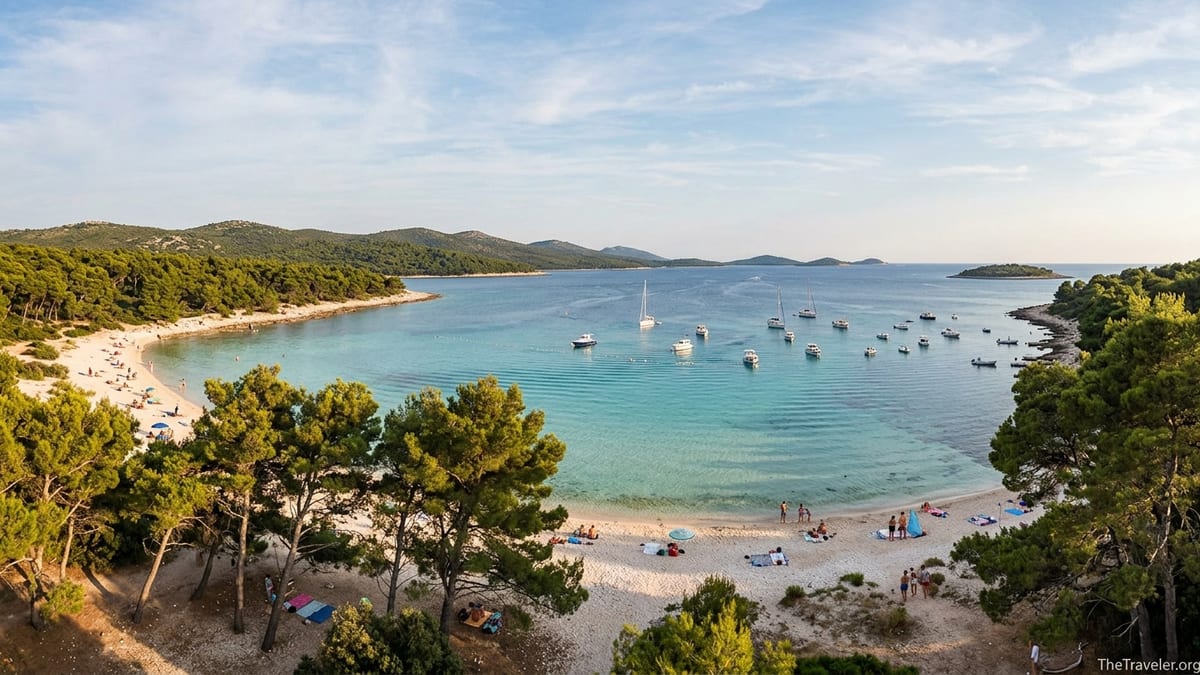
Dugi Otok’s star attraction is Sakarun (often written Saharun), an 800 meter arc of pale sand and fine pebbles on the northwest coast near the villages of Veli Rat, Verunić and Soline. The bay is shallow for a long way out, with a bright turquoise color that has earned it nicknames like “Caribbean of the Adriatic.” You reach Sakarun from the main road via a narrow access road and then a short walk from parking areas behind the pines, which helps keep cars off the sand and preserves the beach’s wide, open look.
In summer you will find a few seasonal beach bars serving drinks, basic snacks and simple lunches. Prices are similar to other popular Croatian beaches: a coffee might cost the equivalent of 2–3 euros, a cold beer roughly 3–5 euros and a light lunch like a toast sandwich or simple salad somewhere in the 7–12 euro range depending on the venue. Sunbed and umbrella rental, when offered, also tends to mirror other Adriatic hotspots. The water is clear and calm most days, with a sandy bottom that is friendly to children and non-confident swimmers, although the shore itself is a mix of white pebbles and sand rather than completely powdery sand underfoot.
Beyond Sakarun, the island is dotted with quieter coves and beaches that rarely make Instagram reels but can be more rewarding if you value solitude. Near Sali, you have mostly rocky and concrete swimming areas with ladders into deep water, which locals use for before-breakfast swims. In the central part of the island, the bays of Brbišćica and Veli Žal offer photogenic stretches of pebbly shoreline backed by rugged cliffs and low pine. These spots rarely feel crowded even in peak season because they require a short walk or drive off the main road and do not have the same marketing appeal as Sakarun.
It is important to arrive with realistic expectations. If you imagine rows of organized beach clubs like on Hvar’s Pakleni Islands, you will be disappointed. Most beaches on Dugi Otok have minimal facilities: perhaps a small bar, a portable toilet and some trash containers. Many have none at all. Bring water, snacks and shade if you plan to explore smaller bays. The payoff is space, clear water and a feeling of being far from the busier coastal strips of Croatia, even in mid-August.
Quiet Vibes: Who Will Love Dugi Otok (and Who Will Not)
Dugi Otok is best suited to travelers who value simplicity over spectacle. Couples looking for a quiet, low-key escape often base themselves in an apartment or guesthouse in Sali or Božava, rent a scooter and spend their days swimming, reading in the shade and cooking local fish on a terrace grill. Families with school-age children who are happy with beach time, snorkeling and a couple of nature trips also tend to enjoy the island, especially if they book accommodation within walking distance of the sea to avoid repeated driving.
Hikers, kayakers and divers also find plenty of appeal. Telašćica Nature Park, at the southeastern tip of the island, offers dramatic cliffs dropping into the sea, hiking paths above the water and the saline Lake Mir, where visitors can swim in warmer, slightly saltier water. Sea kayaking trips explore caves and coves along the coast, often departing from Sali or nearby villages. Divers base themselves around Božava or Sali to reach underwater cliffs and shipwreck sites. For these activity-focused travelers, limited nightlife is a feature, not a bug: early nights mean early starts on calmer seas.
On the other hand, if your idea of a good island stay involves bar-hopping, clubbing or even just a wide range of bars and restaurants to choose from every night, Dugi Otok will likely feel too quiet. After dinner, most people stroll the waterfront, have an ice cream and turn in. There are occasional summer festivals or village events, especially in Sali in August, but you cannot count on a line-up of live music or DJ nights in the way you might on Hvar or in Split.
It is also not ideal for travelers who like to move spontaneously. With limited ferry departures and constrained bus schedules, missed connections matter. For example, arriving late in Zadar and hoping to “just catch an evening ferry” in high season might mean discovering the last departure left earlier in the afternoon. Similarly, if you base yourself in Sali without a car and suddenly feel like a day at Sakarun, you will face a series of bus changes or the need to arrange an expensive private transfer or boat trip instead of simply hopping on a frequent public bus as you might on more connected islands.
Dugi Otok vs Ugljan, Pašman, Kornati and Hvar
When deciding where to spend precious island days, it helps to compare Dugi Otok with its neighbors and with headline islands further south. Ugljan, just across from Zadar, is far easier to reach, with frequent short car ferries between Zadar and the town of Preko. Many locals commute daily, and the island has a lived-in feel with villages strung along the coast, family beaches and modest hills for hiking. Ugljan’s beaches are generally pebble or concrete bathing areas with clear water but not the iconic turquoise lagoon look of Sakarun. Its advantage is convenience: you can wake up in Zadar, jump on a morning ferry and be swimming on Ugljan well before lunch, then return to the city for dinner.
Pašman, connected to Ugljan by bridge, shares some of that convenience while feeling less developed and more rural, especially on its southern side facing the Kornati islands. Reaching Pašman usually involves either the bridge from Ugljan or a short ferry from Biograd na Moru to Tkon. Once there, you find simple villages, campgrounds and a coastline with a mix of family beaches and wilder coves. Pašman suits travelers who want an affordable, low-key base close to the mainland rather than an isolated escape.
The Kornati archipelago, by contrast, is almost never a place you stay overnight unless you are on a yacht. Designated as Kornati National Park, its bare, rocky islets are mostly uninhabited, with a sprinkling of seasonal konobas catering to sailors. From Zadar or from Dugi Otok itself, day trips run in summer to cruise among the islands, swim in sheltered bays and have a grilled fish lunch on shore. This makes Kornati less a direct competitor to Dugi Otok and more a complementary experience: you might base yourself in Sali and join a small boat excursion that spends the whole day weaving through the islets before returning in the evening.
Then there is Hvar, which sits further south off Split and has a different reputation. Hvar Town in particular is known for glamorous yachts, lively bars and a more upscale feel, though recent noise restrictions mean that even Hvar now often quiets down around midnight to 2 am. Outside Hvar Town, areas like Stari Grad and Jelsa offer much calmer, family-friendly bases with historic stone streets and easy access to pebbly coves. Hvar has more frequent catamaran connections, more restaurant choice, organized beach clubs and a broader accommodation range, from hostels to luxury hotels. If you want both social energy and some quiet, Hvar is often a better bet than Dugi Otok.
A practical way to choose is to rank your priorities. If unique beaches and deep quiet rank highest, and you are happy with a limited ferry schedule and modest infrastructure, Dugi Otok and perhaps a day into Kornati make sense. If you want a convenient island dip from Zadar without disrupting your itinerary, Ugljan or Pašman are easier. If you want nightlife, dining variety and the option to socialize with other travelers from around the world, Hvar usually wins. It is possible to combine them as well, for example spending a few slow days on Dugi Otok after a more sociable spell on Hvar to reset before heading home.
How Long to Stay and Where to Base Yourself
For most travelers, two or three nights is enough to get a feel for Dugi Otok without the stay turning into pure repetition. In that time, you can have a full day at Sakarun and the northwest, another day focused on Telašćica Nature Park and Lake Mir, and a half day exploring local coves around your base. If you are an avid hiker, diver or photographer chasing different light conditions on cliffs and coves, extending to four or five nights gives you space to slow your pace and repeat favorite spots at different times of day.
Choosing a base is largely a question of priorities. Sali is the main settlement at the southeastern end and a good choice if you plan to spend serious time in Telašćica or join boat trips to Kornati. Here you can find a small hotel or private apartments within walking distance of the harbor, grocery shops and a handful of restaurants. In the northwest, the villages around Božava, Verunić and Veli Rat put you closer to Sakarun and to quieter beaches and the lighthouse. Some travelers split their stay, spending two nights near Sali and two nights near Sakarun to cut down on daily driving.
Accommodation on Dugi Otok is largely in the form of private apartments, guesthouses and a few small hotels and campsites. If you are visiting in July or August, booking ahead is strongly recommended; the island’s size and limited number of beds means that “just turning up” can result in long walks between fully booked houses. Outside the peak school holidays, especially in May, June, September and early October, you have a better chance of finding last-minute options and lower prices, and the island feels even sleepier.
Because grocery selection is limited, some travelers arriving by car bring a small stash of specialized items with them, such as plant-based milk or particular snacks for children that may not be available in small island shops. Most basics, from fresh bread and fruit to sun cream and bottled water, are straightforward to find, but you should not rely on a large supermarket or shopping mall experience. Think of Dugi Otok as a place where you adapt to what is available rather than try to recreate exactly what you have at home.
Transport Limits: Ferries, Roads and Getting Around
Transport is the main limiting factor on Dugi Otok and the key reason the island feels as quiet as it does. From Zadar’s Gaženica port, the Jadrolinija car ferry to Brbinj on Dugi Otok typically runs a handful of times each day in summer and less often in low season, with crossing times around 90 to 110 minutes depending on the specific departure. Cars queue well before sailing in July and August; arriving late can mean waiting for the next boat. Foot passengers usually board without issue, but even then it is important to book tickets in advance during the busiest weeks.
Once on the island, a main asphalt road runs its length, roughly 40 kilometers, linking Brbinj with Sali in the southeast and Božava, Veli Rat and other small villages in the northwest. Traffic is generally light compared with the mainland, but the road is narrow in places and requires caution, especially at night when there is minimal lighting and local drivers know every bend. Public buses connect the ferry port with the main settlements, and in summer they tend to time their departures around ferry schedules, but there are only a few services per day. Travelers sharing recent experiences often mention that missing the post-ferry bus can mean an expensive taxi ride or a long wait.
Car and scooter rental options exist in Sali and a few other spots, but the fleet is small and can sell out in peak weeks. Prices are often higher than on the mainland, reflecting the limited supply and the cost of bringing vehicles to the island. If you are comfortable driving, bringing your own rental car from Zadar on the ferry offers the most flexibility, bearing in mind that you will pay both for the car ticket and for the driver and any passengers. Cyclists can also bring bikes on the ferry; Dugi Otok’s main road undulates rather than climbs steeply, but in high summer heat it can still feel demanding.
Boat transfers and excursions fill some of the gaps. From Sali and occasionally from Božava, small operators run day trips to Telašćica and Kornati, as well as private transfers to Sakarun for those staying further south on the island or even in Zadar. These can be relatively expensive compared with taking the bus and walking, but for groups or families without a car they may be worth budgeting for. What you will not find is a dense web of late-night catamarans, regular taxi boats and ride-hailing apps; in this sense, Dugi Otok is closer to a remote rural destination than to a tourist-thick island hub.
Is Dugi Otok Worth It For You? Decision Guide
If you are still weighing whether to invest the travel time and effort, it helps to picture real scenarios. Imagine a couple in their thirties based in Zadar for a week in July. They enjoy quiet swims, photography and long dinners, and they do not mind planning around a timetable. For them, booking three nights in an apartment near Sali at the end of the week makes sense. They could spend one day at Telašćica, one day doing a slow drive up to Sakarun with swims along the way, and one day simply wandering their local shoreline, cooking simple meals on their terrace and watching ferries glide past in the distance. The limited restaurant choice is a fair trade for the peace.
Contrast that with a group of friends in their twenties looking for a social scene, drawn by the idea of beach bars and late nights out. They might be tempted by photos of Sakarun’s turquoise water, but in reality they would likely feel constrained by the early end to evenings, the lack of bar variety and the relative difficulty of moving on spontaneously if they changed their minds. That group would almost certainly be happier basing themselves in Hvar Town or Split, where sunset drinks naturally stretch into midnight music and there is always another venue to try.
For families with children, the calculation often hinges on logistics. A family driving their own car around Croatia might appreciate three or four quiet days on Dugi Otok between busier stops, enjoying safe, shallow water at Sakarun and simple rock platforms near Sali that allow for easy supervised swims. A family relying solely on public transport, however, may find the bus and ferry combinations stressful, particularly if they are carrying beach gear and dealing with heat. In that case, choosing Ugljan or Pašman, with shorter ferry rides and more frequent crossings, may be a better fit.
In short, Dugi Otok is worth visiting if you actively want remoteness, are happy to accept transport limits as the price of quiet, and are content with a handful of memorable beaches and coves rather than a long list of built-up sights. If you see islands primarily as social and culinary playgrounds or as bases for rapid day-tripping, the time and structure required to enjoy Dugi Otok may feel restrictive rather than liberating.
The Takeaway
Dugi Otok offers a specific promise: space, quiet and a handful of standout natural spots, most notably Sakarun beach and the cliffs and salt lake of Telašćica. That promise is made possible by the same factors that some travelers see as drawbacks: limited ferry connections, modest bus services, sparse nightlife and a reliance on simple local services rather than a full menu of tourism infrastructure.
It is not trying to be another Hvar, with its mix of yacht-filled harbors, cocktail bars and stylish beach clubs, nor is it as instantly accessible as Ugljan or Pašman, which function almost as Zadar’s suburbs. It sits somewhere else in the Croatian island landscape, closer in spirit to a quiet national park stay than to a classic resort island vacation.
If your dream Adriatic escape involves waking to church bells instead of bass lines, swimming in clear coves where you can still hear cicadas, and planning your days around nature rather than around crowds, then Dugi Otok is likely worth not just a day trip but at least a few slow nights. If you want energy, options and easy logistics above all else, you may be better served by using Dugi Otok as an aspirational image on a postcard while you book ferries to livelier shores.
FAQ
Q1. Is Dugi Otok worth visiting on a day trip from Zadar?
It is technically possible to visit on a long day trip, but the ferry times and travel distances on the island mean you will likely only see one area, usually Sakarun or Telašćica. For most travelers, at least one or two nights on the island makes the journey more rewarding and less rushed.
Q2. Which is better for a quiet stay, Dugi Otok or Hvar?
Dugi Otok is quieter overall, with very limited nightlife and fewer visitors. Hvar has calm corners like Stari Grad or Jelsa, but the island as a whole is busier, especially around Hvar Town in summer. Choose Dugi Otok if you want deep quiet and are happy with modest infrastructure.
Q3. How does Dugi Otok compare to Ugljan and Pašman?
Ugljan and Pašman are much easier to reach with short, frequent ferries and a strong local feel, making them good for quick escapes from Zadar. Dugi Otok feels more remote, has the headline Sakarun beach and Telašćica Nature Park, but requires more planning and usually an overnight stay to enjoy properly.
Q4. Do I need a car on Dugi Otok?
You can manage without a car if you stay put in one village and are happy to explore nearby coves on foot or by boat, but a car or scooter makes it far easier to reach Sakarun, Telašćica and smaller bays. Public buses exist but are infrequent, so many visitors either bring a car on the ferry or rent one on the island.
Q5. Is Sakarun Beach suitable for children?
Yes, Sakarun is popular with families because the water stays shallow for a long way out and the sandy bottom is gentle underfoot. In peak season it can be busy, so arriving earlier in the morning or later in the afternoon can make the experience more relaxed with children.
Q6. When is the best time of year to visit Dugi Otok?
Late May, June, September and early October often offer the best balance of warm weather, swimmable sea temperatures and fewer crowds. July and August bring the hottest weather and busiest beaches, while outside the main season some services and restaurants may close or run reduced hours.
Q7. Can I visit Kornati National Park from Dugi Otok?
Yes, several small boat operators based in Sali and occasionally in other villages run day trips to Kornati during the main season. These usually include cruising past multiple islets, swim stops and a simple lunch, and return to Dugi Otok in the late afternoon.
Q8. Are there sandy beaches on Dugi Otok besides Sakarun?
Most of the island’s coastline is rocky or pebbly, but there are a few other spots with sand or fine shingle mixed in, particularly in smaller coves. However, none match Sakarun’s combination of size, shallow turquoise water and sandy seabed, which is why it remains the island’s headline beach.
Q9. Is Dugi Otok expensive compared with other Croatian islands?
Accommodation and restaurant prices are broadly similar to other mid-range Croatian islands, though exact costs vary by season and style of stay. You may pay a little more for car rental or private boat trips due to limited supply, but basic groceries and casual meals are comparable to what you would find in other coastal towns.
Q10. How many days should I spend on Dugi Otok if I am also visiting Hvar?
If Hvar is your main island base, two or three nights on Dugi Otok is usually enough to see Sakarun, explore Telašćica and enjoy the island’s quiet atmosphere. This pairing works well for travelers who want a mix of livelier evenings and deep calm within a single Croatia trip.