


If you picture Barcelona’s postcard skyline, there is a good chance you are imagining Eixample: the geometric grid of blocks, the grand Passeig de Gràcia boulevard, and the spires of the Sagrada Família. For many visitors, this central district is the obvious place to stay. Yet with rising prices, busy streets, and so many alternative neighborhoods, it is worth asking honestly: is Eixample actually the best base for your Barcelona trip, or just the most famous one?
Get the latest updates straight to your inbox!
What and Where Exactly Is Eixample?
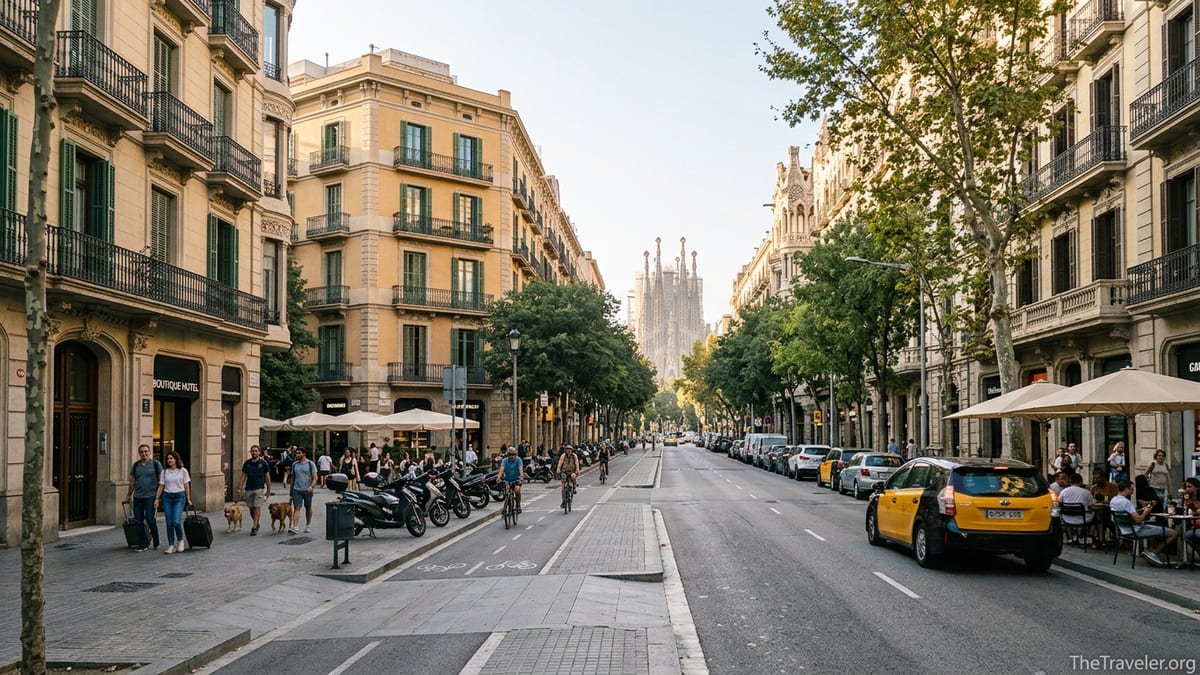
Eixample, which means “extension” in Catalan, is the 19th century grid that connects Barcelona’s old city with the once-separate town of Gràcia. Look at a city map and you will see a wide, perfectly ordered rectangle of square blocks with chamfered corners and broad avenues slicing through it. This is Eixample, and it is where you find some of the city’s most iconic architecture and shopping streets.
The district covers a big area and is usually divided into sub-neighbourhoods like Dreta de l’Eixample (Right Eixample, closest to Passeig de Gràcia and Plaça de Catalunya), Esquerra de l’Eixample (Left Eixample, running towards Sants), and the Sagrada Família area to the northeast. In practical terms, if your hotel is near Passeig de Gràcia, Rambla de Catalunya, or around the Sagrada Família basilica, you are in Eixample.
This location puts you between the medieval alleys of the Gothic Quarter and the village-like streets of Gràcia. Walk ten to fifteen minutes south and you hit Plaça de Catalunya and La Rambla. Head uphill and you are at Verdaguer or Diagonal, gateways to Gràcia and to Gaudí sites like Casa Milà. For first-time visitors who want to see a lot in a few days, that centrality is a strong argument in Eixample’s favour.
It is also a largely residential district, with local pharmacies, bakeries, and markets under the same apartment blocks as boutique hotels and serviced apartments. Staying here, especially away from the biggest avenues, tends to feel more like living in Barcelona for a few days than being in the middle of a theme-park strip.
Proximity to Major Sights and Daily Convenience
One of Eixample’s biggest advantages is how close it is to many of Barcelona’s headline attractions. The Sagrada Família, Casa Batlló, and Casa Milà (La Pedrera) all sit within the district’s boundaries or right on its edges. A typical visitor staying near Passeig de Gràcia can walk from their hotel to Casa Batlló in under five minutes, continue ten more minutes to La Pedrera, and then either stroll or take the metro two stops to Sagrada Família.
For example, a traveler staying near the Passeig de Gràcia metro station can reach Sagrada Família by taking the L2 purple line for about ten minutes door to door, or by a twenty-five minute walk along elegant avenues if the weather is pleasant. Plaça de Catalunya, the starting point for many airport buses and day tours, is usually a ten to fifteen minute walk from much of Dreta de l’Eixample, so you can often avoid extra taxi rides or multiple metro changes when arriving or leaving.
Daily errands are straightforward here. Supermarkets like Bonpreu, Condis or Mercadona are common at street level, and you will find bakeries turning out croissants and pan con tomate from early morning, ideal if you want a simple breakfast before heading to the sights. Many streets are lined with neighborhood bars and cafes where an espresso at the counter still costs roughly 1.30 to 1.80 euros, and a menu del día lunch in a non-touristy spot can run around 13 to 18 euros, which is modest for central Barcelona.
Because this is also an office and residential area, services such as laundries, pharmacies, and small convenience stores are easy to find and often open later than in historic quarters where shops cater mainly to tourists. That can make a real difference if you need medicine at night or want to wash clothes during a longer stay.
Atmosphere: Elegant, Urban and Mostly Calm
Staying in Eixample feels very different from staying in the Gothic Quarter or El Raval. Streets are broad and straight, buildings are tall and uniform, and most blocks hide interior courtyards that add light and air. The prevailing feeling is one of classic urban Europe: grand facades, trees along the pavements, and a steady flow of locals going about their day. You are rarely more than a few minutes from a leafy square or a bench where residents sit and read.
By night, much of Eixample is relatively calm compared to the bar-heavy lanes nearer the port. Around major avenues like Gran Via or Passeig de Gràcia you will still hear traffic well into the evening, but once you step into side streets such as Enric Granados or Carrer de Girona the atmosphere is softer, with low-level chatter from restaurant terraces and only occasional delivery trucks. Many travelers who have stayed both in the old town and in Eixample comment that they sleep better here, particularly if their room faces an inner courtyard rather than a main road.
The exception is around certain nightlife pockets, especially parts of Eixample Esquerra known for cocktail bars and clubs, and the blocks right next to the Sagrada Família, where crowds ebb and flow from early morning until late evening. If you are sensitive to noise, looking for accommodation a few blocks back from big landmarks or choosing a room overlooking a courtyard rather than the street can make your stay noticeably more comfortable.
Overall, the neighborhood offers a good balance: urban and lively in the daytime, with enough restaurants and bars to keep evenings interesting, but not as raucous as areas that lean heavily on nightlife tourism. For many visitors, that middle ground is exactly what they want from a city base.
Getting Around: Transport, Walking, and Airport Access
Eixample is one of the easiest parts of Barcelona to navigate, both because of its grid layout and because it is laced with public transport. Metro lines such as L2 and L5 cross the district, stopping at Sagrada Família, Verdaguer, and Diagonal, while L3 serves Passeig de Gràcia and Catalunya. From a hotel near Passeig de Gràcia, you can typically reach Barceloneta beach in around twenty minutes by metro and transfer, or about half an hour on foot if you enjoy walking through the old town.
Walking is often the most rewarding way to get around. A common itinerary for visitors staying in Eixample might be to walk from their hotel to Sagrada Família in the morning, continue down Avinguda Gaudí towards the modernist Hospital de Sant Pau, then loop back through tree-lined Carrer de Girona, stopping for coffee and pastries along the way. The distances between major points look large on the metro map but often work out to fifteen to twenty minutes on foot, and the streets are generally flat.
From Barcelona-El Prat airport, Eixample is reasonably simple to reach. Many visitors take the airport shuttle bus to Plaça de Catalunya and then either walk to their hotel or transfer to the metro for one or two stops. A taxi or ride-hail from the airport to central Eixample typically takes about twenty to thirty minutes depending on traffic and costs in the range of thirty to forty euros, which can be cost-effective for families or small groups with luggage.
If you plan day trips by train, Eixample also puts you fairly close to key stations. Passeig de Gràcia station, under the boulevard of the same name, handles regional trains to places like Girona and Figueres, while Sants station, the main high-speed hub, is a short metro ride away on L5. For travelers building Barcelona into a longer Spain itinerary, that connectivity is a practical consideration.
Accommodation: What You Actually Get for Your Money
Eixample spans everything from budget-friendly hostels to high-end design hotels and serviced apartments, and prices vary accordingly. Around Passeig de Gràcia, where many luxury brands and emblematic modernist buildings are clustered, you will find five-star properties with rooftop pools and views of Casa Batlló or La Pedrera. Here, summer rates for a classic room can easily exceed 400 euros per night, reflecting not just comfort but the prestige of the address.
A few blocks away, however, the picture changes. In both Dreta and Esquerra de l’Eixample you can find mid-range boutique hotels and aparthotels offering doubles in the 150 to 250 euro range in high season, often with generous rooms compared to similarly priced places in the cramped medieval core. Many of these are in handsome 19th century buildings with high ceilings and balconies, so you get a sense of place without the full luxury markup.
For budget travelers, Eixample has hostels and simple pension-style guesthouses, particularly along streets like Gran Via and near metro stops such as Urgell or Girona. A bed in a shared dorm might hover around 30 to 45 euros in peak months, while basic private rooms can start around 90 to 120 euros. They may not be as cheap as some options on the city’s outskirts, but the trade-off in time and transport costs often favours being central.
One thing to keep in mind is that Eixample has a very high concentration of officially registered tourist apartments. That means you will see a wide range of short-term rentals, from compact studios to multi-bedroom family flats. When comparing these with hotels, factor in cleaning fees and the city’s tourist tax, which are often added on top of nightly rates. In many cases, families or groups of friends staying more than three or four nights find that a two-bedroom apartment with a kitchen works out cheaper than booking multiple hotel rooms.
Food, Shopping, and Everyday Life
Eixample is an easy place to eat well, though it rewards a bit of exploration away from the most famous avenues. Passeig de Gràcia is lined with upscale restaurants and hotel terraces where a main course can cost 25 to 40 euros and cocktails reach double digits, targeting expense-account diners and special occasions. Just one or two streets behind, on Rambla de Catalunya or Enric Granados, you will find more relaxed bistros, tapas bars, and ice-cream parlors, where a dinner of shared plates for two people with drinks might land closer to 35 to 60 euros.
For travelers who like to self-cater or mix restaurant meals with picnics, local markets and bakeries are a major plus. Mercat de la Concepció, just off Carrer d’Aragó, offers fresh fruit, vegetables, seafood, and cheeses, and there are smaller neighborhood markets sprinkled across the district. It is entirely feasible to pick up ham, olives, and bread in the afternoon and assemble a simple picnic to enjoy in nearby parks or back in your apartment.
Shopping ranges from international fashion chains and designer boutiques on Passeig de Gràcia to independent shops scattered along side streets. You can browse flagship stores for Spanish brands, then step into a century-old café for churros or hot chocolate. Compared with the old town, where many stores sell the same souvenirs, Eixample offers a higher proportion of everyday shops used by locals, which can make window-shopping feel more authentic and less repetitive.
In the evening, Eixample’s nightlife is varied but generally more grown-up than party districts close to the port. You will find natural wine bars tucked into side streets, cocktail bars in Eixample Esquerra, and rooftop terraces atop hotels with city views. If you want louder clubs, the metro or a short taxi ride will get you there, but you are not surrounded by late-night noise when you step out of your front door.
Safety, Crowds, and Potential Downsides
In terms of general safety, Eixample is widely viewed as one of Barcelona’s more comfortable districts for visitors, including solo travelers and families. Streets are well lit, pavements are wide, and there is a constant mix of residents and office workers as well as tourists. It is common to see people sitting alone on benches reading, or walking back from dinner at 11 pm, especially in Dreta de l’Eixample and along Rambla de Catalunya.
That said, Barcelona has a long-standing issue with pickpocketing, and Eixample is not immune, particularly around major monuments and crowded metro stations. Areas immediately surrounding Sagrada Família can feel intensely busy in peak months, with tour groups, vendors, and long security lines. If you stay right next to the basilica, expect a tourist-heavy environment from early morning until late evening and plan to be extra mindful of your belongings in crowds and on the metro.
Another downside is cost. Eixample is among the city’s more expensive districts for both housing and tourism-related services. A simple café terrace on Passeig de Gràcia may charge noticeably more for the same coffee or beer than a bar two streets away in a quieter part of Esquerra de l’Eixample. Visitors who do not venture beyond the main avenues often end up paying a premium without realising they could get similar quality for less with a five-minute walk.
Finally, some travelers find the grid layout monotonous after a few days. If you are drawn to labyrinthine alleys, street art, and the feel of an ancient port city, you may find the polished, orderly streets of Eixample a bit sterile. In that case, staying in a more atmospheric district and visiting Eixample by day might be a better fit. The city is compact enough that you can reach its main boulevards easily from almost anywhere within a few metro stops.
Who Eixample Is Best For (and Who Might Prefer Elsewhere)
Eixample tends to work particularly well for first-time visitors who want a central, well-connected base without the late-night noise that can come with staying in the Gothic Quarter or right off La Rambla. Couples on a short city break, families with older children, and solo travelers who value walkability and a sense of everyday local life often find it an excellent fit.
It is also a strong choice if Gaudí and modernist architecture are high on your agenda. Being able to walk to Sagrada Família for an early-morning entry slot, then stroll down to Casa Batlló and La Pedrera, saves time and reduces the stress of crossing the city multiple times a day. If you are in Barcelona for a conference at one of the central hotels or for a work trip combined with sightseeing, Eixample’s mix of business infrastructure and tourist appeal is convenient.
On the other hand, if your priority is nightlife, you might prefer staying closer to El Born, the waterfront, or Poble-sec, where bars and music venues cluster and you can walk home late without a long taxi ride. Travelers on very tight budgets may also find that accommodation in outer neighborhoods or even in nearby towns on the commuter rail network offers more bang for their euro, although at the cost of commute time.
Finally, some repeat visitors deliberately base themselves elsewhere precisely because they have already explored Eixample in depth. They might choose Gràcia for its small plazas and independent shops, or Poblenou near the beach, and then dip into Eixample for a day of shopping or a meal on Enric Granados. That is less a criticism of the district than a sign that Barcelona offers distinct flavours, and Eixample is just one of them.
The Takeaway
So is Eixample worth staying in for your Barcelona trip? For many travelers, the answer is yes, provided you choose the right corner of the district and go in with realistic expectations about crowds and prices. The combination of walkable access to star attractions, solid public transport, and a generally calm, residential feel is hard to beat, especially for first-time visitors and those who value comfort and convenience over bohemian atmosphere.
If you imagine starting your day with coffee on a balcony overlooking a tree-lined street, walking to Sagrada Família or Casa Batlló, then ending the evening in a neighborhood wine bar a short stroll from your hotel, Eixample is likely to suit you very well. If instead you crave narrow medieval alleys, late-night bars under stone arches, or waking up a two-minute walk from the beach, then you may be happier basing yourself in a different district and visiting Eixample as part of your explorations.
Ultimately, Barcelona is a compact, well-connected city, and no single neighborhood will make or break your trip. Eixample offers a polished, architecturally rich, and practical base that works for a wide range of visitors. Whether it is the right choice for you comes down to the kind of streets you want to step into when you leave your hotel each morning.
FAQ
Q1. Is Eixample a safe area to stay in Barcelona?
Eixample is generally considered one of Barcelona’s safer central districts, with broad, well-lit streets and a steady presence of residents and office workers. As elsewhere in the city, you should still watch for pickpockets around busy metro stations and major sights such as the Sagrada Família.
Q2. How far is Eixample from the main tourist attractions?
Many of the city’s main attractions are actually inside Eixample, including the Sagrada Família, Casa Batlló, and Casa Milà. From a typical hotel near Passeig de Gràcia, you can usually walk to at least one major Gaudí site within ten minutes and reach Plaça de Catalunya and the Gothic Quarter in about fifteen minutes on foot.
Q3. Is Eixample noisy at night?
The main avenues, such as Gran Via and Passeig de Gràcia, have steady traffic and can be noisy. However, many side streets in Dreta and Esquerra de l’Eixample are relatively calm after midnight, especially if your room faces an inner courtyard. Choosing accommodation a few blocks away from big junctions and nightlife clusters usually results in quieter nights.
Q4. Is Eixample a good area for families?
Yes, many families find Eixample a good fit. Wide pavements, playgrounds tucked into interior courtyards, easy access to supermarkets, and straightforward public transport make it practical when traveling with children. The district’s central location also reduces the need for long journeys to reach museums, parks, and major sights.
Q5. Can budget travelers afford to stay in Eixample?
While Eixample is not the cheapest part of Barcelona, budget options do exist, including hostels, simple guesthouses, and smaller hotels along streets like Gran Via or near less touristy metro stops. Costs may be higher than in outer suburbs, but many travelers feel the savings in time and transport justify paying a bit more to stay central.
Q6. How easy is it to get to the beach from Eixample?
From central Eixample, Barceloneta beach is typically around twenty minutes away by a combination of metro and a short walk, or about half an hour to forty minutes on foot depending on your starting point. It is not a beachfront neighborhood, but day trips to the sea are straightforward.
Q7. Is Eixample walkable for older travelers or those with limited mobility?
Eixample is largely flat, with wide pavements and many pedestrian crossings, which can be easier than the cobblestones and occasional slopes in the old town. Metro stations have varying levels of accessibility though, so older travelers sometimes prefer taxis for longer hops, which are plentiful in the area.
Q8. What is the best part of Eixample to stay in?
Dreta de l’Eixample near Passeig de Gràcia is ideal if you want to be close to major Gaudí houses and high-end shopping, while Esquerra de l’Eixample offers a slightly more local, residential feel with plenty of restaurants. The immediate surroundings of the Sagrada Família are very convenient for early visits to the basilica but can feel more tourist-heavy throughout the day.
Q9. Are there good food options in Eixample?
Yes, Eixample has everything from upscale restaurants on Passeig de Gràcia to casual tapas bars on streets like Enric Granados, plus neighborhood bakeries and markets such as Mercat de la Concepció. It is easy to find both quick breakfasts and sit-down dinners within a few minutes’ walk of most accommodations.
Q10. Is Eixample worth it for a short two or three day stay?
For a brief city break, Eixample’s central location and transport links can save time and simplify logistics. Being able to walk or take a short metro ride to many key sights means you spend more of your limited stay exploring and less time commuting across the city, which many visitors find more than justifies staying here.