


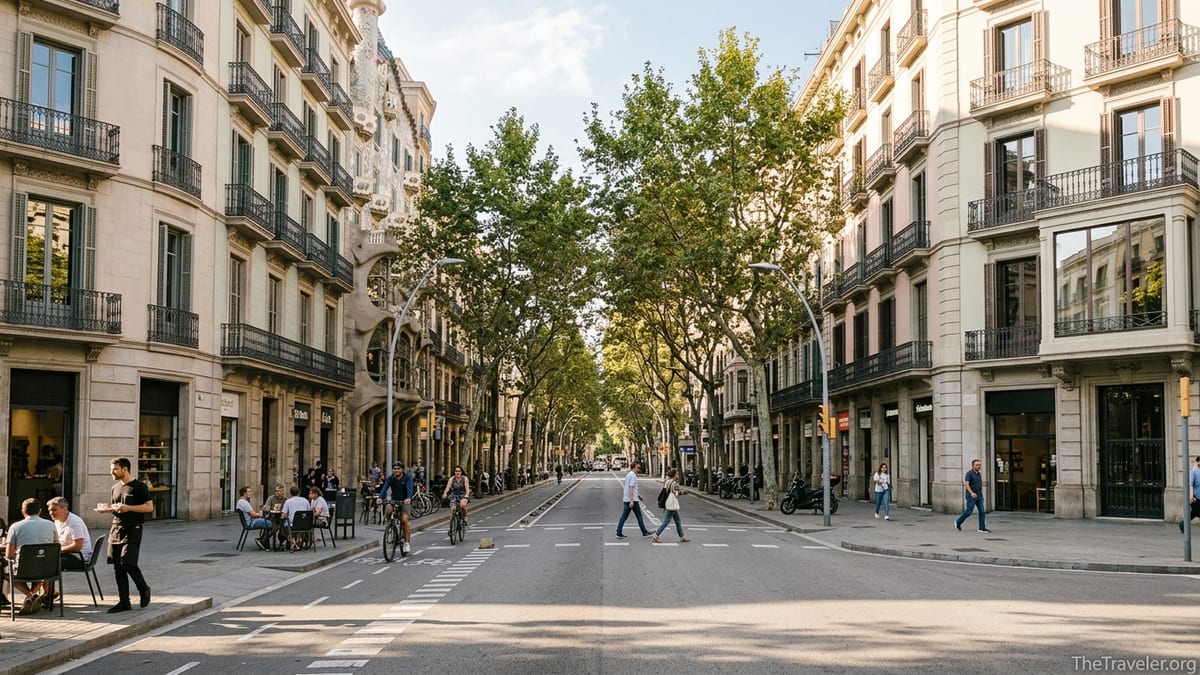
Stand on any corner in Barcelona’s Eixample and look around. Instead of medieval alleys or fishing cottages, you see long, ruler-straight avenues, chamfered corners that open into vast crossroads, and elegant apartment blocks crowned with wrought iron balconies. The neighborhood looks and feels completely different from the Gothic Quarter, El Born, Gràcia or Poblenou. Understanding what sets Eixample apart helps travelers choose where to stay, how to explore, and how to read Barcelona’s past and present through its streets.
Get the latest updates straight to your inbox!
A City Built on a Radical Grid
Eixample literally means “extension,” and that is exactly what it was: the 19th century expansion that burst beyond Barcelona’s medieval walls. Rather than letting the city grow organically, engineer Ildefons Cerdà drew a strict grid of almost identical square blocks with cut corners, each roughly one city minute apart on foot. From above, it looks like a honeycomb of octagons. On the ground, that grid gives travelers a sense of orientation rare in old European cities. You can walk from Plaça de Catalunya up Carrer de Balmes or down Carrer de Girona and always know roughly where you are.
This grid is not just a visual quirk. Cerdà designed it to bring light, air and movement into a city that had been crowded and unhealthy. The wide streets and opened corners were meant to let in sun and breeze, and to allow carriages and, later, trams to turn easily. Today that translates into big intersections where cars, bicycles and pedestrians all have space, and where you can actually see the sky. In contrast, if you cross into the Gothic Quarter, just a ten minute walk away, you suddenly slip into a maze of narrow lanes and small plazas where you can easily lose your bearings and rarely glimpse the horizon.
For visitors, this geometry changes how you explore. In Eixample you might plan a morning by simply choosing a direction: walk three blocks up from Passeig de Gràcia, then four blocks right, stopping for coffee wherever a terrace looks inviting. In El Born or the Gothic Quarter, walking is more about surrendering to the labyrinth. That sense of order is part of what makes Eixample feel more modern, even if much of it is now over a century old.
Light, Space and a Very Different Street Life
The most immediate difference many travelers notice in Eixample is the feeling of space. Streets like Carrer d’Aragó or Gran Via de les Corts Catalanes are far wider than the lanes in the old city, with several lanes of traffic, central bus corridors and generous sidewalks. Trees line many of these avenues, and at the chamfered corners there are often small pockets of outdoor seating where cafes place a few tables. You can sit at a corner bar on Carrer de València and look diagonally across the intersection, seeing people and traffic flowing from four directions at once, almost like a slow urban theater.
This layout affects noise and atmosphere. Some streets carry heavy car traffic and feel busy, especially at rush hour. Others, such as the pedestrianized sections of Consell de Cent, have been recently redesigned with wide pavements, benches and planters. These new “green axes” calm the grid and attract families, runners and people walking dogs. For a visitor staying in Eixample, it means you are more likely to wake up to the sound of buses and scooters on a weekday, but you also have easy access to open, walkable corridors that connect the entire district.
Compare that with Gràcia, just uphill. Gràcia’s streets are much narrower and often closed to through traffic, with small plazas like Plaça de la Vila de Gràcia packed with bar terraces. It feels more like a village that the city grew around. In Poblenou, former industrial streets run toward the sea, with old factories converted into technology offices or design studios. Eixample’s street life is more about the steady rhythms of a residential and commercial grid: bakeries on the ground floor, neighbours chatting outside supermarkets, and office workers crisscrossing wide crossings at lunchtime.
Modernisme Icons on Everyday Corners
Eixample holds one treasure that no other part of Barcelona can match: the densest concentration of Catalan Modernisme architecture. Along Passeig de Gràcia, the district’s grandest avenue, stand Antoni Gaudí’s Casa Batlló and Casa Milà, also known as La Pedrera, alongside works by other masters like Casa Amatller and Casa Lleó Morera. These are not isolated monuments. They are woven into a working neighborhood of banks, fashion stores and apartments, which makes encountering them on a casual walk especially striking.
The difference is clear if you compare with Park Güell or Sagrada Família, Gaudí sites located beyond the grid. Those feel like set-piece attractions where you arrive, visit and leave. In Eixample, Modernisme forms part of the everyday streetscape. You might step out of a modest cafeteria near Diagonal, order a menu del día for a reasonable price, and then turn a corner to find yourself face to face with a façade covered in colored ceramics or wrought iron balconies shaped like seaweed. The interplay of ordinary life and extraordinary architecture is one of the neighborhood’s signatures.
Recent years have seen careful restoration of these buildings and new ways to experience them. Casa Batlló has invested heavily in recovering Gaudí’s original details and opening new spaces to visitors, including areas that still feel like private apartments rather than a conventional museum. The most obvious practical difference for travelers compared to other neighborhoods is price and demand: entry to a major Modernisme house in Eixample typically costs more than most museums in the Gothic Quarter, and timed tickets often sell out, especially in high season. That reinforces Eixample’s role as both a residential district and an open air architectural gallery.
From Bourgeois Mansions to Everyday Apartments
When Eixample was first developed, it was designed with a social ideal in mind: mixed classes, plenty of open gardens, and moderate building heights. In practice, real estate interests pushed the area toward something different. Many of the grandest flats along Passeig de Gràcia and nearby streets were built as luxurious residences for wealthy industrial families. Over time, those mansions were split into separate apartments, converted into offices or turned into hotels. This history is still visible in buildings with elegant marble staircases and old wooden lifts that now carry ordinary residents up to compact apartments.
For travelers, accommodation in Eixample often means staying in a typical early 20th century apartment block with high ceilings, patterned tile floors and tall French doors opening to a narrow balcony. You might book a mid range hotel in L’Antiga Esquerra de l’Eixample, pay a bit less than in a design hotel overlooking the cathedral, and still enjoy a room in a handsome historic building. Throughout the district, businesses occupy the ground floors, so you are rarely more than a block or two from a bakery, a pharmacy or a simple bar serving lunchtime stews and weekday menú.
This differs from the Gothic Quarter or El Born, where many buildings are smaller and much older, with irregular rooms and lower light levels. There, some hotels occupy former palaces and convents tucked down medieval streets. In Eixample, the feel is more like Paris or parts of Buenos Aires: long uniform façades with repeating balconies and a steady rhythm of doorways. The social mix is also distinct. While some streets near Passeig de Gràcia are clearly upscale and international, other parts of Eixample remain firmly middle class, with local butchers, small hardware stores and everyday supermarkets that rarely appear on tourist maps.
Eating, Drinking and Shopping on the Grid
Food in Eixample reflects its role as both a residential and business district. Around lunchtime on a weekday, streets like Carrer de Mallorca and Carrer d’Aribau fill with office workers choosing between simple menú del día offerings: a starter, main dish, dessert and drink for a fixed price that is often lower than what you will find in heavily touristed alleys of the old town. You might sit at a neighborhood bar for grilled chicken and salad, surrounded by people speaking Catalan and Spanish, rather than hearing only English, French or German at the next table.
At the same time, Eixample has become one of the city’s most dynamic areas for contemporary dining and drinks. Brunch cafes and specialty coffee bars are common, particularly in Dreta de l’Eixample, where renovated ground floor spaces house minimalist espresso bars and bakeries selling sourdough loaves. Cocktail bars and natural wine spots are increasingly tucked into side streets off Passeig de Sant Joan or near Carrer d’Enric Granados, a leafy lane where restaurant terraces spill into the traffic calmed roadway. Prices here range widely. A simple cortado at a traditional bar may cost significantly less than a flat white at a fashionable cafe just a few blocks away.
Shopping also feels different from other neighborhoods. On Passeig de Gràcia, the ground floors are dominated by luxury brands and flagship stores, as well as Spanish and international high street chains. This stretch has a glossy, international flavor comparable to major European shopping boulevards. Move a few blocks inland, however, and you are more likely to find independent bookstores, design studios and shops selling household goods to local residents. In the Gothic Quarter, by contrast, many storefronts are devoted to souvenirs, fast fashion and bars catering primarily to visitors. Poblenou, meanwhile, is stronger on co working spaces and tech offices than on retail. Eixample sits somewhere in between: both an everyday commercial zone for locals and a showcase corridor for global brands.
Getting Around: Eixample as Barcelona’s Hub
Because of its central location and planned layout, Eixample works like a hinge between many parts of Barcelona. Plaça de Catalunya, at its lower edge, is the main hub for airport buses and several metro and regional train lines. From there, Eixample’s straight streets take you out toward Sagrada Família, up toward the hills, or across toward the Sants train station. Walking distances are often shorter than they appear. A fifteen minute walk up the grid can take you from the edge of the Gothic Quarter to the heart of the Modernisme zone on Passeig de Gràcia, without the constant turning and backtracking that characterize older neighborhoods.
Public transport connections are especially strong. Several metro lines crisscross Eixample, and many bus routes run along major avenues like Gran Via and Diagonal. For cyclists, the broad, regular streets and increasing number of protected bike lanes make it one of the more comfortable areas to ride. Visitors staying in Eixample can usually reach the beach in Barceloneta or the nightlife of Poble-sec with a single metro ride, while still returning at night to a relatively calm, residential environment.
This contrasts with staying in, for example, Barceloneta, where you are very close to the sand but must rely more heavily on buses and the metro to reach inner neighborhoods. In Gràcia, the hilly streets and fewer wide avenues can make longer walks feel more demanding, although there is a dense network of metro and bus options. Eixample’s flatness and clarity make it forgiving for first time visitors who might otherwise struggle to navigate a foreign city.
Tourism, Regulations and Everyday Life
Barcelona has spent the past decade trying to manage intense tourism pressure, and the differences between Eixample and other districts are part of this story. The medieval core around the Gothic Quarter and El Born absorbs a heavy share of day trippers, cruise visitors and nightlife crowds. There, many traditional shops have been replaced by short term rentals, souvenir outlets and themed bars. Eixample, by comparison, has remained more mixed. It certainly hosts many hotels and some tourist apartments, especially near Passeig de Gràcia and Sagrada Família, but large sections retain a primarily residential character.
Recent rules from city and regional authorities have limited new tourist accommodation and placed stricter controls on holiday rentals. Walking through Eixample today, you still see “For rent” signs for long term flats in several languages, but in many stairwells, notices from the community of owners remind residents that unauthorized tourist lets are not allowed. For travelers, this means that staying in a licensed hotel or apartment in Eixample tends to be more straightforward than trying to find an informal rental in more heavily saturated areas of the old town.
The balance between visitors and locals also shapes the neighborhood’s rhythm. In parts of the Gothic Quarter, mornings can feel sleepy compared to the nightlife that runs deep into the night. In Eixample, early hours are more clearly defined by local routines: children walking to school, office workers heading to metro stations, delivery vans blocking a lane while unloading crates of fruit. For someone spending a week or longer in Barcelona, this everyday cadence can make Eixample feel like a more authentic place to “live” in the city, even if you still walk fifteen minutes to admire Gaudí’s rooflines.
The Takeaway
Eixample stands apart from other Barcelona neighborhoods in almost every way a traveler can sense: geometry, atmosphere, architecture, and daily life. Its rational grid feels worlds away from the tangles of the Gothic Quarter or the village lanes of Gràcia. Yet that same grid hosts some of the most exuberant buildings in Europe, where Modernisme curves and colors spill over otherwise orderly façades. The district’s broad avenues and generous light give it a confident, urban feel, while its many ordinary bars, grocery stores and schools remind you that this is first and foremost a place where people live.
Choosing Eixample as a base means trading the instant drama of staying next to Roman walls or the beach for the slower pleasure of inhabiting a functioning city district. You step out of a 19th century apartment block each morning into a pattern of streets that is easy to read, drop into cafes where staff recognize regulars, and reach nearly every other part of Barcelona with a direct walk or short ride. Modern icons like Casa Batlló or La Pedrera may be on every visitor’s checklist, but in Eixample they share space with supermarkets, schools and hardware shops.
In the end, what makes Eixample different is that it captures Barcelona’s ongoing story of reinvention. It began as a bold social and urban experiment, grew into a showcase for bourgeois ambition and artistic flair, and now functions as a lived in grid where global tourism, local life and civic planning continue to collide. For travelers willing to look beyond postcard corners, Eixample offers one of the clearest windows into how Barcelona became the city it is today.
FAQ
Q1. Is Eixample a good area to stay in for first time visitors to Barcelona?
Yes, Eixample is an excellent base for first time visitors. It is central, well connected by metro and bus, and offers a wide choice of hotels and apartments. The grid layout makes it easy to navigate, and you can walk to the Gothic Quarter, Passeig de Gràcia and often to Sagrada Família, while returning at night to a more residential atmosphere than in the busiest old town streets.
Q2. How is Eixample different from the Gothic Quarter?
Eixample is a planned 19th century grid of wide, straight streets and chamfered corners, with elegant apartment blocks and Modernisme landmarks. The Gothic Quarter is the medieval core, with narrow, winding lanes, small plazas and dense historic buildings. In practical terms, Eixample feels more open, bright and easy to orient yourself in, while the Gothic Quarter feels older, more atmospheric and more crowded with tourists.
Q3. Which famous Gaudí buildings are in Eixample?
The most famous Gaudí works in Eixample are Casa Batlló and Casa Milà, also known as La Pedrera, both on Passeig de Gràcia. Several other important Modernisme buildings by different architects also stand in the district, such as Casa Amatller and Casa Lleó Morera. Sagrada Família sits just beyond the traditional grid but is usually reached by walking or taking the metro through Eixample.
Q4. Is Eixample safe at night?
Eixample is generally considered one of the safer central areas of Barcelona, with many residents, shops and restaurants that keep the streets active into the evening. As in any large city, you should still take normal precautions with bags, phones and wallets, especially near busy intersections, metro stations and tourist landmarks. Most visitors feel comfortable walking home along the main streets until late.
Q5. What is the nightlife like in Eixample compared to other neighborhoods?
Eixample’s nightlife is more dispersed and varied than in areas like El Born or the beach, which have dense clusters of bars. Here you will find cocktail bars, wine bars and late opening restaurants spread across the grid, especially around streets such as Enric Granados or Aribau. Clubs and louder late night spots are fewer in number, so the overall feel is somewhat calmer than in purely nightlife focused districts.
Q6. How expensive is it to eat and drink in Eixample?
Prices vary widely. Around Passeig de Gràcia and the major Gaudí houses, cafes and restaurants often charge higher prices than in more residential streets. A few blocks away, you can find simple bars offering daily lunch menus at moderate prices, and bakeries selling affordable coffee and pastries. Overall, eating and drinking in Eixample can be as economical or as upscale as you choose, depending on the exact streets and venues.
Q7. Is Eixample noisy because of the wide roads and traffic?
Some major avenues in Eixample, such as Gran Via or Aragó, carry heavy traffic and can be noisy, especially at rush hours. However, many side streets and newly traffic calmed axes are much quieter, and apartments often have interior courtyards that reduce street noise. When choosing accommodation, it is worth checking whether rooms face the street or an inner patio and reading recent guest comments about sound levels.
Q8. How long does it take to walk from Eixample to the beach?
From central Eixample near Passeig de Gràcia, walking to Barceloneta beach typically takes around 30 to 40 minutes at a normal pace, crossing through the old city and then down toward the sea. Many visitors prefer to take the metro or a bus for part of the journey, which can reduce travel time to around 20 minutes door to sand, depending on the exact starting point.
Q9. Are there green spaces and parks in Eixample?
Eixample has fewer large traditional parks than some other districts, but it does include several pleasant green spaces. Small interior block gardens, redesigned squares and recently pedestrianized streets with trees and benches provide pockets of greenery. For a larger park experience, residents often walk or take the metro to nearby Ciutadella Park or up toward the slopes of Montjuïc and the hills above Gràcia.
Q10. Is Eixample suitable for families traveling with children?
Yes, many families find Eixample very practical. The sidewalks are wide, crossings are frequent, and playgrounds and schools are integrated into the neighborhood fabric. Supermarkets, pharmacies and everyday services are close at hand, and public transport to attractions such as the zoo, the beach or Montjuïc is straightforward. Parents should still watch children carefully near the larger intersections, but overall the area works well for family stays.