


Planning a Canadian outdoor adventure quickly leads to a big decision: book a Parks Canada site in a national park, or head for a provincial park instead. Both can deliver glacier views, glassy canoe routes, or easy family camping, but the experience on the ground can feel very different depending on who manages the land. Understanding those differences helps you pick the park system that actually fits your style, budget, and timeline instead of fighting waitlists or ending up in the wrong kind of wilderness.
Get the latest updates straight to your inbox!
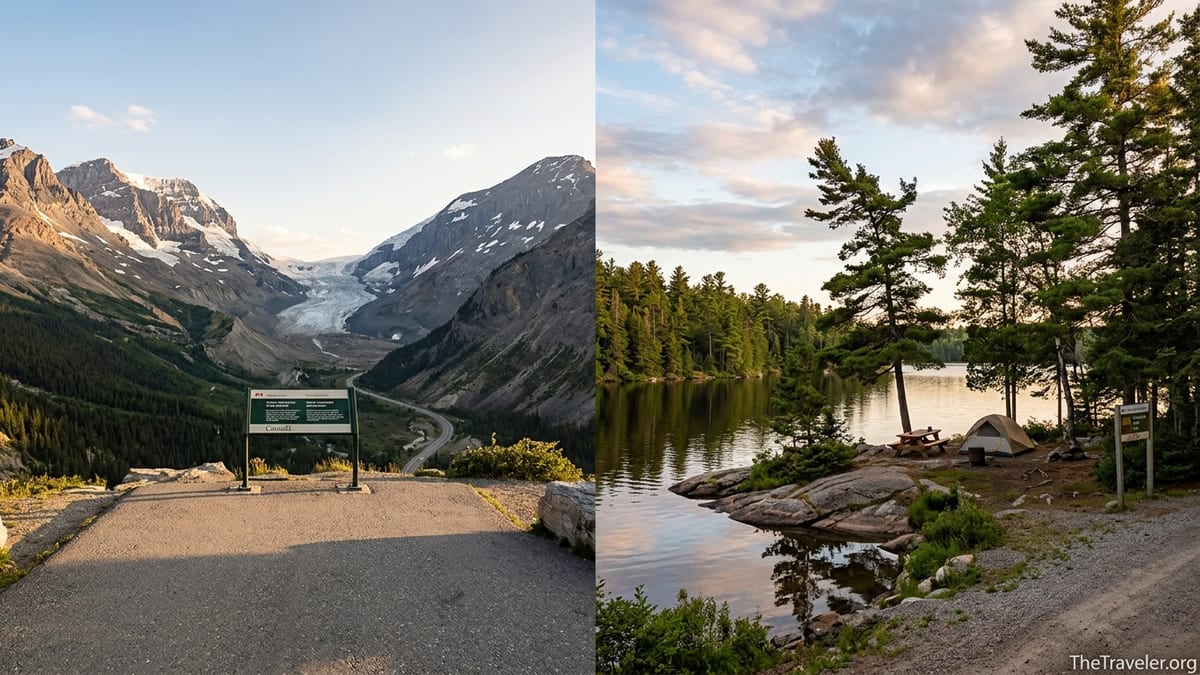
Parks Canada vs Provincial Parks: The Basics
Parks Canada manages national parks, national marine conservation areas, and national historic sites across the country. These are places like Banff and Jasper in Alberta, Gros Morne in Newfoundland and Labrador, or Pacific Rim on Vancouver Island. They are usually nationally significant landscapes with strong conservation mandates, heavy international tourism, and relatively consistent standards for campgrounds, visitor centres, and interpretive programs.
Provincial parks are run by individual provinces and territories, such as Ontario Parks, BC Parks, Parks Nova Scotia, or Sépaq in Quebec. They range from famous wilderness areas like Killarney Provincial Park in Ontario or Garibaldi Provincial Park in British Columbia to tiny day use beaches and non-operating nature reserves with no services at all. Because each province sets its own rules, fees, and infrastructure standards, the provincial park experience in Nova Scotia can feel very different from that in Alberta or Manitoba.
For travelers, this means that “national” does not automatically mean more remote or more scenic, and “provincial” does not necessarily mean second tier. You might watch sunrise over Moraine Lake in Banff National Park one week and then discover equally dramatic, far less crowded backcountry in a nearby provincial park the next. The better question is not which system is superior overall, but which is better for the specific trip you are planning.
Before you book anything, it helps to think through what matters most to you: iconic scenery, ease of access, quieter campgrounds, family-friendly amenities, or the feeling of being completely off grid. The answer often points clearly toward either Parks Canada or a particular provincial system.
Access, Reservations, and Crowds
Parks Canada sites tend to attract more international visitors, so they often come with more complex reservation systems and heavier competition for prime dates. Popular frontcountry campgrounds in Banff and Jasper routinely book out within minutes of the annual launch dates, and shuttles for places like Moraine Lake or Lake O’Hara in Yoho are snapped up quickly as well. A typical summer weekend can feel like high season in a European national park, complete with tour buses and multilingual crowds.
Provincial parks can be just as competitive in certain regions, especially close to big cities. Ontario Parks campgrounds within a few hours of Toronto, such as Sandbanks or the drive-in sites in Algonquin, are notorious for selling out exactly five months to the minute before arrival when reservations open. In contrast, you can often still find last-minute space at more remote provincial parks in Northern Ontario or in parts of Saskatchewan and Manitoba, especially midweek or outside peak summer holiday periods.
If you dream of a flexible road trip without a rigid itinerary, provincial parks often provide better odds of success. In British Columbia, for example, some BC Parks campgrounds still operate on a first-come, first-served basis or hold back a portion of sites for walk-ins, especially in less-trafficked areas of the interior or north. By comparison, many Parks Canada frontcountry campgrounds in the Rockies and along the Atlantic and Pacific coasts are heavily reservation-based, and simply showing up in July without a booking can be risky.
On the other hand, Parks Canada’s central reservation platform lets you plan a cross-country trip around national parks months in advance using a single system, with clear rules for changes and cancellations. If you prefer certainty and are willing to set an alarm for opening day, that level of structure can be a major advantage.
Costs, Fees, and What You Get for Your Money
Pricing is one of the most tangible differences between Parks Canada and provincial parks, and it can add up quickly on longer trips. Parks Canada typically charges a nightly camping fee plus a separate daily admission or a Parks Canada Discovery Pass. Families or frequent visitors often buy the annual pass, which can pay off after a week or more in national parks, especially if you are visiting multiple sites over one season.
Provincial campgrounds generally roll everything into a single nightly fee, though details vary. In many Ontario Parks campgrounds, a regular electrical campsite in a popular southern park commonly falls in the ballpark of roughly 50 to 60 Canadian dollars per night for a car, tent, and family, with slightly lower fees in more remote or non-electrical areas. In BC Parks, typical frontcountry sites in established campgrounds have historically hovered in the range of about 25 to 45 dollars per night, depending on services like power or showers, with premium coastal or high-demand parks now edging higher and new non-resident surcharges recently introduced for some areas.
In Atlantic Canada, nightly provincial park camping often remains somewhat lower than the busiest national parks. For instance, a serviced site at a Nova Scotia provincial park such as Mira River has been listed in recent seasons around the high twenties to mid-thirties per night, with discounts for seniors and veterans. Comparable serviced sites in peak-season Parks Canada campgrounds near Halifax or along the Cabot Trail can come in higher, especially once you factor in park entry fees.
What you receive for these fees is not identical. Parks Canada campgrounds usually offer well-maintained washrooms, showers in many locations, strong staffing levels, and regular interpretive programs. Provincial parks can match or exceed that standard in some provinces and high-use parks, while others lean more basic. In British Columbia, a busy coastal provincial park like Rathtrevor Beach offers flush toilets, showers, and 250-plus vehicle-accessible sites, while some interior provincial parks have pit toilets, hand pumps for water, and little else. For travelers on a tighter budget who are comfortable with simpler facilities, provincial parks often deliver better value per night.
Scenery, Activities, and Signature Experiences
One of the reasons travelers flock to Parks Canada sites is the concentration of famous landscapes. If your bucket list includes hiking to Lake Agnes Tea House above Lake Louise, driving the Icefields Parkway, kayaking in the Broken Group Islands of Pacific Rim, or watching icebergs drift past in Terra Nova National Park, you will be looking at national parks by default. These places are protected precisely because they showcase some of the most dramatic scenery in the country.
Provincial parks, however, often provide experiences that feel just as wild with fewer people. In Ontario, Killarney Provincial Park’s white quartzite ridges and sapphire lakes have inspired painters for decades and now attract backpackers and paddlers to routes such as the La Cloche Silhouette Trail and long canoe circuits. In Quebec, provincial reserves and parks managed by Sépaq open up long-distance canoe trips and hut-to-hut hiking across shield country. In British Columbia, Garibaldi Provincial Park and nearby provincial areas around Pemberton and Squamish have become classics for backcountry hikers and ski tourers, rivaling the vistas inside adjacent national parks.
Activity wise, the systems often complement one another. Parks Canada tends to emphasize a mix of accessible sightseeing and structured backcountry adventures, with well-defined trail networks, clearly signed viewpoints, and backcountry permit systems in places like Banff, Jasper, and Gros Morne. Provincial parks may provide similar networks, but they also sometimes offer more flexibility for off-trail exploration, hunting, or mechanized recreation where it is allowed, especially in non-operating parks or provincial recreation areas.
If your ideal trip is a family road journey with kids who want to swim at a sandy beach one day, join a campfire program that evening, and tackle a short interpretive trail the next morning, you are equally likely to find that in a flagship Ontario park on the shores of Lake Huron as in a Parks Canada campground on the shores of Lake Superior. The difference is often branding and crowd level rather than the underlying experience.
Campground Style, Comfort, and Atmosphere
Another key difference lies in how campgrounds feel day to day. Many Parks Canada campgrounds are large, with hundreds of sites arranged in loops. In a place like Banff’s Tunnel Mountain or Jasper’s Whistlers Campground, you may share the area with large RVs, rental motorhomes from overseas visitors, and tents all mixed together. Facilities are designed to handle that volume: multiple washroom buildings, dump stations, kitchen shelters, and often playgrounds for children.
Provincial parks can offer similar scale near cities, but they also include plenty of smaller, more intimate campgrounds. A northern Ontario park around a single lake may have only a couple of dozen drive-in sites, a small beach, and one comfort station. On Vancouver Island, some BC Parks campgrounds sit right above a storm beach or tucked into a grove of Douglas firs with just a few loops of sites and minimal lighting at night, which can feel much closer to wilderness despite being a provincial facility.
Comfort camping options also differ. Parks Canada has widely rolled out oTENTik structures, roofed accommodations that are part cabin, part tent, in many national parks. These book out quickly and provide an easy entry point for travelers without full gear. Some provincial systems compete directly with yurts, cabins, or soft-sided shelters. For example, Ontario Parks offers yurts in popular parks like MacGregor Point and Killarney, while several provincial parks in Quebec and the Maritimes offer serviced cabins or rustic shelters that can be reserved much like a campsite.
If you are sensitive to noise and light, it is worth reading recent traveler reviews of specific campgrounds in both systems. A provincial park with a reputation as a quiet paddling destination may suit couples or solo travelers looking to unwind, whereas a large national park campground near a town site can feel almost like a temporary village, complete with evening bustle and headlights sweeping the loops.
Remoteness, Regulations, and Backcountry Culture
Backcountry travelers will notice cultural and regulatory differences between Parks Canada and provincial parks. National parks usually impose clear rules on food storage, group sizes, and designated sites, particularly in bear country. In Banff or Jasper, for example, almost all backcountry camping is restricted to reserved sites with tent pads, bear hangs or lockers, and strict quotas per night. That structure protects ecosystems and wildlife but can make last-minute spontaneity difficult.
Provincial parks and related Crown lands can offer more freedom, especially in less-developed areas. Some non-operating provincial parks in Ontario allow dispersed camping with minimal infrastructure, functioning almost like adjacent Crown land. In parts of Northern Saskatchewan or Manitoba, you might launch a canoe route that passes through several provincial parks and unregulated lakes where camping on rock outcrops or small islands is part of the experience. At the same time, other provincial parks have moved toward national park style regulation, enforcing reservations and quotas for popular backcountry circuits such as the Berg Lake Trail in Mount Robson Provincial Park or the canoe circuits in BC’s Bowron Lake Provincial Park.
Hunting and motorized use are other distinctions. Parks Canada national parks generally prohibit hunting and strictly control motorized access off designated roads. Many provincial parks follow similar patterns, but a subset permit seasonal waterfowl hunting, snowmobiling on certain trails, or even limited off-highway vehicle access. For example, some Ontario provincial parks located on the Ottawa River allow regulated hunting within their boundaries, unlike nearby national parks where firearms and hunting are completely banned.
Remoteness is available in both systems, but you will find a higher density of infrastructure in famous national parks. If you are looking for multi-day backpacking with simple tent sites, pit toilets, and hardly another group on the trail, a lesser-known provincial wilderness park might be a better fit than a marquee national park corridor where every campsite is named, mapped, and sold out months ahead.
Planning a Trip: Matching Park Systems to Real Itineraries
The choice between Parks Canada and provincial parks becomes clearer when you apply it to concrete itineraries. Consider a two-week drive from Calgary to Vancouver in July. Many international visitors immediately focus on Banff, Yoho, and Jasper National Parks for their entire stay. Those parks are unforgettable, but in peak season they also mean timed entries, parking challenges, and intense competition for campsites. Adding provincial stops such as Kananaskis Country in Alberta or BC’s Mount Robson, Wells Gray, or smaller interior parks can spread out the crowds and open up more relaxed camping without sacrificing mountain scenery.
On an Ontario road trip from Toronto to Lake Superior, you could easily spend a week moving only between provincial parks: car camping in Killbear or Awenda on Georgian Bay, then paddling or hiking in Killarney Provincial Park, before pushing north to Lake Superior Provincial Park for rugged shoreline trails. Parks Canada’s Pukaskwa National Park lies a bit further along the coast and provides a national park bookend to that journey, with its own trail system and coastal backcountry that feels noticeably more remote once you leave the frontcountry campground.
In Atlantic Canada, a loop combining Cape Breton Highlands National Park with nearby provincial parks can balance iconic drives and more low-key beaches. You might book a couple of nights inside the national park for the classic Cabot Trail lookouts and then move to Mira River or another Nova Scotia provincial park for quieter evenings on the water at a lower nightly cost. The same principle holds on the West Coast, where a visitor to Pacific Rim National Park Reserve might pair it with camping in a provincial park elsewhere on Vancouver Island before or after the high-demand national park days.
For travelers on extended multi-province road trips, a practical strategy is to anchor your route around a few must-see Parks Canada icons, then fill the gaps using provincial parks within an easy drive. This approach keeps you from burning yourself out chasing only the busiest sites and helps you discover local favorites that rarely make international highlight reels.
The Takeaway
Deciding between Parks Canada sites and provincial parks is not about choosing a winner but about aligning expectations and resources with reality. Parks Canada generally offers the most famous scenery, more consistent infrastructure, and a single reservation system that supports cross-country itineraries. In exchange, you often face higher fees, more rigid booking windows, and heavier crowds, especially in marquee parks.
Provincial parks are more varied. At one end, large flagship provincial parks can feel nearly identical to national parks, with strong amenities and intense demand. At the other, non-operating or remote provincial parks deliver low-cost, low-infrastructure experiences that reward self-sufficiency and flexible plans. For many travelers, the sweet spot lies in blending both systems: securing a few hard-to-get nights in iconic Parks Canada locations, then using provincial parks before, after, or in between to slow down, manage costs, and experience a different side of Canadian outdoor culture.
If you start planning with your specific trip in mind instead of park labels, the choice often becomes obvious. Ask where you want to wake up, how much structure you enjoy, how comfortable you are with basic facilities, and what your budget looks like over the whole journey. From there, the right mix of Parks Canada and provincial parks will usually suggest itself, turning a theoretical comparison into the backbone of a real-world itinerary.
FAQ
Q1. Are Parks Canada campgrounds more expensive than provincial parks?
Parks Canada sites often cost more overall when you combine nightly camping fees with required park admission, while many provincial parks bundle access into a single nightly rate. That said, flagship provincial parks in high-demand regions can reach similar prices to popular national park campgrounds.
Q2. Which is better for first-time campers: a national park or a provincial park?
First-time campers usually do well in either a major Parks Canada campground or a well-developed provincial park close to a city, where staff, clear signage, and good washrooms are standard. Availability and driving distance from home often matter more than which system manages the campground.
Q3. Is it easier to find last-minute campsites in provincial parks?
Often yes, especially outside major urban corridors and away from peak holiday weekends. Some provincial parks keep first-come, first-served sites or simply see less demand, which helps spontaneous travelers more than heavily booked national park campgrounds.
Q4. Do I need a separate pass to enter provincial parks like I do with Parks Canada?
Parks Canada commonly uses day passes or an annual Discovery Pass for entry, while provincial systems vary. Some provinces charge only a nightly camping fee, others add day-use or seasonal vehicle permits, so it pays to check the specific province’s rules before you arrive.
Q5. Where will I find better facilities and showers?
Major Parks Canada campgrounds and high-use provincial parks usually offer comparable facilities, including flush toilets and showers. Smaller or more remote provincial parks tend to be simpler, with pit toilets and limited or no shower buildings, while some backcountry national park sites have minimal infrastructure by design.
Q6. Which parks are less crowded for hiking and paddling?
Generally, lesser-known provincial wilderness parks and more remote regions see fewer visitors than famous national parks. Choosing midweek dates, shoulder seasons, and parks farther from big cities is often more important than whether the park is national or provincial.
Q7. Can I hunt or use motorized vehicles in Parks Canada and provincial parks?
Hunting and off-road motorized use are usually prohibited in national parks, with a few specialized exceptions. Some provincial parks allow seasonal hunting, snowmobiling, or other regulated motorized activities, while others follow strict non-motorized policies, so local regulations must always be checked.
Q8. How far in advance should I book campsites?
In high-demand Parks Canada and provincial parks, competitive travelers often book the day reservations open, which can be several months ahead. In quieter areas, especially in more remote provinces or northern regions, you may be able to secure sites weeks or even days before arrival.
Q9. Are backcountry permits different between Parks Canada and provincial parks?
Yes. Parks Canada typically requires permits and reserved sites for most backcountry trips in national parks, while provincial systems range from similarly structured reservations to more flexible self-registration or even unmanaged backcountry camping in certain non-operating parks.
Q10. If I have limited time, should I prioritize national or provincial parks?
With only a few days, many visitors focus on an iconic national park for its concentration of highlights. However, if you prefer quieter experiences and shorter drives from a major city, a nearby provincial park with good facilities can provide a more relaxed and equally rewarding introduction to Canadian outdoors.