


As air travel has bounced back, airport parking has become a surprisingly stressful part of trip planning. Search “airport parking” for almost any major hub and you will see unfamiliar brands offering valet, shuttle or long term parking at prices that look almost too good to be true. One name that keeps popping up is Flyparks (and very similar variations like FlyParks or Fly Park), which raises a fair question for travelers: is Flyparks legit for airport parking reservations, or is it a risky way to leave your car while you fly?
Get the latest updates straight to your inbox!
What Travelers Mean When They Say “Flyparks”
Before assessing whether Flyparks is legitimate, it helps to clarify that there is not a single, global company with that name. Instead, travelers encounter a patchwork of similarly named services and car parks: Flyparks valet services at individual European airports, small independent operators branded as Flypark or Fly Parking near specific terminals, and aggregator listings that show a “Flyparks” option among many other off site lots. Depending on where you are flying, “Flyparks” might refer to a local valet company that meets you curbside, a fenced lot with shuttle transfers, or an option inside a price comparison site that connects you to a third party operator.
For example, a FlyParks valet service appears in results for Stuttgart Airport in Germany, sold through comparison platforms that show its address, shuttle details and user ratings. In the United Kingdom, Flyparks at Exeter Airport is marketed as a meet and greet valet option, where you drive to a drop off zone close to the terminal and a driver parks your car for you. In France, a Flypark facility near Paris Orly Airport is reviewed separately with its own rating and comments about shuttle times and staff. These are distinct businesses that share a similar brand idea rather than one unified network.
This overlap can be confusing. A traveler who used a Flypark near Bilbao in Spain and had a poor experience might warn friends to “never use Flyparks,” even though a Flyparks valet at Exeter or Orly is operated by a different company with its own standards and staff. When trying to decide if Flyparks is legit where you are flying, you need to zoom in on the exact airport, address and booking partner rather than treat the name as a single brand.
The practical takeaway is that legitimacy is local. The name Flyparks by itself does not guarantee quality or risk. What matters is the specific operator behind the listing, their reputation at that particular airport, and the protections that come with the platform you use to book.
What Real Reviews Reveal About Flyparks and Lookalike Brands
Looking at real world reviews is one of the most reliable ways to understand how a parking brand behaves once you hand over your keys. Across Europe, Flyparks and similar Flypark branded car parks show a mixed but instructive pattern. Some locations earn strong satisfaction scores, especially for value and staff, while others attract sharp criticism over vehicle condition, delays and customer service.
At Paris Orly, for instance, a Flypark branded car park is rated very highly on a major European parking comparison site, with hundreds of recent reviews praising the friendliness of staff and overall value. Travelers commonly mention that the car was returned in the same condition and that shuttle transfers, while subject to traffic, felt efficient enough in normal conditions. Comments in late June 2026 still describe “very good experience,” “professional and pleasant staff” and “car safe and shuttle quick,” which suggests the operator is consistent and established at that airport.
By contrast, a Flypark facility serving Bilbao Airport in Spain that is rated on consumer review platforms has drawn frequent complaints in recent years. Travelers have reported issues such as unclear directions to the lot, rude or indifferent staff, vehicles returned without the complimentary exterior wash advertised on the website, and, more seriously, disputes over new scratches or missing items inside the car. Some long time users note that earlier stays were positive but that service has deteriorated as staffing changed and the business got busier, a pattern that is not unusual in low margin parking operations.
There are also Flyparks services in the United Kingdom, such as a valet operation used by passengers flying from regional airports like Exeter. Here, the tone of reviews is often pragmatic rather than glowing. Travelers accept occasional wait times or minor communication hiccups in exchange for the convenience of leaving the car near the terminal at a lower rate than official on site parking. When incidents do occur, such as delays during peak holiday weekends or confusion about meeting points, they typically show up in detailed online reviews within a few days.
Taken together, these examples illustrate that Flyparks and similar brands are not outright scams in the sense of taking payment and disappearing. They usually operate real lots with shuttle buses or valet drivers and genuinely store vehicles while travelers are away. However, the quality and reliability can vary sharply between airports. That means you should treat each Flyparks listing the way you would evaluate an unknown hotel: by checking recent, location specific reviews and looking closely at complaints about damage handling, punctuality and communication.
How Flyparks Style Airport Parking Works in Practice
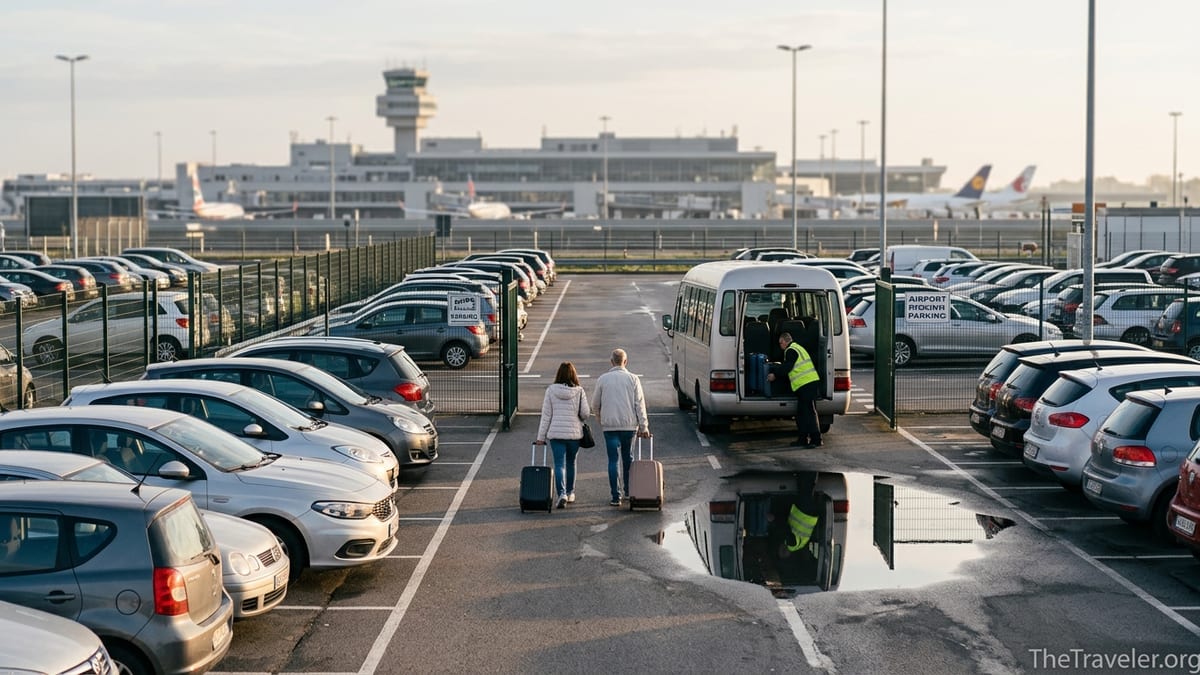
Most Flyparks branded services follow one of two common off airport parking models that travelers encounter worldwide. The first is park and ride: you drive to a fenced or indoor lot several minutes from the terminal, park or hand over your keys at reception, then ride a shuttle minibus to your departure terminal. On your return, you call or follow instructions sent by text, wait at a designated shuttle pick up point, and ride back to the lot where your car has been stored.
The second model is meet and greet valet. In this setup, familiar at many European airports, you drive directly to the terminal forecourt or a short stay car park, usually a few hours before your flight. A uniformed or otherwise identifiable driver from the parking company meets you, takes photographs of the car, fills out a brief condition report and then drives the car to an off site storage area while you proceed to check in. On your return, you call once your luggage arrives or at a pre agreed time, and the same company delivers your car back to the terminal drop off zone.
In Stuttgart, for example, a FlyParks valet listing explains that travelers drive straight to the airport, where a staff member meets them curbside, inspects the vehicle and takes it to a dedicated lot along Plieninger Strasse near the airport. The selling points are convenience and pricing: the service is often priced below the airport’s own covered parking garage for a weeklong stay, while sparing travelers the hassle of shuttles or the long walk from remote economy lots.
At Exeter Airport, a Flyparks service marketed through established intermediaries works similarly. Travelers book online for their exact dates, then receive instructions on the meeting point just outside the terminal. On departure day, they pull into the short stay area, hand keys to the valet driver and walk into the check in hall. When they return from holiday, they call a dedicated number once they have collected bags. The company drives the car back, usually within 10 to 15 minutes, so the traveler can exit directly onto the main road network.
In each case, the underlying business model relies on using cheaper land or shared space away from the high priced airport terminal, then reselling convenience back to travelers via shuttles or valet staff. This structure is not unique to Flyparks. Competitors like Park N Fly, The Parking Spot and a host of local independent lots across the United States and Europe do the same. What matters is how the individual operator executes the basics: secure storage, honest condition reporting, and predictable pick up and drop off times.
Red Flags and Risks Travelers Should Watch For
Because Flyparks and similar brands often promise savings of 30 to 60 percent compared with official airport parking, it can be tempting to focus on price alone. Yet real world cases show that some of the biggest frustrations come from issues that have nothing to do with the initial rate. When scanning Flyparks listings or reviews for your airport, watch closely for recurring red flags that hint at deeper problems.
One category involves vehicle condition and liability. At some locations near Bilbao, multiple customers have complained online that their cars were returned with new scratches, wheel damage or signs that the interior had been searched, such as missing coins or disturbed glove boxes. In disputes, they describe being told that the damage was pre existing or that the company is not responsible for contents left in the car. While every parking operator includes liability limits in its terms, clusters of similar complaints are a sign that the lot is cramped, staff are poorly trained, or management is overly defensive when something does go wrong.
Another type of red flag concerns punctuality and communication. Reviews from busy holiday periods often mention long waits of 30 to 60 minutes for shuttles or valet returns, especially late at night or during peak summer weekends. A single long wait might be an unlucky overlap of delayed flights and traffic jams. But when you see many Flyparks customers at a given airport all describing “we waited nearly an hour in the rain outside the terminal” over several months, it suggests the operator has not matched shuttle capacity to demand. This is more than an inconvenience if you are landing with young children, mobility challenges or a tight connection to onward ground transport.
There are also softer warning signs in how a company responds to criticism. Some aggregator platforms allow the parking operator to reply to specific reviews. If you see Flyparks or any similar brand consistently blaming customers rather than acknowledging issues or describing improvements, that lack of accountability should weigh into your decision. By contrast, operators that respond with apologies, concrete fixes, or offers of partial refunds signal that they treat repeat business and reputation as assets worth protecting.
Finally, be wary of offers that are dramatically cheaper than every other option near the airport without a clear reason. If Flyparks is half the price of other off site lots and on site economy parking for your dates, ask yourself how they are covering the cost of secure land, insurance and labor. Sometimes, there is a legitimate explanation, such as a new lot running a temporary promotion to fill capacity. Other times, the business may be cutting corners on security, staffing or maintenance to sustain those rates, which can show up later as unexpected damage, slow shuttles or chaotic administration.
How to Vet a Flyparks Listing Before You Book
Given the uneven landscape, the safest way to decide whether Flyparks is legit for your trip is to run through a simple vetting process. Start with the basics: identify the exact name of the lot or valet service, its address, and who you are paying. If you are on a comparison site, click through to the detailed listing to see whether Flyparks is the operator or just the marketing name. Confirm how far the lot is from the terminal, how often shuttles run, and whether keys are kept on site or moved elsewhere while you travel.
Next, look beyond star ratings. Open the most recent handful of written reviews from the past six to twelve months, paying special attention to any that mention your travel season. For example, if you are flying in August, see what other travelers reported during the last summer holiday period. A Flyparks facility that earns many five star scores for February business trips might struggle badly during school holidays when lots are full and shuttles are stretched. Focus on comments about damage handling, wait times, staff attitude and clarity of instructions.
Then, read the fine print. Many Flyparks style operators post terms and conditions that spell out their liability for theft, damage and delays. Some explicitly state that they are not responsible for items left inside the car, or that they limit compensation to modest amounts unless you can prove negligence. Others explain that they may move cars between storage sites during your absence. Knowing this in advance helps you decide whether you are comfortable leaving valuables in the vehicle or whether you want to photograph the car thoroughly from all angles before handing over keys.
It is also worth checking how easy it is to reach the operator. Do they publish a local landline number and an emergency mobile for out of hours? Are operating hours clearly stated, particularly for early morning departures or late night arrivals? Travelers have occasionally arrived back after a delayed flight to discover that a small off site lot closed for the night, leaving them stranded until morning. While this is not unique to Flyparks, confirming that staff operate around your flight schedule is an important part of due diligence.
Comparing Flyparks With Official Airport Parking and Alternatives
To answer whether Flyparks is a sensible choice, you have to compare it with concrete alternatives available at your airport on your exact dates. Official airport parking, whether a covered garage attached to the terminal or open air long term lots, offers the security of dealing directly with the airport authority. This usually means robust CCTV, on site security teams and clear recourse if something goes wrong. The trade off is price: during summer holidays or major events, official lots at European and North American hubs can cost significantly more per day than independent off site operators.
Off site competitors beyond Flyparks play in the middle ground. In cities like Orlando, Denver or Atlanta, for instance, large branded operations with their own shuttle fleets compete on price and service. Travelers share stories of off site lots where shuttle buses arrive every few minutes, staff help with luggage, and cars sit in well lit, paved areas with visible fencing and cameras. Others describe bargain operations where shuttles are infrequent, signage is confusing, or cars are parked in rough gravel fields. Flyparks and its local rivals sit somewhere on this spectrum at each airport.
Another alternative is to skip parking entirely if good public transport is available. Many European airports are connected by frequent trains, trams or express buses from city centers, while some North American hubs have commuter rail or metro lines that make it realistic to leave the car at home. In a few mid sized cities, local park and ride facilities allow you to leave the car in a monitored suburban lot and ride a dedicated bus or train to the airport. For very short trips, rideshare or airport taxis can also compare favorably to even a few days of parking fees.
When you factor in all of these options, Flyparks and similarly branded services can still make sense, especially for longer trips where official parking would be prohibitively expensive. A family flying from a regional airport for two weeks of summer holiday might save the equivalent of several restaurant meals by using a well reviewed Flyparks valet instead of the terminal garage. The key is choosing a specific Flyparks operator that has demonstrated reliability, rather than blindly following the brand name or the lowest advertised daily rate.
The Takeaway
So, is Flyparks legit for airport parking reservations? In most cases, what you are seeing under the Flyparks or Flypark name is a real business that operates physical lots and valet services, not a pure online scam. Travelers across Europe and the United Kingdom use these services every day and get their cars back without incident. At airports like Paris Orly or Exeter, recent reviews describe professional staff, reasonable shuttle times and good value compared with official parking.
At the same time, legitimacy does not automatically mean low risk or consistently good service. Some Flypark branded locations, particularly around Bilbao, have attracted criticism for poor communication, unfulfilled service promises such as complimentary washes, and disputes over vehicle damage or missing items. These issues underline that off airport parking remains a trust based service, and the experience you get depends heavily on the operator’s culture, staffing and policies at that specific location.
If you are considering a Flyparks option for your next trip, treat it like booking an unfamiliar hotel in a city you do not know. Read current, airport specific reviews instead of relying on the brand name alone. Verify how far the lot is from the terminal, how shuttles or valet handovers work, and what protections the operator offers if anything goes wrong. Compare the total cost with official airport parking and other off site competitors for your exact dates.
With that groundwork, Flyparks can be a sensible way to trim travel costs without adding stress to your departure or return. Skip those checks, and you risk spending the first days of your holiday worrying not about flight delays or lost luggage, but about whether your car will be waiting in the same condition when you get back.
FAQ
Q1. Is Flyparks a single global company or many separate operators?
Flyparks is not one unified worldwide brand. Travelers encounter a mix of separate parking operators and valet services that use similar names at different airports, each with its own staff, policies and reputation.
Q2. How can I tell if the Flyparks service at my airport is trustworthy?
Focus on recent, location specific reviews from the past six to twelve months, check the exact address and operator name, read their terms and conditions, and confirm shuttle frequency or valet procedures before booking.
Q3. Are Flyparks style services generally cheaper than official airport parking?
They are often cheaper, especially for longer stays, because they use off site lots with lower land costs. However, price should be weighed against factors like security, convenience, and how the operator handles any problems.
Q4. What are the main risks of using a Flyparks or similar off airport lot?
Key risks include disputes over new scratches or dents, long waits for shuttles or valet returns at busy times, limited liability for items left in the car, and weaker customer support if your flight is significantly delayed.
Q5. Should I leave valuables in my car when using Flyparks?
It is safer not to. Many operators state that they are not responsible for items left inside vehicles, so you should remove electronics, cash, important documents and anything of sentimental value before handing over the keys.
Q6. Is meet and greet valet with Flyparks more risky than a park and ride lot?
Valet services add an extra layer of trust because staff drive your car. They can still be safe if the operator is reputable, takes condition photos and uses secure storage, but you should be especially diligent about pre trip photos and reviews.
Q7. What should I do if my car is damaged after using a Flyparks service?
Document the damage with photos immediately, report it to staff on site in writing, and follow up with the operator’s customer service. Having your own pre drop off photos and a copy of the condition report will strengthen any claim.
Q8. How early should I arrive when using a Flyparks park and ride service?
Plan to arrive at least 30 to 45 minutes earlier than you would if you were driving straight to an on site terminal garage, allowing time for check in at the lot, shuttle transit, and potential traffic near the airport.
Q9. Can flight delays cause problems when I have parked with Flyparks?
They can if the operator does not clearly guarantee late night or early morning coverage. When booking, confirm operating hours and what happens if your return flight is delayed beyond those times.
Q10. When is it better to avoid Flyparks and use official airport parking instead?
If reviews at your airport consistently mention damage, theft concerns, long waits or rude service, or if you are traveling with tight timing or vulnerable passengers, paying more for official on site parking can be the safer, less stressful option.