


On paper, Grünerløkka sounds like every other “hipster district” that pops up in European city guides. In reality, this former industrial quarter on the east bank of Oslo’s Akerselva river feels strikingly local, creative and lived-in. For many visitors, a few unhurried hours here end up being the most memorable part of their Oslo stay. So is Grünerløkka worth visiting, and what exactly do travelers love about it?
Get the latest updates straight to your inbox!
Why Grünerløkka Has Become Oslo’s Go-To Neighborhood
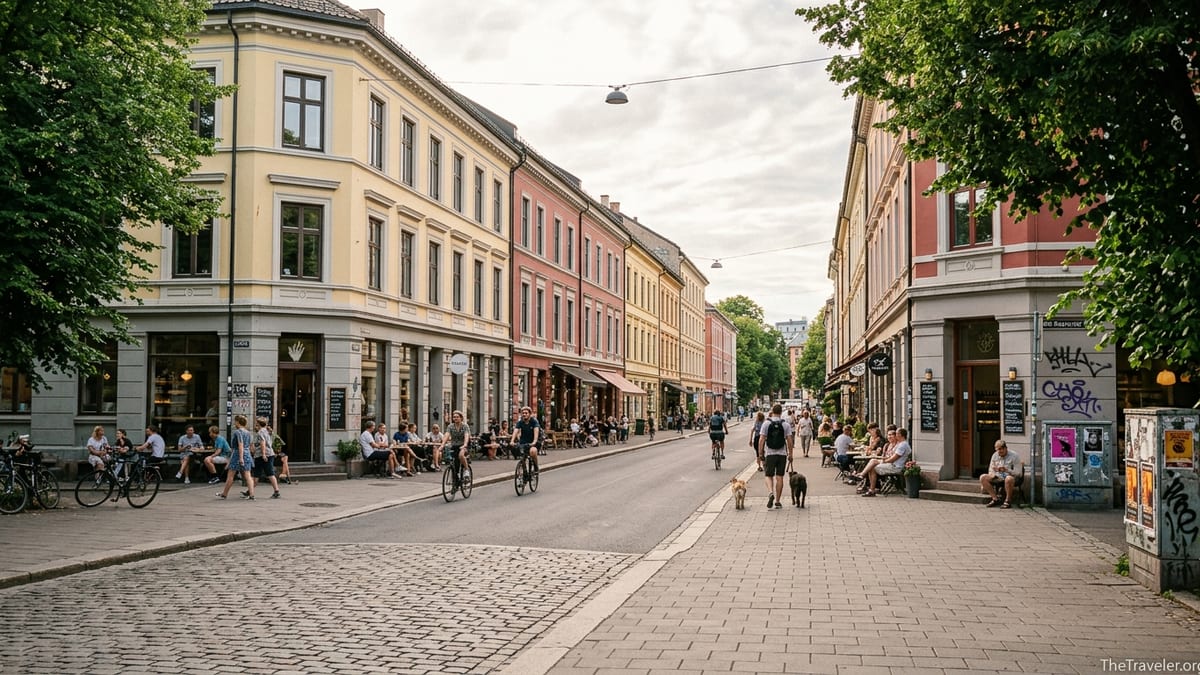
Grünerløkka’s appeal starts with its story. Once defined by factories along the Akerselva river, it has gradually transformed into Oslo’s creative heart, filled with indie boutiques, colorful street art, small design studios and relaxed bars. Today, travelers come less for a single blockbuster attraction and more for the atmosphere of a lived-in city district where people actually work, study and raise families.
Walk along Thorvald Meyers gate, the main commercial spine of Grünerløkka, and you pass specialty coffee bars, vintage clothing shops, record stores and tiny bakeries in quick succession. Side streets lead to leafy courtyards, old brick factory buildings and small galleries. It is the kind of place where your “sightseeing” might be nothing more than drifting between shop windows and cafe terraces, yet you end up feeling like you have understood something essential about modern Oslo.
The neighborhood also benefits from its scale. Grünerløkka is compact enough to explore entirely on foot, yet large enough to reward a full afternoon or even a day if you add the river walk and nearby food hall. Many visitors fit it in between central Oslo’s waterfront developments and the museum peninsula, using it as a counterpoint to the city’s shinier new districts.
Street Life, Cafes and People-Watching
If you ask repeat visitors why they went back to Grünerløkka, they will often talk about its street life rather than specific sights. A classic starting point is Olaf Ryes plass, the square and park that sits in the middle of the neighborhood. On warm days, locals spread out on the grass with takeaway coffee, while the surrounding streets buzz with outdoor seating from cafes and bars. A latte at a corner cafe here typically costs a little under the city average, often in the region of 50 to 60 Norwegian kroner, which feels reasonable by Oslo standards.
From Olaf Ryes plass it is an easy stroll along Thorvald Meyers gate to Birkelunden, another small park framed by late 19th century apartment buildings. On Sundays, Birkelunden often hosts a flea market where you might find second-hand Norwegian sweaters, old vinyl records and mismatched crockery. The experience is less about scoring a bargain and more about soaking up the atmosphere of a neighborhood that still does things on a human scale.
Grünerløkka’s cafes are a major part of its draw. Several of Oslo’s most respected specialty coffee roasters have outlets here, and you can expect serious attention to brewing methods alongside light lunches and pastries. A typical traveler’s routine might be a mid-morning cappuccino and cinnamon bun, a slow lap around the side streets for window-shopping, then another coffee or a glass of natural wine later in the afternoon while people-watching from a sidewalk table.
Street Art, Independent Shops and Local Creativity
One of the pleasures of Grünerløkka is that the neighborhood itself feels like an open-air gallery. Many gable walls and former industrial buildings carry large murals, while smaller pieces of street art hide in alleyways and under bridges along the Akerselva. Travelers who enjoy photography will find plenty of textured brick, painted shutters and colorful facades without needing to hunt out any particular “famous” mural.
The shopping is firmly on the independent side. Along Thorvald Meyers gate and Markveien you will find vintage clothing shops with racks of denim, retro sportswear and 1970s dresses; small design stores selling Norwegian ceramics and textiles; and second-hand bookstores with English-language paperbacks mixed in among Norwegian titles. A traveler on a moderate budget might pick up a locally designed tote bag for around 300 to 400 kroner or a handmade ceramic mug for a similar amount, choosing one item that genuinely feels like it belongs to Oslo rather than an airport gift shop.
There is also a strong focus on sustainability and reuse. Several shops specialize in upcycled fashion or homeware, and even those that look like standard vintage stores often curate pieces with care. For visitors curious about contemporary Nordic design, simply browsing these spaces offers a more current and grounded picture than many museum shops.
Akerselva River Walk and Green Spaces
The Akerselva river forms Grünerløkka’s western edge and is central to its character. Once heavily polluted by the factories that lined its banks, it has been cleaned up and turned into a linear park. Today, a well-maintained path follows the river, crossing small footbridges and passing weirs, waterfalls and remnants of the industrial past. It gives visitors a sense of Oslo as a city that has grown up around water and forest rather than on top of them.
Many travelers like to start at the southern edge of Grünerløkka, near the Vulkan area, and walk north along the river. Within minutes, the sounds shift from traffic to running water and birds. You might see locals jogging, parents pushing strollers, or people barbecuing on the grass in summer. Even in cooler months, the river walk offers a peaceful contrast to the rest of the city and makes it easy to forget you are still close to the center of a capital.
The parks within Grünerløkka itself, especially Olaf Ryes plass and Birkelunden, are destinations in their own right in good weather. On a summer afternoon you will see groups of friends gathering with supermarket snacks, portable grills and cans of beer, taking advantage of Norway’s relaxed attitude to socializing in public spaces. Families use the playgrounds, while students sit on benches with textbooks and takeaway coffee. For visitors on a tight budget, these parks make Grünerløkka an appealing place to experience local life without spending much money at all.
Food, Drink and Nightlife: From Mathallen to Late-Night Bars
Food is another major reason travelers make time for Grünerløkka. Just across the river in the Vulkan area you will find Mathallen Oslo, a covered food hall housed in a converted industrial building. Here, independent vendors sell everything from Norwegian cheeses and cured meats to Asian street food and gourmet burgers. It is a convenient place for visitors to sample a range of Norwegian and international flavors under one roof, and prices, while not cheap, are usually a little lower than eating a full sit-down meal in a traditional restaurant.
A common strategy for budget-conscious travelers is to assemble a picnic from Mathallen’s stalls and then walk back across the river to eat in one of Grünerløkka’s parks. A simple combination of artisan bread, local cheese, cured meat and a pastry might come to around 300 to 400 kroner for two people, which compares favorably with many restaurant meals in central Oslo. It also feels aligned with how locals use their city’s green spaces in spring and summer.
Within the neighborhood itself, you will find everything from relaxed neighborhood bistros to wine bars with thoughtfully curated lists. Some venues emphasize natural wine and small plates, while others lean toward hearty comfort food and craft beer. A glass of wine will typically set you back around 120 to 150 kroner, and a main course often lands somewhere between 250 and 350 kroner. It is not a budget area by global standards, but compared to the most touristy waterfront spots in Oslo, Grünerløkka can feel like better value for the quality and atmosphere you get.
As evening falls, bars and small music venues take over. Some focus on local craft beer, others on cocktails or live DJs, and there are a few intimate spots that host experimental or indie music nights. For visitors who want a night out that feels more “local” than central Oslo’s bigger clubs, Grünerløkka strikes a good balance: lively without being overwhelming, and full of places where you can actually talk to people at your table.
Practicalities: Getting There, When to Go and Who Will Enjoy It
Reaching Grünerløkka from central Oslo is straightforward. The neighborhood lies roughly a 20-minute walk northeast of the central railway station if you cut through downtown and cross the river. Trams serving the Grünerløkka–Torshov line stop at Olaf Ryes plass and other points along Thorvald Meyers gate, and the ride from the center typically takes under 10 minutes. Several bus routes also skirt the area, but most visitors find the trams the easiest option to understand and use.
In terms of timing, mid-morning to early evening is ideal if your priorities are cafes, independent shops and strolling. Most boutiques open around 10 or 11 in the morning and close by early evening, while cafes often get busy around brunch and lunch time. Weekends, especially Saturdays and Sundays from late morning onward, are the liveliest, with markets, flea stalls and parks full of people if the weather cooperates. Even in winter, a short visit can be rewarding, though you will likely spend more time indoors in cafes, bars and the food hall.
Grünerløkka particularly suits travelers who enjoy cities at street level: people who like to walk, browse, snack and observe everyday life. Solo travelers often find it a comfortable place to wander, while couples and groups of friends appreciate the density of places to eat and drink. Families can combine a playground stop and short river walk with a relaxed lunch, although strollers can be a little awkward on some of the older cobblestone sections.
Those looking for grand historical monuments or major museums might find less to occupy them here than in other parts of Oslo. Grünerløkka’s interest lies more in its present than its past. That said, the older apartment blocks, converted factories and surviving industrial structures along the river give a sense of how the city has changed over the last century.
Is Grünerløkka Worth Visiting Compared With Other Oslo Areas?
With only a couple of days in Oslo, travelers often have to choose between several competing neighborhoods. Compared with the shiny waterfront developments around the Opera House and the central shopping streets, Grünerløkka offers a more laid-back and local experience. You trade harbor views and landmark architecture for tree-lined streets, lived-in apartment buildings and the slow rhythm of cafes and parks.
For many visitors, the ideal approach is not to choose but to balance. A morning spent exploring the waterfront and city center followed by an afternoon in Grünerløkka makes for a well-rounded day, showing both Oslo’s new architectural ambitions and its established residential life. Because the neighborhood is so compact, it is easy to slot into even a short itinerary without feeling rushed.
Travelers on tighter budgets often find that Grünerløkka stretches their money a little further. Self-catered picnics from grocery stores or the food hall, coffee and pastry lunches, and drinks in neighborhood bars can feel relatively good value when compared to high-end restaurants overlooking the fjord. Meanwhile, the river walk and parks cost nothing at all.
On the other hand, if you are in Oslo only for a brief business trip with minimal free time, you might prioritize the city center and waterfront for their concentration of major sights. In that scenario, Grünerløkka becomes a “nice to have” rather than essential. But for anyone with at least a full day in Oslo, dedicating a few hours to this neighborhood tends to make the city feel more three-dimensional and human.
The Takeaway
So, is Grünerløkka worth visiting? For most travelers, the answer is a clear yes, provided you enjoy the simple pleasures of city life: walking, cafe-hopping, browsing small shops and hanging out in parks. There is no single blockbuster attraction here, but that is exactly why many visitors end up loving it. The neighborhood invites you to slow down and inhabit Oslo as locals do, if only for an afternoon.
From the leafy lawns of Olaf Ryes plass and the indie boutiques of Thorvald Meyers gate to the riverside paths along Akerselva and the buzz of nearby Mathallen, Grünerløkka packs a lot of atmosphere into a relatively small area. It is easy to reach, easy to navigate on foot and full of low-key ways to connect with the city, whether you are sipping a carefully made espresso, tasting Norwegian cheese or simply watching people cycle past painted brick walls.
If you are piecing together an Oslo itinerary, think of Grünerløkka as the chapter where the city stops posing for the postcard and relaxes into itself. Spend a few unstructured hours here and you are likely to leave with a stronger sense not only of whether you liked Oslo, but of whether you could imagine living here. For many visitors, that lingering “what if” is the strongest recommendation of all.
FAQ
Q1. How much time should I plan for a visit to Grünerløkka?
Most travelers are satisfied with three to four hours, enough time for a river walk, a coffee stop, some browsing and perhaps an early dinner or drink.
Q2. Is Grünerløkka safe to visit, especially at night?
The area is generally considered safe, with plenty of people on the streets into the evening, though normal big-city precautions are sensible, especially late at night.
Q3. What is the easiest way to get to Grünerløkka from central Oslo?
You can walk there in about 20 minutes from the central station, or take a tram that stops along Thorvald Meyers gate and at Olaf Ryes plass in under 10 minutes.
Q4. Are there good options for vegetarian or vegan food in Grünerløkka?
Yes, many cafes and restaurants offer vegetarian and vegan dishes, and the nearby food hall includes several stalls with plant-forward menus.
Q5. Is Grünerløkka suitable for families with children?
It can work well for families, thanks to parks, playgrounds and the riverside path, though parents should be prepared for cobblestones and occasional crowds with strollers.
Q6. What is the best time of day to visit Grünerløkka?
Late morning to early evening is ideal, when cafes, shops and markets are open and parks are lively, especially on weekends in spring and summer.
Q7. Can I visit Grünerløkka in winter and still enjoy it?
Yes, but you will likely spend more time indoors in cafes, bars and the food hall, and shorter daylight hours mean planning your river walk for the middle of the day.
Q8. Is Grünerløkka expensive compared with the rest of Oslo?
Prices are in line with central Oslo, but you can manage costs by choosing casual cafes, picnics from grocery stores and drinks in neighborhood bars rather than fine dining.
Q9. Are there notable cultural venues or events in Grünerløkka?
The neighborhood hosts small galleries, live music bars and seasonal flea markets, and you will often find pop-up events, especially in summer and on weekends.
Q10. Is Grünerløkka worth visiting if I only have one day in Oslo?
If you can spare a few hours, yes: combining central sights in the morning with a relaxed Grünerløkka stroll in the afternoon makes for a well-balanced single-day itinerary.