


Helsinki Cathedral is the bright white church that seems to float above almost every postcard of the Finnish capital. Rising over Senate Square with its green domes and long flight of steps, it is one of the first landmarks many visitors see when they arrive by ferry or explore the compact city center on foot. But once you have admired it from afar, is it actually worth going up to and stepping inside, especially if you only have a short time in Helsinki? This guide looks at what travelers really notice most about Helsinki Cathedral, and what you can realistically expect from a visit today.
Get the latest updates straight to your inbox!
Why Helsinki Cathedral Matters in Helsinki’s Story
Helsinki Cathedral is more than a photogenic white church. It was built in the 19th century as a Lutheran cathedral and completed in the 1850s, forming the crown of the city’s central Senate Square. The building was designed by architect Carl Ludvig Engel, whose neoclassical plan shaped much of central Helsinki, from the government palace to the university buildings that flank the square. When travelers stand in the middle of Senate Square and look up, they are essentially looking at the centerpiece of the entire 19th century city plan.
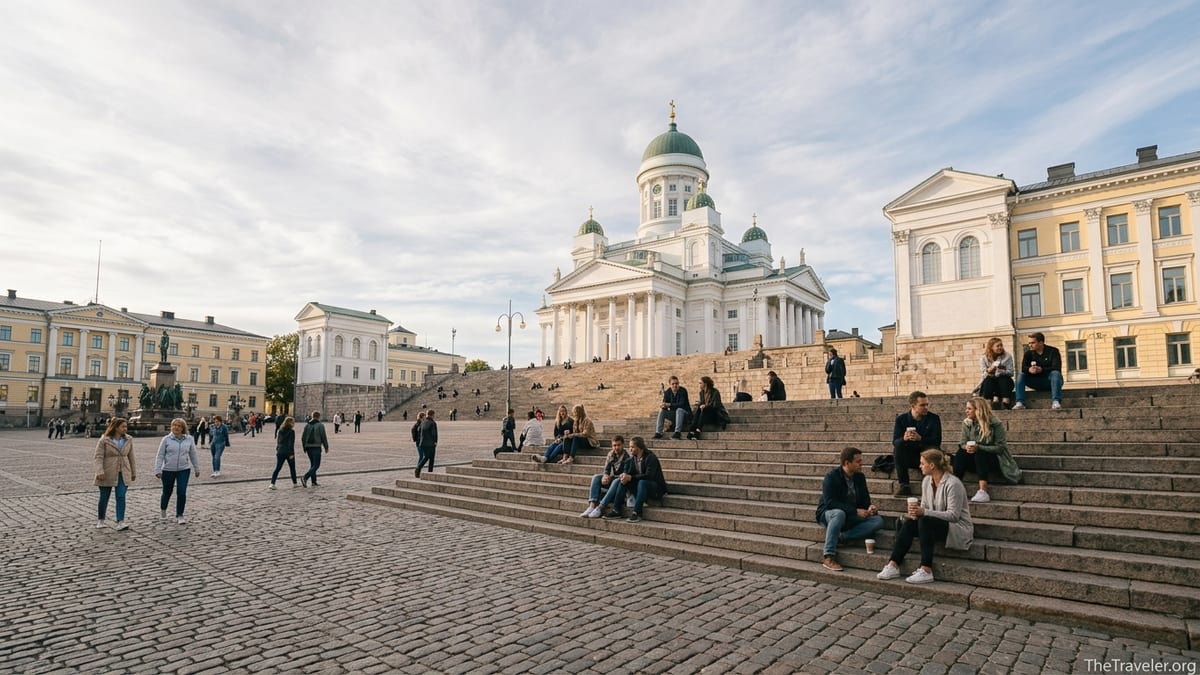
Visitors often notice how the cathedral visually dominates the area. The monumental granite staircase lifts the building high above the other facades, and the main green dome is ringed by four smaller domes. From street level, especially on a gray Baltic day, the bright white walls can seem almost luminous. Travel writers frequently compare the ensemble to imperial squares in St. Petersburg, and film crews have used Senate Square as a stand in for historic Russia, which gives some sense of its atmosphere.
For first time visitors to Helsinki, the cathedral also serves as an orientation point. From the harbor market, from nearby shopping streets like Aleksanterinkatu, or even from the deck of a ferry returning from Suomenlinna, the silhouette of the cathedral’s dome helps you understand where the historic center lies. Many travelers report that after one or two days in the city, they instinctively navigate by the cathedral’s domes rising above the rooftops.
All of this means that visiting Helsinki Cathedral is partly about visiting a church, but equally about stepping into the symbolic heart of the city. Even travelers who are not especially interested in religious sites tend to include a quick stop here because of how closely the building is tied to Helsinki’s identity.
The First Impression: Those Famous Steps and Skyline Views
What most travelers notice first is the staircase. The flight of broad, pale granite steps from Senate Square to the cathedral entrance is long, steep and open to the sky. Photos taken from the bottom, with the white facade rising above lines of people on the steps, are among the most shared Helsinki images on social media. In summer, the staircase becomes an open-air living room: visitors sitting with takeaway coffee, locals chatting after work, bus tour groups gathering around guides with umbrellas.
Climbing the steps provides one of the best free views in central Helsinki. From halfway up, people tend to pause and turn back toward the square. You can see the statue of Alexander II at the center of Senate Square, the pale yellow Government Palace on one side, and the University of Helsinki’s classical facade on the other. Beyond that, the view stretches toward the harbor and, on a clear day, out to the low islands and ferries moving across the water. Many visitors say this brief panorama is one of the moments that convinces them the stop was worth it, even if they do not spend long inside the cathedral itself.
In winter, the steps feel different. They can be icy or covered with packed snow, and there are often sanded strips for safer footing. The square below may host a small seasonal market or Christmas lights, and the cathedral’s white walls stand out even more sharply against the early afternoon darkness. Travelers who visit in December often mention the contrast between the cold, sometimes windy square and the relative calm once they reach the top and step inside.
Because the stairs are so exposed, they are also where visitors feel the weather most. On a bright July afternoon the stone can be warm to the touch and the square filled with open top sightseeing buses. On a rainy October morning, the same staircase may be nearly empty except for a few visitors with umbrellas, and photographers appreciate the reflections on the wet stone. In practice, how enjoyable your first impression is will depend a lot on the season and time of day you choose.
Stepping Inside: A Surprisingly Simple Interior
One of the most common reactions to Helsinki Cathedral’s interior is surprise at its simplicity. From the outside, the multiple domes and statues suggest a richly decorated space, but once inside, travelers find a typical Lutheran interior that is bright, uncluttered and relatively plain. The main hall is high and open, with white walls, round-arched windows and minimal ornament. Instead of side chapels filled with baroque altars, there are clean lines, wooden pews and a restrained color palette dominated by white and pale tones.
At the far end, the golden altarpiece and a few statues provide the main visual focus. Light filters in from the high windows, and on sunny days the space can feel very bright. On short winter days during visiting hours, the interior may be gently illuminated, giving a quieter, almost austere atmosphere. Many visitors comment that the building feels more like a place for reflection than for spectacle, especially compared with nearby Orthodox Uspenski Cathedral, which has a much darker, icon filled interior.
There is no elaborate ticket control at the main entrance during typical daytime visiting hours in the off season, and visitors usually walk directly into the nave. However, the cathedral is an active parish church. That means services, weddings and organ rehearsals can be taking place, and travelers sometimes mention stepping into ongoing worship by surprise. In those moments, staff or volunteers may quietly ask visitors to keep silence or avoid certain areas near the altar. For many, this blend of tourist site and living church is part of the authenticity of the visit.
Several travelers note that the interior visit is relatively short. Unless there is a concert or you choose to sit for a while, most people spend 10 to 20 minutes inside, walking a slow loop around the space, looking at the organ gallery and main altarpiece, and perhaps lighting a candle. For those expecting a detailed art history experience, the simplicity can feel underwhelming. For others, especially those exploring the city center on foot, the quiet interior is a welcome pause between busier urban sights.
Practicalities: Opening Hours, Tickets and When to Go
Helsinki Cathedral is generally open to visitors year round, with daily visiting hours that change by season. According to the cathedral’s own visitor information, the church keeps regular opening times and may extend them in summer, when cruise ships and tour groups are more frequent. Closing times can be earlier in winter or on days when special services or concerts are scheduled. It is worth checking the current day’s hours on local tourism information or cathedral notices once you are in Helsinki, as they can change for events or public holidays.
For many years, casual visits to the main cathedral interior have been free, although donations are encouraged. In recent seasons, local church authorities have introduced paid tickets for certain combined experiences, such as visiting both the cathedral and another major Helsinki church using a joint ticket during peak summer months. One such combined ticket, valid from June to late September 2026, is advertised at around 6 euros for adults for cathedral related entry. Not every visitor will need or choose these tickets, but they reflect a broader trend of managing summer tourism while supporting maintenance costs.
Cruise day crowds are something travelers notice quickly. On days when several large ships are in port, tour buses line nearby streets and the steps can feel like a grandstand. Many independent travelers recommend visiting in the early morning, before 10 am, or later in the evening light, around 7 or 8 pm in summer, to experience a calmer atmosphere. In shoulder seasons like April or October, visiting in the middle of the day is often peaceful, and you may share the pews mostly with local parishioners, small tour groups and individual tourists.
Comfort is another practical point. The climb up the steps can be demanding for travelers with mobility issues. There are side access routes and the bell tower area hosts a visitor center, so those who cannot manage the full height of the main staircase should look for nearby ramps and secondary entrances. For most reasonably fit visitors, the ascent is short but steep, and in winter or during rain, good footwear with grip is strongly recommended due to the possibility of ice or wet stone.
Atmosphere, Etiquette and How Locals Use the Space
One thing many travelers notice is that Helsinki Cathedral does not feel like a museum. It is an active Lutheran parish church, hosting regular Sunday services, baptisms, weddings, funerals and special events. Locals often refer to it by its Finnish name, Helsingin tuomiokirkko, and for them it is as much a part of everyday city life as it is a landmark for visitors. On weekdays, you may see office workers cutting across Senate Square, students from the nearby university meeting friends on the steps, and wedding parties slipping in for photographs between showers of confetti.
Because of this dual role, visitors are encouraged to follow basic church etiquette. There is no strict written dress code and everyday casual clothing is generally acceptable, which suits Helsinki’s relaxed style. However, most locals and guides suggest dressing respectfully, avoiding beachwear or very revealing outfits, especially in summer when the sun and nearby harbor can make shorts and tank tops more common. Removing hats inside the church, speaking quietly, and silencing mobile phones are widely expected courtesies.
Photography is usually allowed, but visitors are asked to avoid flash and to be discreet during services. Many travelers describe pausing their photography entirely once a service begins or if they notice people praying nearby. There are often signs at the entrance reminding guests to respect ongoing worship and to refrain from wandering near the altar during ceremonies. At quieter times, people freely photograph the organ, dome and interior, but staff may intervene if behavior feels intrusive.
Locals also use the area around the cathedral as a meeting point. The bottom of the steps is a typical rendezvous spot for free walking tours, and in summer there may be temporary stages or events installed in the square. Some longtime residents have mixed feelings about the crowds on the steps, especially during large events, but most accept that the cathedral is now both a spiritual center and a major tourist landmark. For visitors, this everyday use adds a layer of authenticity: you are not just touring a monument, but stepping into a living part of the city.
Making It Worth Your Time: Pairing the Cathedral With Nearby Sights
Helsinki’s historic core is compact, and most travelers experience the cathedral as part of a short walking loop. This is one of the key reasons many say the visit feels worthwhile even if the interior itself is simple. Within a few minutes’ walk of the steps you can reach the harbor market square, the waterfront with its ferries, and several other major churches and museums, making it easy to fold the cathedral stop into a broader exploration of the city.
A common route begins at the Market Square by the harbor, where visitors look at seasonal stalls and snack on cinnamon buns or salmon soup from a tent cafe. From there, you can walk uphill along Sofiankatu or Unioninkatu and arrive at Senate Square in five minutes, with the cathedral rising in front of you. After climbing the steps and visiting the interior, many travelers continue toward the nearby National Library or cut across to Aleksanterinkatu for shopping, before looping around to the red brick Uspenski Cathedral on the waterfront hill. This sequence gives a contrasting view of Lutheran and Orthodox church architecture in less than an hour of walking.
Some sightseeing buses and tram based city tours stop close to Helsinki Cathedral, which makes it an easy inclusion for those with limited mobility or tight schedules. Independent travelers often mention using a 24 hour public transport ticket, hopping off near Senate Square to climb the steps and have a look inside, then continuing by tram along the Esplanadi to other neighborhoods. Because there is no long security line or complex entry procedure, the entire visit can be as brief as 30 minutes if needed.
Time of day shapes the experience. In summer, many photographers recommend late evening, when the low sun can cast warm light on the white facade while the square begins to empty of tour groups. In winter, arriving in the early afternoon maximizes the limited daylight for exterior photos, then stepping inside offers a break from wind or sleet. Whatever the season, pairing the cathedral visit with a coffee at a nearby cafe or a walk through the adjacent university courtyard helps it become part of a fuller, more memorable city experience rather than just a quick photo stop.
Is It Really Worth Visiting? Who Will Appreciate It Most
Whether Helsinki Cathedral is “worth it” depends largely on your expectations. Travelers who arrive anticipating richly decorated interiors like those found in Italian or Spanish cathedrals sometimes feel underwhelmed by the Lutheran minimalism. They may describe the interior as plain or even a little empty. However, those who come prepared for a simple, serene space, or who are particularly interested in urban planning, architecture and city views, often rate the visit very highly.
For architecture enthusiasts, the cathedral offers a clear example of 19th century neoclassicism adapted to a northern climate, and the combination of the church, surrounding square and government buildings creates a cohesive ensemble. Photographers appreciate the interplay of white stone, dark domes and changing Baltic sky. Casual visitors frequently say that even if they do not spend long inside, standing at the top of the steps looking over the square and harbor is one of their standout Helsinki moments.
Budget conscious travelers generally consider Helsinki Cathedral good value, since the main visit is free or low cost, and the only potential expense is a donation or a modest ticket for special combined experiences. Families find that children enjoy climbing the wide stairs and exploring the open square, although parents need to watch younger kids closely because of the height and lack of railings at some points near the top. Solo travelers and couples often use the interior as a quiet pause, sitting for a few minutes in a pew to rest from walking while listening to the occasional organ practice or muffled city sounds through the doors.
If your time in Helsinki is extremely limited, such as a short layover or a few daytime hours from a cruise, most itineraries still recommend including the cathedral and Senate Square as a top priority, alongside the harbor and at least one museum or the rock church at Temppeliaukio. The visit is short, free or inexpensive, and gives a strong sense of place. For those spending several days in the city, the cathedral remains a central landmark you will likely pass multiple times, and going inside at least once completes your mental map of Helsinki.
FAQ
Q1. Is there an entrance fee to visit Helsinki Cathedral?
Most of the time, entering the main cathedral interior for a simple visit is free, though donations are appreciated. During peak summer months, certain combined tickets that include the cathedral and another major church may be sold for around 6 euros, but casual visitors can usually step inside the main space without a mandatory fee.
Q2. How much time should I plan for a visit?
Most travelers spend between 30 minutes and one hour at Helsinki Cathedral, including time to take photos on the steps, look around the interior and enjoy the view over Senate Square. If you also linger in the square or attend a service or concert, you may want to allow up to 90 minutes.
Q3. What are the usual opening hours?
Helsinki Cathedral is typically open every day, with longer hours in summer and shorter ones in winter. Exact times vary by season and special events, so it is best to check the current day’s schedule through local tourist information or at the cathedral once you are in the city. Services and private ceremonies can temporarily limit tourist access.
Q4. Is there a dress code for visiting the cathedral?
There is no strict formal dress code, and casual clothing is common. However, visitors are expected to dress respectfully, avoiding beachwear or very revealing outfits, especially in summer. Removing hats inside and keeping shoulders reasonably covered is a good general guideline.
Q5. Can I take photos inside Helsinki Cathedral?
Photography for personal use is generally allowed inside the cathedral and on the steps, as long as you avoid flash and respect any signage. During services or private ceremonies, visitors are asked either not to take photos at all or to be extremely discreet so as not to disturb worshippers.
Q6. Is Helsinki Cathedral accessible for people with limited mobility?
The main staircase from Senate Square is steep and not suitable for many visitors with mobility challenges. However, there are alternative access routes and side entrances near the bell tower area that reduce or bypass the steps. Travelers who use wheelchairs or have difficulty with stairs should look for information at the visitor center or ask staff on site for the most suitable entrance.
Q7. When is the best time of day to visit?
Early morning before tour buses arrive and late evening in summer tend to be the calmest and most atmospheric times. Midday can be busy on cruise ship days, especially in July and August. In winter, early afternoon offers the best natural light, and the interior can provide a welcome break from the cold once darkness falls.
Q8. Are services open to visitors?
Yes, regular Lutheran services at Helsinki Cathedral are open to the public, and respectful visitors are welcome to attend. If you enter during a service, you should remain quiet, follow the congregation’s lead, and avoid walking around to take photos. Some travelers find that attending a Sunday service adds depth to their understanding of local religious life.
Q9. What other attractions are close to Helsinki Cathedral?
The cathedral stands on Senate Square in the heart of Helsinki’s historic center. Within a short walk you will find the harbor market, Uspenski Cathedral, the Esplanadi park, the main building of the University of Helsinki and several museums and cafes. Many visitors combine the cathedral with a stroll to the waterfront or a ferry ride to Suomenlinna sea fortress.
Q10. Is Helsinki Cathedral still worth visiting if I have seen many European churches?
Yes, many experienced travelers feel it is worth visiting precisely because it is different from more ornate southern European cathedrals. The contrast between the grand exterior, stark Lutheran interior and panoramic city views offers a distinct northern European experience, and the cathedral’s location at the center of Helsinki’s neoclassical ensemble makes it a key part of understanding the city.