


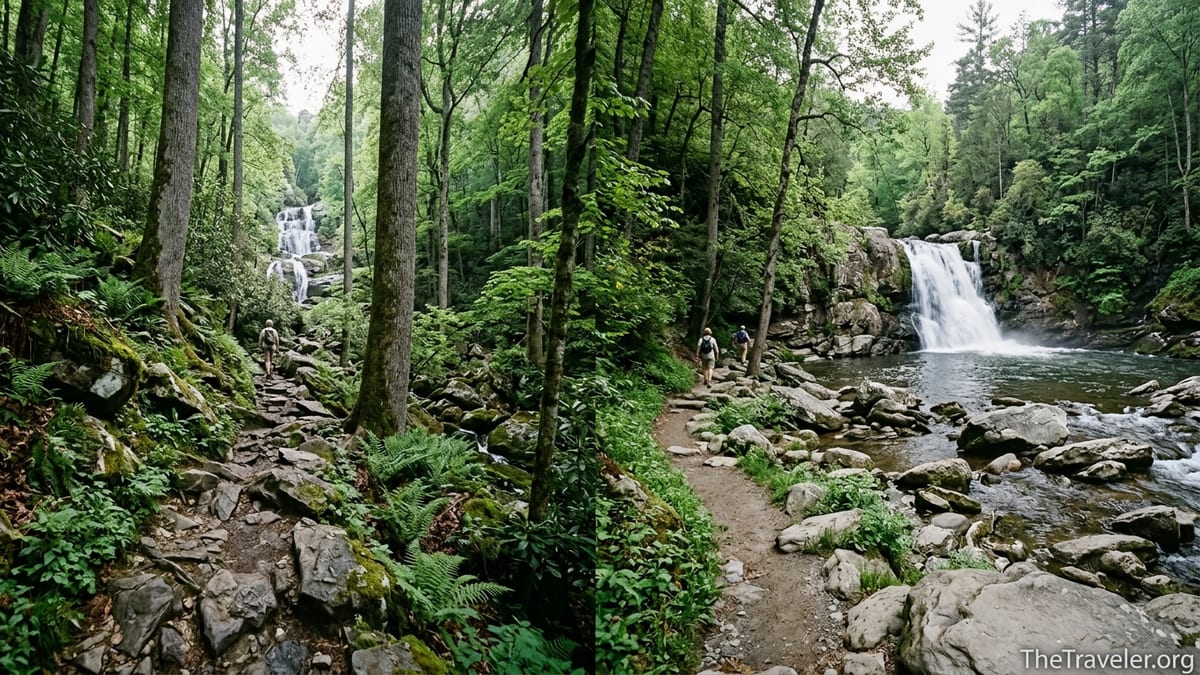
Two of the Great Smoky Mountains National Park’s most beloved waterfall trails, Ramsey Cascades and Abrams Falls, offer very different versions of “rewarding.” One is a strenuous climb to the park’s tallest accessible waterfall. The other is a rolling forest walk to a powerful, low-drop falls with a broad plunge pool. If you have limited time in the Smokies, choosing between them can shape your entire visit. This guide compares the two hikes in detail so you can decide which waterfall experience will reward you more.
Get the latest updates straight to your inbox!
Meet the Contenders: Two Classic Smokies Waterfall Hikes
Ramsey Cascades and Abrams Falls both sit in Tennessee’s section of Great Smoky Mountains National Park, but they are in very different corners of the park and demand different levels of effort. Ramsey Cascades is accessed from the Greenbrier area east of Gatlinburg, at the end of a narrow road up Ramsey Prong. The out and back hike is roughly 8 miles round trip with over 2,000 feet of elevation gain, and the National Park Service describes it as strenuous, with steep rocky sections and roots underfoot. In return, you reach the tallest waterfall in the park that is accessible by trail, a roughly 100-foot cascade tumbling over massive rock ledges into a boulder-filled basin.
Abrams Falls is reached from Cades Cove, one of the park’s most visited scenic valleys. The Abrams Falls Trail leaves from a parking area off the one-way Cades Cove Loop Road. The hike is shorter at around 5 miles round trip with approximately 600 to 700 feet of total elevation gain, rolling up and down along Abrams Creek rather than climbing a single long slope. It is usually rated moderate, though some steeper, rocky stretches and summer heat can make it feel more demanding than the numbers suggest.
Because both hikes end at beautiful waterfalls and both are popular, it is easy for first-time visitors to assume they are interchangeable. In reality, they serve different kinds of travelers. Ramsey Cascades is a destination for hikers who want a big day out and are comfortable with a sustained climb. Abrams Falls is suited to families, casual hikers, and visitors who want to pair a hike with time exploring Cades Cove’s historic cabins and wildlife viewing.
In practical terms, most visitors are choosing between a longer, more remote adventure that will probably take most of a day, and a shorter, more social hike that can fit into a half-day loop drive. Knowing which style of day you want in the Smokies is the first step in deciding which waterfall will “reward” you more.
Effort vs Reward: Distance, Elevation and Trail Experience
On paper, Ramsey Cascades clearly demands more effort. The trail climbs roughly 2,500 feet from the Greenbrier valley floor to the base of the falls over about 4 miles one way. Hikers report that the first part of the route follows an old roadbed along the Middle Prong of the Little Pigeon River and feels relatively gentle. After the roadbed ends, the trail narrows and steepens, winding through old-growth forest with increasingly rocky, rooty footing and a few small stream crossings that can be slick after rain. Fit hikers typically allow 4 to 6 hours for the round trip, and many visitors treat it as their main objective for the day rather than pairing it with other hikes.
Abrams Falls feels very different underfoot. The elevation change is broken into several smaller ups and downs rather than one sustained climb, and the trail closely follows Abrams Creek for long stretches. Although maps often list the net elevation change at only around 200 feet, the cumulative gain as you roll over ridges and hollows is closer to several hundred feet. Hikers commonly report taking 2.5 to 4 hours for the 5-mile round trip, depending on photo stops and time at the falls. For many families staying in Pigeon Forge or Townsend, Abrams Falls is their longest hike of the trip but still feels manageable with older kids.
In terms of pure workout, Ramsey Cascades offers more of a backcountry feel. You are less likely to bump into large groups after the first couple of miles, and many visitors note the sense of accomplishment that comes with reaching the end of a demanding trail. By contrast, Abrams Falls gives you more social energy: steady foot traffic, plenty of people resting on rocks by the plunge pool, and a feeling of shared discovery rather than wilderness solitude. If your idea of “rewarding” includes pushing your limits and earning a big waterfall after a sweat-soaked climb, Ramsey will probably win. If you prefer a moderate challenge that still leaves energy for an evening in Gatlinburg or Townsend, Abrams is the more practical choice.
The time commitment also matters for trip planning. On a typical summer day, a reasonably fit hiker who leaves the Greenbrier parking area by 8 a.m. might return from Ramsey Cascades mid-afternoon and be ready for a relaxed dinner. The same hiker could tackle Abrams Falls in a long morning, then continue around Cades Cove, stop at the visitor center, and still be back in Pigeon Forge or Gatlinburg by late afternoon. Matching the hike to your schedule can be as important as matching it to your fitness.
Waterfall Wow Factor: Height, Power and Setting
Ramsey Cascades delivers vertical drama. The roughly 100-foot cascade spills in multiple tiers over a high rock face, broken into curtains of white water that fan around boulders and ledges. Surrounded by mossy rocks, rhododendron, and towering trees, the falls feel enclosed and wild. Because the water slides and tumbles rather than dropping in a sheer free fall, it photographs beautifully from multiple angles. On overcast days or during spring rains, visitors often comment that the water volume and mist make the scene feel almost cinematic, albeit in a very natural way.
Abrams Falls looks very different. The waterfall itself is only about 20 feet high, but the volume of water rushing over the lip is impressive, especially after rainfall. The falls pour into one of the largest natural plunge pools in the park, a deep basin ringed by boulders and logs. The combination of roaring water, swirling currents, and sunlight playing on the pool creates a lively, energetic scene. While it may not have the towering height of Ramsey Cascades, Abrams Falls offers what many families consider a more interactive environment: more space to spread out on the rocks, more angles to sit and watch the water, and an easier approach right to the water’s edge.
From a photography perspective, both hikes reward the effort but in different ways. Ramsey Cascades shines for wide shots that capture the full vertical sweep of the cascade framed by old-growth forest. Serious photographers often bring a tripod and shoot at slower shutter speeds to blur the multi-tiered flow. At Abrams Falls, the best images often come from moving a bit closer and using a mid-range focal length to emphasize the curtain of water and the curve of the plunge pool. On busy days, you may need some patience to catch a frame without people standing on the foreground rocks.
If your personal definition of “reward” centers on sheer waterfall size and the sense of reaching a dramatic endpoint, Ramsey Cascades has the clear edge. If you are more excited by a powerful, accessible falls with space to linger, snack, and people-watch, Abrams Falls can feel every bit as satisfying as a taller waterfall.
Scenery Along the Way: Forests, Rivers and Wildlife
One of the biggest differences between these hikes is what you see between the trailhead and the waterfall. Ramsey Cascades is prized among park enthusiasts for its old-growth forest. Large tulip poplars and other hardwoods, some centuries old, line the trail in its upper sections. Mossy boulders, ferns, and the sound of the rushing creek create a deep-forest atmosphere that feels far removed from park roads. On a humid summer morning, shafts of light often filter through the canopy, illuminating the moss and understory and making the hike itself feel like a destination, not just an approach to a waterfall.
Abrams Falls, by contrast, leans into its connection with Cades Cove. Before or after the hike, many visitors drive the 11-mile loop road past historic log cabins, churches, and open meadows where white-tailed deer and black bears are often spotted from the car. On the trail itself, you walk through mixed forest and along Abrams Creek, with occasional openings that hint at the broader valley. In spring, wildflowers can be abundant along both routes, but Abrams Falls often combines low-elevation blooms with the chance to see bears grazing in Cades Cove fields at dawn or dusk.
For wildlife viewing, Abrams Falls typically offers more opportunities, simply because the Cades Cove area is one of the park’s hotspots for black bear and deer. Visitors frequently combine an early-morning drive when animals are active with a late-morning hike to the falls. Ramsey Cascades is less about large mammals and more about the subtle richness of a mature forest ecosystem: warblers and other songbirds, salamanders along damp stream banks, and the rare feeling of walking among trees that predate the logging era.
In practical terms, if you want your waterfall hike to also serve as a gateway to historic sites and wildlife-rich meadows, Abrams Falls integrates seamlessly into a Cades Cove day. If your idea of a rewarding hike includes immersion in deep forest and a sense of remoteness, Ramsey Cascades is likely to be the more memorable approach.
Crowds, Logistics and Safety: What Real Trips Look Like
Both trails are popular, but the way crowds show up is different. Abrams Falls typically sees heavy traffic from late spring through fall, especially on weekends and during school breaks. The parking area at the trailhead is not huge, and on a busy July Saturday you might find it full by mid-morning, with cars circling or parking along the gravel access road. Because the trail leaves from the halfway point of the one-way Cades Cove Loop, reaching the trailhead can take longer than the mileage suggests, especially if traffic slows for wildlife viewing. Many experienced visitors plan to be at the loop road gate near sunrise, drive directly to the Abrams Falls parking area, then complete the hike before midday crowds and thunderstorms develop.
Ramsey Cascades, while also popular, feels less like a conveyor belt of hikers and more like a steady stream. Greenbrier Road is narrower and less traveled than the Cades Cove Loop, so the drive in usually feels calmer, though the last stretch can be slow due to potholes and careful passing on one-lane sections. Parking at the Ramsey Prong Road trailhead is limited, and park officials strongly encourage arriving early or using a local shuttle service during peak months. Since March 2023, the park has required a paid parking tag for vehicles parked more than 15 minutes, so visitors should budget a few extra dollars per day or purchase an annual tag if they plan multiple hikes.
Safety considerations differ at the falls themselves. At Abrams Falls, the deep plunge pool and strong current have unfortunately led to accidents and drownings over the years. Despite the inviting water, the National Park Service posts clear warnings against swimming and jumping from rocks. Wet boulders around the pool can be slick, and swift water can pull even strong swimmers toward the base of the falls. At Ramsey Cascades, the main hazard is climbing on or above the wet boulders near the base of the cascade. Rocks here can be extremely slippery, and several rescue incidents have involved hikers climbing higher than the signed viewing area.
Weather and seasonal conditions add another layer. Summer brings humidity, afternoon thunderstorms, and crowded parking at both trailheads. In spring, high water can make stream crossings more challenging on the Ramsey Cascades trail. In winter, ice on rocks and bridges can turn both hikes into serious undertakings; some local guides recommend microspikes or choosing lower, sunnier trails when temperatures drop below freezing. A realistic, rewarding trip accounts for these factors: an early start, proper footwear, extra water, and a willingness to turn around if conditions deteriorate.
Which Hike Fits Which Traveler?
Choosing the more “rewarding” hike really means matching the trail to your travel style, group, and goals for the day. For a fit couple visiting specifically to hike, Ramsey Cascades may be the clear winner. Imagine a long weekend in Gatlinburg where you dedicate one full day to a marquee trail. You leave town by 7:30 a.m., are at the Greenbrier parking area shortly after 8, and spend the morning steadily climbing through old-growth forest. By early afternoon, you reach the cascades, eat lunch on a boulder with the spray cooling your face, then descend in time for a relaxed dinner. The satisfaction comes from doing one big, immersive hike and feeling like you experienced a quieter corner of the park.
For a family of four staying in a rental cabin between Townsend and Pigeon Forge, Abrams Falls often fits better. After breakfast, you drive into Cades Cove, pause briefly for deer in the meadows, then reach the trailhead mid-morning. The kids power through the moderate ups and downs with the promise of snacks by the waterfall, and you are back at the car in early afternoon with enough energy left for ice cream in Townsend and maybe a short evening stroll along the river. In this scenario, the “reward” is a scenic hike that feels like an adventure but does not dominate the entire day.
Solo travelers and photographers might split the difference by doing both on separate days. They could treat Abrams Falls as a warm-up, scouting compositions and people-watching at the plunge pool, then tackle Ramsey Cascades on a cooler, overcast day when waterfall photography is at its best. For visitors with limited hiking experience, a conservative plan might involve starting with Abrams Falls, assessing how the group handles a 5-mile moderate hike, and only then deciding whether a strenuous 8-mile climb to Ramsey Cascades is realistic on a future trip.
Physical limitations matter, too. Steep rock steps and uneven footing on Ramsey Cascades can be hard on knees and ankles, especially on the descent. Abrams Falls, while still having rocks and roots, generally offers more frequent level stretches where less experienced hikers can recover. If anyone in your group is nervous about heights, exposure, or long descents, Abrams Falls will usually feel more approachable and therefore more rewarding.
The Takeaway
If you judge a waterfall hike by sheer grandeur and sense of accomplishment, Ramsey Cascades is hard to beat. It is the taller, more remote, and more strenuous option, delivering a dramatic multi-tier cascade at the end of a demanding forest climb. For dedicated hikers willing to trade sweat for solitude and a big visual payoff, Ramsey Cascades is likely to feel like the more rewarding of the two.
If you measure reward in terms of overall Smokies experience, Abrams Falls makes a compelling case. The hike is shorter and more moderate, pairs naturally with a drive through wildlife-rich Cades Cove, and offers a powerful, photogenic waterfall with room to sit, snack, and soak up the scene. For families, mixed-ability groups, or travelers trying to weave a hike into an already full itinerary, Abrams Falls often delivers more enjoyment per hour and per ounce of effort.
In the end, the “better” waterfall hike is the one that aligns with your fitness, your schedule, and your idea of a perfect Smokies day. If you have time and energy, doing both on separate days reveals two different faces of the same park: the deep old-growth stillness of Ramsey Cascades and the lively, social energy of Abrams Falls and Cades Cove. Either way, you will come home with the sound of falling water in your ears and a clearer sense of what kind of adventures reward you most.
FAQ
Q1. Which hike is better for beginners, Ramsey Cascades or Abrams Falls?
Abrams Falls is generally better for beginners. The distance is shorter, the elevation gain is more moderate, and the rolling terrain offers frequent chances to rest. Ramsey Cascades is considered strenuous, with a longer distance, sustained climbing, and rougher footing that can feel overwhelming to new hikers.
Q2. How long does it typically take to hike Ramsey Cascades compared to Abrams Falls?
Most reasonably fit hikers spend about 4 to 6 hours completing the 8-mile round trip to Ramsey Cascades, including time at the falls. Abrams Falls usually takes around 2.5 to 4 hours for the 5-mile round trip, depending on pace, crowding, and how long you relax at the plunge pool.
Q3. Do I need a parking tag or permit for either hike?
Yes. Great Smoky Mountains National Park now requires a paid parking tag for vehicles parked more than 15 minutes anywhere in the park. You can buy daily or longer-duration tags at visitor centers or automated machines near popular entrances. No separate hiking permit is required for day hikes to either Ramsey Cascades or Abrams Falls.
Q4. Which waterfall has better photography opportunities?
Both offer excellent photography, but in different ways. Ramsey Cascades is ideal for capturing a tall, multi-tiered cascade framed by old-growth forest, especially on overcast days. Abrams Falls works well for images that emphasize the powerful curtain of water and the curve of the plunge pool, and it often includes more human activity and atmosphere in the frame.
Q5. Is it safe to swim at Ramsey Cascades or Abrams Falls?
No. Swimming is strongly discouraged at both waterfalls. At Abrams Falls, the deep plunge pool and powerful currents have contributed to accidents and drownings. At Ramsey Cascades, slick rocks, strong flow, and hidden obstacles make wading and climbing dangerous. It is safest to enjoy both waterfalls from dry, stable spots outside the water.
Q6. When is the best time of year to hike these trails?
Spring and fall are typically the most rewarding seasons. Spring brings higher water levels and wildflowers, while fall offers cooler temperatures and colorful foliage. Summer can be hot and humid, with more crowded trails and afternoon thunderstorms. Winter hikes are possible but can involve ice and cold, so conditions should be checked carefully.
Q7. How early should I start to avoid crowds and parking issues?
For both hikes, arriving at the trailhead by 8 a.m. or earlier is wise, especially on weekends and in peak seasons. At Abrams Falls, starting early also helps you drive the Cades Cove Loop before traffic becomes heavy. At Ramsey Cascades, an early start improves your chances of finding a legal parking space and gives you more daylight for the longer, steeper trail.
Q8. Are these trails suitable for children?
Abrams Falls can be suitable for school-age children who are used to walking a few miles, provided adults closely supervise them near the waterfall and steep drop-offs. Ramsey Cascades is generally better for older kids and teens with hiking experience and good stamina. In both cases, parents should honestly assess their children’s abilities and comfort with uneven terrain.
Q9. What gear should I bring for each hike?
At minimum, wear sturdy hiking shoes or boots, bring at least one to two liters of water per person, carry snacks, and pack a light rain jacket. Trekking poles can help with the steep sections on Ramsey Cascades and the rolling terrain on Abrams Falls. A small first-aid kit, sun protection, and a paper map or offline trail app are also smart additions.
Q10. If I only have one day in the park, which hike should I choose?
If you are a strong hiker who wants a single, all-day challenge in a quieter setting, choose Ramsey Cascades. If you prefer a moderate hike that leaves time for scenic driving, wildlife viewing, and historic buildings, Abrams Falls paired with the Cades Cove Loop will likely feel more rewarding and give you a broader taste of the Smokies in one day.