


Oslo has two headline art attractions that confuse many first-time visitors: MUNCH, the dedicated Edvard Munch museum on the Bjørvika waterfront, and the National Museum of Norway, a vast collection museum just a short walk away along the harbor. With limited time and budget, you might be wondering which one deserves a spot on your Oslo itinerary. The answer depends very much on what kind of traveler you are, how much you enjoy modern architecture, how deep you want to dive into Norwegian culture, and whether you are traveling with kids, a partner or on your own.
Get the latest updates straight to your inbox!
Getting Oriented: What Each Museum Actually Is
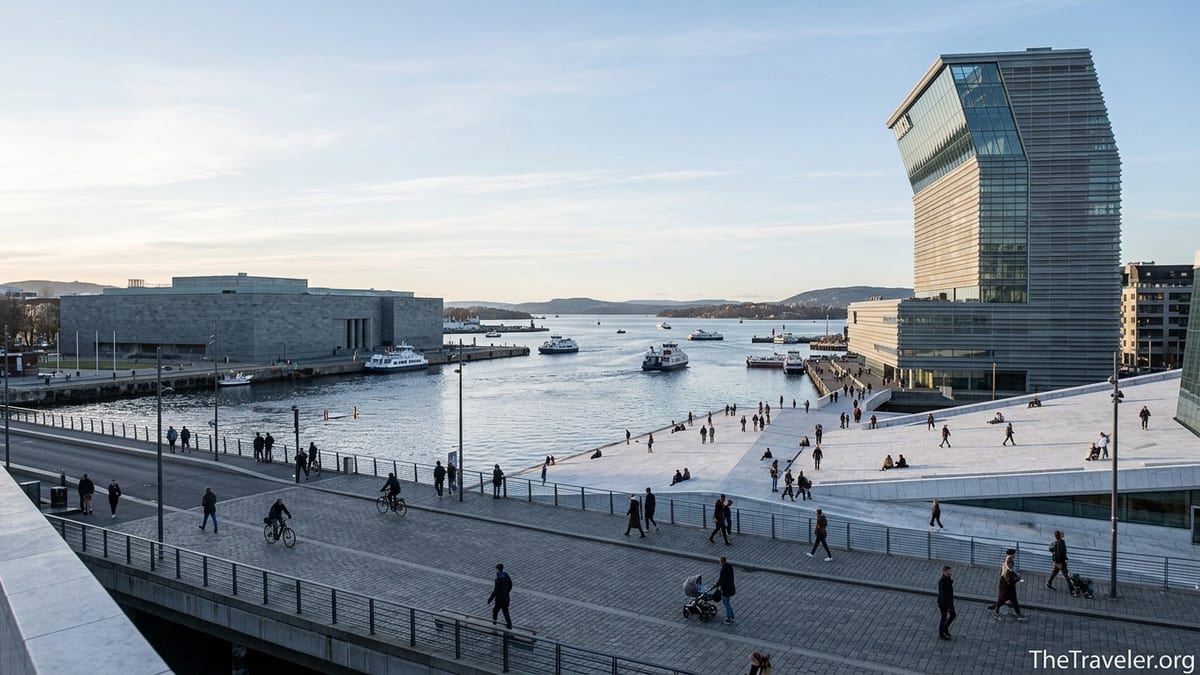
MUNCH is a single-artist museum devoted primarily to Edvard Munch, best known worldwide for The Scream. The institution holds the bulk of his legacy, with more than 26,000 artworks and objects ranging from iconic paintings to experimental prints and personal effects. In 2021 it moved into a striking 13-storey tower in Bjørvika, the fast-changing waterfront district tucked behind the Oslo Opera House. The new building combines galleries with a rooftop bar, performance spaces and fjord views, so the visit often feels like a mix of classic museum trip and contemporary cultural venue.
The National Museum of Norway, which opened its new complex in June 2022 on Brynjulf Bulls plass near City Hall, is a huge all-in-one institution. Instead of focusing on a single artist, it brings together Norway’s national collections of art, architecture, design and crafts, along with important international works. Visitors can see everything from medieval altarpieces and Viking-era artifacts to 19th century Romantic landscapes, Norwegian modernism, Scandinavian design and contemporary installations in a single visit.
If you imagine MUNCH as a deep dive into one artist’s universe, think of the National Museum as a sweeping overview of visual culture in Norway and beyond. Both include works by Munch, but they present him differently. At MUNCH, you see his evolution, experiments and obsessions. At the National Museum, you see Munch placed in context, hanging alongside his predecessors, peers and those he later inspired.
Both museums are within a 10–15 minute walk of Oslo Central Station, which makes them easy to combine in one day if you are determined. For most travelers though, choosing one allows a more relaxed pace, time for a coffee in the museum café and perhaps a stroll along the waterfront afterward.
Art Focus: Depth Versus Breadth
The single biggest question that decides between the two is how much you care about Edvard Munch specifically. If you have been fascinated by The Scream since high school, wrote a paper on Munch at university or just love psychologically charged expressionist art, MUNCH is almost certainly the right choice. Exhibitions there rotate through different themes: one show might explore his relationship with nature and the Oslofjord, another his use of color, and another his later years and health struggles. Because the collection is so large, you will typically see several major works beyond The Scream, such as Madonna, The Sick Child and The Dance of Life, often in different painted and printed versions.
MUNCH also tends to foreground process. Many exhibits highlight sketches, trial prints and unfinished works so you can watch Munch working through ideas. Labels often quote from his notebooks and letters, which helps visitors connect the rawness of the art to the events of his life. If you enjoy feeling like you are “inside an artist’s head,” this is compelling. It can be intense though, especially for sensitive visitors and children, because themes of anxiety, illness and death run throughout the galleries.
The National Museum, by contrast, prioritizes range. A visit here offers a full crash course in Norwegian visual culture, from medieval religious art to contemporary photography and installation. One wing showcases golden-age landscape painters like Johan Christian Dahl, where dramatic mountain scenes tell the story of nation-building in the 19th century. Another presents modern design, including classic Norwegian furniture and everyday objects that shaped Scandinavian aesthetics. Architecture galleries feature models and drawings of notable buildings across Norway.
Munch appears here too, but as part of a much larger story. In the main collection galleries, you will typically find an iconic painted version of The Scream, Madonna and other key works in a room that traces the shift from realism through symbolism to expressionism. Seeing Munch flanked by his predecessors and contemporaries can be illuminating if you enjoy art history. For travelers who want a broad introduction rather than an emotional immersion, the National Museum is the more balanced choice.
Architecture & Atmosphere: Tower Versus “Stone Box”
For many visitors the architecture and general feel of the building is just as memorable as the art. MUNCH is unmistakable on the skyline: a tall, slightly leaning tower wrapped in vertical metal panels, with the upper floors bending toward the fjord. By day it looks industrial and angular; by night the upper galleries glow softly. Stepping inside, you move vertically: a ground-floor lobby with ticketing and shop, then high-speed elevators carrying you to upper galleries and the rooftop terrace. The interior combines raw concrete, glass and pale wood, with some spaces deliberately kept dark to protect delicate works on paper.
The atmosphere at MUNCH skews contemporary and urban. You will see families with strollers riding escalators alongside young locals heading to a concert or film screening in the evening, and tourists detouring from the Opera House just across the road. On a sunny afternoon, the outdoor terraces provide dramatic views over the Opera roof, the harbor baths and the ferries arriving from Denmark and Germany. For travelers who love new-city waterfront developments, MUNCH feels very much part of Oslo’s twenty-first-century identity.
The National Museum, sometimes described in local commentary as a monumental grey “stone box,” offers a deliberately different mood. The building stretches low along the waterfront rather than reaching skyward, clad in Norwegian slate with a luminous “Light Hall” on top for temporary exhibitions. Inside, circulation is mostly horizontal: you weave through long sequences of gallery rooms, with oak floors, carefully calibrated daylight and white or muted walls designed to let the art stand out. The feeling is calmer and more classical, even though the building is new.
The National Museum also includes several generous public spaces that reward slow visiting: a large foyer opening onto a plaza, a museum café looking toward the harbor and an open reading room in the art library. A roof terrace accessible from the upper floor gives elevated views over City Hall, Aker Brygge and the fjord, which can be especially atmospheric at sunset. If your ideal museum visit involves wandering, pausing, and occasionally just sitting and absorbing the surroundings, the National Museum’s atmosphere is likely to suit you better than the more vertical, event-driven feel of MUNCH.
Practicalities: Location, Tickets and Time
MUNCH stands in Bjørvika, just south of Oslo Central Station. From the station concourse, it is roughly a 7–10 minute walk past the Barcode office towers and then across the pedestrian bridge by the Opera House. That makes it convenient if you are arriving by airport train and have just half a day in the city. The area around the museum is packed with cafés, bakeries and casual restaurants, along with the Opera Beach and floating saunas, so it is easy to combine an art visit with a fjord swim or a leisurely lunch.
The National Museum is about a 15-minute walk from the station in the opposite direction, toward City Hall. You follow Karl Johans gate, pass the Parliament and National Theatre, then turn down toward the waterfront between the City Hall and the harborfront area of Aker Brygge. It is an attractive walk that doubles as a quick city orientation. For travelers staying in hotels around Aker Brygge, Tjuvholmen or the City Hall area, the National Museum is essentially on your doorstep.
Ticket prices for both museums are broadly similar and in line with Scandinavian standards. Expect to pay somewhere in the region of 160–220 Norwegian kroner for an adult ticket at either, with discounts for students and seniors, and free or reduced entry for children on certain days. Both recommend pre-booking timed tickets during busy periods such as summer weekends and school holidays, though walk-up tickets are often available on weekdays and in shoulder seasons.
In terms of time, plan at least two hours for MUNCH if you want to see the main permanent displays, catch a temporary exhibition and enjoy the rooftop view. Despite its vertical footprint it is easy to underestimate how long it takes to move between floors, pause at the major works and maybe grab a coffee. For the National Museum, three hours is a comfortable minimum for the permanent collection alone, and you could easily spend most of a day here if you are a museum enthusiast. If you are in Oslo for only one full day, think carefully about how much mental and physical energy you want to dedicate to art in between other activities like walking tours or a fjord cruise.
Different Travelers, Different Best Choices
Solo art lovers who are already invested in Munch’s work will almost always get the most out of a visit to MUNCH. Imagine a traveler who has read about expressionism, follows contemporary art accounts on social media and is curious about how personal trauma can shape creative output. For this person, walking through a floor of Munch’s emotionally charged self-portraits, then stepping onto a terrace overlooking the same fjord he painted, is a cohesive and moving experience. The museum’s programming often includes artist talks, experimental performances and film screenings, which adds another layer for culturally curious visitors.
Couples on a city-break weekend might find that the National Museum offers a more balanced outing. You can browse old masters, linger in the design galleries, debate which modern paintings you like, and then head out for a glass of wine by the harbor without feeling emotionally drained. The roof terrace is an excellent spot for photos together. Because the museum includes both international and Norwegian art, one partner who prefers more familiar European names and another who wants to discover local Norwegian artists will both find something engaging.
Families with children often gravitate toward the National Museum as well, particularly if they have school-age kids. The variety of objects keeps attention spans alive: after a room of paintings there might be a gallery of historical costumes or modern chairs to sit on, then an interactive space where children can draw or build. That said, older teenagers sometimes respond strongly to Munch’s intense imagery and might enjoy MUNCH more, especially if combined with the tactile fun of climbing on the Opera House roof or taking a dip at the nearby harbor baths afterward.
Budget-conscious backpackers or interrail travelers might choose based on which museum aligns better with other things they want to see the same day. Planning to explore Bjørvika’s modern waterfront, pop into the new public library and maybe try a floating sauna? Then MUNCH is a logical anchor. Prefer to wander the historic center, visit City Hall’s murals and take an evening stroll through Aker Brygge? The National Museum slots neatly into that route. Because both museums are substantial experiences, spreading them over two different Oslo visits can also be a satisfying strategy.
Experience Style: Classic Collection Day or Cultural Event Hub
One subtle but important difference between the two museums is how they frame the idea of a “visit.” The National Museum feels like a classic collection museum: you arrive, check the map, perhaps rent an audio guide, and then move through galleries at your own pace. It is ideal for visitors who enjoy losing themselves quietly among paintings and objects without too much background noise. Special exhibitions do take place in the glowing Light Hall on the roof, but the core experience remains the permanent collection.
MUNCH positions itself more overtly as a cultural event hub. In addition to the permanent Munch displays, there are frequently contemporary art exhibitions, music events, film screenings and even club nights in specific spaces. Locals might come after work for a concert or DJ set, using the museum largely as a venue. As a visitor you might find the lobby buzzing with people not in typical “museum mode,” especially on Thursday or Friday evenings. If you enjoy a lively, mixed-use cultural atmosphere, this can be energizing. Travelers seeking a quiet afternoon of contemplation, however, may prefer to aim for a morning slot or choose the National Museum instead.
The way each museum handles interpretation also shapes the experience. At the National Museum, wall texts often take a historical or comparative approach, explaining how Norwegian artists responded to European trends or how everyday objects reflect social change. At MUNCH, the tone is typically more psychological and narrative, emphasizing Munch’s personal experiences and inner world. Deciding which kind of storytelling appeals to you can help clarify your choice.
Accessibility considerations favor both in different ways. The National Museum’s horizontal layout means fewer long elevator rides and more straightforward navigation for visitors with mobility issues. MUNCH’s tall tower depends more on elevators and escalators, but it also offers frequent benches and resting spots with great views. Both provide step-free access from street to galleries and loan wheelchairs on request, so most travelers with reduced mobility can comfortably visit either.
The Takeaway
If you are choosing just one, let your own interests be the guide. Choose MUNCH if you are drawn to Edvard Munch, modern architecture and a lively waterfront setting where the museum feels like part of Oslo’s new cultural district. Expect an emotionally intense, vertically organized experience that blends art with city views and the possibility of evening events.
Choose the National Museum if you want a broad and more traditional survey of art, design and architecture, including but not limited to Munch. Expect calmer, horizontal galleries, a sense of walking through centuries of Norwegian and European culture, and a roof terrace overlooking City Hall and the fjord. It is particularly well suited to first-time visitors who want to come away feeling they have “understood” Norway a little better in a single afternoon.
Travelers with two days in Oslo and a strong interest in art will find that the two museums complement rather than compete with each other. Start at the National Museum to gain historical context, then visit MUNCH to dive deep into the psyche of Norway’s most famous artist and experience the city’s rapidly changing waterfront. However you decide, build in time just to sit with a coffee, watch locals using these spaces, and remember that in Oslo the museums are not only guardians of art but also active participants in the city’s everyday life.
FAQ
Q1. If I only have time for one museum in Oslo, should I pick MUNCH or the National Museum?
If you are especially interested in Edvard Munch and modern architecture, pick MUNCH. If you prefer a broad overview of Norwegian and European art and design, the National Museum is the better one-stop choice.
Q2. Where can I see The Scream in Oslo?
Both museums usually display versions of The Scream. MUNCH focuses on several painted and printed versions over time, while the National Museum typically shows an iconic painted version within its wider collection galleries.
Q3. Which museum is better for families with children?
Families with younger children often find the National Museum easier because of its variety of objects and calmer atmosphere. Teenagers interested in intense, emotional art may connect strongly with MUNCH, especially when combined with exploring the nearby Opera House and harbor area.
Q4. Can I visit both museums in one day?
It is possible but will make for a long and fairly intense day. A realistic plan is to spend a focused two hours at MUNCH and about three hours at the National Museum, with a good break in between for food and a walk along the waterfront.
Q5. Which museum has the better views of Oslo?
MUNCH offers dramatic high-rise views over the Opera House, Bjørvika and the fjord from its upper terraces. The National Museum has a roof terrace with more horizontal views toward City Hall, Aker Brygge and the harbor, which many visitors find especially pleasant at sunset.
Q6. Are ticket prices very different between MUNCH and the National Museum?
Adult ticket prices are broadly similar and in the same general range, with discounts for students and seniors at both. Exact prices can change, so it is wise to check shortly before your visit, but budget roughly the same amount for either museum.
Q7. Which museum is easier to reach from Oslo Central Station?
MUNCH is about a 7–10 minute walk through the Bjørvika district behind the Opera House. The National Museum is about a 15-minute walk in the opposite direction, toward City Hall and Aker Brygge. Both routes are straightforward and give you a good first impression of the city.
Q8. Is one of the museums better for people who are not very “into” art?
The National Museum is generally more forgiving for casual visitors because of its variety: if you tire of paintings you can shift to design, crafts or architecture. MUNCH is more focused and emotionally intense, which can be deeply rewarding but may feel heavy for those only mildly interested in art.
Q9. When are the museums least crowded?
Both tend to be quieter on weekday mornings outside of school holidays. Late afternoons on weekdays can also be calmer at the National Museum. At MUNCH, evenings sometimes get busier when special events or concerts are scheduled.
Q10. If I am mainly interested in Norwegian culture in general, not just art, which museum should I choose?
The National Museum is the stronger choice because it shows how art, design and architecture have evolved alongside Norway’s history, from medieval times to the present. You will come away with a broader sense of the country’s visual identity and everyday life.