


More news on this day
Emergency vehicles converged on an American Airlines aircraft on the tarmac at Chicago O’Hare International Airport after the jet reportedly suffered blown tires on landing, prompting a precautionary response and brief operational disruptions on one of the world’s busiest airfields.
Get the latest news straight to your inbox!
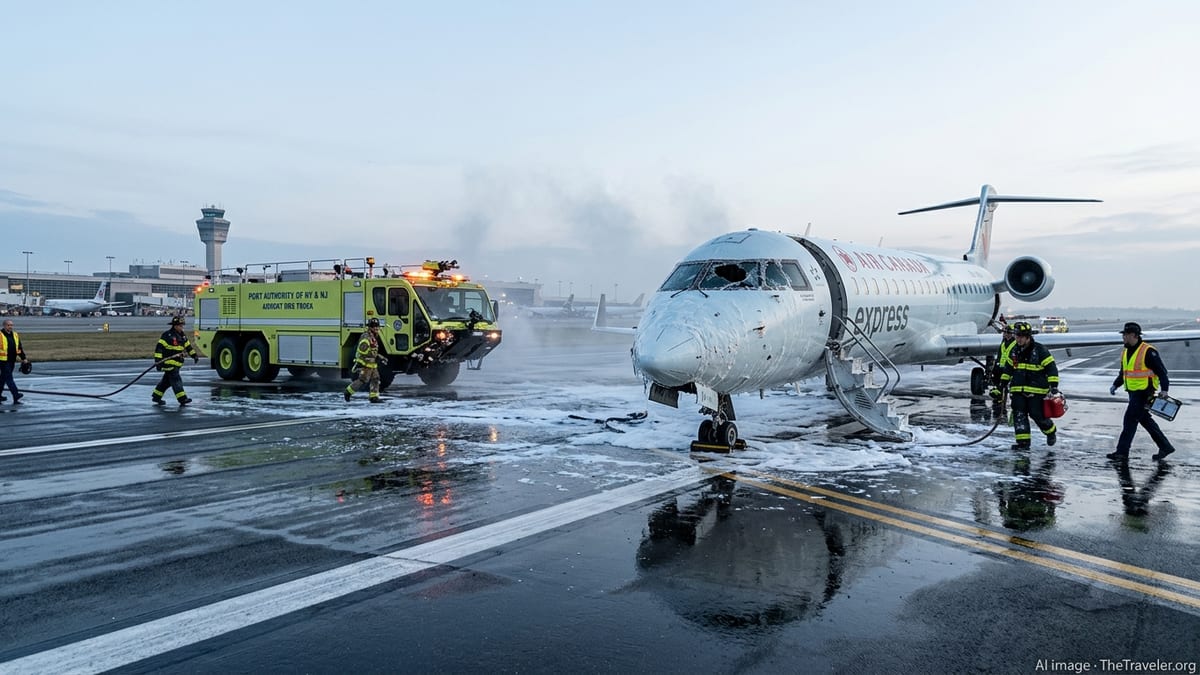
Incident Unfolds on Busy O’Hare Tarmac
Published accounts indicate that the incident occurred after an American-branded flight landed at O’Hare and came to a stop on the runway with apparent tire damage. Images and descriptions shared by passengers and observers describe multiple emergency vehicles surrounding the aircraft as it remained stationary on the airfield.
Reports suggest the aircraft involved was operating as an American Eagle service, a regional flight operated on behalf of American Airlines, and was met by airport fire and rescue units along with ground service teams. The response followed standard airport safety procedures for suspected landing-gear or braking issues.
According to publicly available eyewitness descriptions, passengers remained on board for a period while the aircraft and runway environment were assessed. There were no immediate indications of fire, smoke, or structural damage to the fuselage, and available information does not indicate any serious injuries.
The episode took place against the backdrop of a busy afternoon and evening schedule at O’Hare, where any runway blockage can quickly create a ripple effect for departures and arrivals across several airlines.
Runway Checks and Temporary Disruptions
Accounts from aviation observers and travelers at O’Hare indicate that the affected runway was temporarily closed so that crews could inspect the pavement and clear any debris that might have resulted from the blown tires. Such inspections are a routine part of airport safety when rubber fragments or wheel components may be present on the surface.
Published commentary from individuals who said they were on nearby flights described delays while aircraft waited for clearance to depart or land. Some reported extended time on taxiways as ground controllers rerouted traffic around the closed runway, a standard practice to maintain safety while minimizing wider disruption.
Available descriptions indicate that the damaged aircraft was later towed from its position, escorted by airport emergency vehicles as a precaution. Once the aircraft and any debris were removed, runway operations gradually resumed, easing the backlog of flights that had built during the interruption.
Such delays can quickly cascade through a hub as busy as O’Hare, contributing to missed connections and longer-than-expected ground times, even when the underlying mechanical issue on a single aircraft is contained and non-life-threatening.
Landing Gear and Tire Issues in Airline Operations
Aviation safety records and previous incident reports show that blown tires on landing, while unsettling for those on board, are generally contained events that flight crews train to handle. Commercial aircraft are designed with multiple tires on each main landing gear to distribute loads and preserve controllability even if one tire fails.
Safety analyses from earlier cases involving U.S. carriers describe scenarios in which aircraft continued decelerating normally after a tire failure, with pilots maintaining directional control and bringing the jet to a safe stop on the runway. In many such events, airport fire and rescue units respond out of an abundance of caution while maintenance teams assess the wheel assemblies and braking systems.
Industry guidance places particular emphasis on post-landing inspections and runway sweeps after a suspected blown tire. Removing loose rubber and inspecting for surface damage helps prevent a hazard known as foreign object debris, which can affect subsequent aircraft using the same runway.
The O’Hare incident aligns with this pattern, where prompt response, visual checks, and conservative decision-making are prioritized over keeping to tight departure or arrival banks.
Passenger Experience and Communication
Passenger comments shared through public forums often focus on the uncertainty during such occurrences rather than on physical danger. Individuals describing the O’Hare event reported a visible concentration of emergency vehicles, prolonged waiting on board, and limited early information about what had taken place beneath the cabin floor.
Airlines and airports typically follow standardized communication protocols during ground incidents, balancing the need for timely updates with the caution required while crews are still diagnosing the situation. Cabin announcements tend to emphasize that the aircraft is secure and that responders are on scene as a precaution.
In similar cases documented at major U.S. airports, passengers are sometimes deplaned via air stairs or towed to a gate once maintenance personnel determine it is safe to move the aircraft. Available accounts from O’Hare suggest a comparable approach, with the priority placed on a calm, orderly disembarkation once the tire issue was contained.
Although extended delays and missed onward flights can be frustrating, travel industry observers note that conservative operational decisions in response to mechanical anomalies have contributed to the high safety record of large commercial jets in North America.
O’Hare’s Role as a Hub for Diversions and Irregular Operations
Chicago O’Hare serves as a major hub for American Airlines and several other carriers, and it is accustomed to handling both minor mechanical incidents and more serious emergencies. Previous documented cases at the airport have involved precautionary returns, engine problems, and other technical issues that prompted rapid responses from on-site rescue units.
Aviation specialists note that O’Hare’s extensive network of runways, taxiways, and service roads enables emergency vehicles to reach an aircraft quickly while giving controllers options to reroute other traffic. When an incident blocks a particular runway, the field’s multi-runway configuration helps limit the overall impact on the day’s schedule, though short-term bottlenecks are common.
Travel data for recent years show that irregular operations due to weather, traffic congestion, and occasional mechanical events are an expected feature of flying through one of the nation’s busiest hubs. The O’Hare tire-blowout response fits within this broader pattern, in which robust emergency preparedness coexists with complex, often fragile day-of-travel logistics.
For travelers, the event is a reminder that visible emergency activity on the tarmac does not necessarily signal a life-threatening crisis, but rather a well-practiced safety protocol triggered whenever an aircraft arrives with an abnormal condition.