


Country music is the loudest part of Tennessee’s global image, but it is only one note in a much richer composition. From mist-filled mountains and cave waterfalls to design-forward museums and serious food cities, the Volunteer State has plenty to offer travelers who do not care about twangy ballads or neon-lit honky-tonks. The real question is not whether you like country music, but whether you enjoy landscapes with depth, walkable neighborhoods, and places where American history and contemporary creativity still feel very alive.
Get the latest updates straight to your inbox!
Beyond the Stereotype: What Tennessee Really Feels Like
If your mental picture of Tennessee begins and ends with Nashville’s Lower Broadway, you are missing most of the state. In reality, the biggest magnet for visitors is not a music venue at all but Great Smoky Mountains National Park, which straddles the Tennessee and North Carolina border and draws roughly 11 to 12 million visitors a year, more than any other U.S. national park. Much of that traffic flows in through the Tennessee side near Gatlinburg and Pigeon Forge, where travelers come for misty ridgelines, waterfalls, and hundreds of miles of trails rather than for a soundtrack.
Tennessee is also one of the South’s most diverse road-trip states, with three major cities that feel distinct from one another. Nashville leans cosmopolitan and creative, with a strong restaurant scene and design hotels. Memphis is grittier and more historic, the place where the blues and rock and roll took shape along the Mississippi River. Chattanooga, set along a bend of the Tennessee River, has reinvented itself as an outdoorsy, family-friendly small city with major aquarium exhibits and access to Lookout Mountain.
This geographic and cultural variety matters for travelers wary of a one-note “music city” experience. You can hike along sections of the Appalachian Trail, spend a morning inside a 1930s art deco post office turned gallery, or eat world-class hot chicken and wood-fired pizza in a single day, often without hearing a single cowboy hat anthem unless you go looking for it. In most Tennessee neighborhoods, the soundtrack is as likely to be indie rock, hip-hop, jazz, or nothing at all.
In practical terms, Tennessee is also relatively easy to explore. Interstates connect the four major cities in a loose triangle, and flight connections into Nashville and Memphis are strong, making it realistic to design a long weekend focused on nature, food, or history rather than music. Prices are generally lower than in bigger coastal destinations, so your budget stretches further on lodging and dining, especially outside peak summer season in the Smokies.
Great Smoky Mountains: Tennessee’s Wild Side
Even if you have zero interest in country music, it is hard to argue with the draw of Great Smoky Mountains National Park. The park covers more than 500,000 acres across Tennessee and North Carolina, with dense hardwood forests, historic churches and cabins, and over 800 miles of hiking trails. There is no gate fee to enter, one reason it consistently tops national visitation rankings. That free access makes it especially appealing for budget-conscious travelers who would rather pay for a good cabin than a concert ticket.
On the Tennessee side, many first-time visitors base themselves near Gatlinburg or Pigeon Forge. From there, you can drive the scenic Newfound Gap Road, pull off at outlooks that look across layer upon layer of blue ridges, or tackle hikes like Alum Cave or Chimney Tops. In late spring and early summer, wildflowers line the trails, and in October, fall color draws photographers and leaf peepers from around the world. Casual visitors can stick to short, paved trails and picnic areas, while serious hikers disappear onto backcountry routes and segments of the Appalachian Trail.
The Smokies offer more than just hiking. Cades Cove, a broad valley ringed by mountains, combines wildlife viewing and cultural history. Cyclists ride the 11-mile loop on vehicle-free mornings in summer, while others explore preserved churches and homesteads that hint at how rural communities lived before the park was established. Black bear and deer sightings are common here, especially at dawn and dusk, which turns even a simple loop drive into a wildlife safari.
Outside the park boundaries, towns like Sevierville and Townsend have gradually added small breweries, coffee shops, and independent restaurants that cater to park visitors. It is increasingly possible to spend a week in the Smokies alternately camping, hiking, and then coming back to a craft beer and a solid burger or farm-style meal in the evening, without any connection to Nashville’s tourist bars.
Chattanooga and Lookout Mountain: Scenic, Not Twangy
Chattanooga is one of Tennessee’s strongest answers to the question of what to do if you have no interest in country music. The compact downtown wraps around a revitalized riverfront, with the Tennessee Aquarium at its core. The aquarium often appears on lists of top freshwater aquariums in the United States and is known for its separate River Journey and Ocean Journey buildings, where you can move from river otters and Appalachian streams to stingrays and penguins under one combined admission.
Just a short drive from downtown, Lookout Mountain rises above the city with a trio of classic attractions that have nothing to do with music charts. Ruby Falls, deep inside the mountain, is an underground waterfall open to the public, reached by elevator and guided tour through a limestone cave system. Tickets are sold in timed slots that you typically book in advance, and a visit combines geology, a light physical walk, and the spectacle of a 60-plus-foot waterfall hidden beneath the earth’s surface.
Nearby Rock City, technically just across the state line in Georgia but marketed heavily to Tennessee visitors, is famous for its walking trails past massive rock formations, suspension bridge, and broad views from Lover’s Leap, where on a clear day you can see into several states. Many travelers pair Rock City with Ruby Falls or the steep Lookout Mountain Incline Railway, effectively turning a single day into a sampler of cliffs, caves, and panoramic views. These are straightforward, family-friendly attractions, more like classic roadside Americana than anything tied to the Nashville brand.
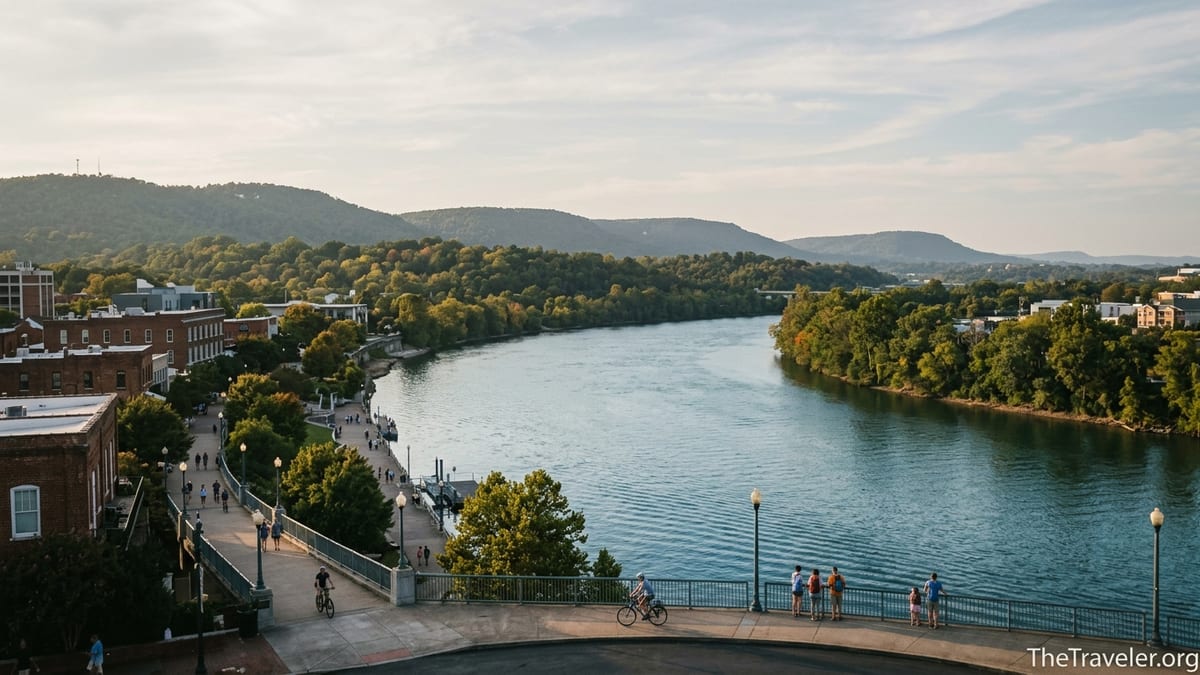
Chattanooga’s city core complements those sights with walkable neighborhoods like the North Shore, home to boutique shops, coffee houses, and public sculptures. The converted Walnut Street Bridge lets you walk over the river and look back at the city skyline. Rather than the raucous, bachelor-party energy of Lower Broadway in Nashville, Chattanooga’s nightlife skews toward craft cocktails, casual live music in small venues, and early closing hours that suit hikers rather than bar hoppers.
Nashville Without the Honky-Tonks
Nashville is the place most travelers question if they are not into country. The image of neon boot signs, pedal taverns, and bar bands belting out covers is not inaccurate, but it is largely confined to a few downtown blocks. Much of the city functions like any other mid-sized American metro, with neighborhoods defined more by coffee shops, independent bookstores, and local restaurants than by any single genre of music. You can easily spend a long weekend in Nashville and never set foot on Lower Broadway if you prefer.
Art and architecture are a good starting point. The Frist Art Museum occupies a 1930s art deco building downtown that once served as the city’s main post office. Today it operates as a non-collecting museum, hosting rotating exhibitions from around the U.S. and abroad. That structure means there is always something new on view, ranging from photography and sculpture to design-focused shows. Visitors pay a modest admission, roughly in line with other regional art museums, and can combine gallery time with lectures, film screenings, or evening events.
Not far away, Cheekwood Estate and Gardens blends art, architecture, and landscape design on a historic estate. The former mansion houses a Museum of Art with a collection rooted in works gathered by the defunct Nashville Museum of Art, while the surrounding botanical gardens feature seasonal displays from spring tulips to autumn pumpkins and holiday lights. A visit here feels less like a city tour and more like a country estate outing, a contrast to downtown’s bustle and any association with honky-tonks.
Neighborhoods like East Nashville, 12South, and The Nations have their own micro-identities, driven by restaurants, vintage shops, and independent boutiques. Here you will find third-wave coffee, plant shops, and small galleries as easily as you will stumble on a bar. Any live music you do encounter is as likely to be rock, jazz, or experimental genres as it is a country standard. Locals often emphasize that the city’s music culture is much broader than the tourist bars, and that an “alt scene” of hardcore, indie, and electronic shows thrives well beyond the neon strip.
Memphis: Civil Rights, Riverfront Walks, and a Deep Food Culture
If your concern is that country music will dominate every cultural site in Tennessee, Memphis offers a completely different story. This Mississippi River city revolves more around blues, soul, and civil rights history than around anything from Nashville. Beale Street is famous as a blues corridor, and while you may hear live bands drifting out of clubs, it is not the same scene as a country honky-tonk strip. For many travelers, the core draw is heavier: the opportunity to confront the legacy of the civil rights movement at the National Civil Rights Museum.
The museum complex incorporates the former Lorraine Motel, where Dr. Martin Luther King Jr. was assassinated, and guides visitors through exhibits on slavery, Jim Crow, the Montgomery bus boycott, and other key chapters of American history. It is one of the most powerful museum experiences in the United States, and many people plan their Memphis trip around visiting it. Expect to spend at least two to three hours moving through the exhibits and allow time afterward to decompress along the nearby riverfront.
Memphis also leans heavily into its reputation as a food city, particularly for barbecue. Iconic joints serve racks of ribs and pulled pork in settings that feel more like neighborhood diners than tourist traps. You can spend an evening hopping from a barbecue restaurant to a craft brewery or cocktail bar along South Main or Overton Square without ever engaging with the tourist-oriented music venues if you are not interested.
Beyond its central sights, Memphis has quieter attractions that appeal to travelers looking for something less obvious. The city’s riverfront parks have been undergoing improvements that make it easier to bike or stroll along the Mississippi at sunset. Neighborhoods like Cooper-Young are dotted with used bookstores, coffee houses, and small performance venues. While the Rock ‘n’ Soul Museum and other music-related institutions do exist, they cover genres like blues, rock, and soul that feel distinct from the Nashville-centric brand many visitors are trying to avoid.
Practical Considerations: Cost, Seasons, and Crowds
From a logistics standpoint, Tennessee compares favorably with other U.S. destinations, particularly if you are willing to travel outside peak holiday periods. Lodging in smaller cities such as Chattanooga and in off-peak seasons in the Smokies often runs noticeably cheaper than comparable stays in coastal metros. Cabin rentals near the national park, for instance, can be affordable if you visit midweek in spring or late fall, before the highest summer demand hits school holidays.
Seasonality shapes the mood of each region in different ways. In the Smokies, late September and October are prime for fall color but also for traffic, as scenic drives and trailheads fill early in the day. Spring brings wildflowers and generally milder temperatures, while summer can be hot and humid, with afternoon thunderstorms. On the other hand, cities like Nashville and Memphis can be rewarding in shoulder seasons such as March, April, October, and November, when daytime temperatures often hover in a comfortable range and festival calendars are busy without overwhelming crowds.
Transportation is straightforward if you are comfortable driving. Interstates connect Knoxville, Nashville, Chattanooga, and Memphis, and rental cars from major brands are readily available at airports. Once in the cities, many of the non-music attractions sit within short ride-share distances or, in downtown cores, walkable grids. Public transit is limited compared to major coastal metros, so a combination of walking, ride-shares, and occasional scooters or bikes is the norm for visitors.
Crowd management is important in the most popular places. In the Smokies, that may mean starting hikes early, choosing lesser-known trailheads, or visiting midweek. At Ruby Falls or the Tennessee Aquarium, booking tickets ahead for preferred times helps avoid long waits, especially on weekends or during school vacations. In Nashville, the easiest way to avoid the high-density bachelor party scene is simply to skip Lower Broadway after dark and focus on neighborhoods and cultural sites elsewhere in the city.
The Takeaway
So, is Tennessee worth visiting if you are not into country music? The evidence from its mountains, museums, and mid-size cities suggests a strong yes. The state’s most visited attraction is a national park, not a concert hall, and the most transformative experiences many travelers report involve mountain sunrises, civil rights history, or unexpected meals in neighborhoods far from neon strips.
If you treat country music as an optional side trip rather than the main event, Tennessee opens up into a tapestry of outdoor adventure, thoughtful museums, independent food and drink, and evolving neighborhoods. You can design a trip that feels entirely your own: a week in a Smokies cabin with daily hikes, a city-hopping itinerary that links Chattanooga’s riverfront and Nashville’s galleries, or a reflective long weekend in Memphis centered on history and food.
In the end, Tennessee’s appeal lies less in any one genre of music and more in its contrasts: river valleys and high ridgelines, historic estates and modern murals, busy tourist strips and quiet side streets. Even if you never set foot in a honky-tonk or recognize a single song on a country chart, you can leave the state with a sense of having touched something genuinely American and surprisingly varied.
FAQ
Q1. Can I enjoy Nashville if I avoid country music entirely?
Yes. Focus on places like the Frist Art Museum, Cheekwood Estate and Gardens, local coffee shops, and neighborhoods such as East Nashville and 12South instead of Lower Broadway.
Q2. What part of Tennessee is best if I mainly want outdoor activities?
East Tennessee around Great Smoky Mountains National Park is ideal for hiking, scenic drives, waterfalls, and wildlife watching, with towns like Gatlinburg, Townsend, and Pigeon Forge as gateways.
Q3. Is Chattanooga a good base for a non-music-focused trip?
Yes. Chattanooga centers on the Tennessee Aquarium, riverfront walks, and Lookout Mountain attractions like Ruby Falls and Rock City, with plenty of cafes and galleries.
Q4. How many days should I spend in the Smokies if I am not a hardcore hiker?
Two to four days is usually enough to sample scenic drives, a couple of short hikes, and historic areas like Cades Cove without committing to strenuous backcountry routes.
Q5. Is Memphis still worth visiting if I skip Graceland and music museums?
Yes. You can focus on the National Civil Rights Museum, riverfront parks, neighborhood restaurants, and historic districts like South Main and Cooper-Young.
Q6. Are there quiet alternatives to Nashville’s party scene at night?
Absolutely. Try wine bars, craft breweries, or restaurants in neighborhoods like Germantown, The Nations, or Hillsboro Village, where the energy is lower-key and more local.
Q7. What time of year is best to visit Tennessee if I dislike heat and humidity?
Spring and fall are most comfortable, especially March to early May and late September to early November, when temperatures are milder and humidity is usually lower.
Q8. Will I hear country music everywhere I go in Tennessee?
No. Outside a few tourist-focused areas, daily life in Tennessee sounds like any other state, with a mix of genres or no music at all in many public spaces.
Q9. Is Tennessee suitable for families that do not care about music?
Yes. Family-friendly stops include the Tennessee Aquarium, Ruby Falls, Rock City, Great Smoky Mountains National Park, and children’s sections in major museums and gardens.
Q10. Can I visit Tennessee without renting a car?
It is possible in a single city like Nashville, Memphis, or Chattanooga using ride-shares and walking, but to connect cities or reach the Smokies, renting a car is much more practical.