


For many visitors, the Acropolis begins at the Propylaea. Yet the hill’s real story starts lower down, on its southern flank, where Athenians once gathered in the Theatre of Dionysus to watch the first tragedies. Entering via the South Slope is not only a practical way to dodge the biggest bottlenecks, it is also one of the most atmospheric routes for first-time visitors. This guide explains exactly how to use the South Slope entrance, how tickets and time slots work, what you will see in walking order, and how to beat both the crowds and the heat.
Get the latest updates straight to your inbox!
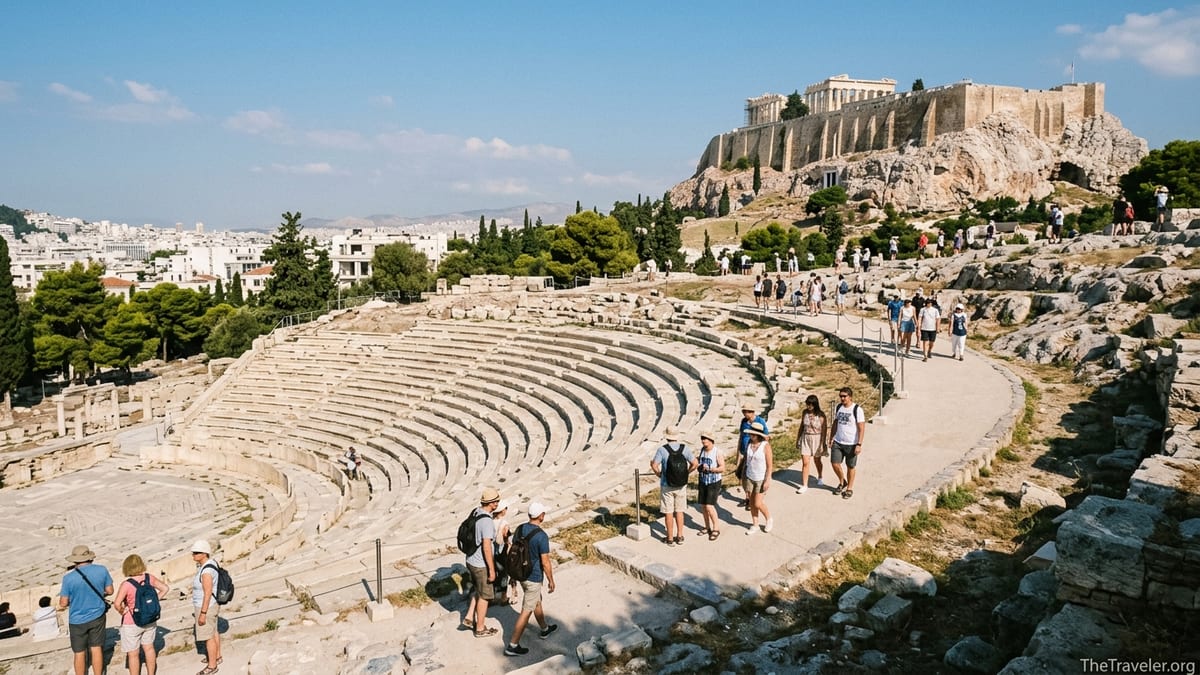
Why Use the South Slope Entrance for the Theatre of Dionysus
The Acropolis has two main access points for independent visitors: the western entrance near the Propylaea and the South Slope entrance on Dionysiou Areopagitou Street, just uphill from the Acropolis Museum. The South Slope gate feeds you directly into the sanctuary of Dionysus and the Theatre of Dionysus, then leads you upward to rejoin the main route toward the Parthenon. For anyone keen to experience the origins of Greek drama, this entrance places you exactly where ancient Athenians once climbed the hill.
In practice, the South Slope entrance can be less stressful than the main west gate, particularly in high season when large cruise groups and coach tours tend to queue at the primary entrance. On a busy July morning, it is not unusual to find a long, snaking line of package tours at the west side, while the South Slope has a much shorter, steadily moving queue. Individual travelers who have prebooked their time-slot ticket often report entering via the South Slope in under 10–15 minutes, even on days when the main gate is backed up.
The South Slope route is also more narratively satisfying for first-timers. You begin with the everyday religious life of the city at the sanctuary of Dionysus, see the stone tiers of the Theatre of Dionysus where plays by Sophocles and Euripides were first staged, then climb past later monuments such as the Odeon of Herodes Atticus before emerging at the ceremonial west entrance. Instead of rushing straight to the Parthenon, you experience the Acropolis as a complex of slopes, sanctuaries and viewpoints.
Finally, the South Slope entrance is exceptionally convenient if you are combining the archaeological site with the Acropolis Museum. Many visitors plan a loop that starts at the museum, walks five minutes uphill to the South Slope gate, visits the theatre and upper Acropolis, then descends via the same gate back toward Plaka or the metro. This approach minimizes backtracking and keeps your day compact and walkable.
Understanding Acropolis & Slopes Tickets and Time Slots
The Theatre of Dionysus is part of the Acropolis & Slopes archaeological site, not a separate ticket. As of summer 2026, the standard adult ticket for the Acropolis & Slopes is around 30 euros in the main season, with reduced pricing in winter. This single ticket covers the hilltop (including the Parthenon and Erechtheion) and the northern and southern slopes, so you can enter through the South Slope gate and explore the Theatre of Dionysus, then continue upward without buying anything extra at the theatre itself.
When you buy your ticket online from an official vendor, you will usually be asked to choose a specific 1-hour time slot for entry to the Acropolis & Slopes. For example, you might book a slot from 08:00 to 09:00 on a particular Tuesday in August. You can arrive at the South Slope gate at any point within that window; staff typically scan the QR code from your phone or printed ticket. The time slot is about controlling how many people enter the site per hour, so if you are hoping to wander down to the Theatre of Dionysus hours before your Parthenon visit, that is no longer possible on a separate schedule. Once you are inside, however, you can move between the slopes and hilltop freely in one continuous visit.
Combined tickets that once bundled the Acropolis with multiple other ancient sites across Athens have been modified or withdrawn in recent years, and conditions can change. For example, past combination passes allowed five days of flexible entry to several sites for a set price; newer structures favor time-specific entry to the Acropolis & Slopes, with separate tickets or passes for other monuments. Before you travel, it is worth checking an up-to-date source or contacting your accommodation in Athens to confirm whether any city-wide heritage passes or new combo options are currently offered.
On the ground, many travelers still buy their Acropolis & Slopes ticket on the spot at a physical ticket office. There are ticket windows near both the main west entrance and the South Slope gate. However, in peak months such as June to September, it is common to see a separate queue for people without tickets at the main entrance, which can easily add 30 minutes or more to your wait. If you plan to enter via the South Slope and have not prebooked, aim to arrive close to opening time and be prepared for a short ticket line before you reach the security check.
Step-by-Step: Reaching and Entering via the South Slope
Reaching the South Slope entrance is straightforward once you orient yourself around the pedestrian ring that circles the Acropolis. From the Acropolis metro station, walk uphill along Dionysiou Areopagitou, the broad cobbled promenade that passes the Acropolis Museum. Within about five minutes, you will see signs for the Acropolis & Slopes entrance on your left. The gate is just above the Theatre of Dionysus and is clearly marked with ticket and security screening areas. If you are staying in Plaka, a gentle 10–15 minute uphill walk along the same pedestrian street brings you to the same gate.
When you arrive, the first checkpoint is usually ticket verification. Staff will scan your QR code or look at your printed ticket to confirm your time slot, then direct you forward to security. As with many major heritage sites, you pass your bag through an X-ray scanner and walk through a metal detector. Simple daypacks, water bottles and compact cameras are allowed, but large suitcases and wheeled luggage are not. A typical family might carry a small backpack with reusable bottles and hats; this is generally acceptable as long as it is worn on the front or carried in hand inside the more fragile areas.
Immediately beyond security, the paved path curves gently upward and opens out toward the sanctuary of Dionysus. On your right, you may see low ruins and explanatory panels; ahead and slightly to the left, the stone cavea of the Theatre of Dionysus begins to appear between the trees. Within a few minutes of stepping through the gate, you will already be looking down into the semi-circular auditorium where the city’s dramatic festivals took place. For many visitors, this quick reward makes the South Slope entrance feel far more satisfying than the longer initial climb from the west side.
If you are entering around opening time, you will notice that organized tours often pause just inside the gate to give an introduction. To avoid getting stuck behind a cluster, it can be worth walking a little further up the path and returning to the first viewpoint above the theatre once that initial wave has spread out. Independent travelers frequently find that simply letting one tour group move ahead can transform a crowded-feeling path into a mostly quiet one within ten minutes.
Walking Order: From Theatre of Dionysus to the Hilltop
The most logical walking order for first-timers entering via the South Slope begins with the Theatre of Dionysus itself. From the main path, small spurs and viewpoints let you look across the orchestra and up at the tiers of seating. The lowest seats, with their carved backs and armrests, were reserved for priests and dignitaries. Spend a few minutes imagining festival days when up to several thousand Athenians gathered here to watch new plays. Photography is permitted, but climbing onto the more fragile sections of stone or crossing low ropes is not.
Continuing upward, you pass the remains of the sanctuary of Dionysus and, a little higher, the more fragmentary Odeon of Pericles. These ruins are less immediately impressive than the theatre, but they complete the picture of this slope as a hub of performance and festival life. The path then turns north, becoming steeper as it climbs toward the main west entrance of the Acropolis. As you ascend, you will begin to glimpse the Parthenon’s columns rising above the rock and, to your left, the later Roman-era Odeon of Herodes Atticus with its distinctive arches and partially restored seating.
Within 20–30 minutes of a leisurely walk from the South Slope gate, most visitors find themselves approaching the formal gateway of the Acropolis, the Propylaea. Here the South Slope path merges with the route from the main west entrance, and the crowds thicken. This is also where steeper steps and uneven rock underfoot become more pronounced. If you are visiting with young children or older relatives, this is a good point to pause, reapply sunscreen and make sure everyone has had some water before the final push through the gateway and onto the exposed summit.
Once you pass through the Propylaea, you are on the upper plateau. For first-timers, a natural circuit is to walk clockwise: pause for the classic view of the Parthenon on your right, continue around its north flank for side views and details of the restoration, then visit the Erechtheion with its caryatid porch. From the north edge, viewpoints look down across the city to the Ancient Agora and Lycabettus Hill. Completing this circuit and then retracing your steps back through the Propylaea and down the South Slope gives you a well-paced visit without unnecessary backtracking or confusion about paths.
Heat, Shade and Crowd Management on the South Slope
Athens can be extremely hot from late May through September, with midday temperatures often exceeding 33 degrees Celsius. The South Slope path offers slightly more patches of shade than the exposed upper plateau, thanks to scattered trees and the shadow of the rock itself, but it is still very warm in the middle of the day. Many experienced travelers target the earliest available time slot, often around 08:00, or the later afternoon slots after 17:00, to avoid the most intense sun. Arriving at the South Slope just after opening, it is common to find quieter paths and gentler light for photographs.
Because the South Slope entrance serves both independent visitors and guided groups, crowds tend to arrive in pulses. For example, a large coach group may arrive together at 09:30, filling the security line for ten minutes, then disperse once inside. If you are not traveling on a fixed schedule, it is often worth stepping aside for a short break in a shaded corner or on a low wall near the lower sanctuary, letting one “wave” of visitors pass ahead. Families with school-age children often find this easier than trying to thread their way through the middle of a cluster.
Heat management is particularly important on the climb from the theatre to the Propylaea. While the gradient is moderate, the combination of reflective stone, crowds, and limited shade can make it feel demanding. Carry at least one large reusable water bottle per person; there are often basic facilities or kiosks near the entrances, but you cannot rely on constant access to cold drinks once you are most of the way up. Lightweight clothing, wide-brimmed hats and sunglasses make a noticeable difference. Visitors who are sensitive to heat sometimes break their visit into two parts, exploring the South Slope early in the morning, exiting for a long lunch or museum visit, then returning for the upper Acropolis in the cooler evening with a second time-slot ticket.
On very hot days, local authorities may adjust opening hours or restrict entry during the hottest afternoon period to protect visitors and staff. If you are visiting in the height of summer, check the day before whether any such measures are in place. It is not unheard of for travelers to find that a planned 14:00 entry slot has been moved earlier or later in response to an official heat advisory, and the South Slope gate will follow the same policies as the main entrance.
Side-Entrance Strategy: Pairing the South Slope with the Main Gate
For first-time visitors, the smartest strategy is often to treat the South Slope as both a thematic starting point and a practical side entrance. One popular approach is to enter via the South Slope for your booked time slot, explore the Theatre of Dionysus and other monuments on the southern flank, then continue all the way up to the hilltop. When you have completed a full circuit of the Parthenon and other buildings, you can choose whether to descend the same way or exit through the main west gate to connect with other city sights.
Consider a typical day in midsummer. A couple staying in Plaka books an 08:00–09:00 ticket for the Acropolis & Slopes. They have an early breakfast, walk up Dionysiou Areopagitou and pass through the South Slope gate by 08:15. In the first 30 minutes they enjoy the Theatre of Dionysus under relatively soft morning light, taking unobstructed photos of the stone tiers. By 09:00 they are nearing the Propylaea, and by 09:30 they have seen the Parthenon before the worst of the heat. Around 10:30 they descend again via the South Slope and are back near the Acropolis Museum in time for an early lunch. This simple loop gives them both the dramatic summit and the quieter lower sanctuaries without ever joining the most congested lines at the west entrance.
Another strategy, often used by visitors staying near Syntagma Square or Monastiraki, is to enter via the main west entrance for the classic first view of the Propylaea and Parthenon, then exit via the South Slope toward the Acropolis Museum. This works particularly well if you have a museum ticket for later the same morning or afternoon. After completing the hilltop circuit, you follow the signposted path down past the Odeon of Herodes Atticus and the Theatre of Dionysus and leave through the South Slope gate, which brings you within a few minutes’ walk of the museum entrance, cafes and tram.
In both cases, the key principle is to use the two entrances in combination to minimize retracing your steps. Instead of climbing and descending the same crowded stairways and ramps, you make a one-way journey across the rock. This is kinder on the legs, especially for older travelers, and it helps spread crowds more evenly across the site. The South Slope entrance becomes less of a “secret gate” and more of a deliberate planning tool for shaping a calm, coherent first visit.
Practical Tips for First-Time Visitors to the Theatre of Dionysus
The Theatre of Dionysus is an archaeological monument rather than a functioning performance space, so expectations should be set accordingly. You will not find modern stage equipment or regular shows; instead, you see layered stone, partial restorations, and informational plaques. Wear sturdy footwear with good grip, as the stone paths and exposed rock can be smooth and slippery, especially after a light shower or under fine dust. Sandals are common in Athens in summer, but sport sandals or walking shoes are safer than beach flip-flops for the sloping terrain around the theatre.
Photography is allowed, but tripods and large camera rigs may require special permission. For most visitors, a smartphone or a compact camera is more than adequate. Early morning and late afternoon offer the best light, with softer shadows and a warmer tone on the stone. If you are visiting in the middle of the day, be prepared for high contrast and consider stepping back to wider viewpoints instead of struggling with harsh close-ups.
There are toilets near the South Slope entrance area, but not immediately beside every monument. Plan to use facilities before you begin your climb in earnest, particularly if you are traveling with children. Snacks and food are not allowed to be consumed around the monuments themselves, and picnicking in the seating areas of the theatre is strictly discouraged. A practical routine is to eat a modest breakfast, visit the Acropolis & Slopes, then have a later snack or early lunch once you are back outside the gate on Dionysiou Areopagitou, where cafes and kiosks are plentiful.
If you are especially interested in ancient theatre, you might choose to download a short audio guide focused on the Theatre of Dionysus before your visit. Several reputable cultural institutions and commercial apps offer walking tours that dedicate 10–15 minutes of commentary to the sanctuary and theatre, explaining how festival days worked, where the chorus stood, and what the original wooden stages would have looked like. Listening to this as you stand on the slope can make the otherwise silent stones feel more alive.
The Takeaway
Approaching the Acropolis via the South Slope is more than a crowd-dodging trick. It is a way of entering the site in historical order, beginning with the cult of Dionysus and the theatrical festivals that shaped Athenian culture long before marble temples crowned the summit. For first-time visitors, this approach offers a calmer, more layered introduction to the rock, while still delivering all the iconic views of the Parthenon.
With a bit of planning around time slots, heat and walking order, the South Slope entrance can turn what might have been a rushed, crowded climb into a memorable half-day that flows naturally from theatre to sanctuary to summit. Whether you choose to start or finish your Acropolis experience at the Theatre of Dionysus, treating the South Slope as an integral part of your route will give you a richer understanding of Athens’ most famous hill.
FAQ
Q1. Can I enter the Acropolis through the South Slope with a standard Acropolis ticket?
The standard Acropolis & Slopes ticket covers both the hilltop and the southern and northern slopes, including the Theatre of Dionysus, so you can use the South Slope entrance with it.
Q2. Is the South Slope entrance less crowded than the main west entrance?
Often it is, especially in the early morning and later afternoon, but this can vary by day and season. Large tour groups sometimes use the South Slope too, so crowds may arrive in waves rather than steady lines.
Q3. How long does it take to walk from the South Slope entrance to the Parthenon?
Most visitors take around 20–30 minutes at a relaxed pace, including a short stop to view the Theatre of Dionysus. If you linger at viewpoints or take many photos, allow closer to 45 minutes.
Q4. Are there shaded areas along the South Slope route?
There are some trees and shadowed sections near the sanctuary and lower paths, but much of the climb is still exposed. You should plan for strong sun, bring water and wear a hat, particularly in summer.
Q5. Can I see only the Theatre of Dionysus without climbing to the top?
Yes, once inside you are free to spend your time on the South Slope and the theatre area and then exit without going all the way to the summit. However, your ticket is the same as for the full site, and you still need a valid entry time slot.
Q6. Is the South Slope entrance suitable for visitors with limited mobility?
The area around the South Slope gate and the first viewpoints over the Theatre of Dionysus are relatively gentle, but the paths become steeper and more uneven as you climb. Visitors with significant mobility concerns should seek up-to-date information on accessible routes and may find a dedicated accessibility entrance or assistance program more comfortable.
Q7. Are there toilets and water near the South Slope entrance?
Basic toilet facilities are usually available near the entrance area, and you may find places to refill or buy water before entering. Once on the slopes, services are limited, so it is advisable to use the facilities and fill your bottle before you begin the main climb.
Q8. Can I exit via a different gate than the one I entered?
Yes, you can usually enter through the South Slope and exit via the main west gate, or the other way around, as long as both gates are open at the time. Following a one-way route helps reduce backtracking and manage crowds more smoothly.
Q9. What is the best time of day to visit the Theatre of Dionysus?
Early morning and late afternoon are generally the most pleasant, with lower temperatures, softer light and fewer crowds. Midday visits can be very hot and bright, especially in July and August.
Q10. Do I need a guided tour to appreciate the Theatre of Dionysus?
A guide is not essential, but can add depth by explaining festival rituals, seating arrangements and the development of Greek drama. If you prefer to explore independently, a short audio guide or a well-regarded guidebook section on the theatre can provide similar context while you walk.