


Far above the Arctic Circle in Finnish Lapland, Urho Kekkonen National Park stretches from the busy little resort village of Saariselkä into a near-trackless wilderness on the Russian border. For many travelers, the question is simple: is it really worth coming all this way for a park with no iconic single viewpoint, no cable car, and no big-name attractions? The answer from those who make the journey is almost always yes, but for reasons that are quieter and more subtle than you might expect.
Get the latest updates straight to your inbox!
Why Urho Kekkonen Captivates Travelers
Urho Kekkonen National Park is one of Finland’s largest protected areas, covering roughly 2,550 square kilometers of fells, bogs, rivers and forest in the municipalities of Savukoski, Sodankylä and Inari. It borders the tourism hub of Saariselkä in the west and runs almost to the Russian border in the east. Visitors often compare its scale to a small country rather than a typical national park. This size is part of the appeal: you can walk for hours or days without seeing a road, and the sense of space is what many travelers remember most.
The park is also surprisingly accessible. Most international visitors fly into Ivalo Airport and take a 30–40 minute bus ride to Saariselkä, where supermarkets, outdoor shops and hotels sit almost on the park boundary. From here, trailheads such as Kiilopää and Laanila are reachable by local bus, taxi or even on foot. For a first-time visitor to the Arctic, it feels almost luxurious to step from a warm hotel lobby or glass igloo cabin straight onto marked routes that lead into genuine wilderness.
What travelers tend to love most is the contrast between comfort and remoteness. You might spend the morning buying snacks in a modern supermarket in Saariselkä, then that same afternoon be standing alone on a fell ridge with only the wind and the sound of reindeer bells. This blend makes Urho Kekkonen particularly appealing for couples or families where one person wants deep nature and another prefers a heated sauna and restaurant dinner at the end of the day.
Visitor surveys conducted in recent years by the Finnish park authorities show steadily high satisfaction, with many respondents citing peace, clean nature and good trail infrastructure as key reasons they would return. While official visitation numbers fluctuate with seasons, the trend has been upward as more travelers discover that the park offers an “authentic Lapland” experience without requiring expedition-level skills.
Landscapes: Fells, Silent Forests and Big Skies
The scenery in Urho Kekkonen is not about towering peaks. Instead, gentle rounded fells rise above swathes of birch forest, peat bogs and winding rivers. Typical summits like Kiilopää or Iisakkipää are around 500–600 meters above sea level, but because the tree line is low at this latitude, the views from the tops feel unexpectedly wide. On a clear September day, hikers report seeing rolling layers of rust-colored tundra and distant blue ridges fading toward Russia.
One of the most loved areas is the Luirojärvi region, several days’ walk into the park for most hikers. Travelers who make the journey describe a classic Arctic scene: a small lake cupped between fells, a simple wilderness hut with smoke drifting from the chimney on cool evenings, and reindeer grazing on lichen-covered slopes. Getting here usually means carrying a full backpack for 3–4 days, but many say that sitting on the shore of Lake Luirojärvi at midnight under a pale summer sky is one of the highlights of their time in Finland.
Closer to Saariselkä, landscapes like Urupää and Kaunispää offer softer introductions. From the Kiilopää gate, well-marked trails climb above the sparse birch belt onto open fell where wooden duckboards cross soggy sections and small waymark posts guide you in mist. Day hikers often start with routes of 5–15 kilometers, such as the Poropolku “Reindeer Trail” loop that begins near Suomen Latu Kiilopää. These shorter trails give a real taste of the park’s character without committing to multi-day routes.
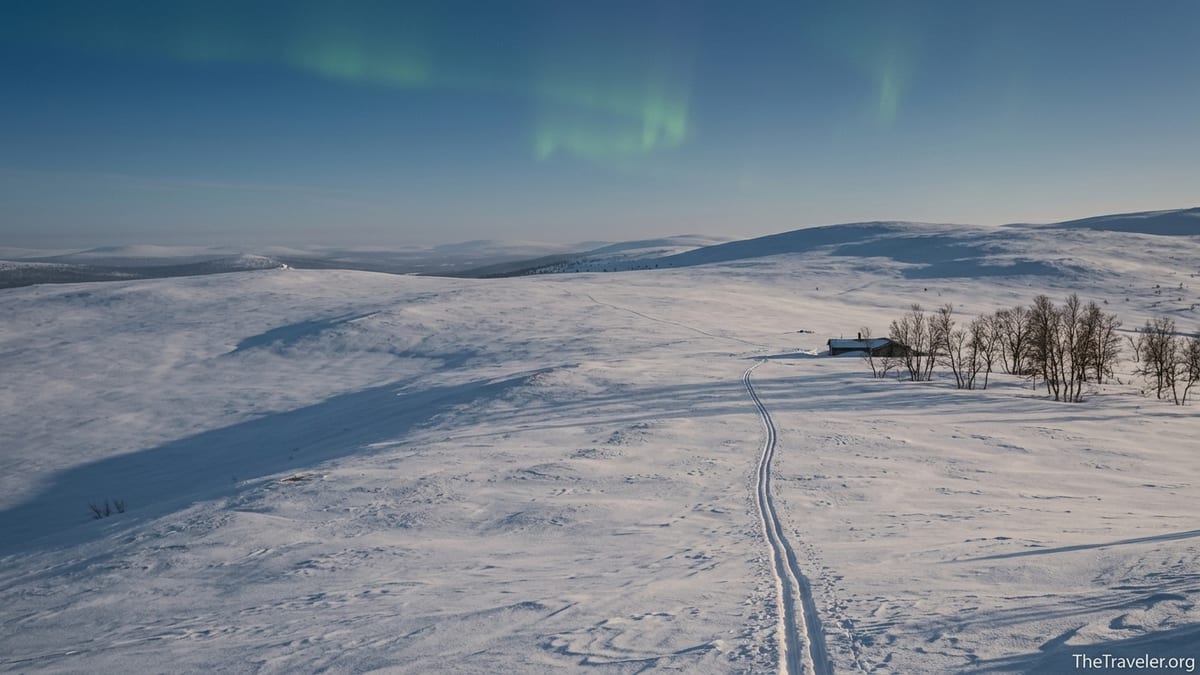
In winter, the same fells transform into something almost monochrome. Travelers on cross-country skis or snowshoes describe moving through a landscape of white curves and bluish shadows, with low polar light or even complete midwinter darkness bathing the snow in a soft glow. The absence of visual clutter is part of the charm: instead of dramatic cliffs, your eye focuses on delicate snow-laden birch branches, animal tracks and the subtle pastel colors around noon.
Four Distinct Seasons, Four Very Different Trips
One reason the park attracts repeat visitors is that it feels like a different destination in each season. In late winter, usually March and early April, daytime temperatures are often still below freezing but the sun is high enough to create bright, long days. This is widely considered prime time for cross-country tours: the maintained ski network in the Saariselkä–Kiilopää area can exceed 150–200 kilometers in a good year, and you can ski from village to fell and between open wilderness huts along packed tracks.
Summer, roughly from late June through August, brings long, mild days and the possibility of multi-day hikes without snow. Daytime temperatures can range from about 10 to 20 degrees Celsius, and around the summer solstice the sun barely sets at all. Visitors often plan 3–7 day hut-to-hut hikes starting at Aittajärvi or Raja-Jooseppi and finishing near Saariselkä, using river valleys like Suomujoki as natural corridors through the landscape. Park authorities recommend choosing routes that match your experience, as distances can feel longer than the map suggests due to wet ground and elevation changes.
Autumn is a favorite for photographers. From late August into mid-September, the birch forests turn gold and orange, the ground shrubs blaze crimson, and the first night frosts sharpen the air. Many travelers choose shorter loops from Saariselkä or Kiilopää at this time, such as a 12-kilometer out-and-back to open fell viewpoints, specifically to photograph ruska, the Finnish word for autumn colors. Stormy days can bring sideways rain and strong winds on the ridges, so proper waterproof layers are essential, but the reward is crisp light and often fewer insects than in midsummer.
Deep winter from December through February is for those seeking real Arctic atmosphere rather than long days on the trail. Temperatures can drop below minus 20 Celsius, with only a few hours of dim blue light at midday. Travelers typically base themselves in Saariselkä hotels or cabins, then do guided snowshoe walks, short backcountry ski tours or aurora hunts into the park in the evenings. The trade-off is limited daylight but a very high chance of encountering snow-covered trees, frozen streams and, with clear skies, the northern lights dancing over the fells.
What Travelers Love Most: Activities for Every Comfort Level
For many first-time visitors, the park’s variety of activities is what makes it feel worth the journey. Seasoned hikers and skiers appreciate the possibility of week-long trips, while more casual travelers enjoy that they can experience authentic Lapland nature in just a day or two. A common pattern is to spend three or four nights in Saariselkä: one day doing an easy marked trail in Urho Kekkonen, another day trying cross-country skiing or fatbiking, and an evening reserved for a guided reindeer or husky excursion that also skirts the park boundary.
In summer, day hikes range from short nature trails of 1.5–3 kilometers to more demanding 15–20 kilometer loops. For example, a visitor might start from the Saariselkä gate and follow a 7–8 kilometer circuit over Kaunispää Fell, stopping at a lean-to shelter to grill sausages over a campfire using wood provided by park management. Families with small children often pick these moderate loops, as they combine open views with the fun of cooking outdoors in the traditional Finnish style.
More experienced backpackers gravitate toward routes like the multi-day journey to Lake Luirojärvi or along the Nuortti River in the park’s southeastern section. These trips involve fording rivers, navigating in areas with fewer waymarks and sometimes camping on boggy ground, so travelers typically carry full four-season tents and several days’ worth of food purchased in Saariselkä or Ivalo. Hut-to-hut tours are also popular: many wilderness huts in the park are basic but free-to-use, with wooden bunks, a stove and an outhouse, and work on a first-come, first-served basis.
In winter, cross-country skiing is king. The groomed tracks around Saariselkä and Kiilopää cater to everyone from beginners renting skis for a single afternoon to serious skiers doing 30–40 kilometer loops. Rental shops in the village typically offer packages that include skis, boots and poles, and many visitors book a half-day lesson to learn basic technique before heading out on their own. Snowshoeing has also grown in popularity, with clearly signed snowshoe trails in the Saariselkä–Kiilopää area and Tankavaara that overlap some of the summer hiking network while remaining safe in winter conditions.
Practicalities: Costs, Access and Where to Stay
From a practical point of view, Urho Kekkonen is relatively budget-friendly in terms of park fees, but daily expenses in Lapland can add up. There is no entrance fee to the national park itself, and use of marked hiking trails and most wilderness huts is free. However, accommodation in Saariselkä can range from simple hostel beds to high-end glass igloos, and food prices in northern supermarkets and restaurants are often higher than in southern Finland. Travelers on tighter budgets often stay in apartment-style lodgings with kitchenettes and cook their own meals using supplies from the local grocery store.
Getting there typically involves flying from Helsinki to Ivalo, then taking a scheduled bus or pre-booked transfer to Saariselkä or Kiilopää. In high season, such as March ski holidays or late December, buses run frequently to align with arriving flights. Independent backpackers sometimes take the overnight train from Helsinki to Rovaniemi and continue by bus north to Saariselkä, combining a city break with their Lapland adventure. Within the resort area, many trailheads are connected by maintained winter ski tracks or summer walking paths, so it is feasible to arrive without a car and still access a wide range of routes.
Accommodation options near the park reflect different travel styles. On one end, there are full-service spa hotels in Saariselkä with extensive breakfast buffets, saunas and sometimes water parks, appealing to families and those who want relaxation after days outside. On the other end, small guesthouses and cabins in places like Kiilopää attract hikers who prioritize immediate trail access and a quieter atmosphere. Some travelers mix and match by spending a couple of nights in a hotel, followed by several nights camping or using wilderness huts deeper in the park.
For gear, most visitors either bring their own equipment or rent basics such as skis, snowshoes and sometimes sleeping bags in Saariselkä. Outdoor shops sell detailed topographical maps covering the park and the nearby Hammastunturi Wilderness Area, which many hikers buy as a backup to digital navigation devices. Because the park is deliberately kept as wilderness, there are no shops or food services once you leave the road-accessible edge, so carefully planning how much you carry is essential.
Safety, Rules and Respecting a Living Wilderness
Although access is easy, Urho Kekkonen is still a true wilderness area where conditions can change quickly. Park authorities highlight that even a short day hike can become serious if fog or snow moves in on the fells. Travelers are encouraged to carry proper waterproof and windproof clothing, extra layers, map and compass, and to let someone know their planned route. Downloading an emergency number app before arrival is also recommended, as mobile coverage weakens rapidly once you move away from Saariselkä and Kiilopää.
The park is divided into zones with slightly different rules, but a few basic principles apply everywhere. Campfires are only allowed at designated sites, and often only when wildfire warnings are not in effect. Visitors are expected to pack out all their waste, as the park is managed as a litter-free area. Fishing and hunting are regulated and generally require permits; for most international visitors, typical activities such as hiking, skiing and tent camping within designated areas fall under Finland’s right of public access combined with the specific rules of the national park.
One distinctive feature of Urho Kekkonen is that it is not an empty landscape but a place where reindeer herding continues as a livelihood. Travelers frequently encounter small groups of reindeer on trails or even near cabins and shelters. Park information materials ask visitors to keep dogs leashed, give herds plenty of space, and avoid chasing or feeding the animals. In winter, snowmobile tracks created by herders may cross skiing routes; these are not recreational paths and should be respected as working routes for local people.
Search and rescue operations in Lapland are well organized but can take time to reach remote parts of the park. For multi-day excursions, many experienced visitors carry a satellite communicator or locator beacon. In winter, frostbite and hypothermia are real risks if you are poorly equipped, while in summer the bigger challenges are boggy terrain, river crossings and clouds of mosquitoes in July. Planning conservatively, choosing routes that match your fitness, and checking the latest guidance from local visitor centers all help ensure your trip remains memorable for the right reasons.
Who Will Enjoy Urho Kekkonen Most?
Urho Kekkonen National Park is not for everyone, and that is part of why it remains special. Travelers looking for a highly developed resort with chairlifts, nightlife and frequent cafés on the trail may find the experience too quiet. Apart from the village of Saariselkä itself, there are no restaurants inside the park, no viewpoints with paved access, and no large visitor complexes beyond a few small nature centers like Tankavaara. Many routes have only the most basic infrastructure: waymarked posts, simple wooden bridges, and rustic huts with no electricity.
On the other hand, if you dream of standing on a windswept fell ridge with broad horizons and almost no human-made structures in sight, this park fits perfectly. Solo hikers often comment on how safe they feel compared with similarly remote areas in other parts of the world, thanks to clear rules, reliable mapping and the general culture of outdoor responsibility in Finland. Couples on anniversary trips mention evening saunas, northern lights over the fells, and the sensation of stepping outside their cabin directly into silent snow as highlights.
Families with older children or teenagers typically enjoy summer and early autumn the most, when days are long and temperatures relatively mild. A common approach is to book a week in Saariselkä, plan two or three day hikes into the national park, and balance those with animal encounters or cultural visits in nearby Inari. Meanwhile, experienced winter travelers looking for a challenging ski expedition use the park as a place to test their skills on 5–10 day journeys between huts in late March or early April.
For North American or central European travelers used to dramatic mountain scenery, the park’s charm can be subtle at first. Many return home saying that the trip changed the way they think about wilderness: less about summits and more about silence, light and the slow rhythms of reindeer herding and seasonal change. If that kind of experience appeals to you, then the effort and cost of reaching Urho Kekkonen are likely to feel worthwhile.
The Takeaway
So, is Urho Kekkonen National Park worth visiting? For travelers who value big skies, quiet trails and authentic Arctic landscapes more than convenience and spectacle, the answer is a resounding yes. The park’s strengths lie in its size, its well-managed yet still wild character, and the unusual combination of easy access with genuine remoteness once you step beyond the last ski track or boardwalk.
From short family hikes above Saariselkä to week-long ski expeditions between remote huts, from midnight sun walks on bare fells to northern lights reflecting off frozen rivers, the park offers more variety than its simple map outline suggests. Real-world experiences shared by hikers and skiers over the years echo the same themes: clean nature, understated beauty and the rare luxury of feeling alone without feeling unsafe.
If your ideal trip involves a lot of cafés, shopping and tightly scheduled sightseeing, Lapland’s cities and more built-up ski resorts might suit you better. But if you are willing to trade some convenience for space, silence and the slow magic of Arctic light, Urho Kekkonen National Park is one of the most rewarding corners of Finland to discover.
FAQ
Q1. How difficult are the hiking trails in Urho Kekkonen National Park?
The western part of the park near Saariselkä and Kiilopää has many well-marked, relatively easy day trails from about 3 to 15 kilometers, suitable for beginners with basic fitness. Deeper in the park, routes to places like Lake Luirojärvi are longer, often involve river crossings and boggy terrain, and are better suited to experienced hikers comfortable with carrying a full pack for several days.
Q2. When is the best time of year to visit Urho Kekkonen National Park?
The best season depends on what you want to do. March and early April are ideal for long, bright days on cross-country skis. Late June through August suits most hikers who prefer snow-free trails and nearly continuous daylight. Late August and September are excellent for autumn colors and cooler temperatures, with fewer insects than midsummer.
Q3. Do I need a guide to explore the park?
Many visitors hike or ski independently on the marked routes near Saariselkä without a guide, using good maps and paying attention to weather forecasts. However, guided tours can be very helpful in winter, for aurora hunting, or for travelers new to Arctic conditions or multi-day wilderness trips. Local companies in Saariselkä and Kiilopää offer guided snowshoe walks, ski tours and overnight excursions into the park.
Q4. Can I see the northern lights in Urho Kekkonen National Park?
Yes, the park sits well inside the auroral zone, and on clear nights from roughly September through March the northern lights are often visible. Many travelers simply walk a short distance out from Saariselkä to darker areas, while others join guided tours that take them by minibus or on snowshoes and skis onto the nearby fells to escape village lights.
Q5. What kind of wildlife might I encounter?
The most commonly seen animals are semi-domesticated reindeer, which graze throughout the park. You might also spot birds like willow ptarmigan, Siberian jay and various birds of prey. Large predators such as bears and wolves live in the broader region but are rarely seen by visitors. Smaller mammals such as Arctic hare and fox leave distinctive tracks in winter snow.
Q6. Are there places to stay inside the park itself?
Inside the park you will find a network of basic wilderness huts, open shelters and designated campfire sites rather than serviced lodges. Wilderness huts typically provide bunks, a wood stove and an outhouse but no electricity, running water or reservations system. Most travelers base themselves in accommodation at Saariselkä, Kiilopää or Tankavaara and then make day trips, or they carry tents and use huts as backup on multi-day routes.
Q7. How much does a typical trip cost?
Costs vary widely depending on your travel style. The park and its wilderness huts are free to use, but flights to Ivalo, accommodation in Saariselkä and restaurant meals can be relatively expensive compared with southern Europe. Budget-conscious visitors often travel in small groups, stay in self-catering apartments, cook most meals, and use public buses instead of private transfers to keep costs down.
Q8. Is the park suitable for children and less experienced hikers?
Yes, if you choose routes carefully. Short, well-marked day trails near Saariselkä and Kiilopää work well for families and beginners, especially in summer and early autumn when conditions are mild. It is generally not advisable to take children or inexperienced hikers on long winter expeditions or into the remote eastern parts of the park without experienced leadership and proper equipment.
Q9. How do I prepare for a multi-day trek in Urho Kekkonen?
Preparation should include choosing a realistic route, carrying detailed maps, checking recent trail and weather information, and ensuring you have adequate clothing, shelter and food supplies. Many experienced visitors recommend packing a four-season tent even if you plan to use huts, as they can be full. Practicing navigation skills and testing your gear before arrival will make your trek safer and more enjoyable.
Q10. Is Urho Kekkonen National Park crowded?
The areas immediately around Saariselkä and the main gates can feel busy on sunny days during peak seasons, especially on the most popular day trails and ski tracks. However, the park’s large size means that even a day’s walk away from road access often brings real solitude. For travelers who value quiet and space, choosing shoulder seasons like early June or late September, or planning routes a little off the main corridors, usually provides plenty of distance from other visitors.