


The short hop from Ischia to Naples is one of the busiest routes in the Bay of Naples, but choosing between a classic ferry and a fast hydrofoil can shape your whole travel day. Crossing times, comfort levels, costs, luggage rules and even which port you arrive at in Naples all vary between the two options. Here is how ferries and hydrofoils on the Ischia to Napoli route really compare, with practical examples to help you decide what makes the most sense for your plans.
Get the latest updates straight to your inbox!
Understanding the Ischia to Naples Route
The sea journey from Ischia to Naples covers roughly 25 kilometers across the Bay of Naples, with multiple daily departures year round. Services are operated primarily by Alilauro, Caremar, SNAV and Medmar, with more sailings in late spring and summer than in winter. Boats generally connect Ischia Porto or Casamicciola on Ischia with either Molo Beverello or Porta di Massa in Naples, two neighboring but distinct port areas that matter a lot when you are planning flights, trains or hotel check-in times.
On this route, "ferry" usually means a larger, slower vessel that can take vehicles and foot passengers, while "hydrofoil" refers to a fast passenger-only boat that skims across the water on foils. In practice, hydrofoils run mainly from Molo Beverello and serve travelers without cars who want a quick crossing, while conventional ferries run from Porta di Massa and are the choice for anyone bringing a vehicle or preferring a more spacious, open-deck ride.
Journey times are relatively short either way, typically around 50 to 60 minutes on a hydrofoil and about 75 to 95 minutes on a conventional ferry, depending on the company and any stop in Procida. For example, an evening SNAV hydrofoil can cover Ischia Porto to Naples Beverello in about 55 minutes, while a Medmar ferry from Ischia Porto to Naples Porta di Massa might take about 1 hour 30 minutes.
Because this is a commuter and tourist lifeline rather than a purely scenic cruise, sailings begin early in the morning and run until late evening in the high season. That makes it feasible to leave Ischia after breakfast and catch a late-morning train from Napoli Centrale, or to enjoy a full last day at the beach and still return to Naples for dinner.
Hydrofoil: When Speed and Convenience Win
Hydrofoils are the faster and more frequent option on the Ischia to Naples route, particularly useful if you are catching a train or flight. A typical Alilauro or SNAV hydrofoil from Ischia Porto or Casamicciola to Napoli Molo Beverello takes around 50 to 60 minutes when sailing direct. In summer you can often find departures roughly every hour at peak times, though exact schedules vary by date and company.
For example, in high season you might see an Alilauro morning hydrofoil leaving Ischia Porto shortly after 7:00 and arriving at Molo Beverello just before 8:00, giving you time to walk or taxi to Napoli Centrale for a mid-morning high-speed train to Rome or Florence. An evening hydrofoil around 19:00 can get you into Naples before 20:00, easily in time for a late dinner in the historic center.
Hydrofoils shine for travelers with light to moderate luggage who value time and location. Most hydrofoils dock at Molo Beverello, which is conveniently close to the historic center, the Quartieri Spagnoli, and the funiculars up to Vomero. From the pier you can walk up to Piazza Municipio in under ten minutes and reach the metro stations or bus stops that connect to the rest of the city. For many visitors, this saves 15 to 20 minutes compared with arriving at the more industrial Porta di Massa ferry docks.
Inside, hydrofoils feel more like a fast commuter boat or a regional aircraft than a traditional ship. Seating is mostly indoors in airplane-style rows, with air conditioning and large windows. You generally do not have access to an open deck while under way, and storage space for bulky items can be limited, which is worth considering if you are traveling with large suitcases, sports equipment or a stroller.
Ferry: Comfort, Space and Vehicles
Conventional ferries are larger, slower ships that can carry both foot passengers and vehicles between Ischia and Naples. Sailing times are longer than on hydrofoils, usually in the range of about 1 hour 20 minutes to 1 hour 40 minutes on common routes, but many travelers find the experience more relaxing. Ferries on this route are typically operated by Medmar and Caremar, with some services by other companies at certain times of year.
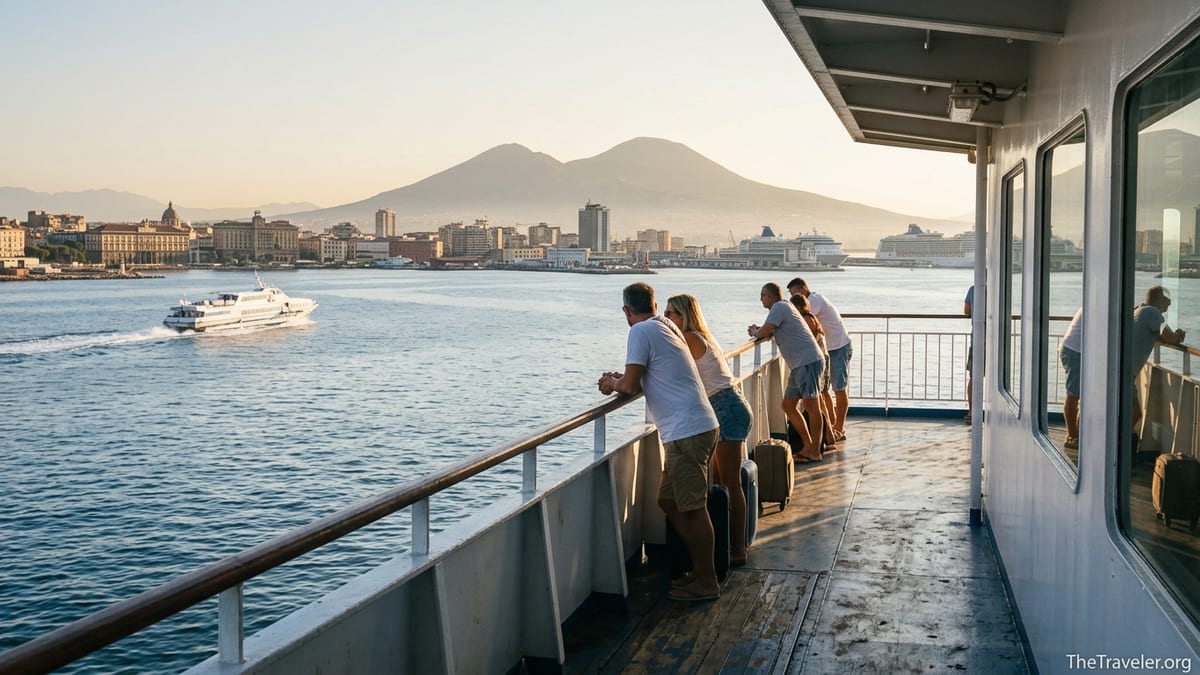
One clear advantage of ferries is space. You can usually choose between interior lounges and outdoor decks, which means ample room to move around, stretch your legs, and enjoy wide views of the bay and the Naples skyline. On a clear day, watching Vesuvius and the city slowly appear on the horizon from the upper deck can be one of the most memorable parts of the journey, something you do not really get behind the windows of a hydrofoil cabin.
Ferries are also the only practical choice if you are bringing a car or scooter to or from Ischia. For instance, a morning Medmar ferry from Ischia Porto to Naples Porta di Massa may accept vehicles and foot passengers, with check-in for cars usually required earlier than for walk-on travelers. If you are continuing a road trip through Campania or heading north along the coast, the ability to disembark with your vehicle in Porta di Massa can be decisive.
Travelers who are prone to seasickness sometimes prefer ferries as well. Larger hulls and a slower speed generally make for a slightly more stable ride, particularly in choppy conditions that can be more noticeable on the faster, lighter hydrofoils. While the Bay of Naples is often calm in summer, spring and autumn storms can occasionally lead to bumpy crossings, and in those cases a conventional ferry may feel more comfortable, even if it adds 20 to 30 minutes to the journey.
Costs, Tickets and Real-World Price Examples
Ticket prices between Ischia and Naples vary by season, company and vessel type, but hydrofoils are usually a bit more expensive than standard ferries. As a broad example, an adult one-way foot passenger fare on a hydrofoil might commonly fall in the range of around 18 to 25 euros, while a foot-passenger ticket on a conventional ferry may start a few euros lower, often in the mid-teens upward, depending on the sailing and how early you book.
Vehicle transport adds a significant extra cost on ferries. Bringing a small car from Ischia to Naples can easily increase the fare into the dozens of euros above the standard passenger price, with different rates for vehicle length, height and season. A family traveling with a compact car at peak summer times can expect to pay substantially more than a solo traveler on foot catching a shoulder-season hydrofoil.
In practical terms, a couple visiting in June without a car might compare a late-morning hydrofoil and a mid-morning ferry and find a price difference of perhaps 3 to 8 euros per person for similar dates. If time is tight before a train from Napoli Centrale, the extra cost for the hydrofoil often feels justified. On the other hand, budget-conscious backpackers with flexible schedules frequently opt for ferries, especially mid-day or evening departures, to save a bit on transport and enjoy time on deck.
Tickets are widely available: you can buy online before travel, through ticket offices at Ischia Porto and Casamicciola, or from agencies and hotel desks that handle ferry bookings. In high season, ferries and hydrofoils can sell out at popular times, particularly on weekends and around Italian holidays such as Ferragosto in mid-August. If you know you must arrive in Naples in time for a specific flight or train, reserving a seat in advance is sensible. For flexible travelers in shoulder season, it is often still realistic to buy on the day, especially earlier in the morning.
Ports and Connections: Molo Beverello vs Porta di Massa
One of the most important differences between ferry and hydrofoil from Ischia to Naples is not on the water at all, but in the city layout when you arrive. Most hydrofoils dock at Molo Beverello, while most conventional ferries use the nearby Porta di Massa. The two areas are side by side in the port of Naples but have distinct terminals, traffic flows and connections to the city.
Molo Beverello sits closer to the heart of tourist Naples. From the pier, you can walk up to Castel Nuovo and Piazza Municipio in a few minutes, then continue along Via Toledo toward the Spanish Quarter. There are taxis waiting near the exit and bus and tram stops just inland from the waterfront. For travelers heading to central hotels or to the cruise terminal for onward voyages, arriving at Beverello feels quick and straightforward, especially if you are rolling a suitcase rather than driving a car.
Porta di Massa is a more industrial-feeling ferry area to the east of Beverello, used mainly by conventional car ferries and cargo. From here, walking to the historic center takes a little longer, and the surroundings are busier with port traffic. However, for anyone traveling with a car, scooter or camper, Porta di Massa is where you disembark. Rental car agencies and major roads out of the city are reachable by a short drive, making it a logical starting point if you are continuing to the Amalfi Coast, Cilento or inland Campania.
Both ports are reasonably connected to Napoli Centrale and Napoli Piazza Garibaldi stations. In typical conditions, a taxi from Beverello to the main station can take around 15 minutes, with a similar estimate from Porta di Massa depending on traffic. If you are catching a Frecciarossa or Italo high-speed service, many travelers allow at least one extra hour between scheduled ferry arrival and train departure to cover potential delays, port congestion and ticketing needs at the station.
Luggage, Comfort and Weather Considerations
Luggage rules differ subtly between ferries and hydrofoils, and they can affect your choice. Hydrofoil operators often include one standard cabin bag or suitcase in the base fare and charge supplements for oversized or extra pieces, especially sports gear like surfboards or unusually large suitcases. Storage space on board is more limited, so boarding with multiple large bags can be awkward, particularly on busy summer sailings.
On ferries, although official policies still apply, the practical experience is usually more forgiving. There is more room in the lounges and on deck, and luggage racks or corners where suitcases can be stowed without blocking aisles. Families with strollers, beach gear and multiple bags often find it less stressful to board a big ferry, settle at a table, and have children move around or nap without feeling confined.
Weather is another factor that can tilt the decision. Hydrofoils can be more susceptible to cancellations or delays in rough seas. In stormy conditions, authorities may suspend fast services even when larger ferries continue to run, as the heavier ships handle waves better. This is more likely outside high summer, such as in late autumn or winter. If you are traveling in March or November and must reach Naples on a specific day, checking forecasts and considering a conventional ferry can be a safer bet.
Comfort preferences also matter. Some travelers love the efficiency of sitting in a modern hydrofoil cabin, working or reading for under an hour until the skyline of Naples appears. Others cherish the slower approach on a ferry, grabbing a coffee at the onboard bar, watching Ischia recede behind them, and photographing Vesuvius as it comes into view. If you are not in a rush, the extra time on a ferry can feel less like transport and more like an inexpensive mini-cruise.
Sample Itineraries: Which Option Fits Your Day?
To see how the choice between ferry and hydrofoil plays out in practice, it helps to imagine a few common travel scenarios. Consider a couple staying in Ischia Porto who have a late-morning flight from Naples Capodichino airport. They might choose an early hydrofoil to Molo Beverello, arriving around 8:30 or 9:00, then take a taxi or airport bus to the terminal. The total journey from hotel check-out to airport security adds up neatly, with minimal waiting around and a comfortable time buffer at the airport.
Now picture a family of four staying near Forio with a rental car. They are ending a week on Ischia and plan to drive down the Cilento coast afterward. For them, a mid-morning Medmar or Caremar ferry from Ischia Porto to Porta di Massa is the logical option. They can load the car with luggage, beach toys and groceries, enjoy an unhurried crossing with space for the kids to move, then drive straight from the port onto the autostrada south, avoiding any need to change transport modes.
A solo traveler with a backpack, flexible timing and a tight budget might look at the day’s schedule and choose a mid-day conventional ferry from Casamicciola or Ischia Porto because it is a few euros cheaper than the nearest hydrofoil and less likely to sell out. That extra 20 or 30 minutes at sea becomes an opportunity to relax, take photos and plan the next steps of their trip. Conversely, a business traveler returning to Naples for a meeting may gladly pay a premium for the fastest hydrofoil, valuing arrival time above all else.
These examples highlight a key point: there is no single "best" choice for everyone. The decision between ferry and hydrofoil from Ischia to Naples usually comes down to a mix of timing, budget, connection plans, weather, luggage and personal comfort priorities. Thinking through your own day step by step is the surest way to see which option genuinely makes more sense.
The Takeaway
On the Ischia to Naples route, both ferries and hydrofoils are reliable, well-established options, but they serve slightly different needs. Hydrofoils are faster, arrive at the more central Molo Beverello, and work best for travelers without vehicles who want to minimize travel time and maximize hours in Naples or onward destinations. Conventional ferries are slower but more spacious, vehicle-friendly and often a touch cheaper, with the added charm of open decks and a more leisurely approach to the city.
If you are catching a specific train or flight, carrying only a suitcase or two, and traveling in good weather, a hydrofoil usually offers the most efficient solution. If you are driving, carrying bulky luggage, prone to seasickness, or traveling in shoulder season when seas may be rougher, a conventional ferry from Ischia to Naples Porta di Massa often makes more sense.
In many itineraries, mixing both can be ideal: for example, arriving on Ischia by ferry with a rental car, then returning later in the week by hydrofoil after dropping the car in Naples. By checking schedules in advance, watching the forecast, and being clear about your own priorities, you can treat the short hop across the Bay of Naples not as a logistical headache but as another memorable piece of your Italian journey.
FAQ
Q1. Is the hydrofoil from Ischia to Naples much faster than the ferry?
The hydrofoil is usually about 20 to 40 minutes faster than a conventional ferry, with typical crossings of roughly 50 to 60 minutes compared with 75 to 95 minutes.
Q2. Which option is better if I have a lot of luggage?
If you have several large bags or bulky items, a conventional ferry is generally more comfortable because there is more space to store luggage and move around on board.
Q3. Can I take my car on the hydrofoil from Ischia to Naples?
No, hydrofoils on this route are passenger-only. If you need to transport a car or scooter, you must book a conventional ferry that accepts vehicles.
Q4. Which port in Naples will I arrive at from Ischia?
Most hydrofoils from Ischia arrive at Molo Beverello, close to the historic center, while conventional ferries usually dock at Porta di Massa, the nearby car ferry terminal.
Q5. Is the ferry cheaper than the hydrofoil?
Foot-passenger tickets on ferries are often slightly cheaper than on hydrofoils, though prices vary by company, season and departure time, so it is worth comparing specific sailings.
Q6. What happens in bad weather?
In rough seas, hydrofoil services are more likely to be delayed or canceled, while larger ferries are sometimes able to continue operating. Always check the latest updates on the day of travel.
Q7. Do I need to book my ticket in advance?
In high season and on weekends, booking in advance is strongly recommended, especially for hydrofoils and for ferries if you are traveling with a vehicle. In quieter periods, same-day tickets are often available.
Q8. Which option is better if I get seasick?
Travelers prone to seasickness often prefer conventional ferries because the larger size and slower speed can feel more stable, especially when the sea is not perfectly calm.
Q9. How early should I arrive at the port before departure?
As a foot passenger, arriving 30 to 45 minutes before departure is usually sufficient. If you are boarding with a car, check-in can be earlier, so follow your ticket instructions.
Q10. Can I sit outside during the crossing?
On conventional ferries you can typically sit on open decks and enjoy the views. On most hydrofoils, seating is indoors only and access to outside areas during navigation is limited or not available.