


More news on this day
Dozens of Italian holidaymakers have found themselves unexpectedly marooned in Bergen after a Norwegian air traffic controllers’ strike forced widespread cancellations, leaving travelers scrambling for beds, rebookings and reliable information.
Get the latest news straight to your inbox!
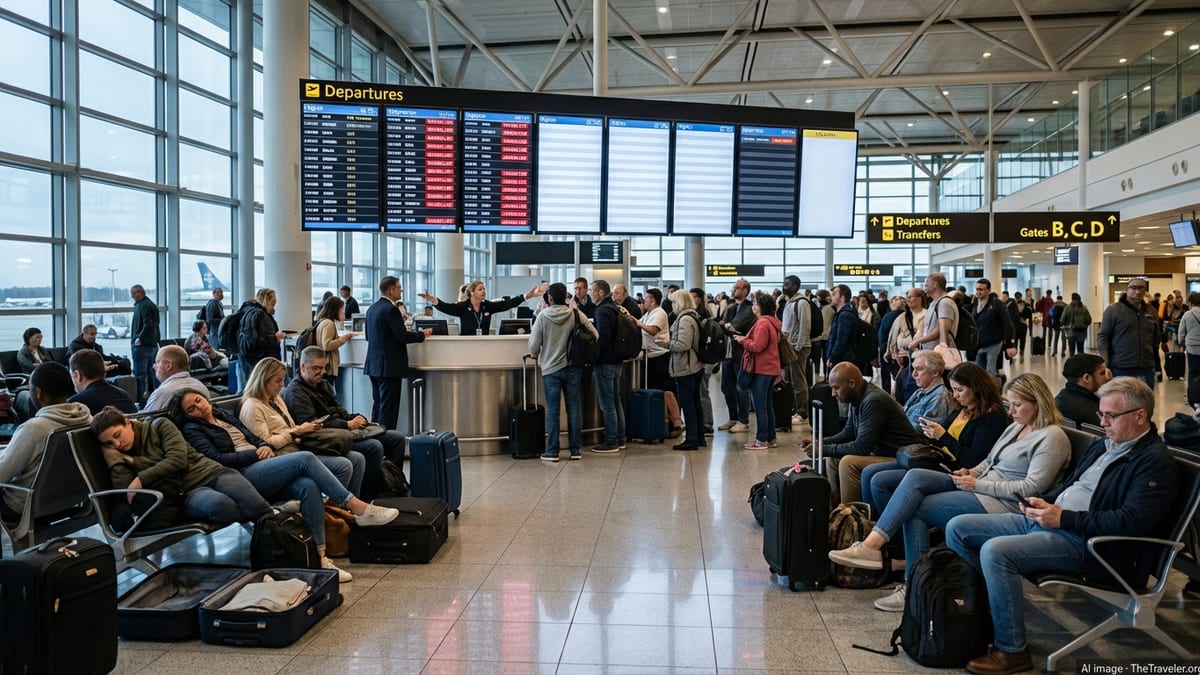
Strike Grinds Bergen Departures to a Halt
The disruption stems from a labor conflict between Avinor Flysikring, which manages air traffic services in Norway, and the Norwegian Air Traffic Controllers Association. Mediation broke down on August 21, triggering a walkout that immediately reduced capacity in Norwegian airspace and forced airlines to trim flight schedules at key hubs including Oslo Gardermoen and Bergen Flesland.
Public information from airport operator Avinor notes that the strike has constrained air traffic control staffing and obliged airlines to adapt traffic levels to the reduced capacity, with safety prioritized above all other considerations. At Bergen Airport, this has translated into a series of cancellations and rolling delays that have rippled across both domestic and international routes.
Travel advisories compiled by Norwegian and international outlets describe a particularly difficult period between August 21 and 26, when cancellations and last-minute schedule changes were concentrated. Bergen, Norway’s second-busiest airport and a primary gateway for fjord tourism, has been singled out as one of the locations hardest hit by the industrial action.
Calendars tracking European strike activity also show Norwegian airspace as affected through the second half of August, reinforcing expectations that disruption would extend beyond a single weekend and complicate return plans for visitors who expected a routine end to their summer holidays.
Italian Holidaymakers Face Mounting Costs
Among those most affected are Italian tourists who chose Bergen as the final stop on itineraries combining fjord cruises, rail journeys and city breaks. According to reporting in Italian media, dozens of Italian citizens have been left stranded at Bergen Airport, many with return flights to cities including Milan, Rome and Venice suddenly removed from departure boards only hours before scheduled take-off.
One detailed account published by an Italian news outlet describes passengers learning of a cancellation less than an hour before departure, followed by a cascade of further scrapped flights over subsequent days. Travelers reported having to fund unexpected hotel nights, meals and local transport on their own while waiting for airlines to offer rebooking options, with some estimating several hundred euros in extra outlay within just a few days.
Independent travel analysis indicates that from August 21 to 24 alone, nearly 250 flights were cancelled across Norway, including multiple services from Bergen to major European hubs and domestic connections that many passengers relied on to reach long-haul departures. For Italian tourists whose itineraries were built around tight connections at hubs such as Oslo, Copenhagen or Amsterdam, a single missed leg frequently unraveled an entire journey home.
With hotel availability in the Bergen area already stretched by the late-summer tourist season, some stranded visitors have reportedly slept on terminal floors or in seating areas. Local coverage and traveler reports suggest that between 300 and 400 passengers had to stay overnight at Bergen Flesland at the height of the disruption, as nearby accommodation filled and alternative transport options proved hard to secure.
Confusion Over Rights and Limited Alternatives
The strike has also highlighted widespread uncertainty among visitors about their rights when industrial action takes place outside the airline itself. Guidance compiled by consumer information sites explains that under European passenger protection rules, strikes by air traffic controllers are generally classified as extraordinary circumstances, limiting entitlement to standard cash compensation for cancellations and long delays.
However, the same guidance stresses that airlines still retain obligations to provide care, including meals, refreshments and, when necessary, hotel accommodation and transport between the airport and place of stay. Publicly available information from Avinor reiterates that carriers are responsible for communicating directly with their customers about schedule changes and rebooking options when capacity is constrained by a strike.
For travelers stranded in Bergen, the practical reality has often been more complex. Accounts shared on travel forums describe long waits to reach airline call centers, uncertainty over which carrier is responsible when journeys involve codeshares, and confusion about whether travel insurance will cover extra nights and rearranged connections. Some passengers report that both airlines and insurers have pointed to the same extraordinary circumstances clause to limit financial support, leaving tourists to shoulder much of the cost.
With rail and long-distance bus alternatives from western Norway to continental Europe limited, overland rerouting has been viable mainly for those able to secure places on domestic flights or ferries to other Scandinavian hubs not as heavily affected at specific times. Even then, reduced airspace capacity has meant that available seats out of Norway were in high demand throughout the strike period.
Key Gateway to the Fjords Under Pressure
The disruption in Bergen has resonated more widely because of the airport’s central role in Norway’s tourism infrastructure. Official descriptions position Bergen Flesland as a major entry point for travelers joining fjord cruises, the popular “Norway in a Nutshell” route and numerous coastal excursions. Several million passengers pass through the terminal each year, many of them during the short summer season when weather conditions are at their most favorable.
Summer schedules typically bring an uptick in direct services between Bergen and Italian cities, reflecting steady growth in Italian interest in Norway’s western fjords. Tourism organizations have noted a rise in Italian visitors combining city stays in Bergen with self-guided road trips and organized cruise packages, making reliable air links at the beginning and end of those itineraries particularly important.
The timing of the strike, falling just as many Italian families and groups were preparing to fly home before the start of the school and work calendar in early September, amplified its impact. Reports from both Norwegian and Italian outlets emphasize that stranded passengers have included multi-generational groups and organized tours, whose logistics become significantly more complicated once group tickets and transfers need to be reissued.
As operations gradually normalize following the end of the walkout, Bergen Airport faces continued pressure to clear backlogs, handle rebooked passengers and keep new delays to a minimum. Public updates from Avinor encourage travelers to check departure information frequently, warning that knock-on effects can persist even after industrial action has formally concluded.
What Travelers Can Do Next
For Italians and other foreign tourists still trying to leave Bergen, the immediate priority is to confirm new travel plans directly with airlines. Carriers serving Norway are advising passengers to use mobile apps and official websites to track real-time changes, request rebookings and, where systems allow, reroute themselves via alternative hubs or dates when more seats are available.
Consumer information services recommend keeping records of all additional expenses incurred during the disruption, including receipts for accommodation, meals and local transport. While eligibility for reimbursement depends on ticket conditions, the cause of the disruption and any applicable insurance policy, thorough documentation increases the chances of recovering at least part of the outlay once claims are processed.
Prospective visitors to Norway in the coming weeks are being urged by travel advisories to monitor developments in the labor dispute and to build more flexibility into their itineraries, particularly for journeys that require tight connections or link to cruises and package tours. Guidance from Avinor on dealing with airport strikes underscores the benefit of checking flight status before leaving for the airport and staying closely informed as conditions evolve.
For now, the experience of Italian tourists trapped in Bergen illustrates how quickly a localized labor dispute can cascade through Europe’s tightly connected air network, straining passenger support systems and leaving travelers reliant on a patchwork of airline policies, insurance cover and personal resources to find their way home.
https://www.avinor.no/en/airport/bergen/
https://om.avinor.no/en/Articles/How-to-act-during-a-strike-at-the-airport/