


The Italian codice fiscale is a fundamental identifier within Italy’s administrative and fiscal systems. For foreign nationals evaluating a relocation, long stay, property purchase or employment in Italy, understanding what the codice fiscale is, when it is required and how to obtain it is essential for planning. This briefing explains the structure and function of the codice fiscale and outlines the practical acquisition routes available to foreigners in 2025–2026.
What the Codice Fiscale Is and Why It Matters for Foreigners
The codice fiscale is Italy’s personal tax identification number, issued by the Agenzia delle Entrate, the Italian Revenue Agency. For individuals it consists of 16 alphanumeric characters generated from personal data such as surname, name, date of birth, gender and place of birth. For entities such as companies it takes the form of an 11-digit numeric code. While conceptually similar to social security or national insurance numbers in other countries, it is used far more broadly in everyday administration in Italy.
The codice fiscale is required to interact with many public and private bodies. Typical situations where a foreign national will be asked for a codice fiscale include signing a residential lease, opening a bank account, registering for utilities, being hired by an Italian employer, filing Italian tax returns, enrolling at a university, accessing parts of the public health system, or purchasing and registering real estate. In many systems it serves as the primary identifier instead of a passport number.
From a relocation-planning perspective, the key point is that a codice fiscale is not in itself proof of residence, immigration status or tax residency. It is simply an identifier in the tax registry. A person can hold a codice fiscale without living in Italy and without having an Italian residence permit, and conversely a person can be physically present in Italy for a short period without needing or obtaining a codice fiscale in some limited scenarios.
The tax code is permanent and does not normally change over the course of a lifetime. Once allocated, the same codice fiscale is used regardless of changes in address, employment or residence status. Only in narrow situations, such as a legal change of name or recognition of different personal data, is a new code issued. This permanence simplifies later interactions: foreigners who obtained a codice fiscale for study or property purchase can typically reuse the same number if they later move to Italy as residents.
How the Codice Fiscale Is Structured
The standard 16-character codice fiscale for individuals encodes basic biographical information. Although there are many unofficial online generators, the only legally valid code is the one actually issued by the Agenzia delle Entrate. For foreign-born individuals, part of the code reflects the country of birth instead of an Italian municipality code, which is a technical detail that can be relevant when checking that a code has been correctly issued.
In overview, the structure is as follows: three letters from the surname, three letters from the first name, two digits for the year of birth, a letter representing the month, two digits for the day of birth (with 40 added for females), a four-character place-of-birth code, and a final check character. For people born abroad, that four-character code begins with the letter “Z” followed by three digits representing the state or territory of birth. This design helps the tax authority and other systems distinguish between Italian and foreign birthplaces when validating records.
For practical relocation decisions, the internal logic of the code matters less than recognizing that inconsistencies in name spelling, date of birth or place-of-birth details can lead to mismatches between a person’s current documents and the data used to generate the codice fiscale. If a foreigner later changes name or acquires Italian citizenship with an Italianized version of their name, the Agenzia delle Entrate may need to update records or, in some cases, issue a revised code to align with the new official identity.
Because the code is derived from personal data, cases of homonymy can occur, where two different people would theoretically share the same code. The tax authority uses internal disambiguation mechanisms when assigning codes to avoid duplication. This is another reason why unofficial generators are not a substitute for obtaining an officially issued tax number, particularly for foreigners whose data patterns may be more prone to collisions.
Key Situations Where Foreigners Need or Do Not Need a Codice Fiscale
Foreign nationals often assume that any interaction with Italian authorities automatically requires a codice fiscale, but regulatory practice is more nuanced. Italian guidance and court decisions have clarified that in some limited circumstances non-resident foreigners can complete certain acts without an Italian tax code, particularly where they remain fully identifiable through foreign identifiers and do not enter into ongoing taxable relationships in Italy.
Typical situations where a codice fiscale is routinely required for foreigners include: long-term residential leases in Italy, long-stay employment with an Italian employer, registration with the national health service where eligible, opening of Italian bank accounts and investment accounts, purchase of real estate or vehicles with registration in Italian registries, and most formal contracts with Italian public bodies. Universities and many private landlords also now expect foreign students or tenants to provide a codice fiscale as part of standard onboarding, even when regulations theoretically allow some flexibility.
Conversely, there are circumstances where a codice fiscale may not be strictly mandatory. Recent clarifications from the revenue agency have indicated that non-resident foreigners do not always need a codice fiscale to register certain private contracts such as some types of leases if they are identified through other means and remain non-resident. Similarly, a 2024 decision of the Court of Cassation removed the requirement for some non-resident foreigners to obtain a codice fiscale solely in order to access legal aid in specific citizenship proceedings, emphasizing proportionality between bureaucratic demands and actual tax relevance.
For relocation planning, the functional takeaway is that anyone intending to live, work, study long term, own property or operate a business in Italy should assume that obtaining a codice fiscale early is prudent and in many cases unavoidable. Those interacting with Italy only marginally or for one-off procedural acts might be able to proceed without a code, but they should be prepared for institutional practices that often still request it as a matter of routine administration.
Main Channels for Foreigners to Obtain a Codice Fiscale
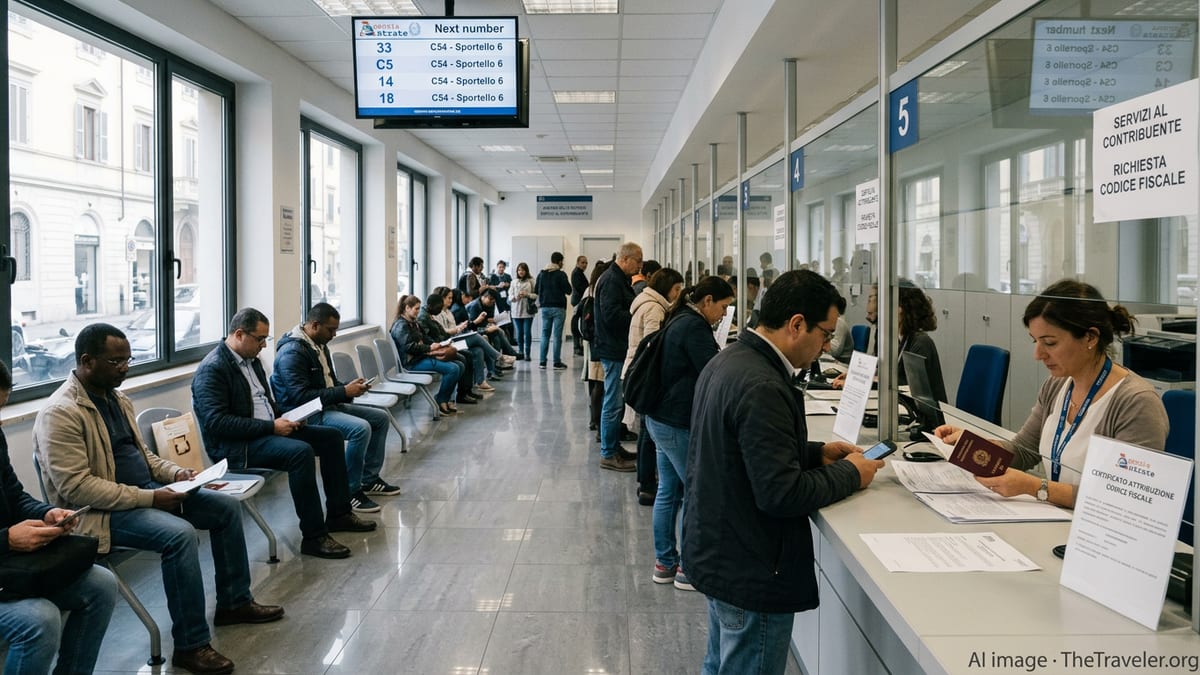
Foreigners can obtain a codice fiscale through several channels, depending on whether they are already in Italy and on their immigration pathway. The primary authority is always the Agenzia delle Entrate, but other offices act as front desks that transmit data to the tax registry and issue the number on its behalf. For many relocation scenarios, the most direct route remains applying in person at a local office of the Agenzia delle Entrate within Italy.
At an Agenzia delle Entrate office, non-resident foreigners typically submit a standardized application form, a valid passport or national identity card, and in some cases evidence of address or purpose (for example, a draft lease, an employment offer or enrollment documents). In the majority of cases the office can issue the codice fiscale immediately, either printing a certificate on security paper or providing a standard printout. Recent practice reported by relocation providers and Italian legal portals suggests that same-day issuance is common where documentation is complete and there are no data mismatches.
For foreigners entering Italy on specific immigration channels, other offices are involved. The single immigration desks and police headquarters handling residence permits can request and assign a codice fiscale as part of the permit issuance process for those who do not already have one. This route is particularly relevant for non-EU nationals arriving with work, family reunion or study visas, who may receive their tax number automatically when applying for or collecting their first residence permit.
Some universities and international student offices also coordinate collection of applications for a codice fiscale from admitted foreign students and forward them to the tax agency. In parallel, Italy’s digitization efforts have expanded remote channels: selected users can submit requests via email or certified email to designated revenue offices, attaching identity documents and application forms. However, the availability and speed of these remote procedures vary by region, and rules are adjusted periodically as the tax authority refines its online services.
Role of Embassies, Consulates and Online Portals
Traditionally, Italian embassies and consulates have played an important role in issuing codici fiscali to both Italian citizens abroad and foreign nationals who need a tax number before traveling. Consular websites in different countries describe the local process, which usually involves submitting an application form, passport copy and occasionally supporting justification by email or appointment. In some cases the consular office obtains the tax code from the Agenzia delle Entrate and sends a digital certificate by email as a PDF.
Over the last two years, however, patterns have shifted. Multiple consular notices and informal reports indicate a general trend of limiting codice fiscale issuance to Italian citizens or to foreign nationals who can demonstrate that they cannot reasonably apply directly to the Agenzia delle Entrate in Italy. Some consulates now explicitly state that non-resident foreigners who simply plan to study or reside in Italy should obtain their codice fiscale on arrival rather than via the consulate, with exceptions only for specific categories such as pension procedures or online-only administrative processes.
Parallel to this consular retrenchment, Italy’s digital platforms are increasingly linked to codice fiscale generation. For example, international student portals used for pre-enrollment, such as those coordinating university admissions, can automatically generate a codice fiscale during the application process for foreign applicants who do not already have one, transmitting their data to the tax authority. In these cases, the student may receive confirmation of their tax code electronically before arriving in Italy, reducing the need for a separate consular or in-person request.
For relocation assessment, this evolving context means that foreign nationals should not assume that a local Italian consulate will issue a codice fiscale on demand. Instead, they should verify current consular policies well ahead of time and be prepared to either obtain the tax code through digital admission platforms (if applicable) or at an Agenzia delle Entrate office or immigration desk after entering Italy. Professional intermediaries such as tax advisers or patronato offices can sometimes act on a foreigner’s behalf via power of attorney where personal attendance is impractical.
Practical Requirements, Processing Times and Documentation
While procedures can vary between offices, practical experience and official guides indicate that the core documentation to obtain a codice fiscale as a foreigner is relatively straightforward. Typically, applicants must present a valid identity document (passport for non-EU nationals, national identity card for EU citizens), a completed application form containing accurate biographical data, and, when applying as a resident, supporting evidence of their Italian address or residence status. For non-resident applicants, proof of the specific need for a codice fiscale might be requested, such as preliminary property purchase documentation or an employment offer.
Processing times depend heavily on the channel used. In-person applications at Agenzia delle Entrate counters are often processed while the applicant waits, with the codice fiscale assigned and printed on the spot. When applications are submitted via email or through institutional intermediaries such as universities or consulates, issuance typically takes several working days to a few weeks, depending on backlogs and the completeness of documentation. Recent mini-guides from universities suggest that students applying through coordinated procedures should expect processing in the range of one to two weeks.
The document issued at first allocation is usually a paper or digital certificate rather than the plastic health card commonly associated with resident taxpayers. The certificate contains the 16-character codice fiscale and a machine-readable code. For most immediate relocation needs, this printed or digital certificate is sufficient to open bank accounts, sign leases and complete other initial procedures. The plastic card, where applicable, is typically produced later and linked to enrollment in the national health system or residence registration.
Foreigners should maintain consistency in the personal data provided across all Italian procedures. Small discrepancies in spelling, the order of given names or date formats can cause mismatches between the codice fiscale held in tax records and the data used by other offices such as municipalities or universities. Correcting such inconsistencies later usually requires contacting the Agenzia delle Entrate with supporting documents, which can add delays at a critical moment of settlement.
Common Issues, Changes and Validation of Codice Fiscale
Foreigners sometimes encounter practical obstacles when requesting or using a codice fiscale. One recurring issue is inconsistent implementation of central guidance by local offices. While regulations allow non-resident foreigners to obtain a codice fiscale without holding an Italian residence permit, some local branches of the Agenzia delle Entrate may incorrectly insist on proof of residence or a tax residency link, leading to confusion. In these cases, presenting the official forms and calmly clarifying that the request is being made as a non-resident can help.
Another area of difficulty is the evolving role of consulates. As several consular districts have restricted issuance of codici fiscali to foreign nationals, some applicants who previously would have obtained their tax number before travel now need to adjust expectations and plan for in-country issuance instead. For those tied to time-sensitive property transactions or university matriculation deadlines, this shift requires careful timing of appointments or reliance on institutional intermediaries that have established channels with the tax agency.
Validation of existing codes has also become more structured. The Agenzia delle Entrate provides online tools and periodic bulk-verification services that allow institutions and professionals to confirm that a codice fiscale corresponds to the personal data provided and is active in the registry. For individual foreigners, the practical advice is to keep a copy of the original certificate and to check that the code used by banks, employers and universities matches the official one. If errors are identified, requesting rectification early reduces the risk of downstream problems with tax filings or social security contributions.
Recent years have seen incremental digitalization of tax registry services, including experimental online procedures for specific events such as the allocation of a codice fiscale to newborns. While these developments currently affect Italian residents more directly than non-resident foreigners, they signal a broader shift toward electronic document exchange and remote identity verification. Over time, this may make it easier for foreigners to apply for and manage their codice fiscale without repeated in-person visits, but implementation remains heterogeneous across regions.
The Takeaway
For foreign nationals evaluating relocation or significant economic engagement with Italy, the codice fiscale is a foundational element of practical feasibility. It is not a visa, residence permit or tax residency status, but a prerequisite identifier for most structured interactions with Italian institutions and private service providers. Obtaining it is a discrete step within the broader relocation process, yet one that can unlock or block critical milestones such as signing a lease, opening a bank account or accessing certain public services.
From a planning perspective, prospective movers should map at what stage their specific projects will require a codice fiscale and through which channel they are most likely to obtain it efficiently: immigration procedures, university enrollment, in-person application at an Agenzia delle Entrate office, or, in limited cases, through an Italian consulate. They should also factor in realistic processing times and potential inconsistencies between local practices and central guidelines, particularly during peak seasons for student arrivals or property transactions.
Maintaining accurate, consistent personal data and safeguarding the original tax code certificate are important risk controls. Once issued, the codice fiscale will accompany a person for the duration of their relationship with Italy’s fiscal and administrative systems, whether as a temporary student, long-term resident, property owner or cross-border investor. Understanding its role and acquisition pathways in advance reduces uncertainty and supports informed decisions about whether and how to proceed with relocation to Italy.
FAQ
Q1. Do I need a codice fiscale before I move to Italy?
In many cases it is not strictly mandatory before arrival, but you will need a codice fiscale soon after entering Italy to sign a long-term lease, open a bank account, start employment or enroll at university. Some consulates may issue it in advance, but increasingly foreigners obtain it upon or after arrival through the Agenzia delle Entrate or immigration desks.
Q2. Can I get a codice fiscale without an Italian residence permit?
Yes. Non-resident foreigners can usually obtain a codice fiscale directly from the Agenzia delle Entrate by applying as non-residents with a valid passport and a clear reason for needing the code, such as study, property purchase or future residence. A residence permit is not inherently required for issuance.
Q3. How long does it take to get a codice fiscale in Italy?
When applying in person at an Agenzia delle Entrate office with complete documentation, the codice fiscale is often issued on the same day. Applications submitted via email, consulates or institutional intermediaries can take from several working days up to a few weeks, depending on workload and local procedures.
Q4. Is the codice fiscale the same as a residence permit or tax residency status?
No. The codice fiscale is only an identification code within the Italian tax registry. It does not prove legal residence, immigration status or tax residency. Those aspects are governed by separate rules and documents, although all of them may reference the same codice fiscale as an identifier.
Q5. Can my codice fiscale change if my name or nationality changes?
In most cases the codice fiscale remains the same for life. However, if there is a legally recognized change of name, date of birth or other key personal data, the Agenzia delle Entrate may need to update records and in some situations issue a revised code to ensure consistency.
Q6. Do all Italian consulates still issue codici fiscali to foreigners?
No. Practice varies. Some consulates now limit issuance primarily to Italian citizens or to specific categories of foreign applicants who cannot apply in Italy. Foreign nationals should consult the current instructions of the consulate responsible for their area and be prepared to obtain the codice fiscale in Italy if consular issuance is restricted.
Q7. Is an online “codice fiscale generator” valid for official purposes?
No. Online generators may approximate the structure of a codice fiscale, but only the code actually issued by the Agenzia delle Entrate is legally valid. Generated codes can be useful for simulations or initial registrations but must be replaced with the official code once it is assigned.
Q8. What document will I receive when my codice fiscale is issued?
Typically you receive a paper or digital certificate stating your 16-character codice fiscale and related data. For most administrative purposes this certificate is sufficient. In some cases, especially for residents enrolled in the health system, a plastic card incorporating the tax number is issued later.
Q9. Can a lawyer, tax adviser or other representative obtain a codice fiscale for me?
Yes, in many situations a professional representative or specialized assistance center can apply on your behalf with a power of attorney, particularly for property transactions or when distance makes personal attendance difficult. Requirements for delegation and accepted documentation can vary between offices.
Q10. What should I do if I suspect my codice fiscale is incorrect or duplicated?
If there is a mismatch between your personal data and the code in use, or if institutions flag a potential error, you should contact the Agenzia delle Entrate with your identity documents and any relevant certificates. The office can verify the record, correct data and, if necessary, issue an updated certificate or code to resolve the issue.