


More news on this day
U.S. Thanksgiving air travelers facing packed airports this week now have updated data on which domestic airlines historically run late during the holiday, with a new analysis of federal records showing JetBlue, Allegiant and Frontier at the back of the pack for on-time performance between 2021 and 2025, and Delta at the front despite suffering a major technology outage on November 22, 2026.
Get the latest news straight to your inbox!
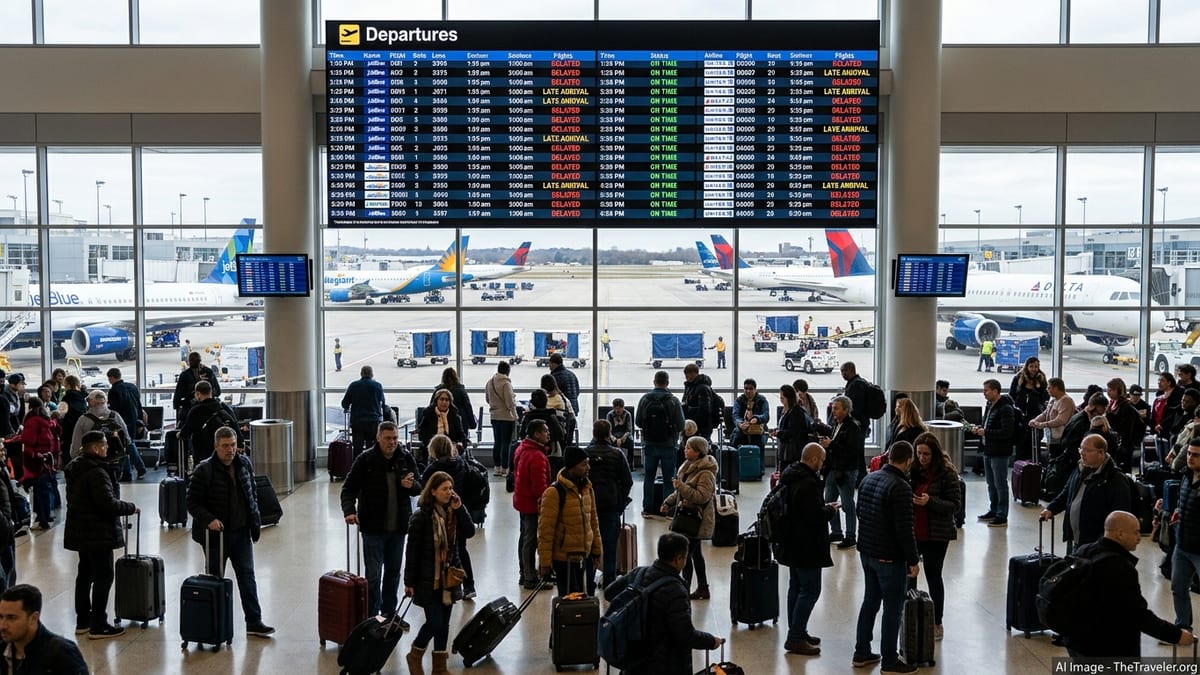
What the new Thanksgiving delay rankings actually measure
The latest rankings come from coupon and deal site CouponFollow, which examined U.S. Bureau of Transportation Statistics on-time performance data for Thanksgiving travel periods from 2021 through 2025. Researchers isolated a defined Thanksgiving window running from the Saturday before the holiday through the Sunday after it, then calculated how many flights on each large domestic carrier arrived at least 15 minutes behind schedule, the standard federal definition of a delay.
Across that five-year sample, JetBlue recorded the highest proportion of delayed flights during the Thanksgiving window, with 28.2 percent of its services arriving late. Allegiant followed at 27.4 percent, and Frontier at 26.5 percent, according to the CouponFollow analysis of Bureau of Transportation Statistics records. The study focused on large U.S. carriers and did not combine these figures with those of regional or ultra-small operators, which means the percentages apply specifically to the airlines named rather than to the entire U.S. network.
At the other end of the table, Delta Air Lines recorded the lowest share of delayed Thanksgiving flights, just under 14 percent across the same 2021 to 2025 period. Other major network carriers, including American Airlines and United Airlines, fell in between these two extremes, with roughly one in five flights arriving late in some recent holiday periods, based on federal data for November and December 2025. Those intermediate figures provide important context for travelers: while some airlines have clearly performed better than others, no large carrier consistently delivered a completely disruption-free Thanksgiving week.
How airline performance compares with wider holiday disruption
The CouponFollow numbers align broadly with separate analyses of Bureau of Transportation Statistics data published this week by news organizations that examined November and December 2025 performance, including the Thanksgiving and Christmas peaks. One such analysis found that nearly one quarter of all U.S. flights during those two months arrived at least 15 minutes late, underscoring that holiday disruptions are a system-wide issue rather than a problem confined to a few low-cost carriers.
In that broader view, JetBlue, Allegiant and Frontier still rank among the more delay-prone airlines around the holidays, while Delta remains one of the strongest performers overall. The same federal data also show that the causes of delays vary, with airline-controlled issues, such as crew scheduling, maintenance and late-arriving aircraft, responsible for a significant share of delay minutes in some regional markets. Weather, air traffic control constraints and security issues account for the rest, which means even carriers with comparatively strong records can experience difficult days when storms or infrastructure problems hit at the wrong time.
For Thanksgiving specifically, Transportation Security Administration checkpoint data highlight how concentrated the pressure has become. The agency’s historical counts show that the Wednesday before Thanksgiving and the Sunday after are regularly among the busiest days of the year at U.S. airport security checkpoints, with daily passenger volumes surpassing 3 million on the Sunday after Thanksgiving in 2025. That intensity magnifies the impact of any airline- or system-level problem: a disruption affecting a few hundred flights can quickly ripple into missed connections and crowded terminals when terminals and runways are already operating at or near capacity.
Delta’s November 22, 2026 tech outage and what it changes
While Delta’s long-run Thanksgiving performance has been comparatively strong, this year’s holiday travel period opened with a reminder that even the best-ranked airlines are vulnerable to operational shocks. On Sunday, November 22, 2026, Delta experienced a technology outage affecting the automated system it uses to calculate aircraft weight and balance figures before departure. The airline temporarily halted departures and imposed delays across its network while the issue was addressed, with a particular impact on flights into and out of its largest hub at Hartsfield-Jackson Atlanta International Airport.
By Sunday evening, flight-tracking services reported that more than half of Delta’s scheduled flights for the day had been delayed, with estimates ranging from around 2,000 to more than 2,100 delayed services globally and several hundred cancellations. While figures vary slightly by source and methodology, all of the major tracking providers indicate that the outage affected a substantial portion of the airline’s network for several hours. Delta said the problem was resolved later on Sunday and stated that there was no indication of a cyberattack, but the carrier continued to deal with knock-on delays and cancellations into Monday, November 23, as aircraft and crews were repositioned.
This incident follows a separate Federal Aviation Administration communications failure on November 13, 2026 that triggered a rare nationwide ground stop, and a United Airlines system outage on November 16 that led to its own wave of delays. Regulators and industry groups have highlighted these episodes as examples of the strain on aging aviation IT infrastructure. For travelers, the practical implication is that historical on-time performance data, including Delta’s relatively strong Thanksgiving week record up to 2025, do not fully capture the risk of technology-driven disruptions that can affect even the highest-ranked carriers.
How travelers should interpret the “worst airlines” label
The CouponFollow study provides a focused look at past Thanksgiving performance for a handful of large domestic airlines, but it has limitations that travelers should keep in mind when making decisions. The rankings reflect averages across five holiday weeks from 2021 through 2025 and do not include data for the current 2026 Thanksgiving period, which is still unfolding. They also rely solely on arrival punctuality and do not attempt to measure other aspects of reliability such as cancellation rates, mishandled baggage, customer service response times or the speed with which airlines recover after major disruptions.
Furthermore, delay percentages do not reveal the typical length of each delay, the specific airports most affected or the reasons behind the performance gaps. For example, low-cost carriers like Allegiant and Frontier often operate thinner schedules with fewer daily frequencies on a given route. That model can make it harder to absorb irregular operations when weather or airspace constraints force changes, because there are fewer alternative flights on the same airline to accommodate disrupted passengers. Network carriers, by contrast, have denser schedules at their hubs and may be better able to rebook travelers when things go wrong, even if that flexibility sometimes comes with higher fares.
Another contextual factor is that holiday-week travel volumes and weather patterns change from year to year. AAA forecasts and airport projections for 2026 suggest that slightly fewer Americans are expected to travel for Thanksgiving this year compared with 2025, ending a recent run of record-breaking holiday volumes, but daily passenger counts are still expected to exceed 2.5 million at TSA checkpoints on the peak days. At the same time, forecasters are tracking storms that could affect parts of the country during the outbound and return rushes. These variables mean that an airline that performed relatively well in past years could still experience a difficult Thanksgiving if weather systems align unfavorably with its network this week.
What Thanksgiving flyers can do now
With this year’s peak travel days approaching, the most practical use of the new rankings is as one input among many rather than as a definitive checklist of which airlines to avoid. Travelers who have not yet booked may wish to weigh an airline’s historical Thanksgiving performance alongside schedule convenience, fare levels and the availability of alternative flights if something goes wrong. In some markets, choosing a carrier with more daily departures on a route can be as important as picking the airline that has performed marginally better in government delay statistics.
For those already holding tickets, real-time monitoring matters more than multi-year averages. Airlines including Delta, JetBlue and others provide app and text notifications about schedule changes, and the Federal Aviation Administration and major airports publish up-to-date delay information that can help travelers anticipate congestion. After the November 22 Delta outage, the airline advised customers traveling in the days that followed to check flight status frequently and offered flexible rebooking for certain affected itineraries, illustrating how responses can evolve in the hours and days after a major disruption.
Looking ahead to the rest of the Thanksgiving window in 2026, travelers can also prepare for delays regardless of airline by allowing extra connection time where possible, scheduling important events several hours after planned arrival times and considering earlier departures on peak days such as the Wednesday before Thanksgiving and the Sunday return. While the latest Bureau of Transportation Statistics data and the CouponFollow analysis provide a clearer picture of which airlines have struggled most often in recent Thanksgiving periods, this year’s combination of heavy demand, recent infrastructure outages and potential weather issues means that flexibility and up-to-date information will be just as important as the choice of carrier in determining who makes it to the holiday table on time.