


More news on this day
A powerful storm forecast for the Eastern U.S., flooding threats along the Pacific Coast and lingering fallout from recent airline technology outages are set to collide with one of the year’s busiest travel periods, raising the risk of delays and cancellations for millions of Thanksgiving travelers across the United States this week.
Get the latest news straight to your inbox!
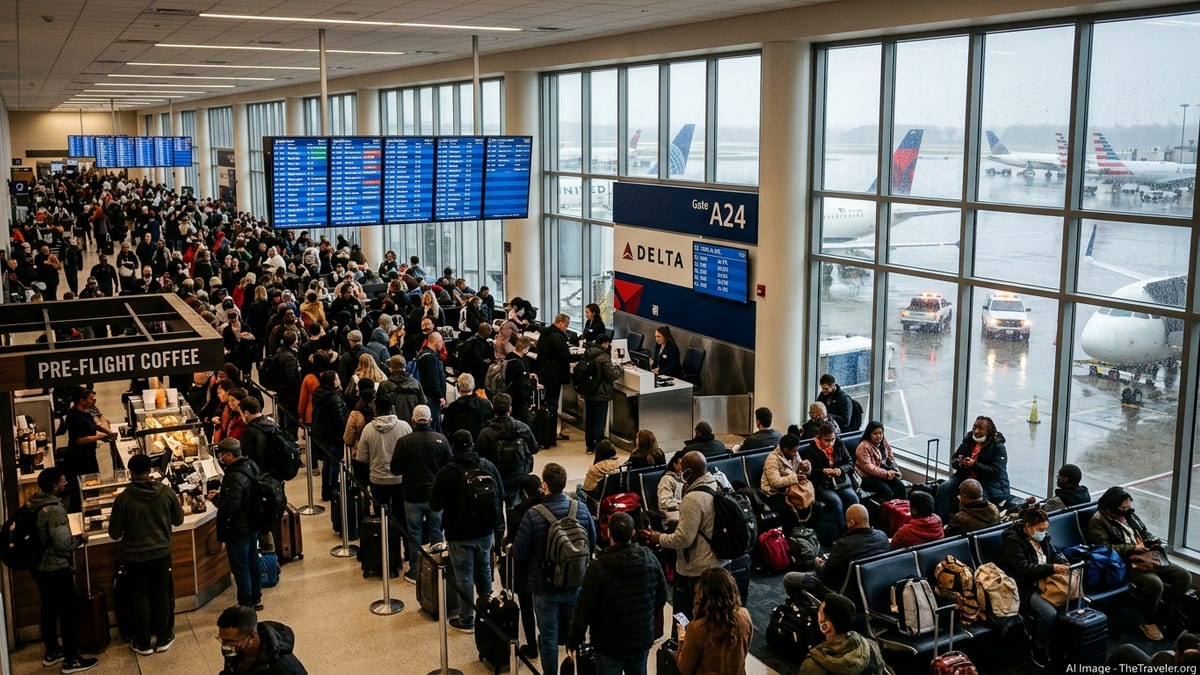
Holiday travel volumes stay high despite slight dip from last year
AAA expects about 81.5 million people in the United States to travel at least 50 miles from home during the 2026 Thanksgiving period from Tuesday, November 24 through Monday, November 30. That projection is slightly below 2025 levels, ending a three-year run of record Thanksgiving travel, but still represents one of the busiest holiday weeks on record. The vast majority of those trips are expected to be by car, with roughly 73 million travelers driving, while millions more will fly or take buses, trains and cruises.
The forecast reflects a modest cooling in demand after several years of strong growth, which AAA and other analysts link partly to higher overall travel costs and broader affordability concerns. Even with that easing, airports are preparing for near-peak passenger numbers. The Transportation Security Administration typically screens more than 2 million passengers a day over the Thanksgiving period, and advance booking data from major carriers indicate that this year will be similar. Travelers should therefore expect crowded terminals and full flights even before weather and operational issues are factored in.
Travel patterns within the week remain familiar. Traffic data provider INRIX, which works with AAA, expects the heaviest road congestion on Tuesday, November 24 and Wednesday, November 25, and again on Sunday, November 29 and Monday, November 30, when many people return home. At major airports around Washington, New York, Atlanta, Chicago and Los Angeles, operators are warning of peak crowds on the same days. That timing is significant because several of the most disruptive weather systems are forecast to overlap with these high-volume windows.
Storms on both coasts raise risk of delays on roads and in the air
Weather models point to an active pattern for much of the continental United States during the Thanksgiving period, with storms expected on both coasts and another system likely during the return-travel window. Forecasters at The Weather Channel and other outlets say multiple low-pressure systems will move across the country, bringing rain, mountain snow and high winds that could affect driving conditions and flight operations at key hubs. A large storm developing in the Southeast is expected to track up the East Coast, taking on some characteristics of a classic nor’easter and impacting travel before, during and after Thanksgiving Day.
Along the East Coast and in parts of the Midwest, this storm is forecast to deliver heavy rain, gusty winds and pockets of wintry weather. AccuWeather expects significant rain along much of the Interstate 95 corridor, with snow more likely in interior parts of the Appalachians, northern New England and around the eastern Great Lakes. Strong winds along the Northeast coast could disrupt ferry services and contribute to delays at airports from Washington and Baltimore through New York and Boston. Forecasters caution that even locations that stay mostly dry can still experience air travel disruptions if aircraft and crews are delayed by bad weather elsewhere in the network.
On the opposite side of the country, the Pacific Coast is facing a different but related set of challenges. A series of disturbances combined with higher-than-usual astronomical tides is expected to produce moderate to locally major coastal flooding from Washington state down to Southern California early in the week. National Weather Service offices have highlighted the potential for “king tides” to inundate low-lying coastal roads and parking areas, which could affect access to smaller airports, ports and seaside destinations. Mountain passes in the West are projected to see periods of snow, which may slow driving and, at higher elevations, temporarily close routes if snowfall is heavier than expected.
Recent nationwide ground stop and airline outages add operational strain
The weather challenges come on the heels of a series of significant aviation technology problems that have already tested the resilience of the U.S. air travel system this month. On Friday, November 13, the Federal Aviation Administration ordered a rare nationwide ground stop for departures after a communications issue affected multiple air traffic control centers. According to a briefing compiled for Congress, more than 12,000 flights were canceled that day, including over 9,000 major airline flights, and disruptions continued into the weekend as airlines repositioned aircraft and crews.
While the FAA traced the initial disruption to overloaded network equipment in its aging communications infrastructure, officials and independent analysts have emphasized that the routers and associated vendor hardware functioned as designed. Instead, the incident underscored broader concerns about the reliance on decades-old systems with limited redundancy and the difficulty of updating critical infrastructure without creating new vulnerabilities. A number of industry and policy reports in the past week have pointed to this outage, along with other recent digital failures in sectors such as email and banking, as evidence that complex, interdependent systems can fail in unexpected ways with wide-reaching effects.
Individual airlines have also experienced separate outages since the FAA event. United Airlines reported a brief but disruptive system failure on November 16 that affected fewer than 150 flights across the country, causing delays but relatively few cancellations. On Sunday, November 22, Delta Air Lines faced a more visible issue when an automated system used to calculate aircraft weight and balance before takeoff malfunctioned, temporarily halting departures in parts of its network, including at its major hub in Atlanta and at Boston Logan International Airport. Local reports from Boston cited around 100 delayed Delta flights at Logan alone, though the airline said it resolved the problem later that day and that operations had largely recovered by Monday.
Carriers and the FAA say they do not expect these earlier outages to continue directly into the peak Thanksgiving travel days, and normal schedules were reported across most major hubs by Monday, November 23. However, the incidents reduce the margin for error. Crews and aircraft have less flexibility when schedules are already tight, and any new disruption caused by weather, air traffic volume or additional technical problems could more easily ripple through the system. Industry groups have used the events to renew calls for additional investment in both federal and airline technology, but those long-term discussions will not provide immediate relief for travelers this week.
How the forecast intersects with specific regions and travel modes
The impact of this week’s combination of storms and system strains will vary considerably by region and travel mode. Drivers in much of the central United States, including large sections of Texas and the lower Mississippi Valley, may see relatively favorable conditions, with only periods of rain in the early part of the week. For example, forecasters around Dallas are calling for some showers on Tuesday followed by clearer skies, which should help traffic flow at Dallas–Fort Worth International Airport and on regional highways. In contrast, routes across the interior West and northern Rockies could see intermittent snow and icy patches, especially on mountain passes, which will slow road travel even if those areas avoid the worst of the coastal flooding and wind.
In the East, the timing of the main storm system is crucial. Current forecasts suggest that the heaviest rain and strongest winds will arrive for many locations on Thanksgiving Day itself or into Friday, rather than peaking on the busiest outbound days. Meteorologists and transportation officials note that this may be a relative “silver lining” for travelers who are leaving earlier in the week, since Tuesday and Wednesday could see fewer major weather-related delays than if the system had arrived 24 to 48 hours earlier. However, those who plan to drive or fly on Thanksgiving Day, Friday or over the weekend should prepare for a greater risk of slower journeys and schedule disruptions, especially in the Northeast corridor and parts of the Midwest.
Rail and bus services are also monitoring conditions closely. Long-distance trains and intercity bus lines typically experience strong demand over Thanksgiving, and both can be affected by heavy rain, snow and high winds that slow operations or require re-routing. Coastal flooding in the Pacific Northwest and California could temporarily affect tracks and roadways close to the water, while snow and ice in the Northeast and interior regions can lead to reduced speeds for safety reasons. Operators generally encourage passengers to sign up for service alerts and to check schedules on departure days, since changes are often made on shorter notice during active weather events.
What travelers should watch in the coming days
For travelers who have not yet departed, the key variables over the next several days will be the exact track and intensity of the main East Coast storm, the evolution of Pacific coastal flooding, and any new operational issues within airlines or the air traffic control system. Forecasts from major weather providers will continue to be updated multiple times per day as new data come in, which can shift the expected timing of rain, snow and high winds by several hours in either direction. That means a flight that currently appears to depart ahead of the worst conditions could find itself operating directly into them if the system speeds up, and vice versa.
Authorities and travel organizations are not currently advising widespread changes to Thanksgiving plans based solely on the weather outlook or recent outages. Instead, they emphasize preparation and flexibility. Travelers are being urged to monitor airline apps and airport websites for real-time status updates, consider earlier departures on particularly busy days, and build additional time into connections and surface transfers where possible. Those driving are advised to check state and local transportation alerts, especially in areas that may experience coastal flooding, mountain snow or strong crosswinds, and to adjust departure times to avoid the heaviest traffic windows identified by INRIX and similar services.
Policy discussions about modernizing the FAA’s infrastructure and improving the resilience of airline IT systems will continue well beyond this holiday season, but they will not directly change operations during the current Thanksgiving period. In the near term, the practical question for travelers is how the confluence of storms and still-recovering operations will play out from Tuesday, November 24 through Monday, November 30. As of Monday, November 23, schedules are close to normal despite the earlier disruptions, yet both weather forecasts and recent experience suggest that conditions could deteriorate quickly in some regions. Anyone planning to travel this week should keep a close eye on updates over the next 24 to 72 hours and be prepared to adjust plans if forecasts or airline operations shift.