


Johannesburg’s O. R. Tambo International Airport is the main gateway to South Africa and the busiest airport in Africa. For many travelers it is where a short domestic hop connects to a long international flight home, or where a regional flight from Cape Town or Durban links to long haul services to Europe, Asia, or the Americas. Understanding how transfers work here, how the terminals are laid out, and how much time you really need can make the difference between a smooth connection and a missed flight.
Get the latest updates straight to your inbox!
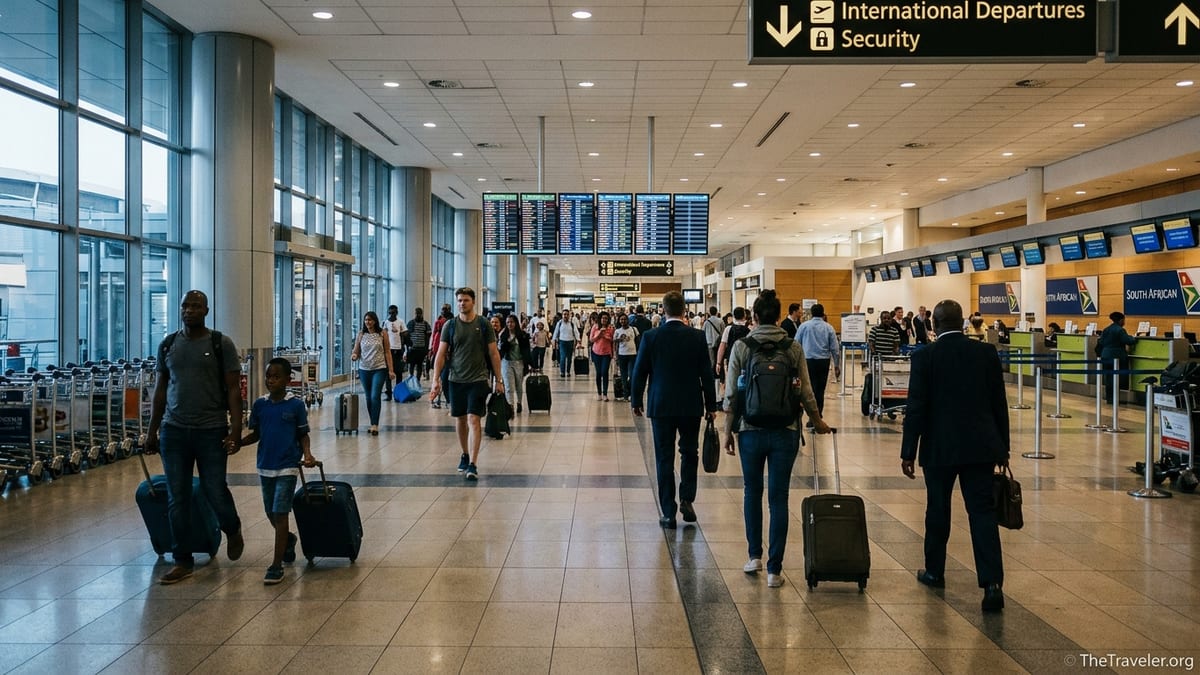
How Johannesburg’s Terminals Work for Connections
O. R. Tambo International Airport uses two linked terminals inside a single continuous building. Terminal A handles international departures and arrivals, while Terminal B is the main domestic side, used by airlines such as FlySafair, Airlink and many South African Airways domestic services. Although they are named as separate terminals, you can walk between them indoors without leaving the building, which is important for anyone connecting from a domestic flight to an international one.
The shared central departures hall and check in area sit between A and B, so you will often see both domestic and international check in counters in the same broad space. For example, you might check in for a Qatar Airways flight to Doha at a bank of counters near one end of the hall, while just a short walk away FlySafair staff are checking passengers to Cape Town. Security and passport control for international flights sit behind the Terminal A side, while domestic security sits behind the Terminal B side.
For a domestic to international connection, the most common pattern is that you land in Terminal B, collect your hand luggage and walk up the concourse towards the central area, then on to Terminal A to check in and clear security and passport control for your international flight. If you are already checked through on a single ticket, your airline may direct you to an international transfer or connections desk rather than sending you out to the main departures hall, but you will still pass through the same security and passport checks before boarding.
The physical distance is not large. Walking from a typical domestic arrival gate in Terminal B to the far end of the international departures pier in Terminal A usually takes around 7 to 10 minutes at a normal pace. That means that, in normal conditions, walking time itself is not what determines if you make your connection; check in cut off times, security queues and passport control wait times are far more important.
Baggage: Through Checked vs Self Recheck
Baggage is the single biggest factor that changes how you handle a domestic to international transfer at Johannesburg. If both flights are on one ticket and the airlines have an interline or codeshare agreement, your bags may be tagged all the way through to your final international destination. In that case, you normally do not see your checked bags again in Johannesburg. You would follow “international transfers” signage, clear security and passport control, and go straight to departures.
Many South Africa based trips, however, involve separate bookings. A common pattern is a low cost domestic ticket with FlySafair or another local carrier into Johannesburg, and a separate long haul booking with Emirates, Qatar Airways, British Airways, Delta, or another international airline. In that scenario the domestic airline will usually only check your bags as far as Johannesburg. On arrival you collect your suitcase at domestic baggage claim in Terminal B, go landside, then walk to the international check in area to drop it again for your outbound flight.
This recheck process adds real time. In a typical case, your FlySafair flight from Cape Town lands at 14:00. By 14:10 the doors are open and passengers walk to baggage claim. Bags may begin arriving within 10 to 20 minutes, so you might have your suitcase by 14:30. From there it is a 5 to 10 minute walk up to the main departures level and across to your international airline’s check in counters. If your Qatar Airways check in closes 60 minutes before a 17:30 departure, your buffer after bag collection is comfortable, but not huge. Any inbound delay or slow baggage delivery eats directly into that margin.
If you are unsure whether your bag is checked through, ask clearly at your origin airport check in. Staff should be able to tell you if your bag tag shows your final destination (for example, “JFK”) or stops at “JNB.” When in doubt, assume you will need to collect and recheck bags in Johannesburg and build your connection time accordingly. It is also wise to keep key items you might need for a night in hand luggage in case a tight transfer leads to a missed bag.
Walking Between Domestic and International Areas
Although Johannesburg uses the terms Terminal A and Terminal B, in practice you experience the airport as a single building with different wings. From domestic arrivals the route to international departures is well signposted. After leaving your domestic gate in Terminal B, you follow signs to “baggage claim” or “exit,” pass through a short arrivals concourse, and reach the domestic baggage hall. Once you have your luggage, you walk out into the public arrivals area of Terminal B.
From the domestic arrivals hall it is a straightforward walk to the main departures level. Escalators and lifts take you up one level to the check in and departures concourse. Here you will see overhead signage pointing to Terminal A on one side and Terminal B on the other. International airlines like Emirates, Qatar Airways, Lufthansa, Air France, and others typically use counters toward the Terminal A end. Local and regional airlines are more common toward the Terminal B side.
Walking along this central hall from one end to the other might take around 5 to 7 minutes. The route is flat and indoors, past coffee shops, currency exchange counters, and information desks. There are no shuttle buses or trains involved. Even if you have never been to O. R. Tambo before, the blue and yellow signage and airline logos make it difficult to get truly lost; the main pitfall is misjudging time spent browsing shops and cafes when you still need to clear security and passport control.
If you arrive late at night or very early in the morning for a tight connection, staff may sometimes redirect you along shorter internal corridors or point you to the fastest lifts and escalators up to departures. When in doubt, tell a staff member which airline and flight number you are catching; it is common for them to quickly point out the most direct path to that airline’s section of the hall.
Security, Passport Control and Queue Risks
For any international departure from Johannesburg, everyone passes through two stages after check in. First is security screening, where your carry on luggage and personal items are scanned. Second is passport control, where your travel documents are checked and your passport is stamped. In quieter midday periods you might clear both in 15 to 30 minutes. During evening long haul peaks, especially between roughly 18:00 and 22:00, passengers report that passport control in particular can become a bottleneck.
In practical terms, that means a domestic to international connection that looks generous on paper can become stressful if you underestimate queues. For example, suppose you land from Durban at 17:00 and have a 20:10 British Airways flight to London. After walking from your gate, waiting a short time for baggage, and walking up to departures, you might reach check in around 17:45. If you have already checked in online and just need to drop your bag, the process could be quick. However, if you still need to check in at the counter and there is a line, you might not leave the landside area until 18:15 or 18:30.
From there you still need to clear security and passport control. On some evenings, travelers report that passport queues have taken up to an hour when multiple wide body flights depart close together. If that happens, you can easily find yourself walking briskly down the long international departures pier with 20 minutes before boarding closes, instead of relaxing in a lounge. The risk is higher on Fridays and at the start or end of South African school holidays when leisure travel peaks.
Security screening itself is usually orderly and predictable. Standard global rules apply: laptops out of bags in most cases, liquids in small containers in a clear bag, no large bottles of water. Johannesburg does not have an official “fast track” for all travelers, but some premium cabins and elite frequent flyers may be directed to shorter queues. Even then, the overall time through both security and passport control can still be governed by that last passport check line, not the x ray machines.
How Much Time to Allow for Domestic to International
The minimum connection time used by airline schedules at Johannesburg for some domestic to international transfers can be as low as around 60 minutes, but that is designed for protected connections where both flights are on the same ticket and airlines can rebook you if there is a misconnection. For real world peace of mind, especially on separate tickets, most frequent travelers recommend allowing considerably more.
A practical rule of thumb is to treat 2 hours as an absolute minimum and 3 hours as the comfortable standard for domestic to international at O. R. Tambo. For instance, if you are landing from Cape Town at 14:00 and planning to connect to a 17:00 international departure, that 3 hour gap gives you margin for a short delay on the domestic leg, 20 minutes at baggage claim, walking time, check in formalities, and potentially 30 to 40 minutes in security and passport control queues.
If you are on separate tickets and your international flight is the only one that works for your trip, it is wise to push that gap closer to 4 hours during busy seasons. As a concrete example, a traveler arriving from Port Elizabeth at 11:00 in December and connecting to a 15:10 overnight flight to Europe would have a 4 hour window. In practice that might break down into 20 minutes taxiing and disembarking, 20 to 30 minutes at baggage claim, 15 minutes to walk up to departures and find the international check in line, 30 minutes in that line, and up to an hour through security and passport control. That still leaves a little buffer for unforeseen delays.
Shorter connections are possible, particularly on a single ticket. For example, a through ticket on South African Airways from Durban to Frankfurt via Johannesburg might show a 1 hour 30 minute connection. If everything runs on time and your bag is checked through, that can work. You disembark, follow the transfers signs, skip baggage claim, and head straight for security and passport control. However, if you are nervous about missed connections or traveling with children, older relatives, or anyone with mobility issues, choosing a longer scheduled connection is almost always the better choice.
Missed Connection Scenarios and What Happens Next
The consequences of a missed connection at Johannesburg differ sharply depending on whether your domestic and international flights are on one ticket or two. On a single through ticket, airlines have an obligation to get you to your final destination. So if a South African Airways domestic flight from East London is delayed and you miss your onward Lufthansa departure, the operating carrier should rebook you on the next available flight with themselves or a partner, subject to availability.
What that looks like in reality varies. Sometimes you will be placed on the next day’s flight and given hotel and meal vouchers if the delay was within the airline’s control. Other times, especially if the disruption comes from weather or air traffic restrictions, you might be rebooked but with more limited support. You would approach the airline’s transfer desk or customer service counter inside the terminal after missing the flight, so building enough margin to avoid that situation is still very much in your interest.
On separate tickets, the risk is entirely yours. If your domestic low cost flight is delayed and you miss an independently booked Emirates or Qatar Airways departure, the long haul airline is not obliged to assist, and you may need to buy a new ticket at walk up prices. In busy seasons, the next flight may not have seats in the same fare class, or may be fully booked. Stories of travelers stranded overnight in Johannesburg because a 90 minute self planned connection went wrong are not uncommon.
To protect yourself, think of any domestic to international self connection at Johannesburg as a place to be conservative. Consider buying travel insurance that covers missed connections caused by delay, particularly if your onward ticket is expensive. If your schedule is tight, you might also plan a backup, such as later flights to major hubs like Dubai or Doha that you could switch to on the same airline for a fee, instead of relying on a last evening departure with no alternatives.
Practical Tips to Make Your Transfer Smoother
Small choices before and during your journey can make a big difference to how stressful your Johannesburg transfer feels. Start with timing. Whenever possible, avoid very tight evening domestic arrivals that land shortly before the long haul bank of international departures. For example, landing from Durban at 18:15 for a 20:10 London flight gives you very little margin if there is a gate delay or long passport control queue. Shifting to an earlier domestic flight, even by an hour, can dramatically reduce anxiety.
Packing strategy also matters. Keep essential items like medication, a change of clothes, and basic toiletries in your cabin bag so that if something goes wrong and your checked bag does not make the same flight, you can still manage overnight. Use distinctive luggage tags or straps so you can quickly spot your suitcase on the carousel, and double check the baggage tag at your origin airport to confirm that it shows your true final destination if the bag is checked through.
On arrival in Johannesburg, move with purpose but not panic. Once the seatbelt sign is off, have your belongings ready so you can disembark promptly. Follow signs carefully and avoid unnecessary stops in shops until you are checked in for your international flight. If you see that queues at check in or passport control are very long and your departure time is approaching, politely inform staff at the front of the queue. They cannot always move you ahead, but if boarding is imminent they sometimes will.
Finally, if you are traveling with children or anyone who might struggle with long walks, request wheelchair assistance or mobility support from your airline in advance. Johannesburg’s terminals are compact compared to some global mega hubs, but distances can still feel significant after a long day of travel. Airline ground staff and contracted assistance providers can often escort you along the most direct routes, which indirectly helps your connection time too.
The Takeaway
Transferring from a domestic flight to an international departure at Johannesburg’s O. R. Tambo International Airport is generally straightforward, thanks to a single connected terminal complex and clear signage. The real variables are baggage handling, check in rules, and the often unpredictable queues at security and passport control. With those in mind, a well planned transfer can be smooth and relatively low stress.
For most travelers, especially those on separate domestic and international tickets, aiming for at least 3 hours between scheduled arrival and departure is the sweet spot. That window allows for moderate delays, baggage collection, a walk between terminal areas, and a cautious view of evening passport control lines. Travelers on single tickets with through checked baggage can work with shorter official minimum connection times, but even they benefit from a little buffer, particularly in peak seasons.
The stakes are higher when the international leg is a once daily long haul flight. Missing that departure can mean an unscheduled night in Johannesburg and costly changes to tickets. Balancing your tolerance for risk, your budget, and the needs of anyone traveling with you is key. In every case, arriving prepared, keeping essential items in carry on, and staying alert to signage and staff directions will help turn Johannesburg from a source of stress into a smooth stepping stone on your wider journey.
FAQ
Q1. Do I need to collect my checked bag in Johannesburg before my international flight?
If your flights are on separate tickets, you almost always need to collect your bag at domestic arrivals in Terminal B and recheck it with your international airline. If both flights are on one through ticket and your bag tag shows your final destination, it is usually checked through and you can follow international transfer signs instead.
Q2. How long does it take to walk from domestic arrivals to international departures?
Walking from a typical domestic arrival gate and baggage claim area in Terminal B up to the international check in area in Terminal A usually takes around 10 to 15 minutes at a normal pace. The route is indoors, mostly flat, and clearly signposted.
Q3. What is a safe connection time for domestic to international at Johannesburg?
For most travelers, 3 hours is a sensible standard. That allows for some delay on the domestic leg, time to collect and recheck bags, and potential queues at security and passport control. On a single through ticket with bags checked to your final destination, 1 hour 30 minutes can work but carries more risk if there are delays.
Q4. Will I have to go through security and passport control again when I connect?
Yes. For any international departure from Johannesburg you pass through security screening and passport control after check in, even if you arrived on another flight the same day. Domestic arrivals do not involve passport control, so you only show your passport when departing on the international leg.
Q5. Can I stay airside when connecting from domestic to international?
In most domestic to international cases you go landside between flights, especially if you must collect and recheck baggage. Some through ticket connections routed by the same airline may use transfer desks that keep you airside, but you still need to clear security and passport control before boarding the international flight.
Q6. What happens if my domestic flight is late and I miss my international connection?
If both flights are on one ticket, the airline that sold the ticket generally must rebook you on the next available flight, subject to their policies and seat availability. If you booked separate tickets, the long haul airline is not obliged to help and you may need to buy a new ticket or pay change fees at current prices.
Q7. Are there peak times when queues are especially long?
Queues at security and particularly passport control tend to be longest in the early evening when many long haul flights to Europe, the Middle East and Asia depart around similar times. Fridays, Sundays, and school holiday periods can be especially busy, so allowing extra time for evening connections on those days is wise.
Q8. Is 90 minutes enough for a domestic to international self connection?
Ninety minutes is generally too tight for separate tickets, because any delay on the domestic leg or slow baggage delivery can quickly eat that time. You must also allow for walking, check in cut off times, and potential queues. Most experienced travelers consider 2 hours an absolute minimum and prefer 3 hours or more on separate tickets.
Q9. Do I need a visa just to change from domestic to international at Johannesburg?
If you are only flying within South Africa and then leaving internationally, your need for a visa is determined by South African entry rules for your nationality. Domestic arrivals do not involve immigration, but you do need whatever documents are required to be legally in South Africa in order to check in and depart on an international flight the same day.
Q10. Are there places to rest or eat during a longer connection?
Yes. Before security there are cafes and fast food outlets in the main departures hall between Terminals A and B, as well as seating areas. After security and passport control in international departures you will find duty free shops, sit down restaurants, bars and several airline or independent lounges, which can be accessed with certain tickets, memberships, or paid entry.