


Landing at Kilimanjaro International Airport (JRO) is the starting point for most safaris in northern Tanzania and nearly every Kilimanjaro climb. The airport itself is small and straightforward, but your first hour on the ground can feel hectic if you do not know what to expect. This guide walks you through arrivals, transport to Arusha and Moshi, safari and climb pickups, SIM cards, money, and essential first-time Tanzania tips so you can start your trip with confidence.
Get the latest updates straight to your inbox!
Understanding Kilimanjaro International Airport
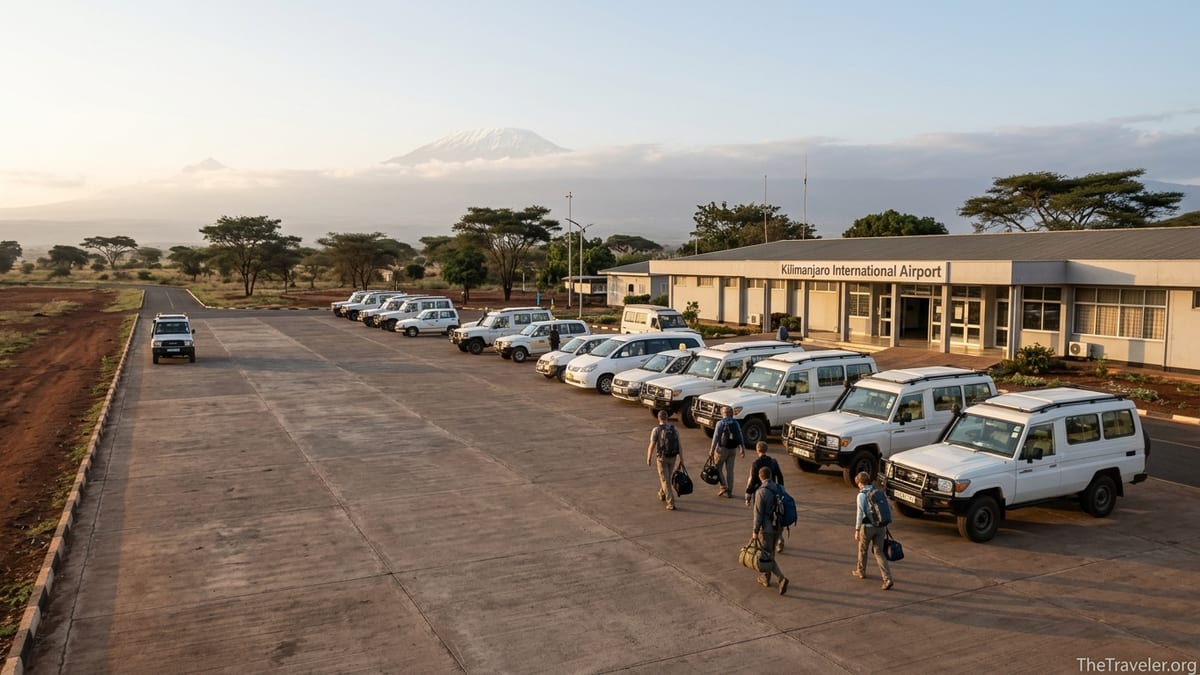
Kilimanjaro International Airport sits out on open plains between Arusha and Moshi, roughly a 45 to 70 minute drive to either town depending on traffic and weather. It is the main gateway for the northern safari circuit, serving iconic destinations like Serengeti, Ngorongoro, Tarangire, Lake Manyara, and Mount Kilimanjaro itself. Most international visitors flying with airlines such as KLM, Qatar Airways, Turkish Airlines, Ethiopian Airlines, and Kenya Airways will pass through JRO before heading to lodges, safari camps, or climbing hotels.
The terminal is compact, with a single main building handling both international and domestic flights. You will not find jet bridges or multiple concourses here; passengers disembark via stairs directly onto the tarmac and walk into the arrivals building. Inside, there are basic services: immigration, customs, several ATMs, a handful of money exchange counters, SIM card kiosks, a small café, and car rental desks. Compared with larger African hubs like Nairobi or Dar es Salaam, JRO feels low key, but at peak times when two or three widebody flights arrive close together, queues can still form.
For first-time visitors, it helps to think of JRO as a functional gateway rather than a destination airport. There are seats, restrooms, and a couple of snack outlets, but not the extensive duty free or brand-name restaurants you might expect at a big international hub. Most people move through quickly: climbers are whisked to staging hotels in Moshi or Machame, while safari travelers transfer directly to Arusha or sometimes continue on short domestic flights to airstrips such as Seronera or Manyara.
Because the airport is in an isolated rural area with limited public transport, arranging your onward transfer in advance is more important here than at many other airports. Taxis and shuttles are available on arrival, but evening flights combined with jet lag can make you less inclined to negotiate, which is why tour operators and hotels often build private pickups into their standard packages.
Arrivals, Visas, and First Steps Off the Plane
When you step off the aircraft, you will follow other passengers into the main arrivals hall. Before reaching the immigration counters, you typically complete an arrival card and, for many nationalities, handle visa-on-arrival formalities. As of mid 2026, visitors from a large list of countries can still obtain a visa on arrival by filling in a simple form, presenting their passport, and paying a fee in US dollars or by card. Many travelers from Europe and North America report paying around 50 US dollars for a single-entry tourist visa, while US citizens are generally issued a multiple-entry visa that costs more. Rules change periodically, so it is wise to double check with Tanzania Immigration or your local Tanzanian embassy before travel.
Alongside the visa fee, Tanzania has introduced a mandatory travel insurance charge at ports of entry including JRO. Travelers arriving in 2026 report paying an additional fee per person that covers emergency medical situations and related incidents for a set period after arrival. The amount and coverage can change with each fiscal year, but you should expect to be asked for this payment at, or just after, immigration checks. Having a credit card ready speeds things up; if you only carry cash, bring clean, recent US dollar bills.
Once you clear immigration, you collect your checked luggage from a small carousel area. Baggage carts are generally available and free to use. You then pass through customs screening, where officers may ask you to put bags through an X‑ray machine. For most tourists with standard personal gear, this is a quick formality, though climbers carrying technical equipment like oxygen bottles or drones should be prepared for questions and, in the case of drones, possible restrictions.
Immediately after customs, you emerge into the public arrivals area. Here you will see drivers holding signs for safari companies and Kilimanjaro outfitters, along with official airport taxi representatives and a cluster of counters for banks, SIM cards, and car rental firms. Take a moment to orient yourself before committing to any service. If you have a pre-booked transfer, your driver will usually be waiting clearly in this hall, often wearing a branded polo shirt from companies based in Arusha or Moshi.
Getting from JRO to Arusha or Moshi: Taxis, Shuttles, and Private Transfers
The most common onward journeys from Kilimanjaro International Airport are to Arusha and Moshi. Arusha lies roughly 45 to 60 minutes west of the airport, while Moshi is about an hour to the east. The road in both directions is paved and generally in good condition, though nighttime driving can be slower because of trucks and livestock near the verge. First-time visitors should decide in advance whether they prefer an official airport taxi, a shared shuttle, or a pre-booked private transfer arranged through a hotel or tour operator.
Official airport taxis are lined up just outside the arrivals hall. Fares are usually quoted in US dollars, and as of 2026 many travelers report paying the equivalent of around 50 to 70 US dollars for a one-way trip to either Arusha or Moshi in a standard sedan, with slightly higher prices late at night or for larger vehicles. It is reasonable to confirm the fare at the airport taxi desk inside the terminal or to agree on a price with the driver before getting into the car. For example, a jet-lagged couple arriving on an evening KLM flight might pay 60 US dollars total to reach an Arusha city hotel, compared with 80 to 90 US dollars for a pre-booked 4x4 arranged by a high-end safari lodge.
Shared shuttles are a budget-friendly option. Several local companies and tour operators run scheduled minivans or small buses between JRO, Arusha, and Moshi, timing departures to meet common international arrivals. Prices can start from roughly 20,000 to 40,000 Tanzanian shillings per person, which is around 8 to 17 US dollars, depending on the route and operator. These shuttles may stop at central points like the main bus stand in Moshi or a cluster of popular mid-range hotels in Arusha. For instance, a backpacker staying near the Arusha Clock Tower might book a seat in advance through their hostel and pay about 10 US dollars for the ride, sharing the van with other independent travelers.
Pre-booked private transfers through safari companies, climbing outfitters, or hotels are especially common for people starting a Kilimanjaro trek or safari early the next morning. The vehicle is usually a 4x4 Land Cruiser or a modern minivan, and the driver will wait even if your flight is delayed. Prices can vary widely. A mid-range safari company might include airport pickup in a package costing several thousand dollars, while a Moshi-based taxi company may quote around 30 to 40 US dollars for a private car from the airport into town if arranged directly. The key advantage is reliability: your driver knows your hotel, understands your schedule, and can often help you stop at an ATM or supermarket on the way if you ask ahead of time.
Safari Pickups, Kilimanjaro Climbs, and Domestic Connections
For many passengers arriving at JRO, the airport is just the start of a carefully planned itinerary. Safari travelers are often met by their tour company in branded vehicles and taken straight to a nearby lodge or to Arusha for an overnight stop. Some itineraries have you land at JRO in the morning, then connect to a domestic flight to the Serengeti or other national parks the same day. Local airlines typically operate from the same airport, but you check in separately at domestic counters, often using small Cessna or similar aircraft that land on dirt airstrips inside the parks.
Kilimanjaro climbers frequently base themselves in Moshi, Marangu, or Machame for at least one night before starting their ascent. Reputable outfitters will include an airport transfer from JRO to your hotel in their trekking package. This might be a simple sedan for a solo climber with one large duffel, or a larger van if you are part of a group expedition with multiple climbers and gear bags. For example, a group of six friends booked on a seven-day Machame Route climb might find a 12‑seater van waiting for them with space for all their duffels, trekking poles, and boot bags, along with drinking water for the journey to Moshi.
If your safari or climb starts very early the following morning, consider the timing of your arrival carefully. Night flights that land close to midnight mean you may only reach your hotel in Arusha or Moshi at 1 or 2 am. In these cases, having a private transfer included in your package is far more comfortable than relying on ad hoc taxis. Tour operators are used to late arrivals and will schedule drivers accordingly. They can also adjust pick-up times if your inbound flight is delayed, something that is harder to coordinate if you have only arranged a shared shuttle.
Domestic connections from JRO to airports like Zanzibar, Dar es Salaam, or the Serengeti region are common but require buffer time. Many airlines recommend arriving at the airport at least two hours before domestic departures, and tour companies often schedule transfers from Arusha or Moshi to the airport three hours before flight time. For example, if you have an 11:00 domestic departure to Zanzibar, your Moshi hotel may arrange for you to leave around 7:30 or 8:00 in the morning to allow for traffic and check-in.
SIM Cards, eSIMs, and Staying Connected
Having mobile data on arrival in Tanzania is helpful for everything from messaging your driver to checking hotel details. At Kilimanjaro International Airport, travelers usually find small kiosks in the arrivals hall selling SIM cards from major Tanzanian providers such as Vodacom and Airtel. The kiosks may not operate 24 hours a day, although they often stay open around the times of major international flights. If you arrive very late at night and find the counters closed, you can normally buy a SIM in Arusha or Moshi the next day at official shops or third-party vendors.
By law, all SIM cards in Tanzania must be registered to an individual using a passport and, in many cases, biometric data such as fingerprints or a facial photo. This means you cannot simply grab a SIM off the shelf and leave; you should be prepared to show your passport and spend a few minutes completing the registration process at the counter. Travelers in 2026 commonly report buying starter packages that cost the local currency equivalent of 5 to 15 US dollars, which might include a few gigabytes of data plus local call minutes valid for 7 to 30 days. For example, a visitor who primarily uses WhatsApp and maps for a 10‑day safari might choose a 10 GB data bundle on Vodacom and pay around the cost of an inexpensive restaurant meal in Arusha.
Evolving technology has made eSIMs an attractive alternative. Several international providers sell eSIM data packages for Tanzania or wider East Africa that you can purchase and activate before departure. With an eSIM, your phone connects to local networks as soon as you land, without stopping at a kiosk. Some local operators also offer their own eSIM products that can be activated at JRO or in town. A traveler planning to split time between Kilimanjaro, Serengeti, and Zanzibar might choose an East Africa eSIM that includes Tanzania and neighboring countries, ensuring continuous data coverage when crossing borders or transiting via Nairobi.
Coverage outside main towns and highways can be spotty, especially deep inside national parks and on higher sections of Kilimanjaro, so do not rely on constant connectivity. Guides often advise downloading offline maps for Arusha, Moshi, and key routes before you leave home. Wi‑Fi is increasingly common at city hotels and many safari lodges, but speeds vary. As a practical example, you may be able to upload a batch of photos from a Moshi hotel on a 10 Mbps Wi‑Fi connection, but you might only manage basic messaging from a tented camp near the Serengeti’s central plains.
Money, ATMs, and Practical Airport Purchases
The official currency of Tanzania is the Tanzanian shilling, and you will likely need some cash for small purchases, tips, and places that do not accept cards. At JRO, there are usually a few ATMs in the arrivals area operated by local banks. They dispense shillings and accept major international networks like Visa and Mastercard. Withdrawal limits can vary by machine and by bank policies, but many travelers find they can take out enough cash in a single transaction to cover a week or more of incidental expenses.
Alongside ATMs, you may see currency exchange counters where you can convert US dollars, euros, or other major currencies into Tanzanian shillings. Exchange rates at the airport are generally less favorable than those in town, so many visitors withdraw only a modest amount at JRO for immediate needs, such as buying bottled water, paying a taxi in local currency, or tipping porters, then do larger exchanges in Arusha or Moshi where rates tend to be more competitive. For example, a traveler might withdraw the equivalent of 50 to 100 US dollars in shillings upon arrival, and then top up later at a city bureau de change once they have compared rates.
Credit and debit cards are increasingly accepted at mid-range and high-end lodges, many safari operators, and supermarkets in Arusha and Moshi, but you should not count on them for every purchase. Smaller guesthouses, local eateries, and markets often operate on a cash basis. It is also worth carrying small denomination US dollar bills for tips and for situations where quoted rates are explicitly in dollars, such as some airport taxis or park fees. Make sure the notes are relatively new and undamaged, as torn or older bills may be refused.
Within the terminal, you will find a small café or snack bar where you can buy coffee, soft drinks, and basic food items. Prices are typically higher than in town but still reasonable by international standards. For example, a bottle of water might cost the equivalent of a couple of US dollars. If you need last-minute items such as a local SIM top-up voucher, insect repellent, or a cheap rain poncho before heading to the parks or the mountain, many travelers wait until reaching a supermarket in Arusha or Moshi, where the selection is broader and prices lower.
First-Time Tanzania Tips: Health, Safety, and Cultural Basics
Arriving in Tanzania for the first time raises a number of practical questions about health, safety, and local customs. From a health standpoint, it is important to consult a travel clinic in your home country well before departure. Depending on your itinerary and recent travel history, you may be advised to receive vaccines for illnesses such as yellow fever, hepatitis A, or typhoid, and to consider taking antimalarial medication if visiting areas where malaria is present. Although airport staff do not routinely check vaccination records for all travelers, those arriving from countries with yellow fever risk or transiting such countries may be asked to show a valid yellow fever certificate.
On the safety front, Kilimanjaro International Airport is generally considered a secure and orderly place. Official taxis operate under airport oversight, and tour company drivers are accustomed to receiving tired travelers at all hours. Petty crime inside the terminal is relatively rare compared to some larger African hubs, but the usual precautions apply: keep your passport and valuables in a money belt or secure pocket, do not leave bags unattended, and be cautious with displaying expensive electronics in crowded areas.
Once you reach Arusha or Moshi, you will find them to be busy but welcoming regional cities. Dress codes are fairly relaxed for tourists, especially around hotels and on safari, but modest clothing that covers shoulders and knees is appreciated in more traditional neighborhoods and markets. Learning a few basic Swahili words, like “asante” for thank you and “habari” for hello or “how are you,” can go a long way in daily interactions. Tipping is customary for guides, drivers, and hotel staff; as a rough guide, many travelers tip a few US dollars per person per day for drivers, and more for safari guides and Kilimanjaro crews based on service and trip length.
Time management is another important consideration. Traffic on the main road between JRO, Arusha, and Moshi can be unpredictable, especially during the rainy seasons when showers reduce visibility. Many experienced travelers aim to arrive at the airport at least three hours before international departures and at least two hours before domestic flights. For example, if your flight from JRO to Europe departs at 22:00, your Arusha hotel or safari camp may schedule your pickup around 18:00, giving plenty of margin for the drive, check-in, and security screening.
The Takeaway
For first-time visitors, Kilimanjaro International Airport is less intimidating once you understand its scale and rhythms. It is a compact, functional gateway serving two main hubs, Arusha and Moshi, rather than a sprawling megahub. Arrivals involve straightforward steps: immigration, visas and insurance payment where applicable, customs, then a short walk into a small arrivals hall where taxis, shuttles, and pre-booked drivers are waiting. By arranging your transfer ahead of time, carrying a mix of cash and cards, and planning where and how you will get connected via SIM or eSIM, you remove most of the uncertainty from your first hour in Tanzania.
From there, the focus shifts quickly to what brought you here: a multi-day safari into the Serengeti, a trek up Mount Kilimanjaro, or a circuit that ends on the beaches of Zanzibar. Treat JRO as the launch pad for those adventures. With realistic expectations about services, transport times, and the practical details of money and connectivity, you can step off the plane, take a breath of the cool highland air, and start your Tanzanian journey feeling prepared rather than overwhelmed.
FAQ
Q1. How long does it take to get from Kilimanjaro International Airport to Arusha or Moshi?
Typical driving time is about 45 to 60 minutes to Arusha and around 60 minutes to Moshi, depending on traffic, time of day, and weather conditions.
Q2. Should I arrange my airport transfer in advance or can I rely on taxis at JRO?
You can find official taxis at the airport on arrival, but arranging a transfer through your hotel, safari operator, or climb outfitter in advance is usually more convenient, especially for late-night arrivals.
Q3. How much does a taxi from JRO to Arusha or Moshi cost?
Recent travelers report paying roughly 50 to 70 US dollars for a one-way trip in an official airport taxi, with prices varying slightly by vehicle type, time of day, and negotiation.
Q4. Is visa on arrival still available at Kilimanjaro Airport?
For many nationalities, visa on arrival remains available at JRO, but fees and eligibility can change, so it is important to confirm current rules with Tanzania Immigration or a Tanzanian embassy before you travel.
Q5. Can I buy a SIM card at Kilimanjaro International Airport?
Yes, there are usually small kiosks in the arrivals hall selling SIM cards from major providers like Vodacom and Airtel, though opening hours often follow major flight times and may not cover the entire night.
Q6. Do I need cash immediately on arrival, or can I use cards everywhere?
Cards are accepted at many hotels and larger businesses, but you will need Tanzanian shillings or small US dollar bills for tips, smaller shops, and some taxis, so using an ATM at the airport for basic cash is recommended.
Q7. Is Kilimanjaro International Airport safe for solo travelers arriving at night?
The airport is generally considered safe, with official taxis and tour drivers operating under supervision, though solo travelers should still take normal precautions, keep valuables secure, and avoid leaving the terminal with unofficial touts.
Q8. How early should I arrive at JRO before my departing flight?
Most travelers aim to be at the airport at least three hours before international departures and two hours before domestic flights, and hotels often schedule transfers with extra buffer time to account for traffic.
Q9. Can I go straight on safari or start my Kilimanjaro climb the same day I land?
Some itineraries do connect directly to domestic flights or start safaris the same day, but many operators recommend at least one night in Arusha or Moshi to rest, adjust, and allow for any flight delays before beginning a climb or long game drive.
Q10. Are there food and basic shops at Kilimanjaro Airport?
JRO has a small café and limited kiosks selling snacks and essential items, but for a wider choice and better prices, most travelers wait until they reach Arusha or Moshi to visit supermarkets or outdoor gear stores.