


Landing at Kilimanjaro International Airport is the moment your safari or Kilimanjaro trek becomes real. The runway sits between Arusha and Moshi, and what you do in the next 60 minutes often shapes your first impression of Tanzania. This guide explains how transfers at Kilimanjaro International Airport work in practice, from private cars and hotel shuttles to safari vehicles and trekking company pickups, with real examples and pricing ranges to help you plan with confidence.
Get the latest updates straight to your inbox!
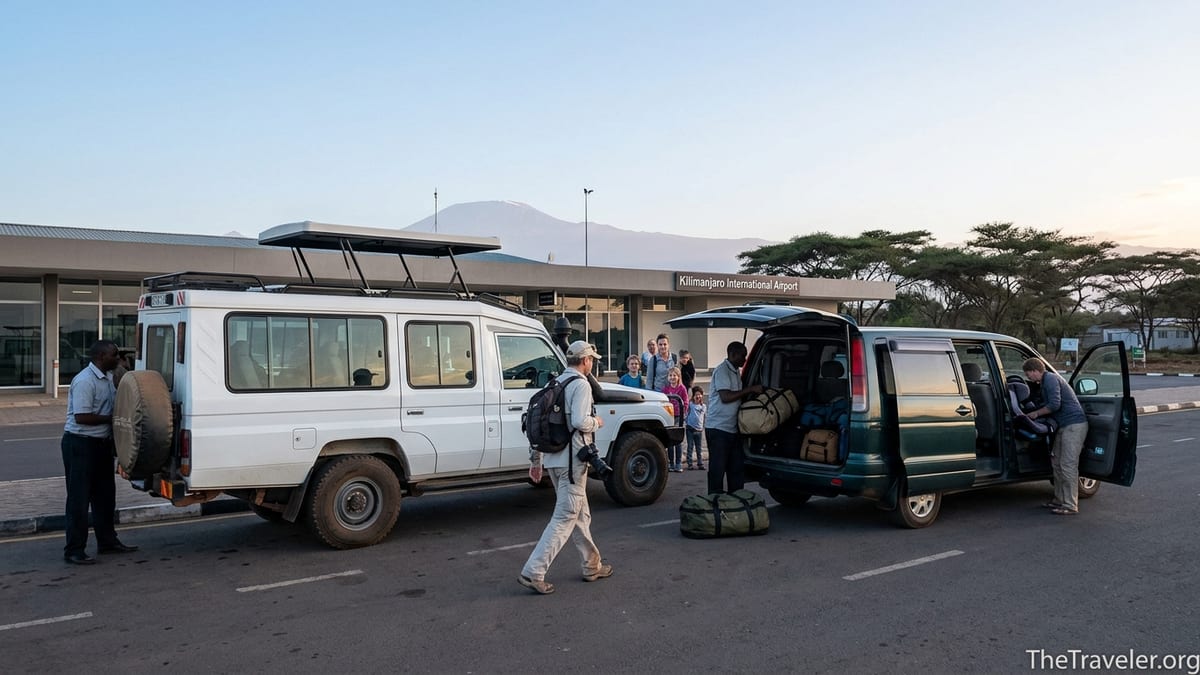
Understanding Kilimanjaro International Airport and Its Gateways
Kilimanjaro International Airport, often written as JRO on airline tickets, is the main arrival point for most travelers heading to Mount Kilimanjaro, the Serengeti and the northern Tanzania safari circuit. It lies roughly midway between Arusha and Moshi, on the main A23 highway that links the two cities. In light traffic, expect about 45 minutes to Moshi and around 60 minutes to central Arusha by road, though evening arrivals and roadworks can add extra time.
There is no railway or public bus station at the terminal building. All onward travel from JRO is by pre-booked transfer, private taxi, hotel vehicle or safari / trekking operator transport. That makes it different from larger hubs where you can simply walk out and find a local bus or train. Planning your ground transfer before you land is usually the smoothest option, especially if you have checked bags, children or bulky trekking gear.
The airport serves regional and long-haul flights from hubs such as Amsterdam, Doha, Addis Ababa and Nairobi, along with regional services from Dar es Salaam and Zanzibar. Many arriving passengers are tired after overnight flights, so reputable operators have adjusted to this reality by offering meet-and-greet services, luggage assistance and direct hotel drop-off rather than leaving guests to negotiate curbside taxis after immigration and customs.
In recent years, local transfer specialists and safari companies have improved coordination at JRO. Many will request your flight number and arrival time in advance, monitor delays and adjust pickup times accordingly. For example, Moshi-based operators such as Moshi Taxi and Kili Taxi highlight 24/7 airport pickup with drivers waiting in the arrivals area holding a sign with your name, then driving directly to your lodge in Moshi or Arusha.
Private Transfers and Taxis: What to Expect and What You Pay
For independent travelers not booked on a packaged safari or guided Kilimanjaro climb, a private transfer or taxi is the most straightforward option. As of 2026, typical pre-booked prices from JRO sit in the following ranges for a standard car seating up to four passengers with luggage: around 30 to 50 US dollars to Moshi and roughly 55 to 75 US dollars to Arusha, depending on your exact hotel location, arrival time and the company you use. These figures are broadly consistent across several local transfer providers and recent traveler reports.
Companies such as Moshi Taxi, Kili Taxi and Kilimanjaro Airport Transfers advertise fixed one-way rates rather than using meters, which is useful after a long-haul flight. For example, a transfer from JRO to Usa River or central Arusha often appears around 60 to 70 US dollars per car for up to three or four passengers, while JRO to Moshi usually falls in the 40 to 60 US dollar range. Some firms offer small surcharges for late-night arrivals, extra luggage or pickups at lodges outside the main urban areas.
At the curbside, you will also find local taxis waiting for walk-up business. These are usually safe but can involve firmer bargaining, especially if you arrive at unpopular hours or when several flights land at once. Without a pre-arranged rate, you may be quoted higher prices than those above. For this reason, many travelers pre-book at least the arrival transfer. Returning to the airport, it can be more practical to have your hotel or guesthouse call a trusted driver who uses known rates to JRO.
Vehicle quality varies. Established transfer companies often use clean, modern Toyota minivans or saloon cars with functioning seatbelts and air conditioning, while informal taxis might be older sedans with more worn interiors. If you are traveling with small children and need a child seat, or if you have oversized trekking duffels, arranging a pre-booked private car or minivan lets you specify your needs in advance instead of improvising at the arrivals apron.
Hotel Shuttles and Lodge Pickups Around Arusha and Moshi
Many mid-range and upscale hotels around Arusha and Moshi offer airport pickups for their guests, either operated by the hotel directly or subcontracted to a local transfer partner. Properties such as Arusha’s larger safari lodges, business hotels on the main road into town, and popular trekking hotels in Moshi often quote a one-way JRO transfer rate similar to a private taxi, typically in the 50 to 80 US dollar range per vehicle.
In some cases, airport transfers are included in a package rate. For example, a lodge that sells a “pre-trek” night with dinner, breakfast and transport might bundle a one-way pickup from JRO into the price for climbers arriving late in the evening. Other hotels keep the room rate low and treat transfers as an optional extra. It is worth asking your hotel explicitly whether the rate they have quoted includes airport pickup or if this is an additional charge.
For budget guesthouses and hostels, complimentary pickups are less common, but many will gladly arrange a trusted local driver on your behalf. In Moshi, some backpacker lodges maintain a short list of known drivers who charge around 40 to 50 US dollars per car from the airport, allowing you to avoid bargaining upon arrival. Payment may be made in cash to the driver or added to your room bill, depending on the arrangement.
Hotel-run transfers can be especially convenient if you arrive very late at night, are nervous about managing transport in a new country, or are carrying bulky safari photography equipment. The driver will usually know the hotel location precisely, even for smaller properties on side streets that a general taxi driver might not recognize by name alone. This is particularly useful in Arusha’s residential neighborhoods and Moshi’s side roads, where street addresses can be informal.
Safari Operator Transfers and Group Vehicles
Travelers who have booked a safari through a specialist operator will almost always have airport transfers included in their itinerary. In practical terms, this means your safari driver-guide or a dedicated transfer driver will meet you at the arrivals area holding a sign with the company name or your name, help with luggage and escort you to a branded 4x4 safari vehicle. Companies such as Serengeti Pride Safaris, Imara Africa Safaris and many other Arusha-based operators routinely structure trips so that your first night is in or near Arusha, with airport pickup timed to your international flight.
On safari itineraries, the same customized Land Cruiser or Land Rover that takes you into Tarangire, Lake Manyara, Ngorongoro or the Serengeti is often used for your airport transfer. This can feel slightly overbuilt for the paved highway between JRO and Arusha, but it is convenient and means you meet your driver-guide from the first day. In group departures, several guests arriving on similar flights may share the same vehicle, which helps keep per-person costs down and gives you a chance to meet fellow travelers early.
Some higher-end safari brands include more premium arrival services. This can range from airside assistance with visa formalities to chilled drinks and welcome packs in the vehicle, as well as complimentary bottled water for the drive. At the top end, guests connecting directly from JRO to private airstrips in the Serengeti may be transferred to Arusha Airport or a nearby airstrip in private vehicles before boarding small aircraft operated by regional carriers.
If your safari starts the morning after you land, your operator will usually schedule the JRO pickup to take you directly to your overnight lodge around Arusha or in Usa River. If your flight is significantly delayed, reputable operators monitor arrivals and shift the plan accordingly, sometimes arranging a quick snack stop if you miss a hotel dinner service. Clear communication of your flight details and any changes is critical so that the right vehicle is waiting for you at the correct time.
Trekking Company Pickups for Kilimanjaro Climbs
Most serious Kilimanjaro trekking companies treat airport transfers as an integral part of the climb logistics rather than an optional extra. Operators such as Kilimanjaro Sunrise, Nyange Adventures, Altezza Travel, Taste of Kilimanjaro Adventures and many others based in Moshi or Arusha typically offer to collect you from JRO, transfer you to your base hotel, then handle all subsequent transfers to and from the mountain gates.
For example, Kilimanjaro Sunrise describes a straightforward system in which, after clearing immigration and collecting luggage, clients walk out to the parking area where a driver holding a sign awaits. That driver takes guests directly to their hotel in Arusha, where pre-trek briefings and gear checks are completed the following day. Similarly, Nyange Adventures notes that airport pickup and drop-off from JRO or Arusha Airport is available alongside their trekking packages, simplifying the process for first-time visitors.
Package pricing for climbs often includes these transfers in the overall per-person cost, especially among mid-range and premium operators. A climber booking an eight-day Lemosho route with hotel nights on either side might see airport pickup, hotel to trailhead, trailhead to hotel and final hotel to JRO all bundled into the quoted rate. Budget operators sometimes strip out transfers to show a lower headline price, then sell airport pickups as an add-on. When comparing quotes, it is important to check exactly which transfers are covered.
Trekking vehicles are usually robust minibuses or four-wheel drives that can cope with rougher access roads to trailheads like Lemosho, Machame and Rongai. On arrival day, these vehicles are simply used on the smoother highway section between JRO and Moshi or Arusha. Because climbers carry heavy duffels, daypacks and sometimes rented gear, trekking companies are accustomed to handling large volumes of luggage and can often provide roof racks or trailers when needed.
Child Seats, Luggage and Special Requirements
Child safety seats are not universally standard in Tanzanian taxis, so families traveling with infants or young children should pay particular attention to this point. Many transfer companies and some safari operators can supply rear-facing or forward-facing child seats if asked in advance, but they rarely appear by default. When you book, specify your child’s age and approximate weight and confirm that an appropriate seat will be fitted in the vehicle before pickup.
Some parents prefer to bring their own travel car seats from home. This guarantees familiarity and compatibility but adds bulk to your luggage. If you choose this route, let your transfer provider know you will be traveling with a child seat so they can plan for installation time at the airport. Drivers are generally patient, and the short delay of fitting a seat at JRO’s curbside is not an issue if your flight details are known.
For luggage, private transfers, safari vehicles and trekking company vans are used to handling large duffel bags and soft-sided suitcases. A standard sedan or small minivan can usually accommodate two trekkers and their expedition gear without difficulty. Larger groups, or parties bringing extensive photography equipment, may need a high-roof van or 4x4 with a roof rack. If you know you will have unusual cargo, such as hard cases or sports equipment beyond trekking, discuss this with your provider during booking.
Travelers with mobility limitations, older relatives or medical considerations should also flag their needs in advance. While wheelchair-accessible vans with ramps are less common than in major Western cities, some hotels and operators can arrange vehicles with wider doors, extra step stools or additional assistance for boarding and disembarking. For nervous first-time visitors, pre-arranged English-speaking drivers can make the arrival process feel less stressful, especially when arriving late at night.
Why Pre-Booking Matters and Practical Booking Tips
Although it is possible to negotiate a taxi after landing, pre-booking your Kilimanjaro International Airport transfer has several advantages. First, you lock in an approximate price before arriving, which reduces the risk of paying a steep “tourist rate” at the curb. Second, your driver or operator will track your flight, adjust for delays and wait at arrivals with a sign, which is valuable if immigration queues are long or your bags are slow to appear.
As a rule of thumb, travelers arriving after dark, families with children, solo travelers, and anyone carrying expensive camera gear or trekking equipment are better off arranging a trusted driver, hotel transfer or operator pickup ahead of time. For example, recent independent travelers who booked with Moshi Taxi or similar services commonly report clear WhatsApp communication in the days before arrival, detailed instructions on where to meet the driver at JRO, and transparent pricing agreed in advance.
When pre-booking, provide your full flight number, scheduled arrival time, the total number of passengers, approximate luggage volume and any special requests (child seats, extra-large vehicle, mobility assistance). Ask whether the quoted rate is per car or per person, if there are surcharges for late-night pickups, and how payment is handled. Some companies prefer cash in US dollars or Tanzanian shillings on arrival, while others can process card payments or accept bank transfers as part of a broader safari or trekking invoice.
It is also prudent to have a backup communication plan. Save your driver’s or operator’s phone number before boarding your final flight, and where possible, arrange the use of messaging apps over airport Wi-Fi in case your roaming does not activate immediately. JRO is small enough that, if you miss your driver at first, walking slowly along the arrivals barrier while scanning signs usually leads to a connection within a few minutes, but having a way to call or message them provides extra reassurance.
Choosing Between Private Cars, Group Vehicles and Shared Options
The best transfer option from Kilimanjaro International Airport depends largely on your travel style, budget and itinerary. Private cars or minivans are ideal for couples, families or small groups who value privacy and the ability to leave as soon as they clear customs. At typical 2026 prices of roughly 40 to 70 US dollars per vehicle for Moshi or Arusha, splitting the cost between two or three people often brings the per-person rate down to the equivalent of a mid-range airport train ticket in Europe.
Group vehicles provided by safari operators or trekking companies are efficient if you are booked on an organized itinerary. In many cases, especially with mid-range and premium operators, you will not see a separate line item for the airport transfer, because it is already rolled into your package. This is convenient but can make it harder to compare like-for-like with budget options where every transfer is charged separately. When comparing operators, note whether airport transfers are included and how many are covered (arrival only, or both arrival and departure).
True “shared shuttle” services at JRO, where unrelated travelers pay for a seat in a van with fixed departure times, are less common than in some other African hubs. Most transfers are still arranged per vehicle rather than per passenger. Occasionally, small group tour operators might consolidate guests from similar flights into one minibus, but they tend to do this for their own clients rather than operate a public shuttle. If your budget is tight, the most economical approach is often to coordinate your arrival with travel companions and share the cost of a private car.
For those starting or ending their trip in smaller communities between Arusha and Moshi, such as lodges near Kiligolf or in the Usa River area, many transfer providers will quote a slightly reduced price relative to city-center runs, because the driving distance is shorter. Conversely, remote lodges outside the main highway corridor may incur small surcharges to cover extra fuel and time. Clarify your exact drop-off point, including lodge name and any local landmarks, to ensure an accurate quote.
The Takeaway
Arranging your transfer from Kilimanjaro International Airport is not the most glamorous part of planning a safari or a Kilimanjaro climb, but getting it right sets the tone for your entire trip. The airport sits in a strategic location between Arusha and Moshi, and almost every reliable transfer option revolves around pre-booked cars, hotel pickups, safari vehicles or trekking company transport rather than casual walk-up shuttles.
For most travelers, the safest and most comfortable choice is to pre-book a private transfer or use the airport pickups included with a safari or trekking package. Expect to pay in the region of 30 to 50 US dollars per car to Moshi and 55 to 75 US dollars to Arusha for standard private transfers, with costs shared among your group. Families should flag child seat needs early, climbers should confirm exactly which transfers are included in their trekking package, and all visitors benefit from sharing precise flight details with their driver or operator.
With a little advance planning, your arrival at JRO can be smooth and stress-free. A driver waiting at the terminal, a comfortable seat in an air-conditioned vehicle and a clear route to your lodge mean that, within an hour of landing, you can be checking into your room, meeting your guide and focusing on the reason you came: the mountain, the wildlife and the landscapes of northern Tanzania.
FAQ
Q1. How much does a taxi from Kilimanjaro International Airport to Arusha cost?
Typical pre-booked private transfers to central Arusha cost roughly 55 to 75 US dollars per car as of 2026, depending on the provider, time of day and exact drop-off location.
Q2. How much should I expect to pay from Kilimanjaro International Airport to Moshi?
Most recent price guides and local companies quote about 30 to 50 US dollars one way for a standard private car from the airport to Moshi town for up to four passengers.
Q3. Do I need to pre-book my airport transfer at Kilimanjaro, or can I just take a taxi on arrival?
You can usually find taxis on arrival, but pre-booking is strongly recommended to secure a fair fixed price, ensure a reputable driver and avoid negotiations after a long flight.
Q4. Are airport transfers included in Kilimanjaro trekking packages?
Many mid-range and premium trekking operators include JRO pickups and drop-offs in their climb price, while some budget outfits charge separately, so you should always confirm what is covered in writing.
Q5. Are safari transfers from Kilimanjaro International Airport usually included in the safari cost?
On most organized safaris, airport pickup and transfer to your first lodge are part of the package, often using the same 4x4 vehicle and driver-guide who will accompany you on game drives.
Q6. Can I get a child car seat for my Kilimanjaro airport transfer?
Child seats are not automatic, but many hotels, transfer companies and safari operators can provide them if requested in advance, or you can bring your own travel seat from home.
Q7. How long does the drive from Kilimanjaro International Airport to Arusha or Moshi take?
In normal traffic, expect around 45 minutes to Moshi and about 60 minutes to central Arusha, with possible delays in the evening or during roadworks.
Q8. Is it safe to arrive at Kilimanjaro International Airport late at night?
Late-night arrivals are common and generally safe when you have a reputable pre-arranged transfer; drivers routinely meet flights that land well after dark and take guests directly to their hotels.
Q9. Can I share an airport transfer with other travelers to save money?
Yes, many visitors share a private car within their own group, and some safari and trekking operators consolidate guests on the same flight into one vehicle, but true public shared shuttles are less common.
Q10. How should I pay for my transfer from Kilimanjaro International Airport?
Most independent transfer companies and taxis prefer cash in US dollars or Tanzanian shillings, while safari and trekking operators often bundle the cost into your main invoice or accept card payments for package bookings.