


Ringed by mountains and opening onto a glassy fjord-like bay, Kotor is one of the most atmospheric small cities in Europe. Yet in peak season, its medieval alleys and waterfront can feel overwhelmed by cruise crowds and tour groups. This guide focuses on the essentials: how to explore Kotor Old Town and its city walls, find the best viewpoints over the Bay of Kotor, time a boat trip to Perast and Our Lady of the Rocks, and navigate real-world basics like parking, restaurants and avoiding bottlenecks.
Get the latest updates straight to your inbox!
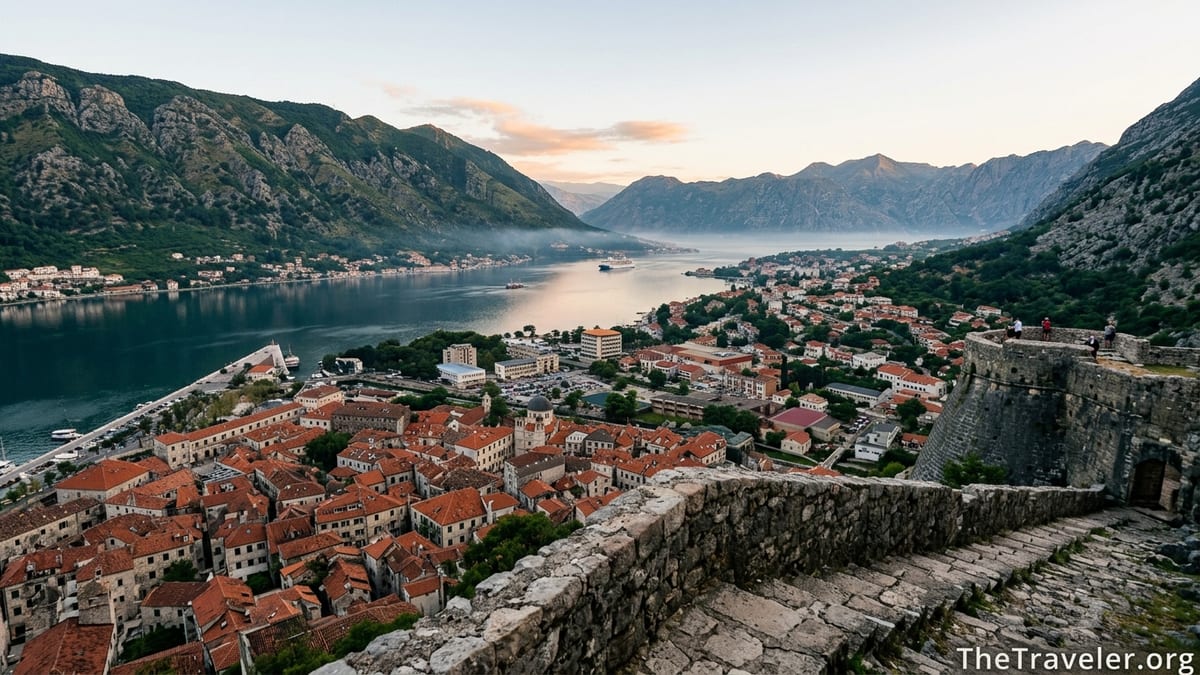
Understanding Kotor and the Bay of Kotor
Kotor sits deep inside the Bay of Kotor, a dramatic inlet on Montenegro’s Adriatic coast that looks more like a Norwegian fjord than a Mediterranean beach resort. The UNESCO-listed Natural and Culturo-Historical Region of Kotor includes the fortified Old Town, its walls marching up the mountain, and the surrounding inner bay. For visitors, this means a compact historic core with big-venue scenery right on its doorstep.
The Old Town itself is tiny, roughly a ten-minute walk from one gate to the other, and completely enclosed by stone walls. The cruise port and main road run just outside the Sea Gate, the principal entrance. You can step off a bus or out of a taxi and be on a shaded square within a few minutes, which is why Kotor absorbs so many day-trippers. Accommodation ranges from simple stone-walled studios inside the Old Town to modern apartments strung along the Dobrota waterfront within a 20 to 30 minute walk.
Tourism here is highly seasonal. From roughly April to October, and especially in July and August, multiple cruise ships can call on the same day, unloading thousands of people into streets originally designed for horses and handcarts. In contrast, an overcast Tuesday in May or a sunny morning in late September can feel remarkably peaceful. When you plan your time in Kotor, you are really planning around this rhythm of cruise arrivals and departures, as much as around the weather.
Because the bay is enclosed, the water is generally calmer than along the open Adriatic, which makes it ideal for easy boat trips and paddleboarding rather than surfing. At the same time, the geography compresses development into a narrow strip between the mountains and the sea. That limited flat land affects almost every practical detail in Kotor, from where you can park to which restaurants have the best views.
Exploring Kotor Old Town
Most visits begin at the Sea Gate, a stone arch facing the harbor. Once inside, you enter a maze of alleys leading to small squares anchored by churches and palaces. The Cathedral of Saint Tryphon, first consecrated in the 12th century, dominates one of these squares with twin bell towers and a simple, pale façade. Another key landmark is the Maritime Museum of Montenegro, set in a former palace and filled with model ships, uniforms and photographs that connect Kotor to its Venetian and Austro-Hungarian past.
In practical terms, you do not need a formal tour to enjoy the Old Town, but a 60 to 90 minute walking tour can help bring the stone to life. Local guides typically charge a modest per-person fee in high season and point out details like carved family crests, hidden courtyards and the marks of past earthquakes on the walls. If you explore independently, give yourself at least two hours to wander slowly, sit in a café and slip into side alleys where the groups rarely go.
The Old Town is almost completely pedestrian, with occasional small utility vehicles early in the morning. Surfaces are mostly smooth stone, which can be slippery in rain or after a summer downpour, so walking shoes with decent grip are more useful here than sandals. Because the streets are narrow, shade lingers for much of the day, making it pleasantly cooler than the waterfront even in July, especially before midday or after 5 pm.
For a quieter atmosphere, aim to enter the Old Town early, around 8 am, when bakers are still stocking counters and delivery carts are rolling in, or later in the evening after most cruise passengers have returned to their ships. If you are staying in Kotor for a few nights, check the latest cruise schedule published by the port or tourism board before locking in dates. Opting for at least one day with no large ship in port can make the difference between shuffling through packed alleys and strolling at your own pace.
Climbing the City Walls and Finding the Best Viewpoints
Kotor’s skyline is defined by its fortifications. The stone walls run from the waterfront up the steep slope of Mount Saint John for around 4.5 kilometers, wrapping the Old Town in tiered lines and bastions. The classic experience is the climb to the upper fortress, often called San Giovanni or St John Fortress, which rewards the 1,300 or so steps with a sweeping view over the red roofs, harbor and the inner bay.
Access to the walls is via signed entrances within the Old Town. In recent seasons, the climb has required a ticket that costs the equivalent of a modest restaurant main course. The fee typically covers the entire route, including the lower church of Our Lady of Remedy and the upper fortress ruins. Many visitors choose to walk up only as far as the church, which you can reach in about 20 minutes at a moderate pace, and still enjoy a beautiful elevated view without committing to the full climb.
Timing is critical. In summer, the stone steps heat up quickly and there is almost no shade on the upper sections. A realistic strategy is to start just after sunrise, often between 6 and 7 am, reach the top before the first big cruise groups, and be back down in the Old Town by mid-morning. The second-best option is to go later in the day, after 5 pm, when the sun drops behind the ridge and the heat begins to ease. Avoid climbing between late morning and mid-afternoon in July and August unless it is an unusually cool or cloudy day.
Beyond the fortress, there are other worthwhile viewpoints. Drivers can take the serpentine P1 road toward Lovćen National Park, where multiple lay-bys offer wide panoramas over almost the entire Bay of Kotor. A newer option is the cable car that connects the bay to the highland plateau above, providing a dramatic overhead view in a matter of minutes. For something more low-key, walking or cycling along the Dobrota waterfront north of the Old Town reveals more intimate perspectives of the bay, with stone jetties, small bathing ladders and old captain’s houses reflected in the water.
Bay of Kotor by Boat: Perast and Our Lady of the Rocks
Seeing Kotor from the water is almost as essential as climbing above it. The calm inner bay makes short boat trips straightforward, and you will find a range of options from simple shared boats to faster speedboat tours. A typical short excursion from Kotor visits Perast, a small baroque town about 20 minutes up the bay by boat, and the tiny artificial islet of Our Lady of the Rocks with its church and museum.
Shared boats usually leave from piers near the park just outside the Old Town walls. Prices vary by season and operator, but as a ballpark figure, a two to three hour group trip that includes Perast and Our Lady of the Rocks often costs in the range of a casual sit-down lunch per person. Private speedboats, which you can charter with a skipper on the spot in summer, are more expensive but offer a flexible schedule and the ability to stop for swims in quieter coves away from the main channels.
Perast itself is little more than a single street along the waterfront, lined with handsome stone houses, several churches and a handful of hotels and restaurants with terraces directly on the bay. Many travelers combine sightseeing with a long lunch here. Be aware that prices on the promenade tend to reflect the location: you may pay significantly more for grilled fish or a risotto with the view at your feet than you would for a similar dish in a backstreet Konoba elsewhere on the bay. It is worth scanning menus before you sit, especially in peak season.
Boats to Our Lady of the Rocks typically drop passengers for 20 to 30 minutes, enough time to circle the small island, go into the church if it is open, and take photographs back toward Perast and the mainland. In strong sun, there is almost no shade outside the church, so a hat and water are important. If you are visiting in July or August, consider booking a morning departure around 9 am or an early evening trip; the middle of the day can see intense heat and a constant flow of tour boats.
Cruise Crowds, Parking and Getting Around
The same geography that gives Kotor its drama also concentrates traffic. The Old Town is car-free, and the main road hugs the bay in a single corridor. Parking lots sit between the walls and the water or a short walk away along the road. In July and August, local car rental companies and parking guides consistently warn that these lots can be effectively full by around 9 am on busy days, especially when multiple cruise ships are in port.
If you are arriving by car and want to park close to the Old Town, aim to reach Kotor before 8 am or after roughly 6 pm. Most central lots charge by the hour, typically a few euros, with daily totals that can exceed a casual restaurant bill if you stay from morning to evening. Slightly cheaper options exist further from the walls, but they may involve a ten to fifteen minute walk along the waterfront. Street parking is limited and policed, and stopping “just for a photo” on double yellow lines near the walls is an easy way to earn a fine.
Travelers who are nervous about summer parking pressure often choose to base themselves in nearby towns and visit Kotor without a car. Buses connect Kotor reasonably frequently with Budva and Herceg Novi, and many visitors stay in Dobrota or further around the bay in places like Prčanj, where accommodation may include on-site parking. From there, you can walk or take a short taxi ride into the Old Town and avoid the stress of hovering for a space.
For cruise passengers, the situation is simpler. The tender pier or dock is immediately opposite the Old Town, and you can be inside the Sea Gate within minutes of disembarking. The trade-off is that you are part of the daily crowd spike. To make the most of limited shore time, flip the standard pattern used by large groups. Start with the fortress climb or a quiet Old Town loop as soon as you land, then use midday for a sit-down lunch in the shade or a slower bay cruise while others are queuing for viewpoints in the heat.
Eating, Drinking and Practical Costs
Kotor’s food scene is shaped by its position between mountains and sea. On typical menus you will see grilled or baked Adriatic fish, squid and mussels alongside cured meats, local cheeses and hearty stews that reflect inland traditions. In the Old Town, most restaurants target visitors, with pricing that can range from good value to unapologetically tourist-focused, particularly on the busiest squares with prominent views of churches or the walls.
As a rough orientation, a simple espresso at a café away from the main gate may cost around the price of a city bus ticket elsewhere in Europe, while a main course of grilled chicken or pasta can be comparable to mid-range restaurant prices in neighboring coastal destinations. Fresh fish priced by weight, particularly sea bass or gilt-head bream, tends to be the splurge option, as do platters of mixed seafood. Perast’s waterfront restaurants often add a premium on top of this, trading on the close-up views of the islets and the constant stream of boats.
To eat well without overspending, look for Konobas and smaller family-run places on side streets or just outside the walls in Dobrota, where a plate of grilled vegetables, local cheese and bread can form a satisfying lunch at more moderate cost. Ask locally for current favorites, as ownership and quality can shift from season to season. If you have dietary restrictions, especially vegetarian or vegan, it is worth messaging or calling ahead if you plan to join a full-day boat or mountain excursion, since options en route may be limited to simple salads and bread.
Most accommodations will add a modest per-person, per-night tourist tax to your bill, which is standard across Montenegro. Card payments are widely accepted in hotels and established restaurants, but small bakeries, kiosks and bus ticket counters may prefer cash, so carrying some euros for small purchases is wise. Tipping is not obligatory yet appreciated; rounding up the bill or leaving around ten percent for good service is customary in sit-down restaurants.
Planning Your Stay and Timing Your Visit
The best time to visit Kotor depends on what you value most. Late spring and early autumn, especially May, June and September, usually strike a balance between pleasant temperatures, relatively clear water and cruise traffic that is busy but not at its most intense. Summer brings long days, warm sea and vibrant nightlife, but also the densest crowds, higher accommodation prices and parking headaches. Winter is quieter and can be atmospheric on fine days, though some seasonal restaurants and boat operators close or run shorter hours.
When booking accommodation, understand exactly where a room is located. Staying inside the Old Town walls immerses you in the medieval setting, with stone staircases, bell chimes and narrow alleys right outside your door. It also means hauling luggage over cobblestones from the nearest gate, dealing with occasional nighttime noise and accepting that there is no on-site parking. Staying just outside the walls, or further along the bay in Dobrota or Prčanj, usually gives you easier access to parking, more modern facilities and quieter nights, at the cost of a slightly longer walk to the main sights.
However long you stay, build slack into your schedule. A common pattern for first-time visitors is to arrive from Dubrovnik or Podgorica, spend an afternoon in Kotor, and leave the next morning. This gives you enough time for a quick Old Town circuit and perhaps a short boat ride if everything runs exactly to plan. A more relaxed approach is to spend two or three nights in the bay, which allows you to pick a cooler morning for the fortress climb, another for Perast and Our Lady of the Rocks, and still have time for an unscripted evening wandering the alleys or watching the harbor from a café terrace.
Always keep an eye on the daily weather forecast. In summer, short but intense afternoon thunderstorms are fairly common; they can drench the Old Town and make the fortress steps treacherous for an hour or two, then pass, leaving clear skies behind. On such days, you might swap your planned climb for a museum visit or long lunch and wait for the stones to dry. Flexibility is especially valuable if you are traveling with children or older relatives who may tire quickly in the heat.
The Takeaway
Kotor’s appeal lies in the contrast between its miniature size and its outsized setting. Within a walled area small enough to cross in minutes, you can trace centuries of history in palaces, churches and fortifications, then look up to see cliffs and clouds towering overhead and, beyond the walls, the calm surface of the bay. In recent years, that same compactness has made Kotor vulnerable to crowding, especially on peak cruise days, so a satisfying visit depends as much on when and how you move as on where you go.
With a bit of planning, you can tilt the experience in your favor: enter the Old Town early or late, climb the walls in the cool, take a boat to Perast before lunch or as the light softens in the evening, and use the rest of the day for slow walks and shaded café stops. If you are driving, arrive outside the busiest hours and consider basing yourself in neighboring villages to enjoy easier parking and quieter waterfronts. Above all, give Kotor enough time to breathe. The city rewards those who let the rhythms of the bay dictate the pace rather than the arrival schedule of the next ship.
FAQ
Q1. How many days do I need in Kotor to see the main sights?
Most travelers are comfortable with two full days and nights in Kotor. That usually gives you time for a relaxed Old Town visit, a fortress climb in cool hours, and a separate half-day for a boat trip to Perast and Our Lady of the Rocks, with space left for unscripted wandering or a swim along the bay.
Q2. When is the best time of year to visit Kotor?
Late spring and early autumn, especially May, June and September, generally offer the best balance of pleasant temperatures, manageable cruise crowds and open services. July and August deliver the warmest water and longest days but also the heaviest visitor numbers, while winter can be quiet and atmospheric yet more limited in terms of boat tours and seasonal restaurants.
Q3. How difficult is the climb to Kotor’s fortress and city walls?
The climb involves roughly 1,300 stone steps and can take 45 to 60 minutes each way for someone of average fitness, with little shade on the upper sections. Many visitors choose to walk only as far as the church of Our Lady of Remedy, about 20 minutes up, which still gives rewarding views without the full effort.
Q4. Do I need to buy a ticket to walk the walls?
In recent seasons, access to the main fortress path and wall circuit has required a paid ticket collected at the entrance booths in the Old Town. The fee typically includes both the lower sections and the upper fortress, and is priced at about the level of a simple restaurant main course. Carry cash or a card, as policies can change from year to year.
Q5. Is it better to visit Perast and Our Lady of the Rocks by boat or by car?
Most visitors prefer boat trips from Kotor because they combine transport with views along the bay and easy access to the islet of Our Lady of the Rocks. You can also drive or take a bus to Perast and then hop on one of the small shuttle boats from the waterfront, which may appeal if you are already touring the bay by car.
Q6. How bad are cruise crowds in Kotor?
On peak summer days with multiple large ships in port, Kotor’s Old Town can feel extremely crowded between late morning and mid-afternoon, with slow movement in the narrow alleys. Early mornings and evenings are much calmer. Checking the cruise schedule before choosing your travel dates or daily plans is one of the most effective ways to improve your experience.
Q7. What are parking options like near Kotor Old Town?
Parking near the Old Town is limited and paid, with lots along the bay road and near the Sea Gate filling quickly in July and August. Arriving before 8 am or after 6 pm significantly improves your chances of finding a space. Many travelers choose accommodation that includes parking in nearby Dobrota or other bay villages and then walk or take a taxi into Kotor.
Q8. Can I swim in the Bay of Kotor near the Old Town?
You can swim in designated spots along the bay, particularly further out in Dobrota and other villages where stone jetties and small “beaches” are common. Close to the Old Town the waterfront is more built up and busy with boat traffic, so most people walk or drive a short distance along the bay to find cleaner, quieter swimming areas.
Q9. Is Kotor suitable for families with children?
Kotor can work well for families, especially with school-age children who enjoy exploring castles and boat rides. Parents should be mindful of heat on the fortress climb, steep drops along some viewpoints and the lack of car access within the Old Town, which means strollers must cope with stone surfaces. Planning activities early or late in the day helps avoid the worst of the sun.
Q10. Do I need a car to enjoy Kotor and the Bay of Kotor?
You do not need a car to enjoy Kotor itself or take basic boat trips on the bay, as the Old Town and harbor are compact and walkable. A car is useful if you want to explore further afield, including Lovćen National Park or multiple villages around the bay, but it also brings parking challenges in peak season, so some visitors combine a car for part of their trip with car-free days in Kotor.