


Kuala Lumpur International Airport (KUL) is many travelers’ first taste of Malaysia. Spread across two large terminals, it can feel overwhelming on a first visit, especially after a long-haul flight. This guide breaks down how Kuala Lumpur International Airport works in real life, from choosing the right transport into the city to surviving late-night layovers, finding a bed between flights, and navigating immigration when you are entering Malaysia for the first time.
Get the latest updates straight to your inbox!
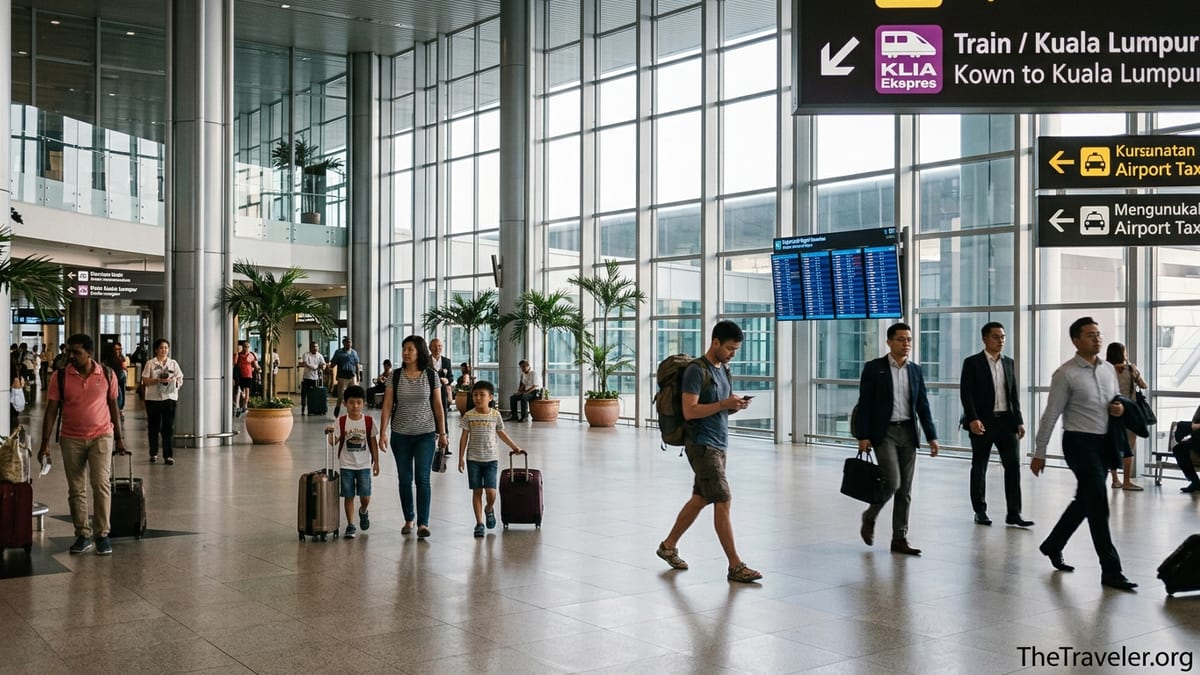
Orientation: Understanding KUL, Terminal 1 and Terminal 2
Kuala Lumpur International Airport consists of two main terminals: Terminal 1, the original building often associated with full-service carriers and long-haul flights, and Terminal 2, a newer low-cost carrier hub previously branded as KLIA2. The two terminals sit a short distance apart, roughly a couple of kilometers, and are connected by rail and road. In practice, they feel like two separate airports, so it is important to know which terminal your flight uses before you land or depart.
Most legacy and full-service airlines such as Malaysia Airlines and many international carriers typically use Terminal 1. Terminal 1 has a main contact pier and a satellite building linked by an automated people mover, with separate areas for domestic and international operations. Terminal 2 is dominated by low-cost carriers, with AirAsia and AirAsia X as the most visible names, and is designed around high passenger volumes and short turnarounds. If your ticket involves AirAsia for any leg, assume you will use Terminal 2 unless specifically stated otherwise.
Both terminals have their own immigration, security, baggage claim and check-in facilities, so you usually remain within one terminal for your entire journey. However, if you are connecting between a full-service airline and a low-cost carrier on separate tickets, you may have to transfer between Terminal 1 and Terminal 2, clear immigration, collect your checked bag, and then recheck in. Allow generous time for this kind of self-transfer, especially during peak evening or holiday periods.
Transit between Terminal 1 and Terminal 2 is straightforward but requires a short ride. The Express Rail Link (ERL) trains, including the KLIA Ekspres and KLIA Transit, connect the two terminals in just a few minutes, and there are also airport shuttle buses and taxis. If, for example, you land in Terminal 1 at 22:00 and have a low-cost departure from Terminal 2 after midnight, plan at least 3 hours total to clear immigration, collect baggage, move between terminals and check in again, particularly if you also intend to buy a SIM card or change money.
Arrivals: Immigration, Baggage and First Steps into Malaysia
On arrival at either terminal, you will first pass through immigration. Queues fluctuate by time of day and season; late-night banks of arrivals and early-morning waves can both generate heavy lines. Citizens of many countries receive visa-free entry or visas on arrival, but rules change, so check in advance and carry printed confirmation of your onward ticket and accommodation just in case. The immigration officers typically ask standard questions about your stay, such as where you are staying in Kuala Lumpur and for how long.
After immigration, you proceed to baggage claim. Kuala Lumpur International Airport has modern carousels and screens in English and Malay indicating your flight number. If you have connecting flights on separate tickets, this is where you must collect any checked luggage before re-checking at the next airline’s counter. Baggage trolleys are widely available and free to use, which is a relief if you have multiple suitcases or sports equipment.
Once you pass customs, you enter the public arrivals hall. This is your moment to get set up for Malaysia. Airport money changers and ATMs are easy to find in both terminals. Exchanging a small sum for immediate expenses, or withdrawing cash in Malaysian ringgit (MYR), is generally enough for transport and food on the first day. You will also see multiple mobile providers with kiosks offering tourist SIM packages, which often bundle data with local calls and, sometimes, discounts on ride-hailing or attractions. Setting up a SIM at the airport can make using Grab, maps, and translation apps much easier in the first hour outside.
In the arrivals area, you will encounter touts offering taxi or transport services. For a first-time visit, it is safer to stick to official airport taxis, the KLIA Ekspres ticket counters, or ride-hailing apps rather than following anyone who approaches you unsolicited. The airport signage points clearly to official taxi counters and the Express Rail Link station; following the big overhead signs will generally steer you toward legitimate options.
Getting to the City: KLIA Ekspres, KLIA Transit, Buses and Taxis
The most efficient way from Kuala Lumpur International Airport to downtown Kuala Lumpur is the KLIA Ekspres, a non-stop airport train service connecting both Terminal 1 and Terminal 2 to KL Sentral, the main rail hub in the city. The ride typically takes around 30 minutes from Terminal 1 to KL Sentral, slightly more if you start from Terminal 2, and runs most of the day with frequent departures. Standard one-way fares are in the range of several dozen ringgit per adult, with discounts sometimes available for return tickets, families, or online purchases. The train cars are air-conditioned, with luggage racks and power outlets on newer sets.
The KLIA Transit is a related service using the same tracks but stopping at several intermediate stations between the airport and KL Sentral. Travel time is slightly longer, but it can be convenient if you are staying near suburbs like Putrajaya or Cyberjaya and prefer to avoid going all the way into central Kuala Lumpur first. Tickets for KLIA Ekspres and KLIA Transit are easy to buy from ticket counters, vending machines, or official apps; both services share the airport stations at each terminal, and signs clearly indicate which platform is for non-stop versus stopping trains.
For budget-conscious travelers, airport buses connect both terminals to various points in the city, particularly KL Sentral and some major neighborhoods. These buses cost significantly less than the airport train, often in the low tens of ringgit, and can be a good choice if you are not in a hurry or traveling outside peak road-traffic times. Expect a journey of around one hour or more, depending on traffic conditions. Tickets are sold at clearly marked bus counters in the arrivals area and, in some cases, directly from the driver.
Taxis and ride-hailing services offer door-to-door convenience. Official airport taxi counters inside the terminal sell fixed-fare coupons for different zones in the city, which helps you avoid haggling. Ride-hailing apps like Grab are widely used, and typical fares from the airport to central Kuala Lumpur often fall in a general band comparable to a mid-range restaurant meal, with higher prices during peak times or heavy rain. The ride can take 45 minutes to over an hour depending on traffic. If you arrive late at night with heavy luggage or small children, a pre-booked Grab or an airport taxi is usually the least stressful option.
Using Grab and Other Ground Transport at KUL
Grab is the dominant ride-hailing app in Malaysia and many visitors use it from the moment they exit the terminal. Before your trip, it is worth installing the Grab app and setting up payment, although cash payments are also common. When you land, connect to the airport Wi-Fi or your new SIM card, open the app, set your pickup location to your terminal and level, and request a car. The app will show the designated pickup zones; at Terminal 2, for instance, Grab vehicles typically use specific bays on the lower levels, away from the main taxi lanes.
In real-world terms, a standard Grab car from Kuala Lumpur International Airport to a central area such as Bukit Bintang, KLCC, or Chinatown often costs in the region of 70 to 100 ringgit in normal conditions, depending on time of day and demand. At quieter times, prices can be lower; at late-night or during severe weather, surge pricing can push them higher. Tolls along the highway are sometimes added to the fare or paid in cash at tollbooths, and the app usually indicates whether they are included. For a family or small group sharing one car, this door-to-door cost is often comparable to combining several train tickets plus a final taxi ride from KL Sentral.
If you prefer a more traditional taxi, head for the official taxi coupon counter after customs. Here you pay in advance for a fixed fare based on the zone of your destination. The staff will hand you a coupon, which you then present to the taxi driver at the rank outside. This system helps to avoid negotiation, though it can be slightly more expensive than Grab for some destinations. For business travelers or those wanting extra comfort, there are also premium taxi options and private transfer services, which use larger sedans or vans and are priced accordingly.
Public buses and intercity coaches operate from designated areas outside the terminals. For example, travelers headed straight to other Malaysian cities such as Malacca or Ipoh may find direct coaches departing from the airport, saving a trip into central Kuala Lumpur. These services are usually cheaper than hiring a car or arranging a private transfer, but schedules can be limited. If you plan to use a long-distance bus immediately after landing, try to book in advance and allow extra time for immigration and baggage, as missing a scheduled coach can mean a long wait for the next departure.
Layovers, Transit Hotels and Sleeping at the Airport
Kuala Lumpur International Airport is a practical hub for long layovers, with a range of options from full-service hotels to capsule-style pods. Inside Terminal 1 and Terminal 2, several transit hotels are purpose-built for passengers with long connections who prefer not to leave the airport. Brands such as Sama-Sama Express and Aerotel operate airside and landside, offering rooms in blocks of hours so you can shower and sleep without committing to a full overnight stay. A typical short-stay block might be in the 6- or 12-hour range, and while per-hour costs are higher than downtown hotels, the convenience of staying inside the terminal is significant.
Capsule-style accommodation has also become popular at KUL. CapsuleTransit, for example, runs sleep pods and compact rooms in public and transit areas across both terminals. These are designed for solo travelers or couples who just need a clean bed, a shower, and a secure place to store bags for a half-day stopover. Prices are typically far below a full hotel room, making them attractive to backpackers or digital nomads on long-haul routes between Asia, Europe, and Australia. Booking in advance is wise during peak holiday seasons, as these compact facilities can sell out when multiple night flights converge.
If you prefer a traditional hotel room with more space, there are full-service properties connected to or very near the terminals. At Terminal 1, the main airport hotel is linked by a covered walkway or short shuttle, offering standard hotel amenities like restaurants, a gym, and extended room service. Around Terminal 2, you will find options such as Aerotel and various nearby hotels accessible on foot or via a short shuttle. Room rates vary considerably with demand, but you can sometimes find competitive nightly prices comparable to a mid-range city hotel, especially if you book ahead.
Some travelers on tight budgets choose to sleep in public areas of the terminals during overnight layovers. While this is generally tolerated if you stay discreetly near your gate or in quieter seating zones, comfort is limited compared with a paid bed. Bright lighting, cleaning announcements, and cooler air conditioning can make real sleep difficult. For first-time visitors, especially those carrying valuables, a paid capsule or transit hotel is usually a safer and more restful choice than stretching out on the floor or benches.
Departures: Check-in, Security and Boarding from T1 and T2
When departing from Kuala Lumpur International Airport, aim to arrive at least 2 to 3 hours before an international flight and 90 minutes to 2 hours before a domestic one. Terminal 1 and Terminal 2 both handle large numbers of passengers, and queues at check-in, baggage drop, security, and immigration can build quickly around major banks of departures, such as late-night flights to Europe or early-morning regional services. Self check-in kiosks and bag-drop counters are available for many airlines, particularly low-cost carriers in Terminal 2, but you should not rely on them to compensate for arriving late.
At Terminal 1, check-in counters are grouped by airline along several islands, with big overhead displays showing current assignments. After check-in and baggage drop, you pass through security and, for international flights, immigration, before emerging into the departures area. The satellite building, reached by an automated train, houses many of the long-haul gates, so you need to allow extra travel time from the main terminal. Boarding for wide-body flights often begins 40 minutes or more before departure time, and some gates close early, so pay attention to announcements and screens.
Terminal 2 is built around a large departure hall with long rows of check-in counters for budget carriers like AirAsia and others. The process is generally efficient but unforgiving if you arrive late, with firm cut-off times for bag drop, sometimes as early as one hour before departure. The terminal includes extensive dining and retail options, including a multi-level mall area, but you should proceed through security and immigration before getting too comfortable in public zones. Inside the secure departures area, you will find more food choices, duty-free shops, prayer rooms, and lounges.
Both terminals offer airline lounges and independent pay-per-use lounges that can be a good refuge on long travel days. Access rules vary; some accept major credit cards with lounge benefits or allow walk-in entry for a fee payable in ringgit or by card. Facilities typically include Wi-Fi, light meals, showers, and, in some cases, nap areas. If you are connecting between two flights at KUL and remain airside, consider whether a lounge pass will make your wait significantly more comfortable, particularly if you need to work or rest.
First-Time Tips for Arriving in Malaysia
For many visitors, Kuala Lumpur International Airport is the first contact with Malaysian culture and practicalities. One of your early tasks after landing should be arranging phone connectivity. Airport SIM counters from major Malaysian providers offer tourist packages that usually include several dozen gigabytes of data over one to four weeks, often at prices that compare favorably to roaming charges from foreign providers. Staff will typically set up and activate the SIM for you on the spot if you hand over your passport and unlocked phone.
Cash remains widely used across Malaysia, though card payments and contactless methods are common in malls, chains, and hotels. At the airport, you can pay for most services by card, but having at least 100 to 200 ringgit in small notes is helpful for highway tolls included in taxi fares, small snacks, and tipping porters or hotel staff if you choose to. Currency exchange counters operate long hours and display rates clearly; ATMs from major Malaysian banks accept most international cards and often provide competitive exchange rates, subject to your own bank’s fees.
Malaysia’s climate is hot and humid year-round, which can be a shock when you first step outside after hours in air-conditioned terminals. Light, breathable clothing is more comfortable once you reach the city, but airplanes and airport interiors can feel cool, so keep a light layer handy in your carry-on. If your schedule allows, try to time your journey into the city to avoid the worst of the evening rush, when the highways between KUL and central Kuala Lumpur can experience heavy, slow-moving traffic.
Cultural considerations are straightforward for most visitors. Malaysia is multi-ethnic and relatively relaxed, but it is also a majority Muslim country. Dressing modestly in public, particularly when visiting smaller towns or religious sites later in your trip, is appreciated. At the airport, you will see prayer rooms and halal food options signposted in both terminals. English is widely spoken among airport staff, taxi drivers, and hotel receptionists, so communicating your needs is usually not difficult.
The Takeaway
Kuala Lumpur International Airport is a major Southeast Asian hub that can feel complex at first glance, with two large terminals, multiple train services, and a spread of transit hotels and ground transport options. Once you break it down, however, the airport is relatively easy to navigate, provided you know which terminal your airline uses and allow enough time at each stage of your journey.
For first-time visitors to Malaysia, the key decisions involve how you will enter the city and how you will handle any layovers. The KLIA Ekspres and KLIA Transit trains offer quick, predictable rides into central Kuala Lumpur, while Grab and official taxis provide flexible, door-to-door service at prices that are reasonable by international standards. Inside the terminals, transit hotels and capsule accommodations mean that even awkward overnight connections can be managed with a proper bed and shower.
By planning ahead for immigration, baggage, phone connectivity, and transport, you can turn your arrival at KUL from a source of stress into a smooth introduction to Malaysia. With a little preparation and realistic expectations about queues and travel times, Kuala Lumpur International Airport becomes less of a maze and more of a gateway to the country’s food, culture, and landscapes.
FAQ
Q1. Which terminal will my flight use at Kuala Lumpur International Airport?
Most full-service and long-haul international airlines use Terminal 1, while low-cost carriers such as AirAsia and AirAsia X typically operate from Terminal 2. Always check your booking and boarding pass, as terminal allocations can change.
Q2. How long does it take to travel from KUL to central Kuala Lumpur?
The KLIA Ekspres airport train usually takes around 30 minutes from the airport to KL Sentral, while taxis or Grab rides often take 45 minutes to over an hour depending on traffic and time of day.
Q3. What is the fastest way to get from the airport into the city?
The KLIA Ekspres non-stop train from both terminals to KL Sentral is generally the fastest and most predictable option, especially during rush hour when highway traffic can slow cars and buses significantly.
Q4. Is Grab cheaper than the KLIA Ekspres for a solo traveler?
For a solo traveler, the KLIA Ekspres can be similar or slightly cheaper than a Grab ride, depending on promotions and time of day. For two or more people sharing one car, Grab often works out to be good value for door-to-door service.
Q5. Are there hotels inside Kuala Lumpur International Airport?
Yes. Both terminals have airside and landside transit hotels, including capsule-style options and full-service rooms. Facilities like Sama-Sama Express, Aerotel, and CapsuleTransit cater to different budgets and layover lengths.
Q6. Can I sleep in the airport without booking a hotel?
It is generally possible to rest in public seating areas, and some travelers do so during overnight layovers. However, lighting, noise, and security concerns make a paid capsule or transit hotel a more comfortable and secure choice.
Q7. How early should I arrive at KUL before my flight?
Plan to be at the airport at least 2 to 3 hours before international departures and 90 minutes to 2 hours before domestic flights. Add extra time if you need to transfer between terminals or check in at peak periods.
Q8. Where can I buy a SIM card at the airport?
Mobile operators have clearly marked counters in the arrivals halls of both terminals. They offer tourist SIM packages with data and local calls, usually activated on the spot once you present your passport.
Q9. Is it easy to transfer between Terminal 1 and Terminal 2?
Yes. The terminals are linked by rail and road, and the Express Rail Link trains make the journey in a few minutes. Still, if you have separate tickets requiring baggage collection and re-check, allow several hours for the full process.
Q10. Do I need cash immediately on arrival, or can I rely on cards?
Cards are widely accepted for transport tickets, hotels, and many shops, but having some Malaysian ringgit on arrival is useful for smaller purchases, tolls included in taxi fares, and places that prefer cash.