


Kuala Lumpur International Airport is one of Southeast Asia’s major hubs, but its two-terminal setup can be confusing. Tickets may show “KUL,” “KLIA,” “KLIA1,” “KLIA2,” “Terminal 1,” or “Terminal 2,” sometimes all referring to slightly different things. Choosing the wrong terminal can easily cost you time, money, and even a missed flight. This guide breaks down the differences between Terminal 1 and Terminal 2, how full-service airlines and low-cost carriers are split, and what to do if you land at the wrong place.
Get the latest updates straight to your inbox!
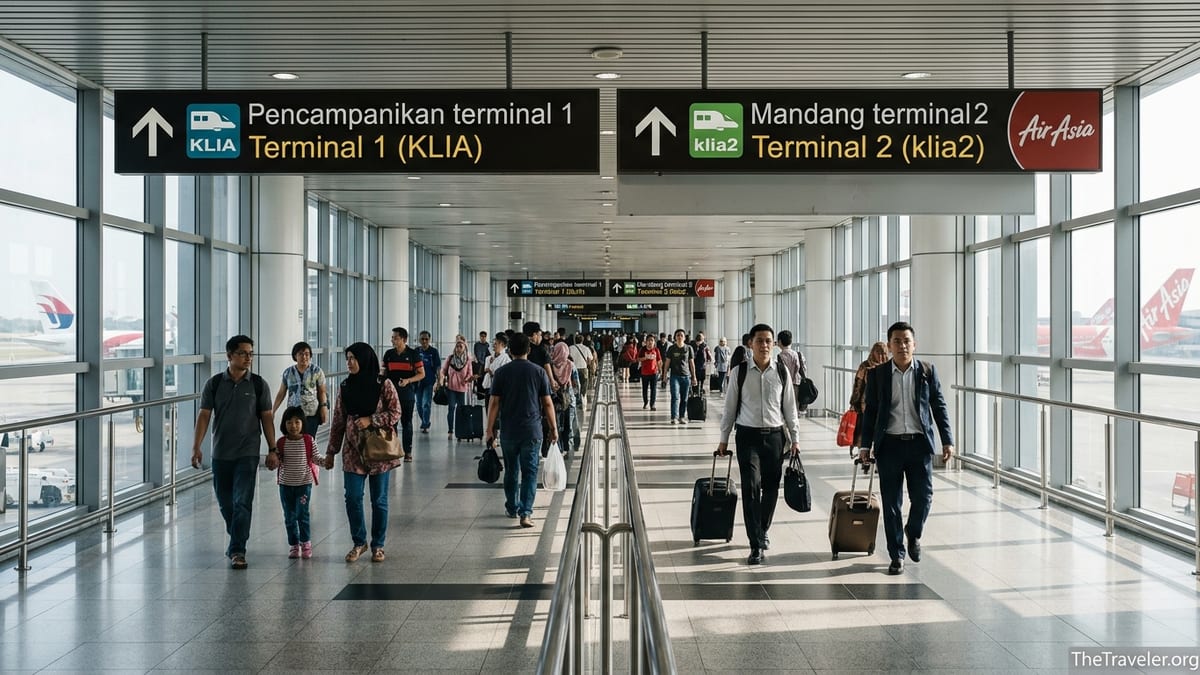
KLIA in a Nutshell: One Airport, Two Terminals
Kuala Lumpur International Airport carries a single IATA airport code, KUL, but operates two separate passenger terminals: Terminal 1 and Terminal 2. Terminal 1 is the original main terminal that opened in the late 1990s and handles most full-service and legacy airlines. Terminal 2, previously branded “klia2,” opened later as a low-cost carrier terminal and today is heavily dominated by AirAsia and its affiliated airlines.
The two terminals sit roughly 2 kilometers apart, each with its own check in halls, security, immigration, baggage claim and transport connections. You cannot simply walk from one to the other within the secure area. If you need to change terminals, you must fully exit to landside and then travel by airport train or shuttle before checking in again.
This setup is particularly important for self-connecting travelers. For example, a passenger arriving from Tokyo on Japan Airlines into Terminal 1 and then continuing to Bali on AirAsia from Terminal 2 will need to budget time to clear immigration, collect luggage, transfer between terminals, and check in again at the new terminal.
The key point: your boarding pass will always show KUL, but you must know which terminal your airline uses. Terminal 1 and Terminal 2 are different buildings with separate security and boarding gate systems. Treat them as two distinct airports that happen to sit side by side.
Terminal 1: Full-Service & Long-Haul Hub
Terminal 1 is the main hub for Malaysia Airlines and a long list of full-service international carriers. In practice, if you are flying with airlines such as Malaysia Airlines, Singapore Airlines, Cathay Pacific, Qatar Airways, Emirates, British Airways, Japan Airlines, Korean Air, or Turkish Airlines, you will almost certainly be using Terminal 1 for both departure and arrival. Many regional full-service carriers and some newer medium-haul operators also call this terminal home.
Physically, Terminal 1 consists of a main building with check in halls, immigration, and domestic gates, plus a satellite building connected by an automated people mover. Long-haul flights to Europe, the Middle East, North Asia, and Australia often depart from the satellite’s international gates. It feels like a typical full-service Asian hub terminal, with duty-free shops, brand-name boutiques, airport lounges, and a range of sit-down and fast-casual restaurants.
Business and frequent travelers often appreciate Terminal 1’s lounge selection. Malaysia Airlines runs several lounges for its premium and oneworld passengers, while other carriers either maintain their own facilities or use contract lounges. For example, a Qatar Airways business-class passenger flying Kuala Lumpur to Doha can relax in a partner lounge with hot food, showers, and quiet workspaces before boarding.
For domestic trips on Malaysia Airlines or Batik Air, Terminal 1’s domestic gates provide seamless same-terminal connections. A traveler flying Kuching to Kuala Lumpur to London on Malaysia Airlines will usually check bags through to London and simply follow transfer signs airside, without changing terminals or rechecking luggage.
Terminal 2: Low-Cost Carrier Stronghold and AirAsia’s Home
Terminal 2 is the low-cost carrier terminal and the main base for AirAsia’s Malaysian operations. Virtually all AirAsia, AirAsia X and related brand flights now use this terminal. If your ticket shows AirAsia flight numbers such as AK, D7, FD, or other group codes, you should assume you will be departing from or arriving into Terminal 2 unless explicitly told otherwise.
This terminal was purpose-built around the low-cost model. It is connected to a large commercial complex, often referred to as the gateway mall, stacked with budget eateries, convenience stores, pharmacies, and mid-range retail. Travelers on early-morning AirAsia flights often stay at the on-site capsule hotels or mid-range hotels integrated into or next to this complex, walking directly into the departure hall the following morning.
Inside the terminal, expect long, straight concourses and plenty of walking, especially to the higher lettered gates. Domestic flights to popular Malaysian destinations such as Penang, Langkawi, Kota Kinabalu, and Kuching, as well as short international hops to Bangkok, Singapore, Bali, and Ho Chi Minh City are common sights on the departure board. While amenities are not as plush as Terminal 1’s flagship lounges, there are pay-per-use lounges such as Plaza Premium, useful for travelers on longer layovers who want showers or workspace.
Because AirAsia operates largely on a point-to-point basis rather than a traditional hub-and-spoke system, many travelers use Terminal 2 for self-connecting itineraries that pair a long-haul AirAsia X flight with a shorter domestic leg. For example, someone might fly Sydney to Kuala Lumpur on AirAsia X and then continue Kuala Lumpur to Kota Bharu on AirAsia, never leaving Terminal 2.
Full-Service vs Low-Cost: How Airline Type Decides Your Terminal
The broad pattern at Kuala Lumpur is simple: full-service airlines use Terminal 1, while low-cost carriers use Terminal 2. In reality, there are occasional exceptions and regional nuances, but this basic rule will correctly guide most first-time visitors. If you booked a ticket that included checked baggage, a free meal, and potentially seat selection on an airline like Malaysia Airlines, Emirates, or Singapore Airlines, Terminal 1 is your likely starting point.
Conversely, if you booked a no-frills fare that required you to pay extra for baggage or seat choice, and your confirmation email shows airlines such as AirAsia, Cebu Pacific, Scoot, or other budget brands, you can assume Terminal 2. For example, a traveler coming from Manila on Cebu Pacific and continuing to Phuket on AirAsia will be fully Terminal 2 for both legs, even though those are two different airlines, because both are low-cost carriers that have chosen the same terminal environment.
The distinction matters in practical terms. Terminal 1 is generally set up for more traditional connecting itineraries, with better integrated transfer desks and options for through-checking luggage on a single ticket. Terminal 2, especially for AirAsia, is optimized for fast point-to-point turnarounds and high passenger throughput rather than seamless interline connectivity with other airline groups.
When in doubt, the single best shortcut is this: if you see AirAsia anywhere on the ticket, think Terminal 2. If you see Malaysia Airlines or a major international legacy brand, think Terminal 1. Mixed itineraries, such as Malaysia Airlines one way and AirAsia the other, will require you to pay close attention to which terminal you are using on each leg.
Finding Your Flight: Decoding KUL, KLIA, KLIA2 and Terminal Labels
Part of the confusion around Kuala Lumpur arises from how different websites and apps label the terminals. Flight search engines and booking sites often still use “KLIA” and “klia2” as unofficial names alongside the newer Terminal 1 and Terminal 2 designations. These are simply two ways of describing the same places: KLIA equals Terminal 1, and klia2 equals Terminal 2.
On your booking, you might see a departure like “Kuala Lumpur Intl, KLIA” with no mention of terminal number. In that case, check which airline is operating the flight. If it is Malaysia Airlines, Singapore Airlines, or another full-service carrier, you should treat that as Terminal 1. On the other hand, a booking that says “Kuala Lumpur Intl, KLIA2” is explicitly referring to Terminal 2, almost always associated with AirAsia or other low-cost carriers.
Real-world example: a traveler from London to Bali might book London to Kuala Lumpur on British Airways and Kuala Lumpur to Denpasar on AirAsia as two separate tickets. The London to Kuala Lumpur leg will state “Kuala Lumpur International (KUL), Terminal 1 or KLIA,” while the AirAsia sector might be described as “KUL – Kuala Lumpur International Airport 2 (klia2) or Terminal 2.” Understanding that both are part of the same greater airport but located in different buildings is vital for planning your connection time.
Arrival screens at hotels and in ride-hailing apps such as Grab also usually ask you to choose KLIA or KLIA2 when entering your pickup or drop-off point. Select KLIA for Terminal 1 flights and KLIA2 for Terminal 2 flights. Choosing the wrong option will send your driver to the other building, easily adding 15 to 30 minutes of confusion, backtracking, and potentially extra fare.
Inter-Terminal Transfers, Baggage Claim, and Connection Risks
Because Terminal 1 and Terminal 2 are separate, moving between them requires a landside transfer. The quickest option is the airport train that links the two terminals in just a few minutes. Trains run regularly throughout the day, and the ride itself is short, but you must factor in walking time to and from the platforms, waiting for the next departure, and queuing for immigration and security at both ends of the journey.
For travelers on separate tickets, the process usually looks like this: arrive at Terminal 1 or Terminal 2, clear immigration (if arriving from abroad), collect any checked baggage from the carousel, exit through Customs to the public area, travel by train or shuttle to the other terminal, then locate the check-in counters for the onward airline, drop bags, and clear security and immigration again before proceeding to the departure gate. Under typical conditions, doing all this comfortably can take 3 hours or more.
Consider a realistic scenario. A passenger lands in Kuala Lumpur at 13:00 on an AirAsia flight from Chiang Mai at Terminal 2 and has booked a separate 15:55 Cathay Pacific flight to Hong Kong from Terminal 1. They must deplane, walk to immigration, clear border control, wait for and collect checked luggage, pass Customs, find the train station, ride to Terminal 1, check in, drop bags, clear security and immigration again, and reach the gate. Any delay to the inbound AirAsia flight, long queues at passport control, or slow baggage delivery could quickly make this tight connection fail.
When both flights are on the same airline and under a single booking reference, the situation can be different. For example, Malaysia Airlines might check bags through from a domestic city to an international destination, or AirAsia’s own “Fly-Thru” service can provide protected connections entirely within Terminal 2. However, if your itinerary involves two different airlines in different terminals on separate tickets, assume that missed connections are entirely your responsibility.
Wrong Terminal Mistakes: What Happens and How to Fix It
Arriving at the wrong terminal is a common mistake at Kuala Lumpur, especially for travelers unfamiliar with the KLIA versus KLIA2 naming. Fortunately, it is usually fixable, but it can be stressful and potentially expensive if time is tight. The most frequent scenario is an AirAsia passenger who mistakenly goes to Terminal 1, because their booking app only showed “KUL” and they assumed all flights leave from the same building.
If you realize this mistake on arrival in Kuala Lumpur city, the remedy is straightforward but time-consuming. A Grab driver or taxi can drive between the terminals in around 10 to 20 minutes in normal traffic, and the ride cost between the two airport buildings is modest compared to a city transfer. Alternatively, you can ask to be dropped at the nearby airport train station and ride one stop between KLIA and KLIA2. Either solution will work if you have enough buffer before check-in closes, often 60 minutes before departure for low-cost carriers and a bit longer for some full-service airlines.
More critical is arriving at the wrong terminal on your way back from Kuala Lumpur city or another destination. For instance, imagine you are flying Emirates from Terminal 1 at 19:00 and accidentally tell your driver “KLIA2” because that was the option shown at the top of the ride-hailing app. You arrive at Terminal 2 at 17:30, discover no Emirates counters, and then must transfer to Terminal 1 by train or shuttle. This extra step could shave 30 to 45 minutes off your check-in window, leaving little margin for queues or document checks.
If you truly misjudge and reach the correct terminal after check-in closes, you may be treated as a no-show. Low-cost carriers such as AirAsia are particularly strict; they are unlikely to rebook you for free if the error was yours, and walk-up fares on a new flight on the same day can be significantly higher than your original ticket. Full-service airlines sometimes have more flexible policies, but you should not rely on goodwill. The safest prevention is to double-check your terminal on both the airline’s official app and the airport’s website the day before travel.
Practical Tips for Smooth Travel Through KLIA
To minimize stress and avoid expensive mistakes, start with a simple discipline: always confirm your terminal at least 24 hours before departure. Check the airline’s website or mobile app, then cross-check with the airport’s online airline list that shows whether an airline uses Terminal 1 or Terminal 2. For AirAsia, assume Terminal 2 unless updated guidance says otherwise. For Malaysia Airlines and major full-service international carriers, assume Terminal 1.
Next, build generous connection times into any self-planned transfers that cross between terminals. A safe rule of thumb for international to international self-transfers involving a terminal change is at least 3 hours, and more if you are traveling at a busy time such as late evening bank departures to Europe or during major holidays. For example, a traveler pairing a low-cost flight from Surabaya on AirAsia with a separately booked long-haul to London on a European carrier would be wise to leave 4 hours between scheduled arrival and departure.
When entering “Kuala Lumpur Airport” into ride-hailing or taxi booking apps, manually select KLIA or KLIA2 according to your terminal. If you are unsure, keep your electronic ticket handy and show it to the driver or a staff member when you reach the airport; they can often spot from the airline name whether you are in the wrong place. Similarly, when organizing hotel shuttles from downtown Kuala Lumpur, explicitly state “Terminal 1” or “Terminal 2” rather than the generic “airport.”
Finally, consider the layout of each terminal if you have mobility issues or are traveling with young children. Terminal 2 in particular can involve long walks to distant gates, so allow extra time or request assistance in advance from your airline. Terminal 1’s satellite building is also large, and some gates are a considerable distance from the main amenities, which can matter if you plan to visit a lounge before departure.
The Takeaway
Functionally, Kuala Lumpur International Airport is a single airport with two personalities. Terminal 1 is the traditional full-service hub used by Malaysia Airlines and most major international carriers, while Terminal 2 is the dynamic low-cost base anchored by AirAsia. Understanding which side of the airport your flight uses will shape everything from where you tell your taxi to stop to how much time you need between connections.
If you remember only a few rules, let them be these: AirAsia and most low-cost carriers operate from Terminal 2; Malaysia Airlines and major legacy airlines operate from Terminal 1; and transfers between terminals require you to go landside and allow plenty of time. Confirm your terminal in advance, label it correctly in transport apps, and pad your connection windows, especially when using separate tickets.
Handled with a bit of preparation, KLIA’s two-terminal system works smoothly and can even be convenient, especially for those taking advantage of AirAsia’s extensive network out of Terminal 2 or enjoying the lounge options of Terminal 1. The difference between a calm transit and a stressful sprint often comes down to simply knowing which building you belong in.
FAQ
Q1. How do I know if my flight uses Terminal 1 or Terminal 2 at Kuala Lumpur?
Check which airline is operating your flight. Most full-service airlines like Malaysia Airlines, Singapore Airlines, Emirates, and Qatar Airways use Terminal 1, while AirAsia and many low-cost carriers use Terminal 2. If your booking or airline app mentions “klia2,” that is Terminal 2.
Q2. Are KLIA, KLIA1, and Terminal 1 all the same place?
Yes. When you see KLIA or KLIA1 on screens, tickets, or in transport apps, it refers to the main Terminal 1 building of Kuala Lumpur International Airport. KLIA2 is the older name still widely used for Terminal 2.
Q3. If my ticket says KUL but not a terminal, what should I do?
Use the airline name as your guide. If it is a full-service or legacy carrier, assume Terminal 1. If it is AirAsia or another low-cost carrier, assume Terminal 2. You can then confirm on the airline’s website or app before you travel.
Q4. How long does it take to transfer between Terminal 1 and Terminal 2?
The actual train ride between terminals is only a few minutes, but you must add time for walking, waiting for the next train, and clearing immigration and security. For separate tickets involving a terminal change, plan at least 3 hours between flights, and more during busy periods.
Q5. Do I need to collect my baggage if I am changing terminals?
In most cases, yes. If your flights are on separate tickets or different airlines in different terminals, you will need to collect checked baggage, exit to the public area, transfer to the other terminal, and check in again. Through-checked luggage is usually possible only when both legs are on the same airline or on a single ticket.
Q6. What happens if I go to the wrong terminal for my flight?
You will need to travel to the correct terminal, either by airport train or shuttle, and then locate your airline’s check-in counters. If this causes you to miss the check-in cutoff time, your airline may treat you as a no-show and require you to buy a new ticket, especially on low-cost carriers.
Q7. Can I stay airside when connecting between Terminal 1 and Terminal 2?
No. Terminal 1 and Terminal 2 have separate secure areas, and there is no direct airside corridor between them. To change terminals, you must go landside, which means clearing immigration and Customs where applicable before transferring and then re-clearing security and immigration at the new terminal.
Q8. Are there lounges in both terminals?
Yes. Terminal 1 has a wider range of airline and contract lounges used by full-service and long-haul carriers. Terminal 2 also offers pay-per-use lounges and facilities suitable for low-cost and AirAsia passengers, though the overall experience is generally simpler.
Q9. Which terminal is better for shopping and food?
Both terminals offer a mix of duty-free shops and dining options. Terminal 1 leans toward more premium and international brands alongside lounges, while Terminal 2 has a large attached mall with many budget-friendly restaurants, cafes, and convenience stores, often favored by low-cost travelers.
Q10. Is it safe to book a short self-transfer from AirAsia in Terminal 2 to another airline in Terminal 1?
Booking a tight self-transfer across terminals is risky. Delays, long queues, or slow baggage delivery can easily cause you to miss your second flight. If you must self-connect between terminals, choose a connection window of at least 3 hours, and ideally more, to protect yourself from disruption.