


More news on this day
Lagos is accelerating a dramatic shift in the way its 20-million-plus residents move, as new metro rail lines on the Lagos Rail Mass Transit network begin to redefine daily commuting across Nigeria’s largest city.
Get the latest news straight to your inbox!
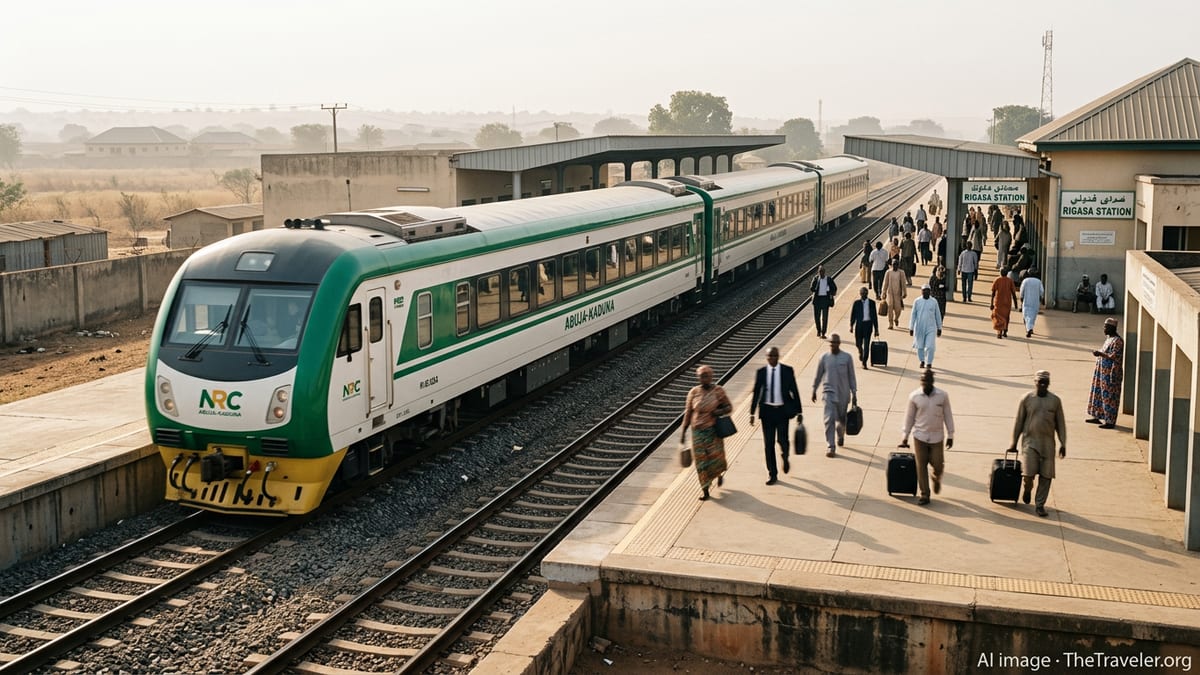
Blue and Red Lines Anchor a New Era of Mass Transit
The Lagos Rail Mass Transit blueprint has moved decisively from plan to reality, with the Blue and Red Lines now forming the backbone of a modern urban rail network. Publicly available information from Lagos transport agencies shows that the first phase of the east–west Blue Line between Marina and Mile 2 entered full commercial service in 2023, providing an electric rapid-transit alternative to notoriously congested roads along the Lagos-Badagry corridor.
The momentum continued on February 29, 2024, when the first phase of the north–south Red Line was inaugurated, running along a 37-kilometer corridor from Agbado in neighboring Ogun State to the National Theatre at Iganmu. Subsequent regulatory approvals enabled commercial operations from October 15, 2024, after a formal trial period and the issuance of operational licenses to both the Blue and Red lines by the Nigerian Railway Corporation. Together, the two lines represent the most significant rail investment in Lagos since independence and mark a tangible step toward a multimodal metro-scale system.
The Red Line shares standard-gauge track with the national Lagos–Ibadan railway on part of its alignment, but features dedicated stations, overpasses and pedestrian bridges designed to separate passengers from road and freight traffic. The Blue Line, by contrast, operates on fully segregated infrastructure and is designed for electric multiple units running on a dedicated right-of-way, a configuration intended to insulate service from the city’s chronic congestion and flooding.
State economic reports indicate that within the first year of full operation the Blue Line carried around 2 million passengers, underscoring pent-up demand for reliable, high-capacity public transport. Transport planners view that ridership as a baseline, with expectations that numbers will rise sharply as more stations open, service frequency increases and integration with bus and ferry services improves.
From Gridlock to Predictable Travel Times
The impact of the new metro lines is being felt most directly in travel times. Commuters who previously spent two to three hours in traffic between suburbs such as Agbado, Agege, Oshodi and Lagos Island now have a rail option that can cover major sections of the journey in under an hour, according to published coverage of early operations. The Red Line’s initial seven stations, including hubs at Ikeja, Oshodi and Yaba, are positioned along some of the city’s busiest arterial roads, providing a rail spine that intersects with existing road-based transport.
Studies of Lagos mobility patterns have consistently highlighted intense peak-hour demand and unreliable journey times on bus and informal minibus routes. By providing fixed schedules and grade-separated tracks, the metro is beginning to inject predictability into daily travel, a change that has implications for productivity, logistics and quality of life. Research on multimodal integration in Lagos suggests that even modest shifts from road to rail during peak hours can ease pressure on key corridors used by both commuters and freight.
Accessibility is also shifting. Stations such as Ikeja, which sits near the domestic airport, and Marina, a historic commercial hub on Lagos Island, are evolving into interchanges that can connect rail passengers to bus rapid transit (BRT) lines and ferries. While full fare and timetable integration remains a work in progress, new interchange infrastructure is creating the physical conditions for more seamless transfers between modes over the coming years.
Early evidence indicates that park-and-ride facilities and feeder bus services are beginning to shape new commuting habits. As more residents test rail for part of their journey, transport analysts are watching closely to see whether car-dependent commuters will permanently switch modes when faced with a consistent alternative that can bypass chronic bottlenecks such as Oshodi and Mile 2.
Expanding Network: Green and Purple Lines on the Horizon
Lagos is not stopping with two lines. The broader rail blueprint envisions up to six main corridors, and recent agreements point to a rapid expansion phase. In September 2024, the state government signed a memorandum of understanding with China Harbour Engineering Company and the federal government’s investment arm to develop the Green Line, a planned 68 to 70 kilometer metro route. Public presentations in 2025 detailed a route from Marina through Victoria Island and the Lekki peninsula to the Lekki Free Trade Zone and a future airport, with a projected initial daily ridership of about 500,000 passengers.
The Green Line is conceived as a single-phase megaproject connecting emerging residential districts and new industrial zones east of the city. Planning documents describe a series of stations at high-growth nodes such as Lekki Phase 1, Ajah, Sangotedo and Ibeju-Lekki, areas currently dependent on a crowded expressway that serves both commuters and heavy port-bound traffic. By adding rail capacity parallel to this corridor, planners aim to support large-scale housing developments and logistics facilities without replicating the gridlock seen on older axes of the city.
Alongside the Green Line, preparatory work has advanced on the Purple Line, another corridor identified in Lagos’s Strategic Transport Master Plan as a priority investment. Consultations held in early 2025 between the metropolitan transport authority and local government representatives outlined the Purple Line’s role as a connector between rapidly growing inland districts and the waterfront corridors served by the Blue and future Green lines.
Over the longer term, additional planned lines such as the Orange and Yellow corridors are expected to form a wider lattice across the metropolitan region. This network approach reflects a shift from isolated projects toward a unified rail system designed to move hundreds of thousands of passengers per day, complementing expanding BRT routes rather than competing with them.
Integration Challenges and Equity Concerns
Despite the transformative potential of the new rail network, transport researchers highlight several challenges that will shape how widely the benefits are shared. Academic analyses of Lagos’s urban transport projects point to complex resettlement processes around rail corridors, limited opportunities for community input in station design, and uneven access for lower-income neighborhoods that remain far from rail alignments.
Integration with existing modes is another critical test. The metropolitan transport authority’s long-term plans envision unified ticketing, coordinated timetables and physically connected interchanges between rail, BRT, informal minibuses and ferries. However, recent studies on multimodal integration in Lagos observe that institutional fragmentation and legacy contracts in the bus sector can make coordination difficult, potentially limiting the network effect of the new lines if not addressed.
Affordability will also influence ridership patterns. While formal fares are positioned as competitive with road-based options on a per-kilometer basis, the upfront cost of rail tickets may still be significant for low-income commuters who rely on informal minibuses or shared taxis. Analysts note that without carefully designed subsidies or fare policies, the metro could disproportionately serve middle-income riders and new real-estate developments near stations, while the poorest residents remain dependent on slower, less predictable modes.
Urban development around stations is already becoming a focal point. Investment prospectuses from Lagos economic planning bodies highlight station areas as prime sites for mixed-use projects, from retail and offices to higher-density housing. How these projects are regulated will determine whether station districts evolve into inclusive urban centers or become enclaves that accelerate displacement from adjacent low-income communities.
A Megacity Tests Its Long-Term Mobility Blueprint
The roll-out of the Blue and Red Lines offers a glimpse of what a fully realized Lagos rail network could deliver. If current plans for the Green and Purple lines advance on schedule, by the next decade the city could count several hundred kilometers of urban rail, connecting historic cores, new industrial corridors and emerging residential districts. For a metropolis widely cited as one of the world’s most congested, that would represent a profound restructuring of how people and goods move.
International experience suggests that such systems only reach their full potential when paired with policy choices that prioritize public transport, walking and cycling. In Lagos, those choices may include redesigning major roads around stations, tightening parking supply, and reallocating some road space to bus and non-motorized users feeding into rail. Transport policy studies on the city emphasize that without these complementary measures, new rail infrastructure risks being undermined by continued car-led growth and fragmented governance.
Even at this early stage, the city’s rail turn is influencing perceptions of Lagos as an investment destination. Infrastructure briefs for 2025 emphasize mass transit as a cornerstone of economic strategy, linking ports, free trade zones, airports and dense residential areas in a single network vision. For residents, the test will be more immediate and practical: whether the daily journey to work, school or the market becomes faster, safer and more predictable than the status quo.
As additional stations open and new lines break ground, Lagos’s rail revolution is likely to remain a central storyline in debates about how Africa’s largest cities can grow while easing, rather than deepening, the pressures of rapid urbanization.
Lagos State Government – Red Line inauguration and project overview
The Guardian Nigeria – Operational licences for Blue and Red Lines
Lagos Economic Development Update 2025 – Transport and Blue Line ridership