


High on the summit of Mount Le Conte, a rustic lodge glows softly at dusk while, miles away, a lone tent glints beside a Smokies creek. Both belong to the same park, but they deliver very different adventures. If you are torn between scoring a coveted reservation at LeConte Lodge or shouldering a pack into the Great Smoky Mountains backcountry, understanding the real tradeoffs in comfort, cost, effort, and atmosphere will help you choose the experience that truly fits you.
Get the latest updates straight to your inbox!
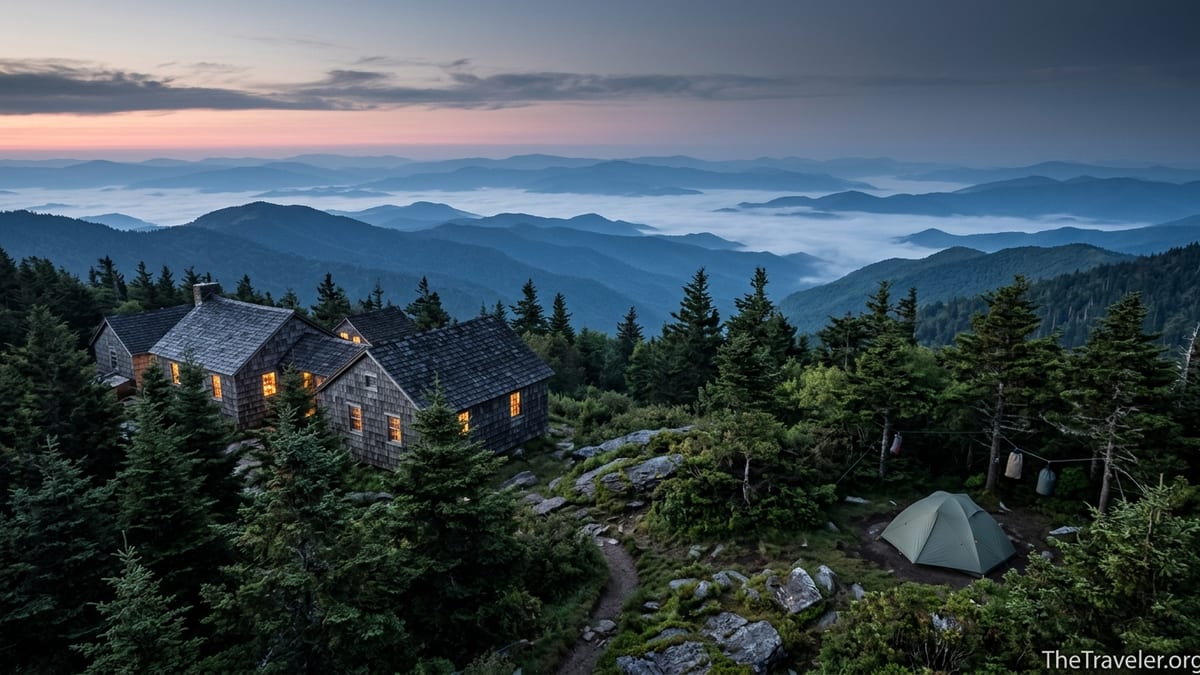
LeConte Lodge and Smokies Backcountry at a Glance
LeConte Lodge is the only place in Great Smoky Mountains National Park where you can sleep in a bed, indoors, without carrying your overnight gear on your back. Perched just below the summit of Mount Le Conte at over 6,000 feet, this small complex of cabins and a main lodge is a full-service mountain inn that you can reach only by hiking one of several demanding trails. Think hot, family-style dinners by kerosene lamplight, a bunk under heavy wool blankets, and a thermos of coffee delivered to your cabin porch at sunrise.
Backcountry camping in the Smokies is almost the opposite. Instead of one destination, you have more than 100 numbered backcountry campsites and shelters scattered across the park, from creekside hollows near Deep Creek to high ridges along the Appalachian Trail. You carry everything you need on your back, hike to a reserved site, and sleep in your own tent or in a basic three-sided shelter if you are on the Appalachian Trail. The tradeoff for less comfort is immersive quiet, flexible itineraries, and access to corners of the park lodge guests will never see.
In practical terms, the LeConte Lodge experience feels like a hut-to-hut trek in the Alps: rustic but catered. Backcountry camping feels more like classic American backpacking, where you manage food, shelter, and navigation yourself. Many travelers are capable of both, but your ideal choice often hinges on what you want out of your precious Smokies days: a single memorable summit stay, or a wandering, exploratory route through the park’s deep hollows and ridges.
Because the Smokies are the most visited national park in the United States, logistics matter. LeConte Lodge runs on a lottery-based reservation system and books out many months in advance, especially in peak fall foliage season. Backcountry campsites also require reservations and permits, but they are spread across a much larger area, giving planners more options, especially if you are flexible about dates and locations.
Effort, Fitness, and Trail Style
Whichever experience you choose, you will be hiking. The difference lies in how far, how hard, and how heavy your pack will be. To reach LeConte Lodge, you must commit to a substantial day hike with 2,500 to 3,800 feet of elevation gain, depending on your trail. The most popular approach, Alum Cave Trail, is about 5 miles one way and often takes 3 to 4 hours for reasonably fit hikers. It is steep, rocky in places, and features exposed sections with cable handrails but does not require scrambling.
Other approaches, like Rainbow Falls or Trillium Gap, stretch to around 6.5 to 7 miles one way and can take 4 to 5 hours. They are less cliffy than Alum Cave but still involve sustained climbing with few flat stretches. Because you do not carry a tent, stove, or full food load, your pack can be relatively light: clothing layers, water, snacks, and personal items. Many guests hike with a 20 to 30 liter daypack, which makes the climb challenging but manageable for people who hike a few times a year.
Backcountry camping changes the equation. A typical one or two night backpacking trip in the Smokies might involve 6 to 10 miles per day with 1,500 to 3,000 feet of elevation gain, but now you are carrying overnight gear. Even a minimalist setup adds a tent or hammock, sleeping bag, pad, stove, fuel, bear-resistant storage, and all your meals. Realistically, many visitors shoulder 25 to 35 pounds, and inexperienced backpackers sometimes exceed that. The payoff is that you can choose routes that match your fitness, from mellow riverside hikes like Forney Creek or Deep Creek to demanding climbs up to ridgeline sites near the Appalachian Trail.
If you are new to mountain hiking but active, LeConte Lodge via Alum Cave can be a satisfying challenge: a single big push followed by a cozy cabin and no need to manage camp chores. If you have never backpacked before and do not own gear, overnight backcountry trips are a steeper learning curve. In that case, a good compromise is to day hike to LeConte one year, then plan a guided or one-night backcountry trip the next once you have gained more trail confidence.
Cost, Reservations, and What You Actually Get
Cost is one of the starkest differences between these two options. LeConte Lodge charges per person, per night, with 2026 rates running into the low-to-mid hundreds of dollars for dinner, lodging, and breakfast in a shared or private cabin. Taxes and gratuities are additional, and you will also need a daily parking tag for your vehicle in the national park, which currently costs only a modest amount but is required for most trailheads. For a couple staying one night, the total can easily land in the high hundreds by the time all fees are included.
Backcountry camping in Great Smoky Mountains National Park is dramatically cheaper. As of 2026, the park charges a modest per-person, per-night backcountry camping fee, plus a small nonrefundable permit fee for the reservation itself, with no maximum cap. For a two night trip with two people, you are often paying less than a mid-range dinner out in nearby Gatlinburg, provided you already own gear. The parking tag requirement still applies, but there is no additional campground fee beyond your backcountry permit unless you stay in a frontcountry campground before or after your hike.
What you get for those fees is equally different. At LeConte Lodge, your rate includes a bunk in a wooden cabin, kerosene lanterns for light, propane heat in common areas during cold spells, family-style hot dinner and hearty breakfast in the dining hall, and unlimited hot beverages like coffee and hot chocolate. There is no electricity, no showers, and only shared bathrooms with cold running water, but you also do not have to cook, filter water, or hang a food bag. Many guests treat it more like a high mountain inn than a traditional lodge.
In the backcountry, your fee buys access and administration, not comfort. Most backcountry campsites offer flat tent pads, a fire ring, and a cable or pulley system for hanging food away from bears. You purify your own water from nearby streams or springs, cook on a backpacking stove, and sleep in your own shelter. On the Appalachian Trail, a few sites use three-sided stone or wood shelters with sleeping platforms. There are no staff, no meals, and no built-in security; your experience is entirely self-reliant.
Atmosphere, Social Vibe, and Sense of Solitude
When you arrive at LeConte Lodge in late afternoon, the scene often feels like a tiny, walking-only village. Hikers filter in along the different trails, drop their packs on the porches of low-slung cabins, and fill metal rockers along the railings to watch clouds drift over the valley. Staff ring a bell for dinner, everyone gathers in the dining room at long tables, and conversation ranges from trail conditions to where people are visiting from. It is communal and social by design, closer to a cozy mountain hostel than a secluded retreat.
Nights at the lodge are dark and quiet, but you are almost never alone. During busy weekends in October, when the park’s sugar maples ignite into oranges and reds, every cabin is full and the dining room hums with energy. Even sunrise at Myrtle Point or sunset from Cliff Tops can feel like a small gathering, as lodge guests and ambitious day hikers alike make their way to the overlooks. If you draw energy from shared experiences and like swapping stories with strangers, this atmosphere will likely delight you.
Backcountry camping, by contrast, trades that convivial indoor setting for a more dispersed, nature-centric mood. At some popular sites a few miles from trailheads, like those near Kephart Prong or Big Creek, you will probably share the area with one or two other parties, each cooking quietly and retreating to their tents at dark. At more remote spots along creeks like Hazel Creek or up high along lesser-used ridges, you might have the entire site to yourself on a shoulder-season Tuesday night. Your evening soundtrack becomes the rush of water and barred owls, not cutlery on dinner plates.
That solitude can be deeply restorative, but it also means embracing a greater sense of responsibility and, for some travelers, unease. The lack of staff or other people means you must be comfortable troubleshooting minor issues, securing your food properly, and dealing with the psychological effect of true quiet after dark. Solo travelers often choose more popular backcountry itineraries, so they are not fully alone, or opt for LeConte Lodge as a first step into spending the night deep inside the park.
Comfort, Weather, and Seasonal Considerations
Mount Le Conte’s elevation means weather can be dramatically different at the lodge than in Gatlinburg below. Spring and fall nights can drop near or below freezing even when the valley is in the 40s or 50s. At LeConte Lodge, you still feel that chill, but thick blankets, sheltered cabins, and hot meals soften the blow. In shoulder seasons, staff may light heaters in the dining hall and lounges, so you have warm common spaces even if your bedroom remains brisk.
In the backcountry, you shoulder all the consequences of weather. A cold, windy rain that passes quickly over the lodge can turn into a miserable night if your tent leaks or your sleeping bag is under-rated. In summer, humid heat and afternoon thunderstorms are common in creek valleys, making well-ventilated shelters and good site selection essential. Keen planners often watch the forecast closely and choose more sheltered, lower-elevation sites when a cold snap or front is predicted, while saving high ridges for stable weather.
Seasonality also affects logistics. LeConte Lodge typically operates from late March through late November, with exact opening and closing dates varying slightly by year. Booking for an entire season usually opens the previous summer or fall and sells fast. Some approach roads and trailheads, like Roaring Fork Motor Nature Trail for Trillium Gap Trail, are also seasonal and close in winter. That means your trail options to the lodge vary by date, something you need to verify when planning.
Backcountry camping is technically available year-round, but winter in the Smokies is no joke at higher elevations. Ice, snow, and subfreezing nights are all possible, especially along the Appalachian Trail ridge. If you are a three-season backpacker without specialized gear, the prime windows for most people are April through early June and mid-September through late October. Summer offers lush greenery and long days but also more heat, storms, and bugs, which can make creekside sites both beautiful and buggy.
Permits, Planning, and Practical Logistics
Reaching LeConte Lodge requires only standard national park logistics plus your reservation. You drive to a trailhead like Alum Cave, Rainbow Falls, or Trillium Gap, display a valid daily or longer-term parking tag on your vehicle, and start hiking. Once you arrive at the lodge and check in, staff explain meal times, water access, and any current trail updates. For most visitors, the main planning challenge is securing a reservation and choosing the right trail combination, such as ascending Alum Cave and descending Trillium Gap the next day.
Backcountry camping involves more layers of planning. Every overnight stay requires a backcountry reservation and permit specifying where you will camp each night. As of spring 2026, the park has shifted its permits to an online system hosted through Recreation.gov, meaning you create an itinerary, see site capacities and availability, and pay fees through that platform. Popular campsites near major trailheads or waterfalls can book up weeks in advance for peak weekends, so flexibility in both dates and sites is very helpful.
You must also factor in rules specific to the Smokies. For instance, you cannot stay more than three consecutive nights at a single backcountry site, and group sizes are capped, often at eight people for standard sites. Food storage regulations are strict due to a healthy black bear population: all food, trash, and scented items must be hung on provided cables or stored in approved containers. Because cell service is patchy to nonexistent, you need printed maps or downloaded offline maps, and you should leave a clear itinerary with someone at home.
Transportation is another practical point. Both LeConte Lodge guests and backcountry campers often design loop hikes or out-and-back routes to avoid needing a shuttle. However, some of the best longer traverses in the park, such as multi-day routes from Clingmans Dome down to the Deep Creek area, require arranging vehicle shuttles or partnering with local shuttle drivers based in gateway towns like Gatlinburg or Bryson City. If you prefer simple logistics, LeConte Lodge via a single trailhead or a short out-and-back backpacking trip to a nearby site, like those off Kephart Prong Trail, will feel more straightforward.
Who Should Choose LeConte Lodge vs Backcountry Camping
If you picture yourself savoring coffee on a rustic porch while looking across a sea of clouds, but you also value a real mattress and not having to cook, LeConte Lodge is probably your best fit. It is ideal for travelers who enjoy full-day hikes but do not own backpacking gear, couples celebrating an anniversary, multigenerational families with teens or college-age kids, and solo hikers who prefer a social setting with staff nearby. It is also a strong choice for shoulder-season travelers who want to experience high-elevation fall colors or spring wildflowers without investing in winter-grade camping equipment.
Backcountry camping, by contrast, tends to attract people who value autonomy and wilderness immersion over comfort. That includes experienced backpackers ticking off miles of the Appalachian Trail, small groups of friends planning two or three night loops, and photographers who want the flexibility to camp near a creek, bald, or fire tower without day-hiking in and out. Budget-conscious travelers who already own gear may also favor the backcountry, since they can extend a trip to four or five nights for less than the cost of a single night at the lodge.
Safety and risk tolerance are also part of this equation. While both options require basic hiking competence, LeConte Lodge wraps that experience in a more controlled environment. Staff can share up-to-date information on trail conditions, and you are surrounded by other hikers. In the backcountry, you are on your own for decisions about river crossings after heavy rain, route options if a trail is blocked by blowdowns, and minor injuries or gear failures. Confident planners often relish that responsibility; new hikers may prefer to build experience with challenging day hikes and a night or two in the park’s drive-in campgrounds before shouldering a backpack.
Finally, think about the kind of memories you want. A stay at LeConte Lodge often crystallizes into a single, luminous snapshot: sunset blazing off Cliff Tops, stars pricking through gaps in the clouds, the murmur of voices drifting from the dining hall. A backcountry trip becomes a string of moments: mist lifting off a creek at dawn, the satisfaction of finding your campsite after a long climb, shared jokes around a crackling fire, and waking up to frost on your tent fly. Neither is better; they are simply different stories you tell about your time in the Smokies.
The Takeaway
If you crave comfort, a sociable mountain inn atmosphere, and a single unforgettable night above the treeline, choose LeConte Lodge and commit to the hike required to get there. You will eat well, sleep under a solid roof, and immerse yourself in the unique culture of one of the park’s most coveted overnight experiences, all without needing to invest in a closet of backpacking gear. Just be prepared to plan well ahead and budget for a premium price per night compared to typical camping.
If you dream of starry skies framed by tent doors, campfire embers floating into the dark, and the flexibility to roam from creek valleys to high ridges, backcountry camping is the experience that will satisfy you most. You will spend less money per night but invest more in skills, self-reliance, and equipment. For many hikers, that tradeoff pays dividends in a deeper connection to the Smokies’ quieter corners, especially if you seek out lesser-used trails and midweek departures.
In the end, the choice is not permanent. Many devoted Smokies travelers start with a stay at LeConte Lodge, fall in love with the high country, and later return with packs to explore beyond the lodge’s glow. Others backpack the park for years, then treat themselves to a milestone birthday perched in a rocking chair above the clouds. However you begin, the key is choosing the experience that matches your current skills, budget, and comfort level while leaving room to grow. The Smokies will still be waiting when you are ready for the other side of the mountain.
FAQ
Q1. Do I need a reservation for both LeConte Lodge and backcountry camping?
Yes. LeConte Lodge requires advance reservations, often many months ahead, and every backcountry campsite or shelter in Great Smoky Mountains National Park also requires a paid reservation and permit.
Q2. How much harder is backcountry camping compared to staying at LeConte Lodge?
Backcountry camping is usually more demanding because you carry full overnight gear and manage your own camp. Hiking to LeConte Lodge is still strenuous, but your pack can be lighter and camp chores are handled by staff.
Q3. Can beginners safely hike to LeConte Lodge?
Fit beginners who are comfortable with several hours of uphill walking can usually handle the hike, especially via Alum Cave or Trillium Gap, as long as they start early, carry layers, water, and snacks, and watch the weather.
Q4. Is backcountry camping in the Smokies safe from bears?
Black bears are common, but following park rules makes incidents rare. Use provided food-hanging cables or approved canisters, never store food in your tent, keep a clean camp, and give any bear plenty of space.
Q5. What is included in a night at LeConte Lodge?
A night at LeConte Lodge typically includes a bunk in a rustic cabin, family-style hot dinner, hot breakfast, basic linens and blankets, and hot beverages like coffee or cocoa, but no electricity, showers, or private bathrooms.
Q6. What permits and fees are required for backcountry camping?
You need a backcountry reservation and permit for each night, paid per person, per night, plus a small nonrefundable permit fee and a separate parking tag for your vehicle in the park.
Q7. When is the best time of year to stay at LeConte Lodge?
Spring and fall are especially popular for wildflowers and foliage, but the lodge’s operating season from roughly late March to late November offers varied experiences, from cool early-season nights to warm midsummer sunsets.
Q8. When is the best time of year to go backcountry camping in the Smokies?
Most backpackers prefer April to early June and mid-September to late October, when temperatures are moderate and bugs are less intense, though prepared hikers camp year-round, including winter on higher ridges.
Q9. Can I combine LeConte Lodge with a backcountry camping trip?
Yes. Some travelers book a night at LeConte Lodge as part of a longer route, hiking in or out via trails that connect to backcountry campsites, or they stay at the lodge one year and plan a multi-night backpacking trip the next.
Q10. Which option is better for families with kids?
For most families, LeConte Lodge is easier because kids can hike with lighter daypacks and enjoy hot meals and real beds. Short, one-night backcountry trips to nearby sites can work too if children are already comfortable with camping.